
Why Bible translation ministries support Scripture engagement is ultimately a question about what Christians believe God intends his Word to do. Translation makes Scripture accessible. Engagement presses Scripture into the life of the church, the household, and the conscience so that access becomes formation. Donors who care about faithful stewardship are right to ask whether ministries are funding books on shelves or the living voice of God among his people.
The modern translation movement has learned that literacy rates, distribution totals, and launch events can be real achievements and still fall short of the Great Commission if people do not understand, trust, and obey what they can now read. Scripture engagement is not an optional add-on to translation work. It is a practical expression of a theological conviction: “the word of God is living and active” (Hebrews 4:12), and the church’s calling is to teach nations to observe all that Christ commanded (Matthew 28:20).
Translation is necessary but not sufficient for discipleship
Access is the first obedience to the command to teach
Most donors understand the moral urgency of language access. If people cannot hear God’s Word in a language they understand, the ordinary means of Christian formation are constrained from the start. Translation answers a basic question of justice and mission: will a community be able to hear the gospel and the whole counsel of God in its heart language?
Yet Scripture itself frames “hearing” as more than physical reception. The parable of the sower hinges on understanding and perseverance, not mere exposure (Matthew 13:19–23). Translation ministries therefore pursue engagement because translation alone does not guarantee comprehension, trust, or sustained use. A New Testament in a box does not automatically become a New Testament in the prayers, preaching, and decisions of a people.
Christian donors should expect ministries to measure more than outputs
Across our verification work at Most Trusted, we observe that mature Bible translation ministries distinguish between outputs (drafts completed, portions published, copies distributed) and outcomes (Scripture used in worship, families reading together, leaders teaching faithfully from the text). Both categories matter, but they do not carry the same spiritual meaning. Output metrics can be counted quickly. Outcome indicators often take years, require humility about attribution, and depend on partnership with local churches.
The ministries that meet The Most Trusted Standard tend to articulate this difference clearly, because they know donors can confuse activity with fruit. Scripture engagement is one of the principal ways translation ministries hold themselves accountable to the deeper aim: people being built up into Christ through the Word (Ephesians 4:11–16).

Scripture engagement protects against two common failure modes
Distribution without understanding can harden skepticism
Donors sometimes assume that if the text exists, the community will naturally receive it. On the ground, ministries face layers of complexity: limited literacy, oral cultures, competing language prestige dynamics, and distrust created by past political or colonial entanglements. Engagement practices—oral Bible storying, facilitated group readings, comprehension testing, and locally led teaching—serve as safeguards against the tragedy of “available but unused.”
This is not speculation; the global literacy landscape alone forces the issue. UNESCO estimates that hundreds of millions of adults worldwide still lack basic literacy skills, which directly shapes how people can access printed Scripture (UNESCO). In many contexts, oral and audio engagement is not a concession; it is the responsible form of access.
Translation without church integration can become a parallel institution
Christians genuinely disagree about the best institutional arrangement for translation work. Some emphasize the role of specialized agencies; others prefer translation efforts rooted directly in denominational structures. What is less disputed is the danger of translation becoming detached from the worshiping community. If Scripture is translated but not preached, sung, taught, and discussed in the church, the project risks functioning as a technical accomplishment rather than an ecclesial gift.
Scripture engagement pushes ministries back toward the local church: training readers, equipping pastors, collaborating with educators, and encouraging Scripture use in discipleship pathways. Donors evaluating translation work should therefore ask how the ministry relates to the church in the target community, not only how it manages linguistic expertise. For broader context on the landscape of agencies and approaches, see Bible Translation Ministries.
Engagement is where theology meets methodology
Engagement is not marketing the Bible
Many donors have seen “engagement” language used superficially in other nonprofit sectors, where it can mean brand awareness or audience growth. In responsible Bible translation work, engagement is closer to pastoral theology than marketing. It includes ensuring the translation is accurate and understandable, but it also asks whether people can interpret Scripture faithfully, within the life of the church, with appropriate respect for genre and context.
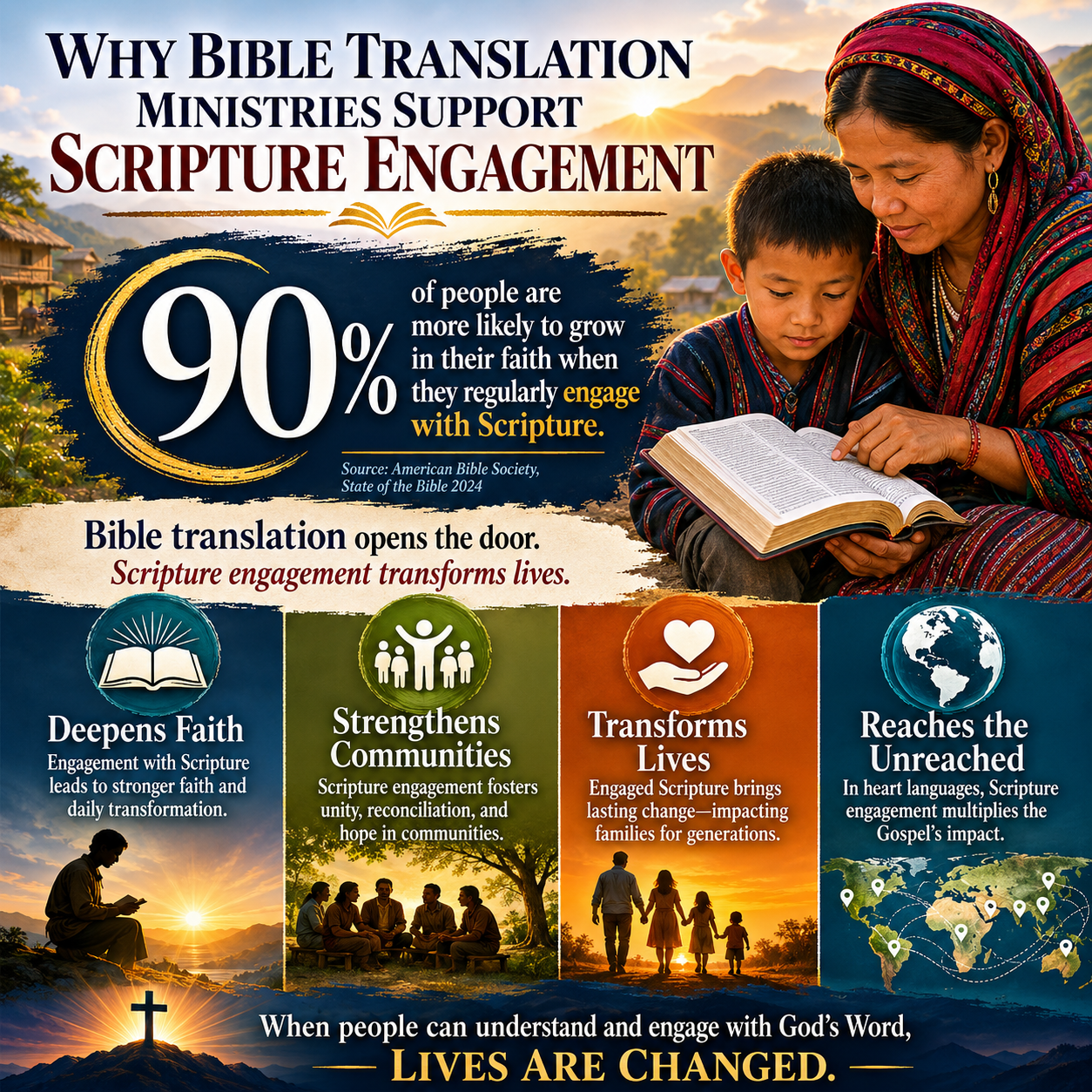
This is one reason serious agencies invest in community checking and comprehension. The goal is not to simplify the Bible into something easier than God intended. The goal is clarity without distortion, so that the church can read, hear, and keep the Word (Revelation 1:3).
Audio, oral, and sign language engagement are often the primary frontier
Donors often picture translation as printed pages. Many communities primarily engage through audio, oral retellings, and, for Deaf communities, sign language translation. Scripture engagement in these contexts includes training facilitators, producing high-quality audio recordings, and developing teaching resources that fit oral memory patterns.
What this means in practice is that a ministry’s “translation” work may include tools and formats that are not the bound Bible many donors imagine. The test is whether the ministry is faithful to the text and attentive to how people actually receive and transmit meaning in their language community.
What credible impact looks like in Scripture engagement
Better questions produce better donor confidence
Donors who fund translation ministries are not merely funding publishing. They are funding a chain of discipleship: translation, reception, comprehension, use, and formation over time. Measuring that chain is difficult. It can also be done with integrity if ministries resist the temptation to overclaim.
Across the category, the strongest ministries use mixed evidence: qualitative testimony from churches, documented patterns of use, and observable adoption in worship and teaching. They also name what they cannot prove. It is rarely responsible to claim that a translation “caused” revival; it is often responsible to show that Scripture use increased, that leaders were trained, and that churches adopted the translation for regular preaching and catechesis.
Indicators donors can reasonably ask for
When a translation ministry says it supports Scripture engagement, donors can ask for concrete indicators that respect complexity. A short list that tends to be both meaningful and verifiable includes:
- Documented local church adoption, such as regular use in preaching, liturgy, or small groups
- Training delivered for pastors, readers, and facilitators, with clear curricula and attendance records
- Comprehension and acceptability testing results summarized transparently
- Evidence of sustained use over time, not only launch-period activity
- Audio, oral, or sign language distribution plans aligned with local access realities
The harder question is whether such indicators are gathered in ways that honor local agency and avoid extracting stories for donor appeal. Engagement that treats communities as marketing material is not Christian ministry; it is spiritualized exploitation. Ministries worthy of trust show restraint and respect in how they communicate impact.
How The Most Trusted Standard frames engagement and accountability
Faithfulness and effectiveness must remain joined
Bible translation occupies a distinctive place in Christian philanthropy because the product is Scripture itself. That does not exempt ministries from accountability; it intensifies it. Donors are not only concerned with whether funds were used legally and efficiently, but also whether the work honors the church and serves the stated mission without distortion.
The Most Trusted Standard evaluates ministries across fifteen criteria spanning faith foundation, financial integrity, governance and leadership, and transparency and effectiveness. In practice, Scripture engagement touches all of these: theological commitments shape translation philosophy; governance affects how disputes are handled; financial integrity affects whether projects are sustained; transparency determines whether donors can assess claims responsibly.
Engagement claims should be legible to a thoughtful donor
Across our reviews, we find that the most credible ministries do not hide behind spiritual language when asked for evidence. They explain their engagement strategy, define the outcomes they are pursuing, and disclose limitations. They also avoid the “overhead obsession” that distorts nonprofit evaluation. The field has been chastened by the Overhead Myth statement, signed by major evaluators, which clarified that administrative ratios alone are a poor proxy for impact (Charity Navigator).
Donors seeking clarity on how translation ministries articulate and measure engagement can also explore How Bible Translation Ministries Measure Impact. The goal is not to force ministry into a simplistic scorecard, but to insist that claims about Scripture’s transforming power be paired with honest reporting about what has been done, what has been observed, and what remains unknown.
FAQs for Why Bible translation ministries support Scripture engagement
Is Scripture engagement a distraction from the core work of translation?
Not when it is framed properly. Translation is the act of making the text accessible; engagement is the set of practices that helps communities understand and use what is now accessible. Without engagement, translation can remain a technical success without becoming an ecclesial instrument for teaching, worship, and discipleship.
What should donors watch for when ministries report engagement outcomes?
Donors should watch for clarity and restraint. Credible ministries define what they mean by engagement, provide evidence that matches their claims, and avoid implying direct causation where multiple factors are at work. They also show how local churches and leaders are central, since Scripture is given to form the people of God, not merely to complete projects.
Why this matters for Christian stewardship
Scripture engagement is where Bible translation ministries show that they are not merely producing texts but serving the church’s long obedience in the same direction. A translated Bible that is understood, trusted, and used in worship and daily life is a more faithful return on donor sacrifice than a translation that exists without adoption. Donors give best when they give toward that fuller horizon: access that becomes discipleship, and discipleship that becomes mature churches shaped by the Word of God.



