
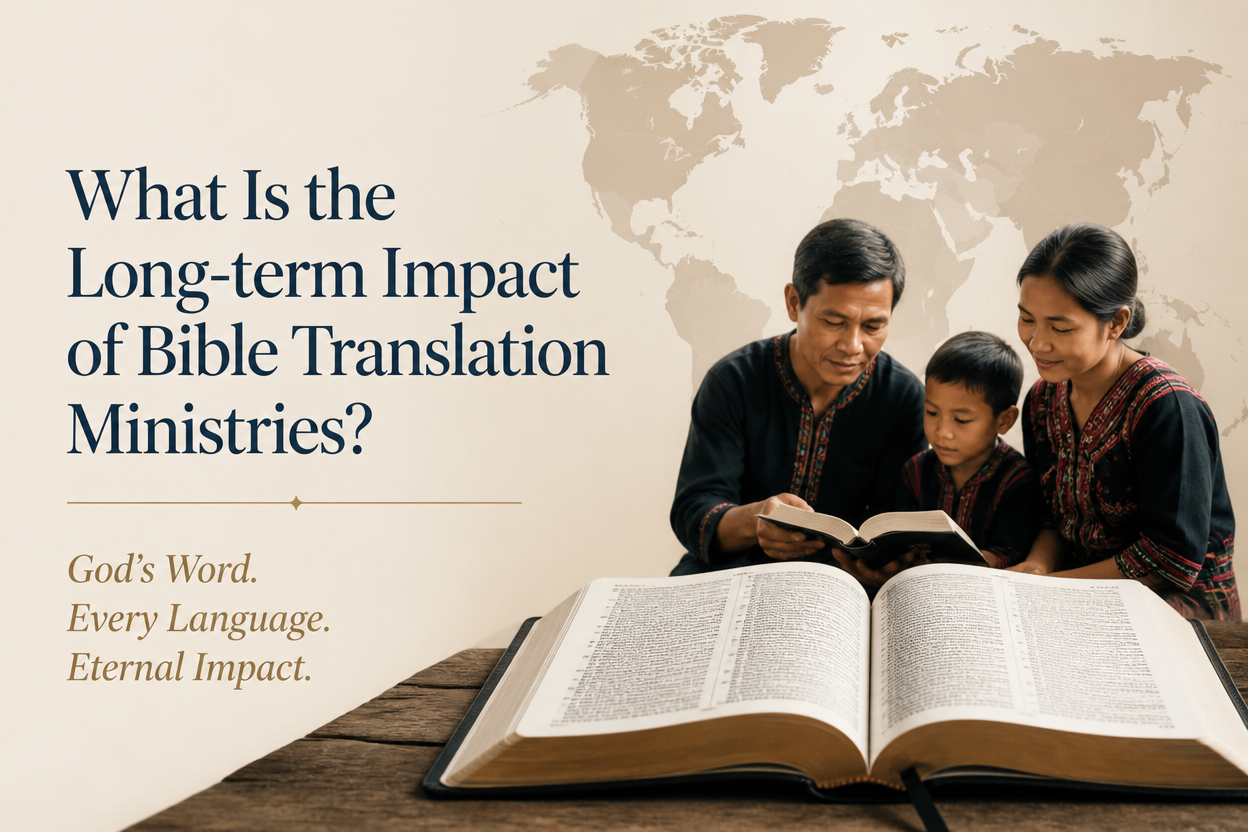
What is the long-term impact of Bible translation ministries? For Christian donors, the question is not academic. Bible translation is measured in decades, often across political change, language shift, and leadership turnover. The durable fruit is rarely visible on a quarterly dashboard, yet Scripture trains us to value seed that bears harvest over time (Mark 4:26–29).
The harder question is how to recognize faithful, verifiable long-term impact without reducing Bible translation to a single metric, a single story, or a single moment of publication. The field has learned that producing a text is necessary but not sufficient; the end is Scripture received, trusted, and used in the life of the church. Across our verification work at Most Trusted, we have found that donors give with greater confidence when ministries can show patient outcomes: strong local ownership, clear quality controls, honest reporting, and a credible plan for ongoing Scripture engagement.
Long-term impact begins with the Church hearing God in its own language
Scripture’s pattern is intelligibility for edification
From Pentecost onward, the Christian faith has been carried in languages people actually speak. Acts 2 does not present comprehension as a luxury; it presents it as a sign of God’s mercy toward the nations. Paul is equally direct that intelligible speech builds the church, while unintelligible speech does not (1 Corinthians 14:9–19). Bible translation ministries serve this basic ecclesial good: enabling worship, preaching, catechesis, and counsel rooted in God’s Word rather than mediated only through a trade language or outside teacher.
For donors, this frames long-term impact properly. The question is not whether a community “has a book,” but whether the church in that community can hear, confess, and teach the faith with clarity. This is why the most mature translation movements treat local church participation as a theological necessity, not merely a contextual strategy.
From access to formation is the central trajectory
Printed Bibles, audio Scripture, and mobile distribution can dramatically increase access. Yet access alone does not guarantee understanding, trust, or sustained use. Many regions have experienced the arrival of Scripture alongside limited literacy, few trained teachers, and competing narratives from other religious movements. Long-term impact therefore depends on pairing translation with forms of Scripture engagement that respect local churches and strengthen them: public reading, storying, discipleship materials, and training for pastors and translators.
Donors evaluating impact wisely ask whether a ministry’s theory of change ends at “publication” or moves through “use” toward “formation.” This is not about making translation into a social program; it is about acknowledging what translation exists for.

Long-term impact is measured in generational outcomes, not launch events
Publication is a milestone, not the finish line
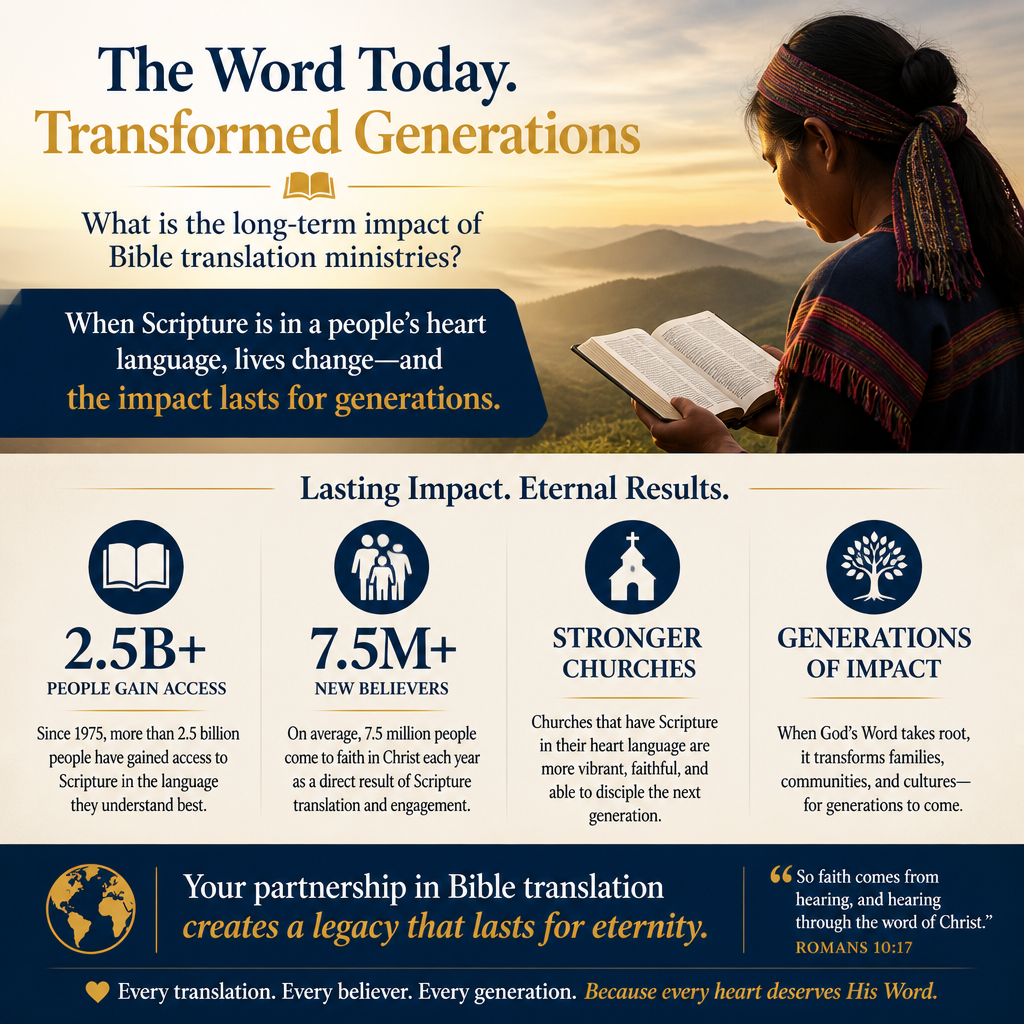
Bible translation work has visible moments: a New Testament dedication, the first audio recordings, the first complete Bible. Those are legitimate points of gratitude, and donors should celebrate them. But the deeper impact emerges slowly: whether sermons become more text-driven, whether Christians can test teaching against Scripture, whether children learn the story of redemption in their heart language, whether family devotions become normal rather than exceptional.
Christians genuinely disagree about how directly Bible translation should be linked to broader social outcomes such as health, education, or civic participation. Some research suggests that literacy efforts associated with translation can have wider benefits, but the evidence varies by context, and attribution is difficult. A mature donor posture values those possible secondary effects without treating them as the main proof.
Long-term impact often looks like resilience under pressure
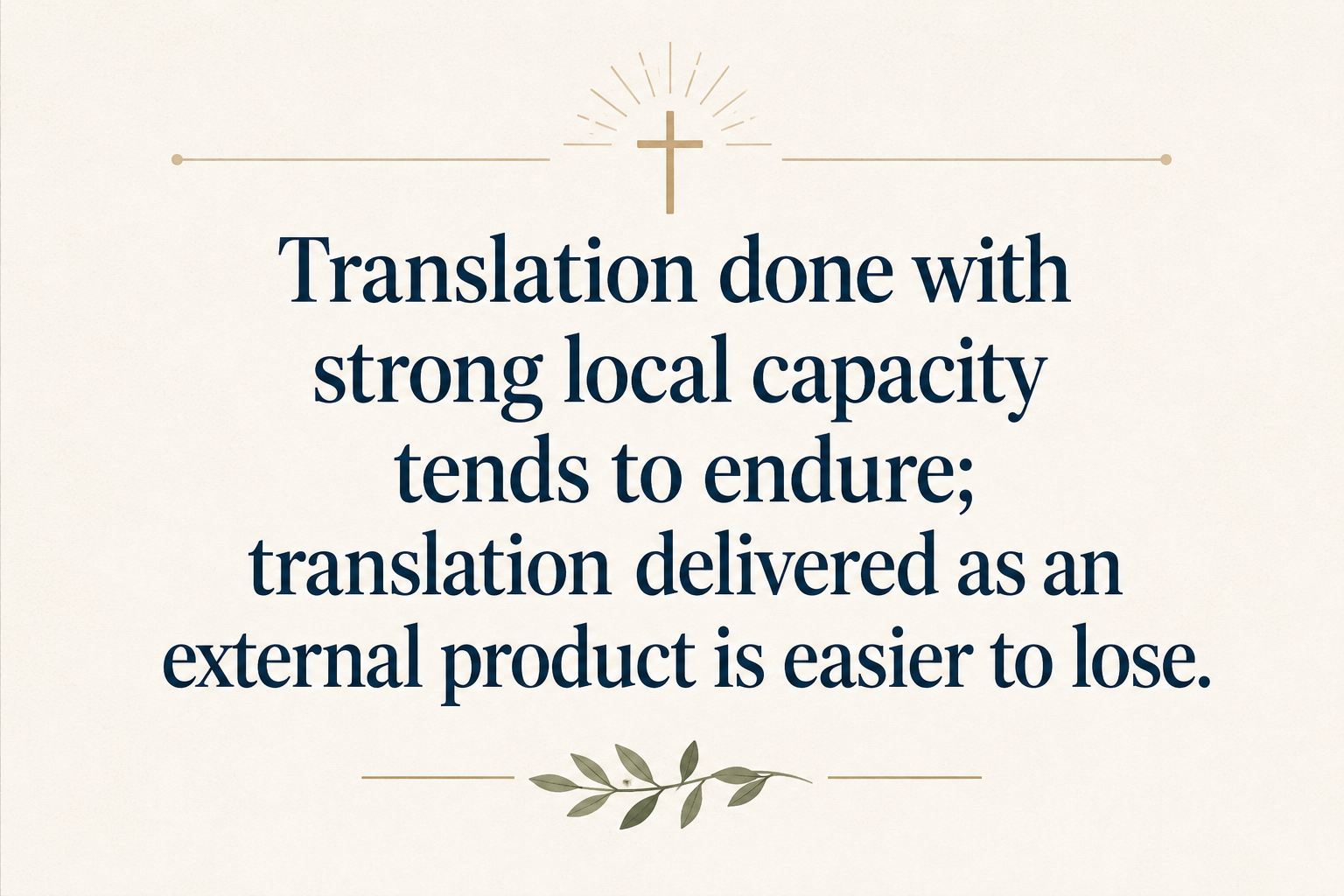
In many contexts, the strongest evidence of lasting impact is resilience: churches continuing to preach and disciple when foreign funding fluctuates, when leaders are replaced, or when political restrictions increase. Translation done with strong local capacity tends to endure; translation delivered as an external product is easier to lose.
Donors can also watch for indicators that communities are not merely consuming Scripture but stewarding it. That includes reprints financed locally, sustained distribution networks, and growing numbers of trained local reviewers and facilitators. These are less dramatic than a launch ceremony, but they are often closer to the long-term story.
Quality, trust, and local ownership determine whether Scripture will be received
Accuracy and clarity are spiritual stakes, not technical preferences
The long-term impact of Bible translation ministries rests partly on something donors cannot see at a glance: translation quality. Faithful translation requires a disciplined process: exegetical rigor, community testing, consultant review, and safeguards against doctrinal distortion. When quality is compromised, the damage can persist for generations through memorized phrasing, inherited misunderstandings, and teaching built on unclear or misleading renderings.
That is why donors should pay attention to whether a ministry participates in recognized translation standards, uses competent consultants, and can explain its approach to key questions: How are dialect decisions made? How is biblical terminology handled? How are poetic and narrative forms rendered? These are not mere academic matters. They shape how a people understands God.
Local ownership protects the work from dependency and distortion
Long-term impact is strongest when local churches and local leaders own the work. Ownership does not mean excluding outside expertise; it means ensuring the community has real decision-making authority and the ability to sustain Scripture use over time. It also protects against a subtle donor temptation: treating translation as something “we did for them,” rather than as an act of service to Christ’s church.
In our coverage of Bible Translation Ministries, we consistently find that ministries with healthier governance and clearer accountability cultivate local ownership more reliably. They do not romanticize “local” as automatically pure, but they refuse to treat local churches as a distribution channel for external goals.
For donors, responsible evaluation requires both faith convictions and verifiable evidence
Impact claims should match what can actually be measured
Christian donors deserve more than inspirational anecdotes. Yet they also deserve better than a narrow demand for metrics that flatten spiritual realities. The most credible ministries distinguish between outputs (drafts completed, books published, audio hours recorded), outcomes (Scripture use in churches and homes), and longer-term fruit (leadership development, theological stability, intergenerational transmission of the faith). They also name limits honestly: Scripture engagement is influenced by pastoral training, literacy, economics, and conflict, and no translation team controls all of it.
When ministries report impact responsibly, they tend to use clear definitions and third-party validation where appropriate. They can also articulate how data is gathered without endangering believers in restricted settings. That is a sign of maturity, not evasiveness.
What donors should examine in long-term impact reporting
For donors seeking to assess long-term impact without confusing it with marketing, a short set of questions often clarifies the picture:
- Does the ministry define success beyond publication, with credible indicators of Scripture use?
- Is local church involvement substantive and ongoing, including real authority in decisions?
- Are translation quality controls explicit, documented, and consistently applied?
- Does the ministry report both progress and setbacks, including delays and revisions?
- Is the pathway from donor funding to field activity transparent and auditable?
Within Most Trusted, this is where The Most Trusted Standard is most helpful for donors: it evaluates ministries across Faith Foundation, Financial Integrity, Governance and Leadership, and Transparency and Effectiveness, so impact claims are read alongside the structures that sustain or undermine them. Donors rarely regret asking for this kind of coherence; many regret giving based on a single story.
Long-term impact is strengthened by transparency, financial integrity, and wise partnerships
Translation timelines expose governance and financial discipline
Bible translation work is long and costly, and its timelines create particular integrity pressures. Donors should expect years of work before a finished product, and ministries should be candid about that reality rather than disguising it with vague promises. Transparent budgeting, clear field reporting, and consistent audit practices protect both the donor and the communities served.
Some donors assume the best ministries will always report rapid progress. In practice, delays can reflect responsible quality control, community consultation, or security constraints. The question is not whether the path is perfectly smooth; it is whether the ministry can explain decisions and demonstrate stewardship.
Wise collaboration avoids duplication and honors the global church
The field has matured toward collaboration: shared linguistic research, common technical tools, and partnerships between agencies and local church networks. Donors should value ministries that coordinate rather than compete, particularly in regions where multiple organizations might otherwise build parallel systems.
For donors wanting to understand how ministries present and substantiate their results, our work on How Bible Translation Ministries Measure Impact addresses the common approaches and their limitations. The goal is not to produce cynicism; it is to ground generosity in truth.
FAQs for What is the long-term impact of Bible translation ministries
How long does it take to see lasting impact from Bible translation?
Lasting impact typically unfolds over decades because translation is only one part of a larger ecclesial reality: literacy, pastoral formation, and sustained Scripture engagement. Publication can be a major milestone, but long-term fruit is better assessed by ongoing use in worship and discipleship, local capacity to maintain and distribute Scripture, and the church’s ability to teach sound doctrine in the heart language.
What is the most reliable indicator that a translation ministry’s impact will endure?
The strongest indicator is local ownership paired with credible quality controls. When local churches and trained local leaders have real authority, and when the ministry can document rigorous review and consultant processes, the work is more likely to be trusted, used, and sustained beyond the involvement of outside personnel or funding.
A durable gift to the church requires patient, verifiable faithfulness
The long-term impact of Bible translation ministries is most faithfully understood as the church receiving the Word of God with clarity, trusting it, and passing it on. Donors who want to serve that end should resist both naïve optimism and reductive skepticism. The better path is patient generosity, informed by evidence and shaped by theological seriousness: translation quality that honors Scripture, local ownership that honors the church, and integrity structures that honor the donor’s stewardship before God.



