
What outreach models work for Bible study and engagement ministries depends on more than creativity or channel strategy. The durable models are those that honor the way Scripture forms people over time: through faithful proclamation, embodied community, and accountable discipleship in local context.
Donors often ask for “what works” as if the question were purely technical. Yet Bible engagement is a spiritual work with real operational constraints. Attendance metrics can be inflated without conversion or perseverance; digital reach can mask shallow formation; and rapid scaling can dilute theological oversight. Mature funding begins by distinguishing publicity from pastoral fruit.
1. Begin with a theology of formation rather than a theory of reach
Many outreach plans start with a funnel. Scripture begins with a people. God forms his covenant community by word and sacrament, by teaching and discipline, by worship and mission. Bible study and engagement ministries that endure usually treat outreach as an extension of formation, not a substitute for it.
The Great Commission is teaching, not only contacting
Jesus commissions the Church to “make disciples… teaching them to observe all that I have commanded you” (Matthew 28:19–20). The outreach models most aligned with that mandate are structured for sustained teaching, not merely first touch. This does not require every ministry to be a local church, but it does require clarity about the path from initial interest to accountable learning under sound doctrine.
Evidence of success should include faithfulness indicators
Ministries can count downloads, views, event attendance, or decision cards. Those numbers may have meaning, but they are not self-interpreting. Across our verification work at Most Trusted, we find that the ministries that meet The Most Trusted Standard tend to define outcomes in layers: reach (who was contacted), engagement (what they did), and formation (what changed over time), with humility about what can and cannot be measured.

2. Relationship-based models remain the most reliable for durable engagement
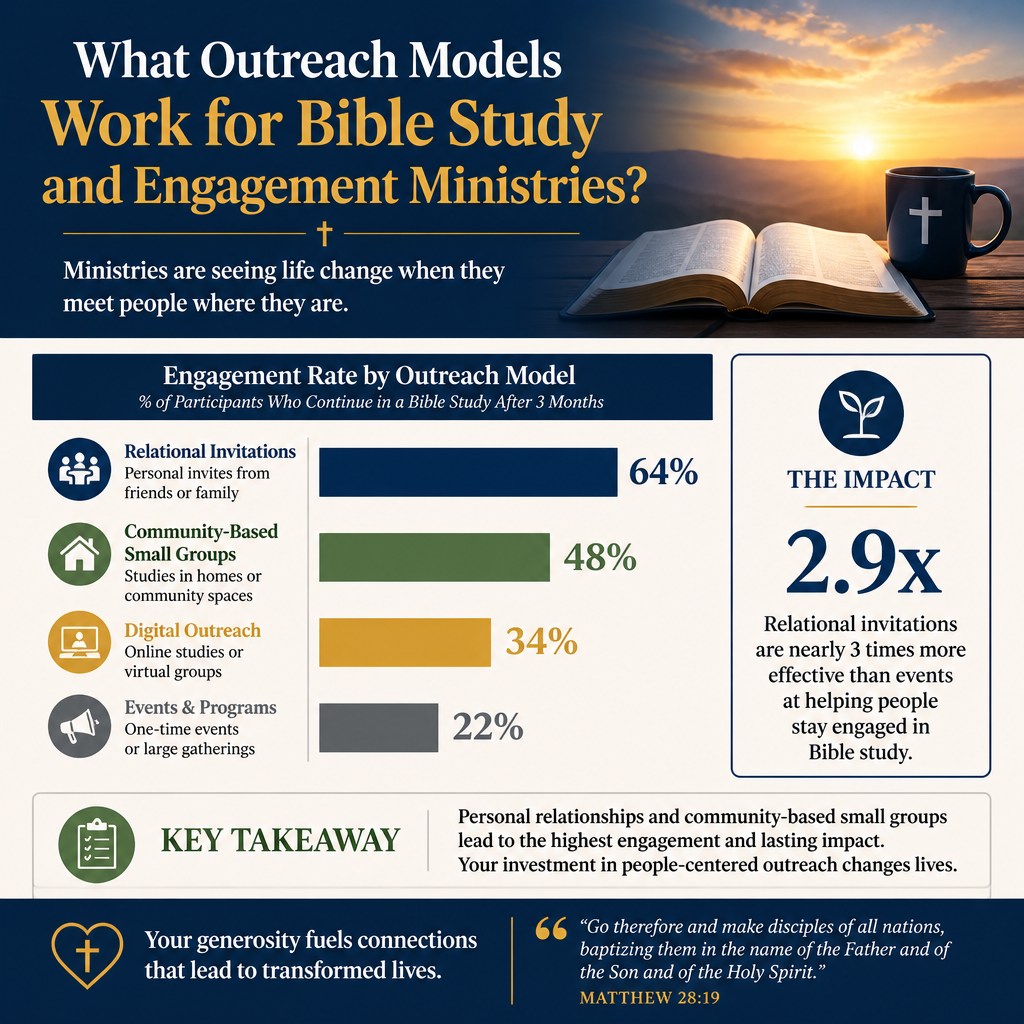
Large-scale proclamation has an essential place in the Church’s witness, but Bible engagement commonly deepens through trusted relationships. In practice, relational models cost more per participant and scale more slowly, yet they often produce more durable discipleship because they attach Scripture to a community that can carry it.
Micro-groups and discovery studies in existing networks
Small groups hosted in workplaces, neighborhoods, recovery communities, campuses, and immigrant networks frequently outperform “invite everyone” programs because they begin with real social bonds. Models such as Discovery Bible Study can be effective when paired with doctrinal guardrails, trained facilitators, and a clear connection to a biblically grounded church community. The risk is equally real: leader drift, therapeutic moralism, or an anti-church ethos if “group” becomes a replacement for shepherding.
Mentored engagement for new readers and returning Christians
Many adults are not hostile to Scripture; they are simply unfamiliar with it. The American Bible Society has reported a long-term decline in “Bible Users” in the U.S., which signals that first-time and returning readers need structured accompaniment rather than mere access to content American Bible Society. Ministries that pair reading plans with mentor check-ins, live Q&A, and pastoral referral pathways often see fewer initial sign-ups but higher retention among those who begin.
3. Digital and media models work when they are integrated with real shepherding
Digital outreach can extend teaching across geography and schedule constraints. It can also become a high-volume distribution system with minimal discipleship. The question donors should ask is not whether a ministry has an app or a podcast, but whether its media is embedded in accountable pathways that connect people to mature teaching and community.
Content that assumes confusion rather than contempt
A significant share of the audience will approach the Bible with honest questions about violence, sexuality, suffering, and the Church’s public failures. Serious engagement ministries do not market around those questions; they teach through them. This is where theological depth matters: donors should look for ministries that can handle hermeneutics, biblical theology, and church history without either embarrassment or aggression.
Hybrid models that move from screen to table
Many effective ministries use digital tools to initiate engagement and then move participants into relational settings: moderated cohorts, local partner groups, or church-based classes. Pew Research Center has documented that religious practice and affiliation in the U.S. have become more fluid over time, which increases the need for clear next steps after initial exposure Pew Research Center. The healthiest digital models treat “reach” as the beginning of pastoral responsibility, not its end.
4. Partnership models can expand trust, but they raise governance and theology questions
Partnership with churches, schools, prisons, shelters, and community organizations can multiply access to people who will not attend a typical Bible study. Partnerships also introduce complexity: shared platforms, shared reputational risk, and sometimes theological mismatch. Donors should expect ministries to name these tensions directly.
Church partnerships that respect the local shepherds
Engagement ministries are at their strongest when they strengthen the teaching ministry of the local church rather than competing with it. The best partnerships clarify roles: the ministry provides training, curriculum, tools, or translation; the church provides pastoral oversight, sacramental life, and ongoing discipleship. This is also where donors can use Most Trusted’s verification lens: sound governance makes partnerships safer because decision rights, accountability, and doctrinal commitments are explicit rather than assumed.
Institutional access models with clear boundaries
Programs inside prisons, universities, and shelters often rely on institutional permissions and require careful policies to protect vulnerable people. Boundary clarity matters: how volunteers are screened, how data is handled, what follow-up is permitted, and how coercion is avoided. Ministries that treat these as “compliance details” rather than pastoral obligations are taking a moral shortcut.
- Written theological commitments that guide curriculum and partnerships
- Volunteer screening and training appropriate to the setting
- Clear referral pathways to local churches and pastoral care
- Safeguarding policies for minors and vulnerable adults
- Feedback loops with partners to address problems early
5. Donor evaluation should weigh effectiveness and integrity together
Outreach models are not only ministry choices; they are stewardship choices. Two ministries can run the same model with sharply different integrity, theological seriousness, and financial discipline. Donors who want to fund Bible engagement without funding dysfunction should insist on verifiable signals of health.
Ask for the ministry’s theory of change and its evidence
Serious ministries can articulate how a person moves from first contact to sustained engagement and what they count as meaningful outcomes. They can also explain what they do when the model fails. If the only proof offered is testimonials and growth graphs, donors should press for deeper accountability.
Use a consistent verification framework for trust
Most Trusted exists because donors need more than charisma and good intentions. We evaluate ministries against The Most Trusted Standard, a 15-criteria framework spanning Faith Foundation, Financial Integrity, Governance and Leadership, and Transparency and Effectiveness. For Bible engagement work, this often clarifies questions donors already feel but cannot easily validate: Who sets doctrine? How are leaders held accountable? Are programs evaluated honestly? Are finances presented with candor? Are results communicated without exaggeration?
Many donors also want to understand the broader landscape of Bible Study and Engagement Ministries and how different organizations reach different communities. The most constructive giving is patient, theologically anchored, and appropriately demanding about integrity—especially when a ministry’s outreach model puts it in contact with the spiritually curious or the socially vulnerable.
For readers comparing approaches across the field, see Bible Study and Engagement Ministries for the wider context of what these ministries do, and how donors can evaluate them with clarity.
For a closer view of how ministries connect with specific populations and local ecosystems, see How Bible Study and Engagement Ministries Reach Communities for the range of outreach approaches donors commonly encounter.
FAQs for What outreach models work for Bible study and engagement ministries
Which outreach model should donors prioritize if they want measurable impact?
Donors should prioritize models that can demonstrate a credible pathway from first contact to sustained engagement and that report outcomes with restraint. In many contexts, relational models supported by disciplined digital tools offer the best balance: they can track participation and retention while keeping engagement connected to real shepherding and community. The key is not the channel but the ministry’s ability to document faithfulness, protect people, and tell the truth about results.
Is digital Bible engagement enough, or should donors fund in-person programs?
Digital engagement can be genuinely fruitful, especially where geography, disability, or work schedules isolate people from in-person settings. The limitation is that Scripture is meant to form a people, not merely inform individuals. Donors should favor digital programs that build accountable cohorts, offer access to trained leaders, and intentionally connect participants to local churches and pastoral care rather than treating isolated consumption as the end goal.
Why outreach models matter for Christian stewardship
Donors are not only funding distribution of biblical content; they are funding a particular way of relating to people in God’s image. Outreach models that respect the pace of formation, the necessity of community, and the demands of integrity are more likely to bear lasting fruit. A mature donor posture asks both questions at once: does this model plausibly help people meet Christ in his Word, and does this organization operate in a way that deserves trust?



