
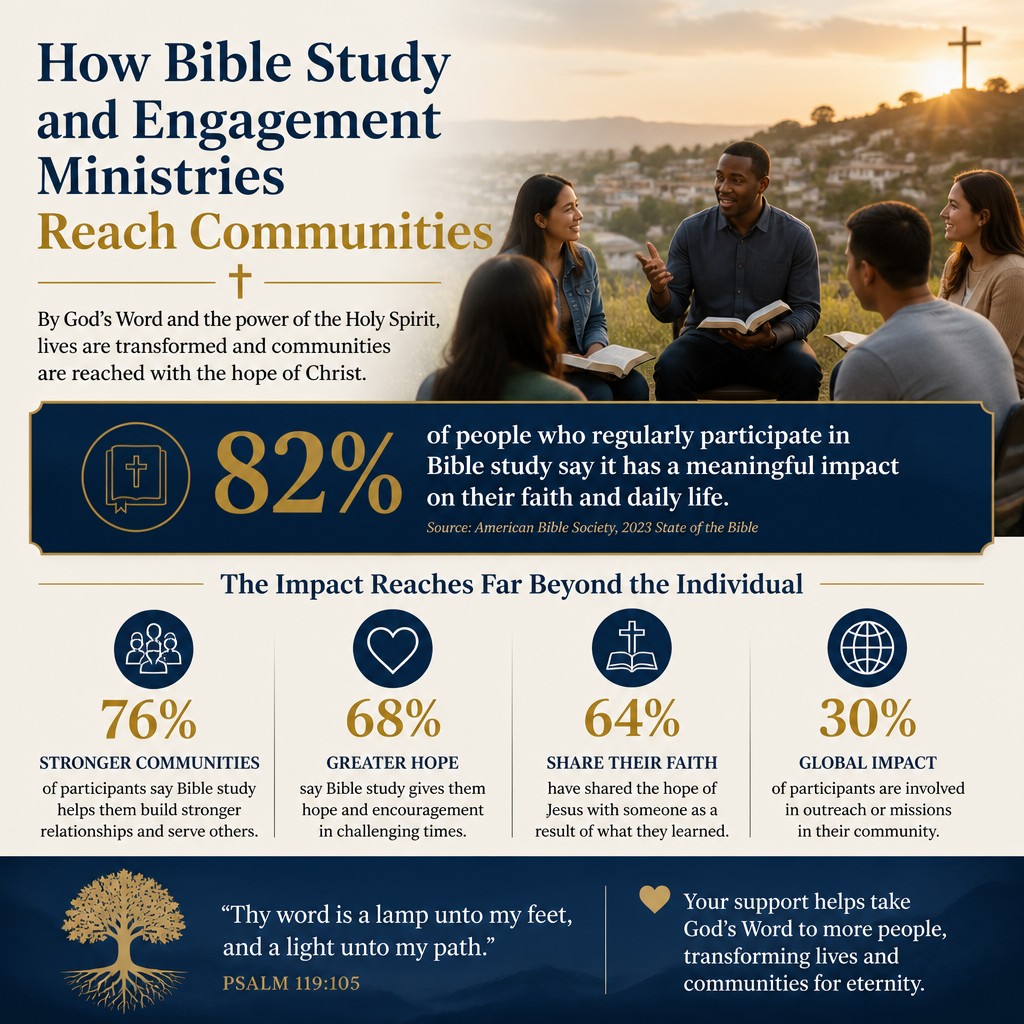
How Bible study and engagement ministries reach communities is not primarily a question of marketing tactics. It is a question of spiritual formation meeting real human networks, in a way that honors both the Word of God and the dignity of those receiving it. Donors tend to ask about “reach” in the language of scale and access; Scripture presses us to ask about faithfulness, clarity, and fruit that endures.
The New Testament does not treat the Word as an optional supplement to the church’s life. The earliest believers “devoted themselves to the apostles’ teaching” (Acts 2:42), and Paul insists that “faith comes from hearing, and hearing through the word of Christ” (Romans 10:17). Bible engagement ministries exist because access to Scripture and formation in Scripture are not the same thing, and because many communities—whether unchurched, de-churched, immigrant, rural, or working-class—face obstacles that are spiritual, cultural, educational, and logistical at once.
Access is only the first barrier ministries must cross
Most donors have heard of “Bible translation” and “Bible distribution,” and those remain indispensable. Yet many ministries doing Bible study and engagement are operating downstream of another reality: access to a Bible does not ensure understanding, trust, or willingness to open it. In communities shaped by trauma, fractured families, or institutional distrust, the very act of gathering around Scripture can feel unsafe unless relationships and wise facilitation are present.
At a global level, the translation task is still unfinished. Wycliffe Global Alliance reports that over 1 billion people lack a full Bible in the language they understand best, and hundreds of millions have no Scripture at all in their first language Wycliffe Global Alliance. Distribution can close part of that gap, but Bible engagement ministries often face a second-order challenge: the gap between owning Scripture and encountering Scripture.
Local trust and cultural translation often matter as much as language translation
Some communities have high literacy but low biblical literacy; others have the opposite. In both cases, ministries that reach well tend to make careful choices about teaching approach, reading plans, group structure, and the pace at which participants are asked to speak, share, and lead. The fruit is rarely instantaneous. Donors should be cautious of stories that imply a single event reliably produces deep discipleship.
Christian leaders also disagree about how “contextual” engagement should be. Some fear that adapting methods risks diluting doctrine. Others recognize that refusing adaptation often functions as a cultural preference baptized as faithfulness. A credible ministry typically names its doctrinal commitments clearly while also showing humility about methods—especially when operating cross-culturally.
Digital access expands the funnel but does not replace shepherding
Digital Scripture tools have changed the landscape, particularly for younger adults and for people hesitant to attend a church. The global reach of Bible apps is real; YouVersion reports hundreds of millions of installations worldwide YouVersion. Still, Bible engagement ministries that rely heavily on digital tools must account for a persistent limitation: private consumption can become an end in itself, and algorithms can shape spiritual intake as much as Scripture does.
Ministries that reach communities effectively often use digital tools as a doorway rather than a destination—pairing reading plans with local group invitations, trained facilitators, and pastoral pathways for those who respond. What this means in practice is that “engagement” should be defined by more than downloads, clicks, or streaks.
Healthy ministries build relational ecosystems, not one-off events
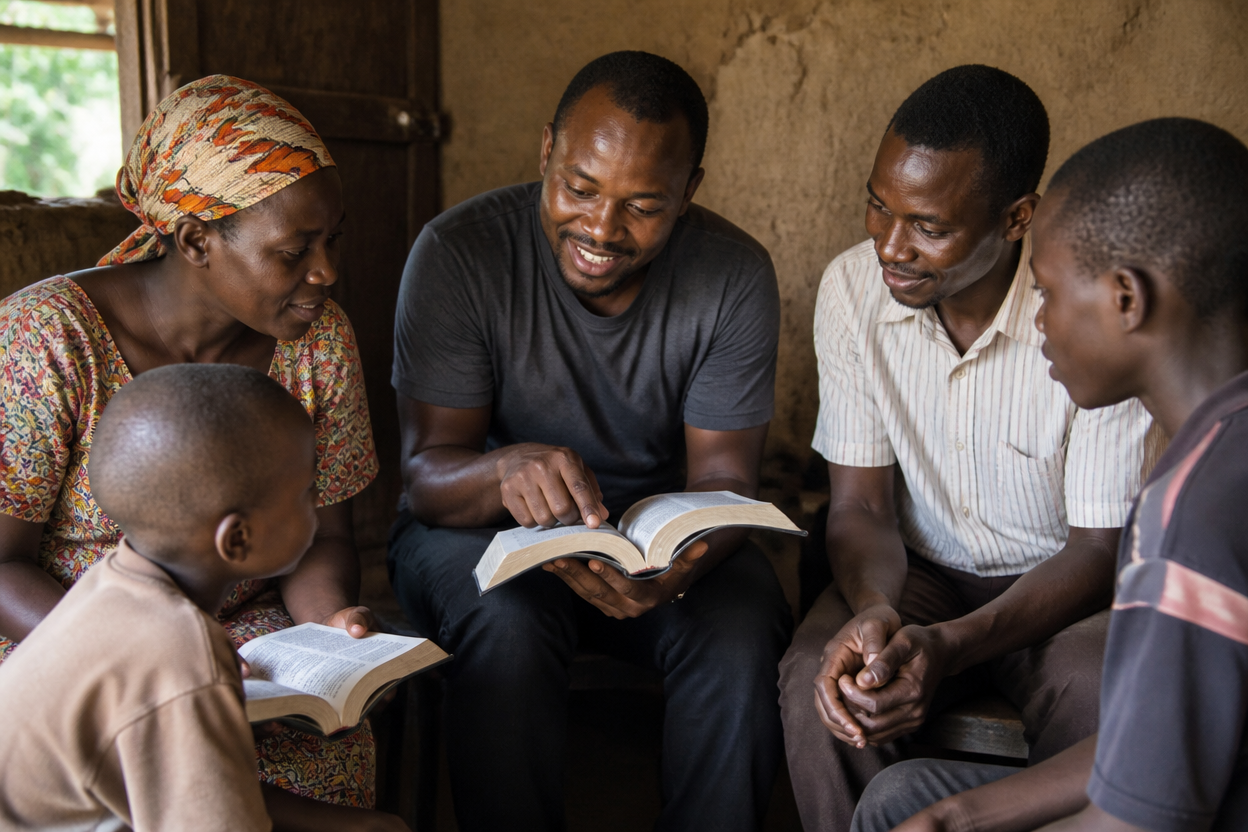
When Bible engagement is durable, it usually rides on relationships. Scripture itself assumes the Word is received and interpreted within a people: “Let the word of Christ dwell in you richly, teaching and admonishing one another” (Colossians 3:16). The ministry question is how that “one another” takes shape in neighborhoods where church attendance is low, schedules are crowded, and trust is scarce.
Small groups create the repeatable unit of discipleship
Small groups are not a novelty; they are a practical expression of the church as a teaching community. In many contexts, the group becomes the most viable entry point for unchurched adults who will not attend a Sunday service but will meet around a table, a workplace breakroom, or a community center. The group also creates a pathway for leadership development: participants can become facilitators, and facilitators can become multipliers.
The tension donors should recognize is that small groups can drift into therapeutic conversation with minimal Scripture, or into rigid teaching that leaves little room for questions. Ministries with strong engagement typically train leaders to keep Scripture central while also taking questions seriously—especially from skeptics, the recently de-churched, or those with painful church histories.
Public institutions can be legitimate mission fields and complex partners
Many Bible engagement ministries reach communities through prisons, recovery programs, shelters, schools (where permitted), and veteran networks. These settings concentrate need and often remove ordinary barriers like transportation or childcare. They also introduce constraints: security protocols, chaplaincy rules, and the ethical responsibilities of working with vulnerable people.
Wise ministries resist the temptation to treat institutional access as proof of spiritual fruit. They track follow-up, reentry support, local church connection, and the long, uneven work of repentance and restoration. Donors should expect sober reporting, not heroic narratives.
Partnerships determine whether engagement becomes discipleship
For many donors, the most practical question is whether a Bible engagement ministry is meaningfully connected to the local church. Christians genuinely disagree about where parachurch organizations should end and where church-led ministry should begin. Still, the New Testament pattern is clear that teaching and formation are responsibilities of the church, even when aided by specialized workers (Ephesians 4:11–13).
Across our verification work at Most Trusted, we observe that ministries best positioned for lasting community impact tend to define partnerships precisely: who shepherds new believers, who handles crisis care, who provides sacraments and discipline, and how leaders communicate when problems arise. Vague language about “working with churches” often masks fragile relationships or untested assumptions.
Church collaboration is not a slogan, it is an operating model
Some ministries function as curriculum providers, training engines, or conveners, equipping congregations to do the ongoing work. Others plant groups that later integrate into churches. Others serve populations the church struggles to reach, while intentionally handing off those who become open to congregational life. These models can all be faithful. The credibility question is whether the ministry can articulate its ecclesiology, its handoff points, and its accountability.
Donors should also expect ministries to handle theological diversity with integrity. If a ministry serves multiple denominations, it must be transparent about what it requires of partners and where it allows freedom. Confusion here frequently produces downstream conflict and participant distrust.
Local nonprofits can extend reach when roles remain clear
Partnerships with pregnancy centers, food pantries, refugee resettlement organizations, and recovery homes can open doors for Scripture engagement among people already seeking help. The risk is instrumentalizing people in crisis, attaching Bible study as a condition of services, or confusing spiritual care with pressure.
Ministries that reach communities with integrity usually uphold a clear ethic: Scripture is offered as life-giving truth, not as leverage. They set boundaries on proselytism within service delivery contexts, and they document safeguarding practices for vulnerable adults and minors.
Donors should evaluate both reach and faithfulness with verifiable signals
Reaching communities is not only about where a ministry goes; it is also about what it brings and how it accounts for the work. Donors are right to want evidence. Yet the evidence appropriate to Bible engagement is different from the evidence appropriate to, say, disaster relief. Counting outcomes in discipleship work requires care because spiritual formation is real but not easily reduced to metrics.
What credible measurement can and cannot claim
Helpful indicators often include: the number of active groups that meet consistently, leader training completion, Scripture reading behaviors over time, retention rates, and referrals to local churches. Qualitative evidence matters as well: testimonies, pastoral observations, and case studies can be honest data when they are collected systematically and not curated as marketing.
The research is mixed on whether self-reported Bible reading predicts long-term discipleship in a simple linear way. Still, it is not nothing. The American Bible Society’s State of the Bible research has tracked population-level patterns in Bible engagement and religious practice over time American Bible Society. Donors can reasonably ask ministries to define “engagement,” show how they measure it, and explain the limitations of their claims.
Governance and financial integrity are not secondary to spiritual impact
Bible engagement ministries often depend on trust-based giving. That reality increases the moral obligation for strong oversight, restrained fundraising claims, and careful use of donor funds. Christians can be tempted to treat governance as “secular” and therefore less spiritual. Scripture does not allow that separation. Leaders are stewards, and stewardship is accountability before God and neighbor (1 Peter 5:2–3).
Most Trusted exists to help donors give with confidence by evaluating ministries against The Most Trusted Standard, a 15-criteria framework spanning faith foundation, financial integrity, governance and leadership, and transparency and effectiveness. The point is not to replace spiritual discernment with bureaucracy. It is to bring verifiable clarity to questions donors should ask anyway: Who is in charge? How are decisions made? Are outcomes reported candidly? Are risks named and managed?
Red flags donors should not ignore
Some warning signs appear repeatedly in ministries that struggle to reach communities with integrity over time. Inflated numbers that cannot be reconciled with staffing and budget. Story-driven fundraising that features vulnerable people without clear consent and safeguarding. Minimal board oversight or boards composed primarily of insiders. Doctrinal ambiguity paired with aggressive claims of “revival” or “movement.” These patterns do not prove wrongdoing, but they should slow a donor down until clarity is obtained.
Conversely, mature ministries often speak plainly about constraints: volunteer turnover, leader burnout, uneven group quality, and the difficulty of forming new habits in adults. That candor is often a more reliable sign of integrity than polished reports.
Giving that strengthens Bible engagement should strengthen the church’s long obedience
How Bible study and engagement ministries reach communities is ultimately a question of whether people are brought under the living voice of God in Scripture, within relationships that can sustain repentance, growth, and mission. Donors can serve that end by funding ministries that combine accessible entry points with trained leadership, church-connected pathways, and honest accountability.
Those seeking to orient their giving within this field can begin with Bible Study and Engagement Ministries and then apply the same rigor they would apply to any other form of Christian stewardship: theological clarity, verifiable integrity, and evidence that the ministry’s reach is ordered toward disciples who endure.



