
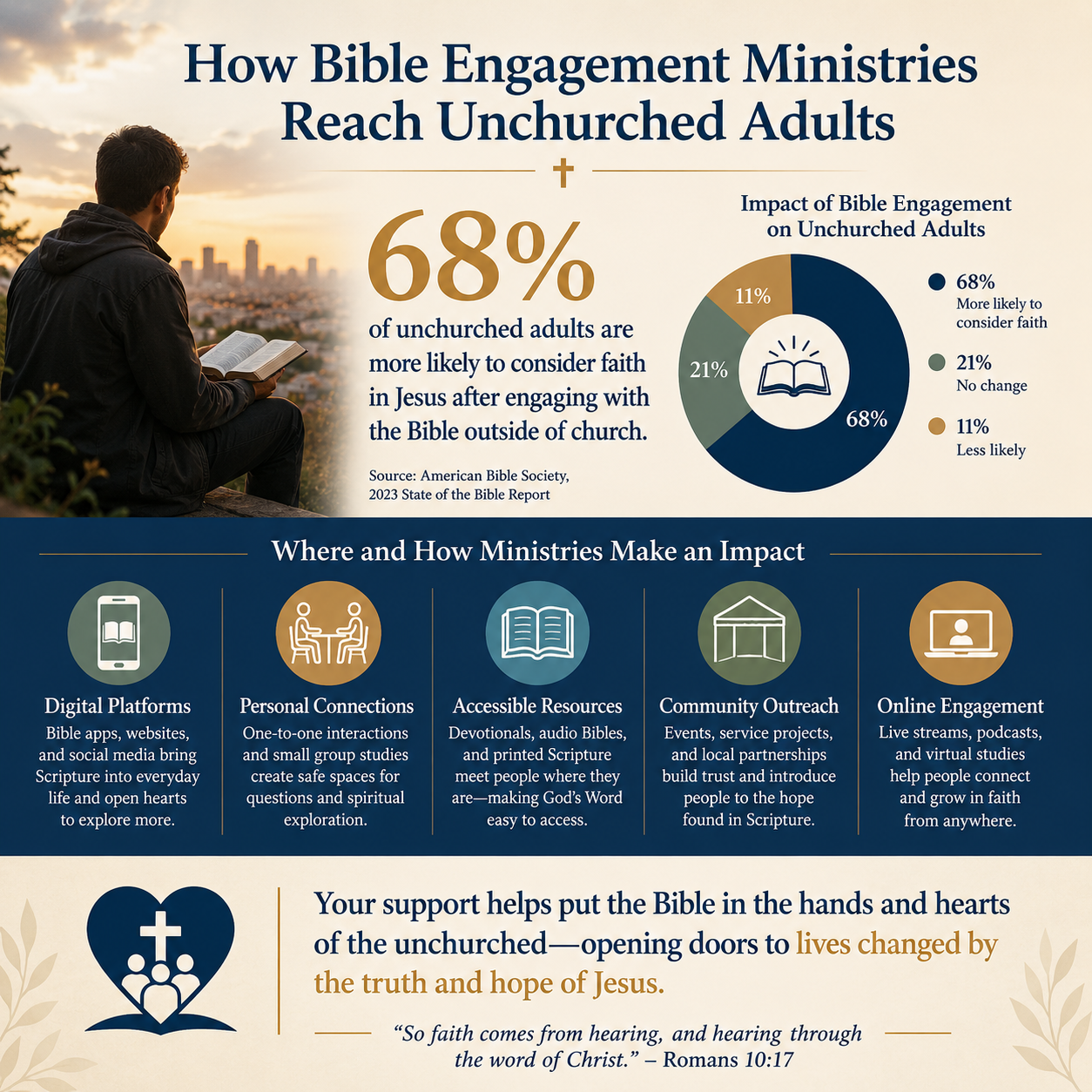
How Bible engagement ministries reach unchurched adults depends less on novelty than on faithful translation: making the Scriptures accessible, credible, and relationally plausible for people who do not share church assumptions. Many unchurched adults are not “seeking” in the consumer sense; they are wary of institutions, stretched thin by work and family, and carrying prior experiences of hypocrisy or harm. A ministry that treats the Bible as living Word and the listener as image-bearer must address both spiritual hunger and the social conditions that keep people at a distance.
For Christian donors, this creates a stewardship question with moral weight. It is possible to fund “Bible distribution” without funding genuine engagement, and it is possible to fund engagement models that blur the gospel into self-help. The wise path is neither cynicism nor romanticism, but careful attention to method, theology, and verifiable fruit.
1. Credibility begins with honoring the real barriers to engagement
The unchurched are not a monolith
“Unchurched” can describe the dechurched (previously involved and now disengaged), the never-churched, immigrants navigating language and cultural distance, or adults shaped by anti-institutional politics and media. The Barna Group has documented a rise in “dechurched” adults in the United States in recent years, reshaping the evangelistic landscape for local churches and parachurch ministries alike Barna Group. A credible Bible engagement strategy begins by distinguishing these groups rather than assuming a single outreach script.
What this means in practice is that “reach” must be defined carefully. Attendance at a study, downloads of an app, or number of Bibles shipped may reflect activity without representing understanding, trust, repentance, or durable attachment to Christian community.
Trust repair is often the first ministry
Many unchurched adults have an internal file of reasons to distrust Christian claims: public scandals, politicized Christianity, painful interpersonal experiences, or simply the perception that faith is a private preference with no public truth. Bible engagement ministries that reach them tend to treat trust as a spiritual and pastoral issue, not as a marketing obstacle. They create settings where questions are received with seriousness, where leaders name what Christians have done badly, and where Scripture is not used as a weapon.
This is not a retreat from conviction. It is an attempt to remove unnecessary offense so that the necessary offense of the cross is actually heard.

2. Ministries reach adults by relocating Scripture into ordinary life
Access must be practical, not merely available
For an unchurched adult, “read the Bible” is rarely a simple instruction. Literacy levels vary, schedules are crowded, and many have never been taught how to interpret a text that is ancient, multi-genre, and morally demanding. Bible engagement ministries that reach unchurched adults commonly use short, guided reading plans; audio Scripture for commuters and shift workers; and facilitated discussion that models how to observe, interpret, and apply without flattening the text.
Digital delivery can widen access, but it does not guarantee formation. YouVersion’s Bible App has reported hundreds of millions of installations globally, illustrating scale but not necessarily depth of engagement YouVersion. Mature ministries treat technology as a channel, not as a substitute for discipleship.
Hospitality is a theological method, not an event tactic
Scripture often advances through tables, homes, and ordinary relationships: Jesus teaching in meals, the early church gathering from house to house, Lydia’s household opening space for ministry. Many unchurched adults will consider a living-room reading group before they will enter a sanctuary. Ministries that take hospitality seriously train hosts to be non-anxious, to refuse manipulation, and to let the Bible speak for itself without forcing premature conclusions.
This approach also helps donors evaluate programs: if the primary “unit” of ministry is a relationship and a text, it tends to resist the spectacle-driven patterns that produce impressive numbers with fragile outcomes.
3. The most durable approaches keep the gospel clear and the questions honest
Scripture as revelation, not merely inspiration
Unchurched adults often encounter “Bible content” in the form of inspirational excerpts detached from the Bible’s story. Bible engagement ministries reach them, over time, by restoring the Bible’s coherence: creation, fall, Israel, Christ, church, new creation. When the storyline is taught patiently, the hard passages and moral claims become part of a narrative rather than isolated offenses.
Christians genuinely disagree about pedagogy—inductive study versus catechetical teaching, chronological approaches versus topical entry points. But the dividing line is often simpler: whether the ministry treats Scripture as God’s self-disclosure culminating in Christ, or as a sourcebook for personal improvement. Donors should be attentive here because theological drift is frequently masked by strong presentation.
Psychological and cultural realities should be faced without surrendering doctrine
Many unchurched adults are shaped by therapeutic assumptions: identity is self-authored, authenticity is the highest good, and moral limits are oppressive. Bible engagement ministries that reach them do not pretend those assumptions are trivial. They patiently show why the Bible’s view of the person is both more honest about sin and more hopeful about renewal.
At the same time, serious engagement must recognize trauma, addiction, and mental illness as pastoral realities. The question is not whether Scripture is sufficient, but how ministries apply Scripture responsibly—integrating wise referral networks and avoiding simplistic counsel that can harm vulnerable people.
4. Donors should fund models that connect engagement to embodied community
From study group to belonging
The New Testament assumes that Word and body belong together: teaching, sacraments, mutual care, and discipline in a recognizable community. Bible engagement ministries reach unchurched adults most sustainably when they build bridges into local churches or create accountable Christian communities where the Word is lived, not only discussed.
This is where donors should look for strong partnering behavior rather than empire-building. Programs that compete with the local church for loyalty often struggle to produce long-term discipleship. Programs that serve churches—training facilitators, providing curricula, resourcing follow-up—tend to show more coherence with biblical ecclesiology.
What donor diligence should focus on
Across our verification work at Most Trusted, we observe that ministries with the strongest outcomes tend to be explicit about what they mean by “engagement,” and they measure it in ways that do not reduce people to data points. They also have governance and financial practices that match their spiritual claims. For donors who want to understand the broader landscape of Bible Study and Engagement Ministries, these are the patterns that separate compelling stories from credible work.
The following questions are often more revealing than program branding:
- Does the ministry define engagement as exposure, comprehension, obedience, or discipleship?
- Are leaders trained to handle Scripture faithfully, including difficult texts and contested doctrines?
- Is there a clear pathway into local church community and pastoral care?
- How does the ministry guard against manipulation, coercive counseling, or performative testimonies?
- Are outcomes verified in a way that reflects integrity rather than fundraising pressure?
5. Verification matters because fruit is real and so are incentives
Numbers can mislead without context
Christian ministries live with legitimate pressure to demonstrate results. But in Bible engagement work, the easiest metrics are often the least meaningful: content served, materials distributed, events held. The harder metrics—faithfulness to Scripture, depth of formation, healthy integration into church life—require time and careful evaluation.
The sector has also had to reckon with well-known distortions in nonprofit reporting, including the mistaken assumption that low overhead automatically signals virtue. The “Overhead Myth” letter, signed by major evaluators, argued that overhead ratios are a poor proxy for impact and can incentivize unhealthy underinvestment in systems and accountability Charity Navigator. Bible engagement ministries that reach unchurched adults over the long term often require patient investment in training, safeguarding, and follow-up—costs that are easy to criticize and unwise to avoid.
The Most Trusted Standard as a donor tool
Most Trusted exists to help donors give with confidence by evaluating Christian nonprofits against The Most Trusted Standard, a 15-criteria framework across Faith Foundation, Financial Integrity, Governance and Leadership, and Transparency and Effectiveness. This is not a replacement for discernment; it is a means of making discernment more grounded. Where Bible engagement is concerned, donors can reasonably ask for:
Clear theological commitments, board-level accountability, transparent financial statements, safeguarding policies for small-group environments, and evidence that the ministry’s engagement claims correspond to real comprehension and real discipleship. For donors comparing approaches across How Bible Study and Engagement Ministries Reach Communities, verification provides a common language to distinguish faithful work from compelling rhetoric.
FAQs for How Bible engagement ministries reach unchurched adults
What approaches tend to be most effective with unchurched adults who distrust churches?
Approaches that combine relational credibility with textual seriousness tend to endure: small groups hosted in homes or neutral spaces, facilitated studies that welcome questions without relativizing truth, and a clear pathway into healthy Christian community. Distrust is often addressed through consistency over time, transparent leadership, and an unwillingness to manipulate decisions.
What should donors look for to avoid funding shallow or distorted Bible engagement?
Donors should examine theological clarity, leader training, safeguarding practices, and how the ministry defines and measures engagement. Strong ministries can explain how participants move from exposure to understanding and then into obedient, communal discipleship. Verification against The Most Trusted Standard can help donors assess whether a ministry’s governance, finances, and public reporting match the seriousness of its spiritual claims.
A prudent confidence in funding Bible engagement
How Bible engagement ministries reach unchurched adults is ultimately a question of faithful presence: Scripture offered with clarity, relationships formed with patience, and community built with integrity. Donors are right to desire bold evangelistic ambition, and they are also right to demand accountable practices. The goal is not merely to place Bibles in hands, but to see men and women encounter the living Christ through the Word, in ways that endure.



