
Why monthly giving helps Bible study and engagement ministries is not primarily a question of fundraising technique. It is a question of formation: how sustained, predictable generosity can underwrite sustained, faithful discipleship in real congregations and communities.
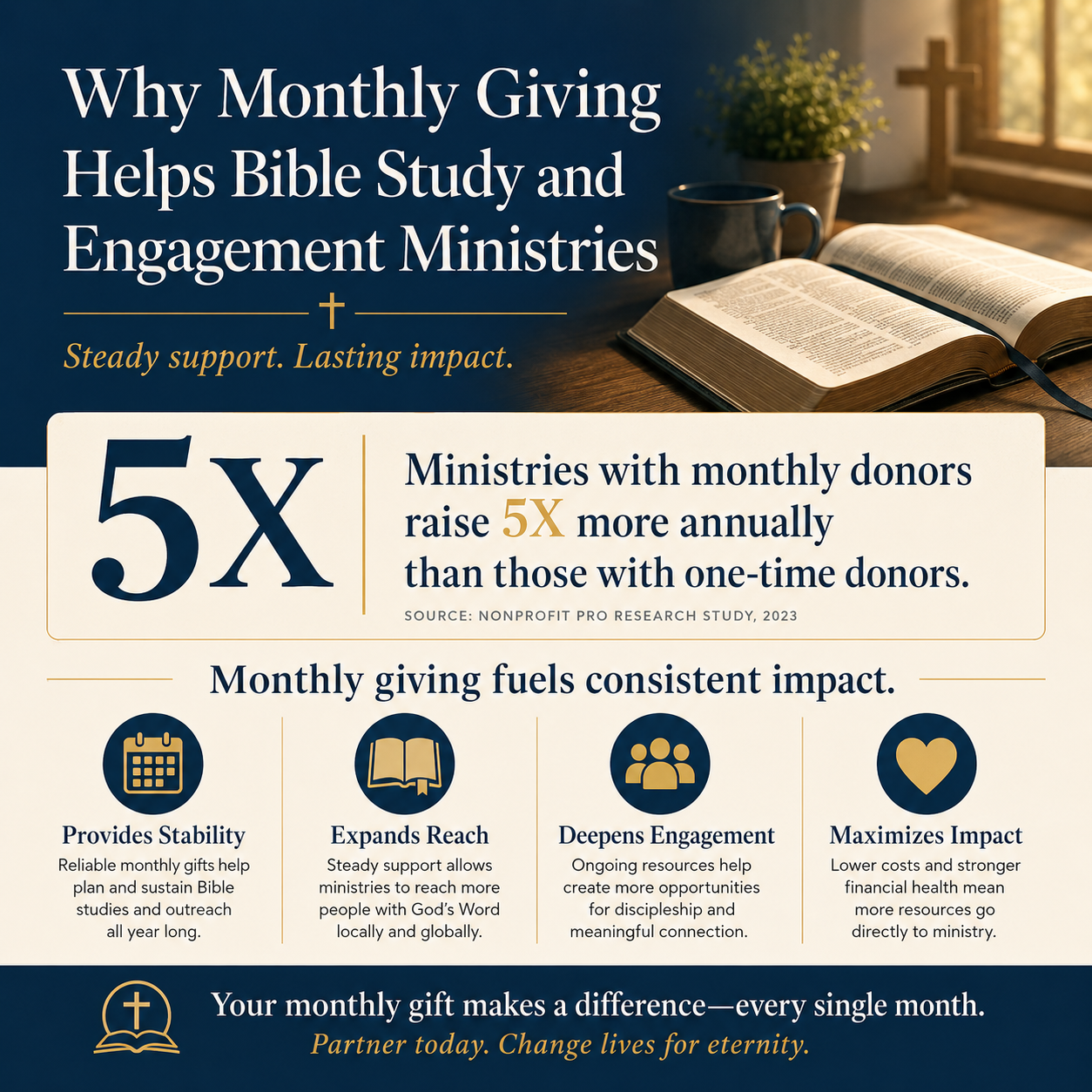
Most Bible study and engagement ministries are built around slow, cumulative work—Scripture intake, small-group leadership development, translation and distribution, digital engagement, training for teachers, and pastoral support. That kind of work rarely moves on the same timeline as a donor’s moment of interest. Monthly giving is one of the few funding models that can match the pace of spiritual formation without forcing ministries into a cycle of urgency.
Monthly giving matches the cadence of discipleship
Formation is ordinary before it is extraordinary
The New Testament assumes repeated, embodied practices: the public reading of Scripture, teaching, exhortation, prayer, and mutual encouragement (1 Timothy 4:13). Bible engagement ministries exist to serve that steady pattern. A one-time gift can launch an initiative, but it seldom sustains the unglamorous work that makes Bible engagement durable: recruiting and coaching facilitators, developing curriculum, updating content, evaluating outcomes, and staying present in hard places.
Monthly giving aligns a donor’s commitment with the ordinary means God uses. It is not less spiritual because it is scheduled. The Psalms themselves are scheduled prayer for God’s people, rehearsed across weeks and seasons. In the same way, recurring generosity can become a rule of life—quietly consistent, resistant to mood, and ordered toward love of God and neighbor.
Stability serves ministry integrity
Many ministries serving Bible study and engagement feel pressure to translate spiritual realities into immediate, reportable “wins.” Some results can be measured responsibly, but not everything that matters is quickly visible: perseverance in faith, increased scriptural literacy, reconciled relationships, renewed repentance, and deeper prayer. Funding that rises and falls dramatically often pushes leaders toward communication strategies that oversimplify what faithful growth looks like.
Monthly donors help ministries plan with integrity. Predictable revenue makes it more feasible to commit to multi-month cohorts, to retain qualified staff, and to build systems for safeguarding and accountability—areas donors should want strengthened even when they do not generate compelling photographs.

Recurring support reduces the ministry costs donors rarely see
The hidden expense of constant reacquisition
When funding is primarily episodic, ministries must repeatedly invest in finding new donors and reactivating lapsed ones. That work is not automatically wasteful; it can be a legitimate part of inviting believers into generosity. But a constant treadmill of reacquisition can drain leadership attention away from program quality, staff development, and pastoral care for partners in the field.
For donors, monthly giving can be a disciplined refusal to make ministries earn the same trust from scratch each quarter. It also reduces the operational volatility that tempts organizations to make short-term decisions they would not make under calmer financial conditions.
Budget predictability strengthens stewardship
Serious donors often ask whether a ministry budgets responsibly and whether its plans are realistic. Monthly giving does not guarantee good stewardship, but it makes good stewardship more possible. Predictability supports appropriate reserves, responsible staffing, and sound vendor contracts for printing, technology, or translation work.
It also supports transparency. Ministries with stable funding can invest in clearer reporting—financial statements, program metrics, governance documentation, and disclosures that allow donors to evaluate the work honestly. That kind of disclosure is central to how we at Most Trusted think about trustworthy Christian giving. Our verification work evaluates ministries against The Most Trusted Standard, a 15-criteria framework across Faith Foundation, Financial Integrity, Governance and Leadership, and Transparency and Effectiveness.
Monthly giving supports the long horizon of Bible engagement outcomes
Scripture engagement is not a one-time transaction
Bible engagement ministries are often attempting to change not merely what someone knows, but what someone loves and practices. That takes time. Even well-designed programs can require several iterations—especially across cultures, age groups, literacy levels, and church traditions.
Some donors worry that “long horizon” language can become an excuse for vagueness. That concern is legitimate. Mature ministries make long-term claims cautiously, define outcomes they can actually observe, and invite outside scrutiny. But the answer is not to fund only what can be proven in a 30-day window. It is to fund work that is both patient and accountable.
Digital Bible engagement carries real ongoing costs
Many ministries now meet people through mobile apps, online courses, and streaming content. Digital distribution can be efficient, but it is not free. Content moderation, cybersecurity, licensing, translation updates, accessibility, data privacy practices, and user support are recurring responsibilities.
Monthly giving is well-suited to recurring costs. When donors expect digital content to be continuously improved, they should not be surprised that the funding model must also be continuous.
Monthly donors can ask better questions and receive better answers
Trust grows when accountability is sustained
One of the understated benefits of monthly support is relational: it gives donors the standing to ask deeper questions over time. A one-time donor may receive a receipt and a newsletter. A long-term partner can reasonably ask about governance, safeguards, theology of ministry, and evidence of effectiveness.
That posture is consistent with Christian stewardship. Scripture commends prudence (Proverbs 14:15) and teaches that leaders are accountable for how they handle what belongs to God. Donors should not apologize for asking for clarity, especially in ministries that speak in God’s name and handle significant resources.
What monthly giving makes possible for donors
In our observation, recurring donors are often able to support healthier organizational behavior because they can fund the less visible work that integrity requires. When monthly giving is paired with careful due diligence, it can enable:
- Multi-year training pipelines for Bible study leaders and facilitators
- Translation and revision cycles that respect linguistic and theological accuracy
- Safeguarding policies, background checks, and grievance processes
- Independent financial review and stronger internal controls
- Clearer outcome reporting that does not oversell spiritual change
These are not luxuries. They are some of the basic costs of doing ministry responsibly in a world where scandals, mismanagement, and theological drift are not theoretical risks.
Monthly giving should be paired with verification, not sentiment
Not every recurring ask is equally warranted
Monthly giving can be unhealthy if it becomes a substitute for evidence. Some ministries use recurring programs to mask weak governance, unclear theology, or ineffective programming. Others treat monthly donors as a captive base, reducing transparency precisely because the revenue is predictable.
The Christian donor’s task is to give faithfully, not naively. Recurring support should be directed toward ministries that can demonstrate a clear faith foundation, sound financial practices, qualified oversight, and credible reporting. That is precisely why independent verification exists. Most Trusted evaluates ministries against The Most Trusted Standard so donors can distinguish between confidence grounded in evidence and confidence grounded only in emotion.
Due diligence is a form of love
Christians genuinely disagree about certain methods in Bible engagement: which pedagogies form readers best, how much to invest in digital versus local church structures, and how to handle contextualization without diluting biblical authority. Donors do not need to resolve every debate before giving. But donors should expect ministries to acknowledge trade-offs, to avoid manipulative certainty, and to maintain theological clarity under pressure.
For donors who want to understand the broader landscape of this work, we maintain a curated view of Bible Study and Engagement Ministries that reflects the kinds of questions mature givers tend to ask.
FAQs for Why monthly giving helps Bible study and engagement ministries
Does monthly giving actually increase giving over time?
Often it does, though results vary by donor and by ministry practice. From the donor side, recurring giving can reduce decision fatigue and anchor generosity as a consistent discipline. From the ministry side, it lowers revenue volatility and fundraising overhead, which can translate into stronger programming and clearer reporting. The crucial qualifier is trustworthiness: recurring giving works best when the ministry has demonstrated financial integrity, credible governance, and transparent communication. Donors who want sector-wide context on responsible donor practice can also consult Donor Engagement in Bible Study and Engagement Ministries.
Should monthly donors restrict their gifts to specific Bible engagement projects?
Sometimes, but not automatically. Project restrictions can protect donor intent and align giving with a clear outcome, yet they can also create operational strain if they prevent leadership from funding core necessities like staff development, evaluation, or safeguarding. A prudent approach is to restrict when there is a clear reason and strong reporting, and to fund general operations when the ministry has earned that flexibility through transparency and consistent performance. The goal is not control; it is stewardship that strengthens the ministry’s ability to serve the church faithfully.
A serious model for serious work
Monthly giving helps Bible study and engagement ministries because it funds ministry the way Scripture forms people: steadily, patiently, and with accountability over time. For donors, recurring generosity is most faithful when it is paired with sober evaluation of a ministry’s theology, governance, financial integrity, and transparency. Confidence is not a feeling. It is the fruit of truth tested in the light.



