

How Bible study ministries budget for discipleship materials is not a secondary administrative question; it is a theological and pastoral one. The materials a ministry chooses, how it prices them, and how it subsidizes access will either widen or narrow the path for ordinary believers to “let the word of Christ dwell in you richly” (Colossians 3:16).
For donors, the budgeting question is also a trust question. Discipleship materials sit at the intersection of mission clarity and financial integrity: curriculum can become a quiet engine of formation, or a quiet source of distortion, dependency, or waste. Mature giving asks for more than a vague assurance that “resources are needed.” It asks how decisions are made, who benefits, what is measured, and whether the economics serve the gospel rather than the other way around.
What discipleship materials actually cost and why the line item is complicated
The public tends to imagine discipleship materials as “a workbook and some PDFs.” In practice, a ministry’s material budget often includes editorial development, theological review, cultural contextualization, translation, graphic design, printing, digital platforms, licensing, shipping, warehousing, and customer support. Each of those costs can be appropriate; each can also become a hiding place for inefficiency or for priorities that do not match a ministry’s stated mission.
Fixed costs versus marginal costs
Most discipleship content has a fixed-cost front end and a marginal-cost back end. The up-front work of creating a faithful, usable study—drafting, review, pilot testing, revisions—can be substantial. Once created, the next thousand digital downloads may cost little, while the next thousand printed books carry obvious per-unit cost. Ministries that budget well generally know which part of their model is truly fixed and which scales with participants.
Quality control is not optional in Christian formation
Discipleship is not value-neutral information transfer. Scripture warns that teachers will be judged “with greater strictness” (James 3:1), and the church has long recognized that doctrinal drift often enters through popular-level teaching rather than formal confessions. Budgeting for careful theological review can be a mark of sobriety rather than “overhead,” particularly when materials are distributed widely or translated into contexts the original authors do not fully understand.

Common funding models and the theological trade offs donors should notice
Bible study ministries tend to fund discipleship materials through some combination of donor subsidy, participant purchase, church partnerships, and licensing. No single model is universally faithful or universally compromised. The question is whether the model protects access for the poor, guards the ministry’s theological independence, and remains financially honest.
Donor subsidized distribution
Some ministries raise designated gifts to print and distribute studies at no cost or at a token price. This can embody the generosity of the early church, where believers shared so that “there was not a needy person among them” (Acts 4:34). The risk is that the subsidy becomes untethered from demonstrated use. When ministries cannot show that distributed materials are actually being used for real formation, “free” can become expensive clutter.
Cost recovery through sales
Other ministries price materials to cover production and a portion of staff time. This approach can support long-term sustainability and reduce dependence on unpredictable giving. The risk is mission drift: when sales become the economic center, content can subtly bend toward what sells rather than what forms, and the poor can be priced out unless a scholarship or church-sponsored path is clearly funded.
Licensing to churches and networks
Licensing can be a healthy way to scale distribution and keep local churches in the driver’s seat. It can also create opacity if pricing, contract terms, and renewal expectations are unclear. Donors should be slow to trust “enterprise” models that require increasingly complex contracts but cannot explain how that complexity serves discipleship rather than administration.
How wise ministries set budget priorities for materials that form people, not consumers
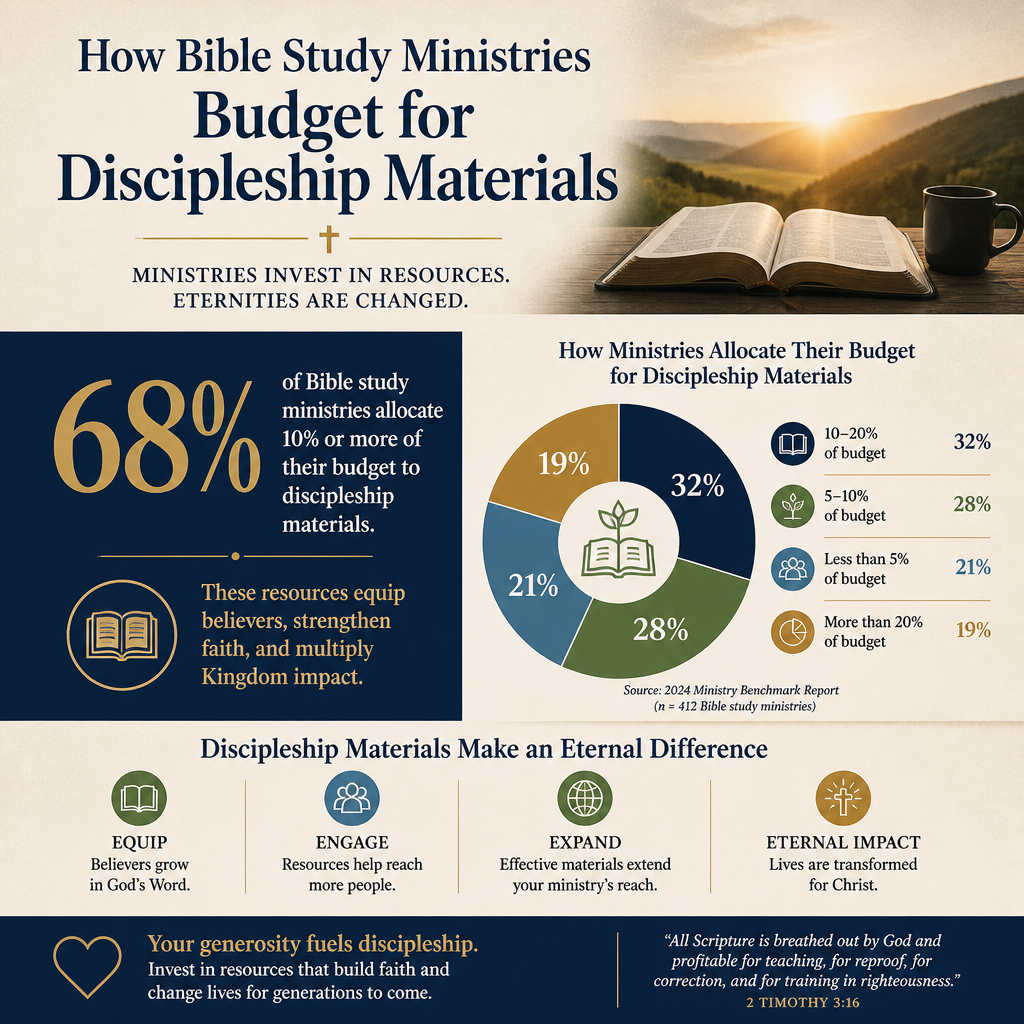
Across our verification work at Most Trusted, we observe that strong ministries do not begin with production capacity. They begin with formation outcomes: who is being discipled, toward what maturity, and in what context. Only then do they decide what materials must exist, which formats are appropriate, and what support structures are necessary for people to use the materials faithfully.
Budgeting begins with the ministry theory of formation
Some ministries aim for broad Bible literacy. Others train small-group leaders. Others equip families for catechesis at home. Those goals drive materially different budgets. A leader-training ministry may invest more in facilitation guides and coaching tools, while a literacy-focused ministry may invest more in translation, audio access, and distribution logistics. Donors should expect to hear a clear account of how the materials budget follows the discipleship strategy.
Digital efficiency is real but not automatic
Digital distribution can reduce printing and shipping, but it introduces other costs: platform maintenance, user support, cybersecurity, and ongoing updates. Ministries that treat “digital” as a synonym for “cheap” tend to underfund durability and overpromise reach. Ministries that budget with integrity show the actual costs, maintain stable platforms, and avoid data practices that commodify participants.
A short list of healthy budget signals
- Clear separation between restricted funds for materials and general operating funds, with documented internal controls
- A disciplined content lifecycle: commissioning, review, pilot, revision, retirement
- Documented translation and contextualization practices, not merely “we translated it” claims
- Evidence of use and learning, not only distribution counts
- Pricing and subsidy policies that protect access for lower-income participants
What donors can ask to discern stewardship without reducing discipleship to overhead ratios
The Christian donor’s instinct to avoid waste is sound. Scripture condemns dishonest scales and careless stewardship. But it is also possible to demand the wrong kind of “efficiency” and unintentionally pressure ministries into underinvesting in what makes discipleship faithful: careful teaching, accountable leadership, and meaningful evaluation.
Ask for verifiable clarity, not merely reassuring language
When a ministry says, “Every dollar goes to the mission,” a mature donor asks what that sentence means in accounting terms. The sector has repeatedly had to correct simplistic overhead thinking. Charity Navigator, Candid, and the BBB Wise Giving Alliance jointly warned donors not to use overhead ratios as the primary measure of a charity’s worth, urging attention to governance, transparency, and results instead Charity Navigator. For Bible study ministries, the question is not whether staff time touches “program” but whether the organization can demonstrate that its spending is honest, necessary, and tied to disciple-making outcomes.
Ask how restricted giving is handled
Discipleship materials are often a magnet for restricted gifts: “print 10,000 books,” “translate into Swahili,” “build the app.” Restrictions can be a gift to mission focus, and they can also create distortion when the organization accepts restricted funding without the capacity to fulfill it well. Donors should ask how restricted funds are tracked, who approves acceptance of restricted gifts, and what happens when a project’s real costs exceed the restricted amount.
What this means in practice is that a donor conversation about materials should include basic governance questions: Who approves theology? Who approves pricing? Who signs vendor contracts? Who reviews conflicts of interest? The mature donor is not distrusting; the mature donor is refusing to make trust a substitute for accountability.
How Most Trusted evaluates budgeting for discipleship materials under The Most Trusted Standard
Most Trusted exists to help donors give with confidence by evaluating Christian nonprofits against The Most Trusted Standard, a 15-criteria framework that examines faith foundation, financial integrity, governance and leadership, and transparency and effectiveness. Discipleship materials budgeting touches each of those concerns because materials are both theological outputs and financial products.
Faith foundation and doctrinal accountability
We look for evidence that a ministry’s content is anchored in an articulated statement of faith and that it has real mechanisms to preserve theological fidelity over time. This is especially important where a brand grows faster than its accountability, or where a ministry’s “platform” becomes functionally independent from any meaningful ecclesial oversight. Donors can reasonably ask whether the ministry’s content review process includes qualified theological oversight and whether the process is documented rather than merely assumed.
Financial integrity and pricing ethics
We examine whether financial reporting is coherent, whether revenue recognition is accurate, and whether the ministry’s approach to pricing and subsidy aligns with its stated mission. A ministry that charges for materials is not suspect; Paul affirmed the legitimacy of material support for ministry labor (1 Timothy 5:18). The question is whether the economics are transparent and whether financial incentives have displaced the primacy of faithful teaching and equitable access.
Many donors will want to place this discernment within the broader landscape of Bible Study and Engagement Ministries, where models vary widely and where the most responsible organizations can explain their choices without defensiveness or ambiguity.
Transparency and effectiveness in measuring formation
Measuring spiritual formation is complex, and Christians genuinely disagree about what should count as evidence. Some outcomes are easier to quantify (completion rates, retention, distribution, translation volume). Others are spiritually weightier but harder to measure (repentance, perseverance, increased love of neighbor). A sober ministry does not pretend that discipleship can be reduced to metrics, but it also refuses to hide behind mystery as an excuse for never learning. Donors should expect ministries to report what they can responsibly measure, to state limitations plainly, and to avoid exaggerated claims.
FAQs for How Bible study ministries budget for discipleship materials
Should Bible study materials be free for everyone?
Free distribution can be a faithful expression of generosity, especially where participants have limited means or where materials support evangelism and new-believer formation. But “free” is never costless. Donors should ask whether the ministry can show that free materials are used, that distribution is targeted to need, and that subsidy is not masking weak demand or poor design.
How can donors evaluate whether a ministry is overspending on content production?
The most reliable signal is not a single percentage but a pattern of clarity: documented editorial and theological review, transparent vendor relationships, appropriate capitalization versus expense treatment, and evidence that materials lead to sustained engagement rather than one-time transactions. Donors who want a broader funding lens can also review How Bible Study and Engagement Ministries Are Funded to compare common revenue structures and their risks.
Budgeting that serves discipleship and honors the donor’s trust
Bible study ministries do not merely distribute information; they shape the spiritual imagination of congregations, families, and leaders. Budgeting for discipleship materials is therefore a matter of stewardship before God and responsibility before the church. Donors best serve the work by funding what is faithful, asking questions that strengthen accountability, and supporting ministries whose economics remain clearly subordinate to the formation of mature disciples.



