

Donor engagement in Bible Study and Engagement Ministries is not a marketing exercise with religious vocabulary. It is a stewardship discipline shaped by the nature of Scripture itself: God speaks, his people hear, and the hearing issues in faith, obedience, and love. When donors support Bible study and Bible engagement work, they are not only funding content or distribution; they are participating in the church’s long obedience of making disciples through the Word (2 Timothy 3:16–17).
The harder question for many Christian donors is not whether Bible engagement matters, but whether a particular ministry’s donor engagement practices reflect the gospel it proclaims. A ministry can produce sound materials and still form donors through anxiety, exaggeration, or vague reporting. At Most Trusted, our verification work exists for precisely this tension: donors want to give with confidence, and ministries need accountable patterns that honor both truth and trust.
Donor engagement is discipleship of the giver, not merely retention
Christian donors are accustomed to hearing “impact” language. Yet donor engagement in Bible-focused ministries is often a more delicate task than in other sectors, because “impact” is not only measurable outputs (studies delivered, languages translated) but spiritual formation—real, and often slow. The ministry that treats donor communication as discipleship will speak carefully, report honestly, and refuse to turn spiritual fruit into a sales metric.
Scripture gives a framework for this seriousness. Paul describes a stewardship commission that must be found faithful (1 Corinthians 4:1–2). Faithfulness includes truth telling, humility about what only God can do, and clarity about what the ministry actually did. Donors can handle nuance; what undermines confidence is the impression that a ministry is managing perceptions rather than reporting reality.
What donors are actually asking when they ask for updates
Most mature Christian donors are not asking for constant news. They are asking whether their giving is being handled with integrity, whether the ministry’s work is coherent with its stated doctrine, and whether leadership understands the moral weight of representing results in the name of Christ. When a donor asks, “How is it going?” they often mean, “Is there evidence of wise stewardship, and are you telling the truth about what can be known?”
This is one reason some of the most trustworthy donor engagement is quiet and regular rather than dramatic. Consistency signals governance maturity. The ministry that over-promises to keep attention often trains donors into restlessness and trains its staff into overstatement.
Gratitude that honors donors without flattering them
Scripture commends gratitude and mutual encouragement in the body of Christ. Yet Christian donor engagement can become distorted when it frames donors as saviors, heroes, or the decisive factor in God’s work. A faithful ministry thanks donors concretely—what their gift made possible—while keeping the spotlight where it belongs. The tone is partnership under God, not patronage and not emotional dependence.
Practically, this usually means donor thanks that is prompt, specific, and modest. It names the work accomplished, avoids spiritualizing the donor’s identity, and resists manipulative urgency. Gratitude and restraint are not opposites; in Christian stewardship they belong together.

What trustworthy engagement looks like in practice
Ministries that sustain trust over time tend to treat donor engagement as a set of repeatable practices rather than a series of creative campaigns. Across our verification work at Most Trusted, we observe that ministries meeting The Most Trusted Standard typically have communication rhythms that are predictable, accountable, and reviewable. The goal is not constant contact; it is credible contact.
Updates that report decisions, not only stories
Impact stories have a legitimate place in Bible study and engagement work. Testimonies of Scripture changing lives can strengthen faith and help donors see the human reality behind budgets. But stories should not be the only form of reporting. Mature donors also want to understand decisions: what was attempted, what succeeded, what did not, and what the ministry learned.
This is especially important in Bible translation, literacy, discipleship curricula, and digital engagement, where outcomes can be complex and timelines are long. When ministries report only compelling anecdotes, they may unintentionally suggest that anecdote is the evidence. Strong donor engagement includes a few well-chosen stories and then anchors them in clear descriptions of strategy, constraints, and next steps.
Impact communication that avoids the credibility traps
Bible engagement ministries face several recurring credibility traps. The first is imprecise language about reach: “millions impacted” can mean anything from a one-time download to years of sustained discipleship. The second is attributing spiritual outcomes to a single intervention when many influences are at work. The third is collapsing “activity” into “fruit.”
Donors do not need ministries to pretend uncertainty does not exist. They need ministries to name what they can measure and what they cannot. The Overhead Myth statement—signed by Charity Navigator, Candid, and the BBB Wise Giving Alliance—made a related point for the broader nonprofit sector: simplistic metrics can distort behavior and mislead donors (Candid). The same caution applies spiritually. When engagement reporting becomes a competition for the most impressive number, truth is usually the first casualty.
How reliable ministries handle restricted gifts
Restricted giving is a stewardship test. Donors often restrict gifts because they want clarity and moral assurance about the use of funds. Ministries sometimes feel tension here, because restrictions can complicate budgeting and operations. Trustworthy donor engagement does not hide that tension. It explains how restrictions are received, recorded, honored, and reported, and it offers donors counsel about when restrictions help and when they unintentionally hinder.
The discipline required is not merely administrative. It is moral. If a ministry accepts a restricted gift, it has an obligation before God and neighbor to use it as designated or to seek explicit donor permission for any change. A ministry that is casual with restrictions will eventually be casual with other forms of truth.
Monthly giving, retention, and the ethics of stability
Monthly giving has become central to the funding model of many Bible Study and Engagement Ministries. For donors, recurring giving can be a disciplined form of generosity—quiet, planned, and resilient in seasons when emotional appeal should not be the driver. For ministries, it can stabilize cash flow and allow long-range planning, particularly for translation work, curriculum development, and long-term discipleship initiatives.
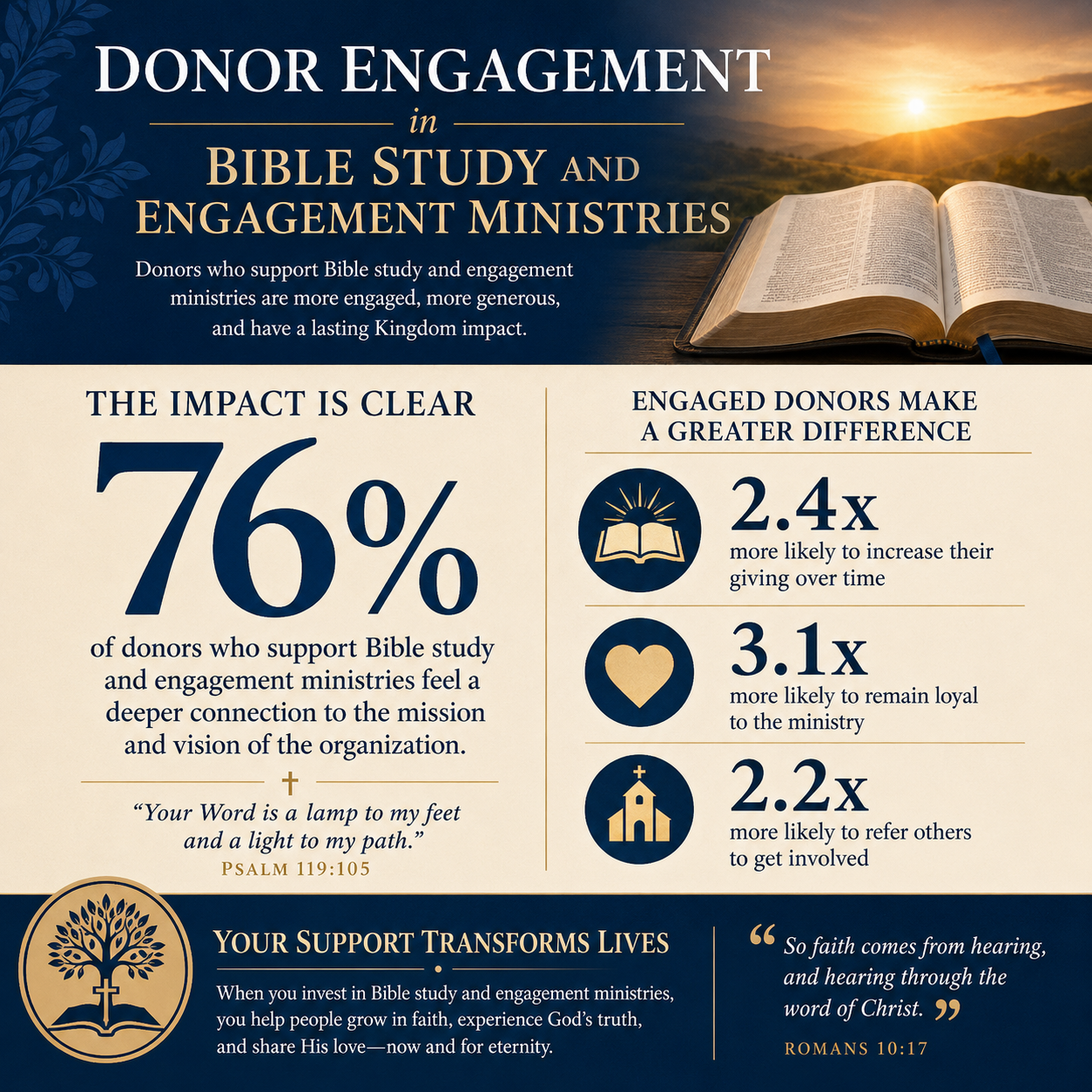
The ethical question is how a ministry invites monthly giving. The most credible invitations are transparent about why stability matters and what it will enable. They avoid implying that those who cannot give monthly are less faithful. They avoid using recurring giving as a substitute for sound budgeting, adequate reserves, and clear governance.
Retention is not a spiritual metric
Nonprofit leaders often track retention as a sign of relational strength. That can be useful, but Christian donors should be careful about treating retention as an implied spiritual scorecard. A donor may stop giving because their church needs have changed, because they are responding to a crisis elsewhere, or because they have discerned a different calling. Not every departure is a moral failure on either side.
Healthy ministries do not punish donors with guilt when they step away. They keep communication respectful, honor donor intent, and remain thankful. That posture is not only courteous; it reflects confidence that God sustains his work without coercion.
What donors should expect from monthly donor care
Recurring donors deserve more than automated receipts, but they do not need constant emotional engagement. Reasonable expectations include clear annual summaries, periodic program updates that match the ministry’s operating reality, accessible channels for questions, and timely documentation for tax purposes. In the United States, donors also care about whether a ministry is responsibly governed and whether its reporting aligns with public filings such as IRS Form 990 (IRS).
When ministries treat recurring givers as a segmented marketing list rather than as Christian stewards, the relationship eventually thins. The best monthly donor care builds long-term confidence: donors understand the work, the limits, the risks, and the reasons to remain committed.
How Most Trusted evaluates donor engagement through The Most Trusted Standard
Donor engagement can feel subjective—tone, frequency, and style vary widely across faithful ministries. Yet donors are not powerless to evaluate it. Most Trusted assesses ministries against The Most Trusted Standard, a 15-criteria framework across four areas: Faith Foundation, Financial Integrity, Governance and Leadership, and Transparency and Effectiveness. Donor engagement intersects with each area, because communication is where doctrine meets stewardship in public view.
Faith Foundation and the integrity of the message
In Bible study and engagement work, “mission drift” is not always a doctrinal crisis. It can appear as a subtle shift from forming people in Scripture to building a content brand. Donor engagement signals which is happening. Ministries grounded in a clear Faith Foundation can describe their theological commitments, articulate how Scripture functions in their programs, and avoid reducing biblical engagement to generic inspiration.
Donors should expect clarity about what the ministry teaches, what it considers central doctrines, and how it relates to the local church. Christians genuinely disagree about secondary matters in methodology, but serious ministries can still speak plainly about what they affirm and why.
Financial Integrity and governance that protects truth
Responsible donor engagement is supported by systems: accounting controls, independent oversight, conflict-of-interest policies, and budget discipline. When these are weak, communications tend to become compensatory—more urgent appeals, fewer specifics, and an increasing reliance on emotion.
Donors can ask direct questions: Does the ministry provide financial statements? Are restricted gifts tracked and reported appropriately? Does leadership have meaningful board oversight? These questions are not cynical; they are a form of Christian love that refuses to enable disorder.
Transparency and Effectiveness without exaggeration
Christian donors often want evidence that a ministry is effective, but they also understand that spiritual fruit is not always reducible to metrics. The most trustworthy ministries acknowledge both: they report what is measurable (distribution, participation, completion, translation milestones) and they are careful with what is not (conversion claims, “lives changed” counts).
Where quantitative reporting is used, donors can ask for definitions. What counts as “engaged”? Over what time period? Is the number an estimate, a verified count, or a projection? This kind of clarity does not dampen faith; it protects the ministry from the temptation to bear false witness in the name of momentum.
Giving with confidence in Bible Study and Engagement Ministries
Donor engagement in Bible Study and Engagement Ministries is ultimately about truthfulness, accountability, and spiritual seriousness. Donors should expect gratitude without flattery, reporting without hype, and clarity without defensiveness. Ministries should expect donors to ask adult questions and to fund what is faithful, not merely what is loud.
For donors seeking a wider view of the ministry landscape and how Bible-centered work is evaluated, we maintain ongoing coverage of Bible Study and Engagement Ministries. The goal is not to replace discernment, but to strengthen it—so that giving reflects both Christian conviction and verified confidence.



