

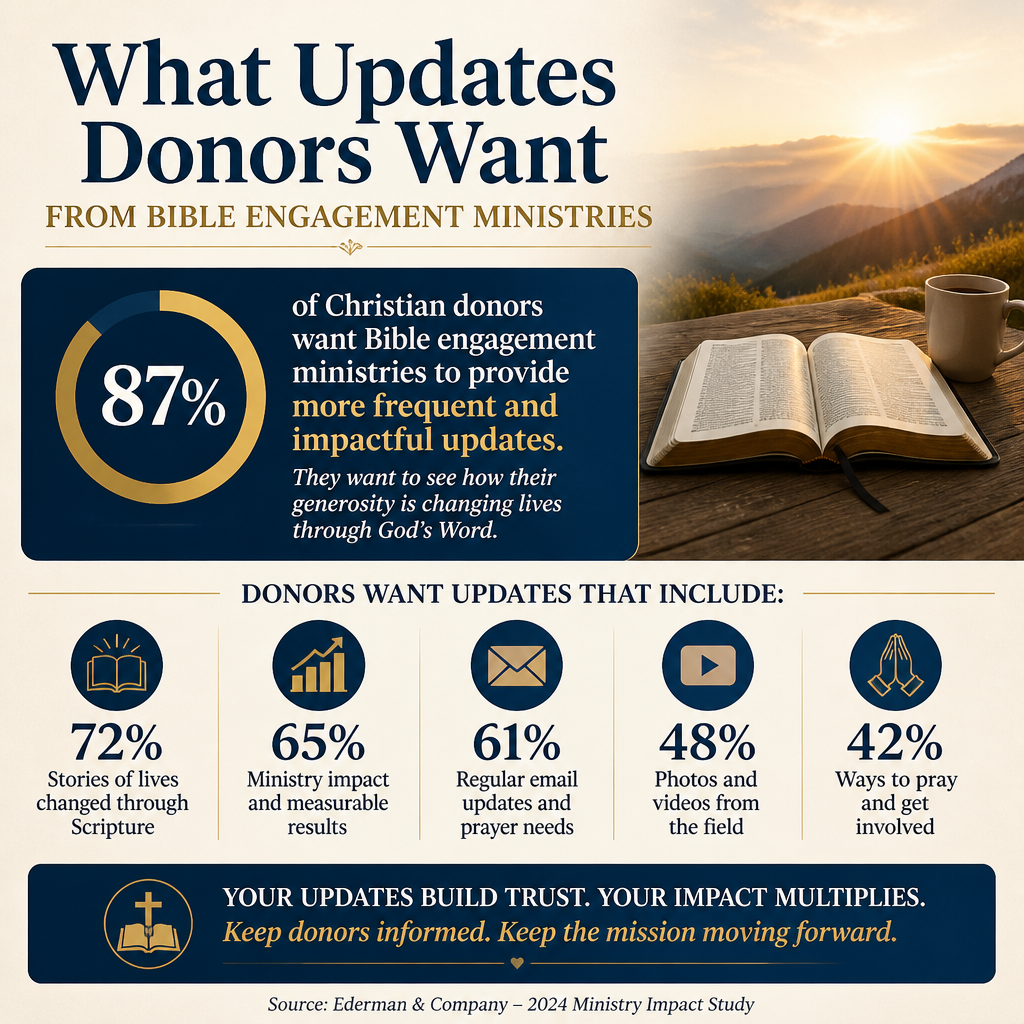
What updates donors want from Bible engagement ministries is not a question of marketing preference. It is a stewardship question: whether a ministry’s communication matches the nature of the work and the weight of the claims being made about Scripture’s role in forming disciples and renewing communities.
Bible engagement work is also unusually easy to romanticize. The fruit is often real, but it is rarely linear, and it is not always measurable in the same way food distribution or disaster relief can be. Mature donors are not asking ministries to reduce Scripture to metrics. They are asking for truthful, verifiable updates that respect both the spiritual nature of the work and the practical realities of accountability.
Donors want clarity about the ministry model and the theology underneath it
A Bible engagement ministry cannot be evaluated by enthusiasm alone. Donors are increasingly attentive to what, precisely, a ministry is doing: translation, distribution, literacy, trauma-informed Scripture engagement, inductive study training, digital access, pastoral training, or some combination. Each model has distinct risks, timelines, and indicators of integrity.
Across our verification work at Most Trusted, the ministries that meet The Most Trusted Standard tend to communicate their “theory of ministry” plainly: the doctrine of Scripture that animates the work, the practical pathway from inputs to outcomes, and the specific communities served. This kind of clarity prevents both inflated expectations and cynical doubt.
What donors hope to understand early
Donors are rarely asking for a seminary lecture. They are asking for enough theological and operational definition to discern whether the ministry’s approach is faithful and coherent.
- What is the ministry’s stated doctrine of Scripture, and how does it shape strategy and boundaries?
- Who is being served (age, language, geography, church context), and who is not?
- What is the primary intervention (training, materials, translation, platforms, mentorship, small groups)?
- What partnerships are essential (local churches, denominational bodies, schools, prisons, community organizations)?
- What does “success” mean in spiritual terms, and what indicators are appropriate without overclaiming?
Scripture used as grounding, not decoration
When ministries cite Scripture to support their work, donors listen for whether the text is being used reverently and responsibly. The Great Commission and the call for the Word of Christ to dwell richly among God’s people (Colossians 3:16) are not slogans; they carry ecclesial and pastoral implications. Updates that treat the Bible as a brand asset, rather than the living Word that judges and heals, may generate short-term interest but will not sustain mature trust.

Donors want evidence of spiritual seriousness without spiritual exaggeration
Bible engagement ministries often report stories of conversion, revived prayer, healed families, and renewed churches. Donors are grateful for such accounts, but they also know how easily testimonies can become performative or selectively curated. The deeper question is whether a ministry’s updates are shaped by humility and truth rather than by fundraising pressure.
What this means in practice is that donors tend to trust ministries that distinguish between reported fruit and verified outcomes, and that name the limitations of what they can responsibly claim. This is not a lack of faith. It is an application of the ninth commandment to institutional communication.
What disciplined reporting can look like
Better updates do not eliminate testimonies; they contextualize them. Donors respond well when a story is paired with clear information: who collected it, what questions were asked, what follow-up occurred, and what is unknown. When a ministry claims impact at scale, donors expect some methodological transparency—sampling, response rates, or independent evaluation where feasible.
Many donors are aware of broader research on Bible engagement and spiritual practice. For example, the American Bible Society’s annual State of the Bible report has tracked shifts in Scripture engagement patterns and public attitudes toward the Bible, providing context that helps donors interpret claims responsibly (American Bible Society).
Complex outcomes require careful language
Christian donors are not offended by complexity; they are wary of certainty that exceeds evidence. If a ministry’s update implies that a single distribution event “transformed a community,” sophisticated donors will ask what changed, how it was observed, and over what timeframe. They will also ask whether the ministry has safeguards against motivated reporting, especially in contexts where local partners have incentives to tell donors what they want to hear.
Donors want transparency about money that resists both cynicism and spin
Bible engagement work is often cost-intensive: translation teams, printing, shipping, digital infrastructure, curriculum development, field staff, and long-term training systems. Donors want financial updates that show stewardship without reducing faithfulness to a low “overhead” figure.
The nonprofit field has had to reckon with the “overhead myth”—the mistaken assumption that low administrative cost automatically signals effectiveness. A widely cited open letter from major evaluators warned that overhead ratios are a poor proxy for performance and can pressure nonprofits into underinvesting in governance, systems, and evaluation (Charity Navigator).
What good financial updates include
Donors tend to trust ministries that publish audited financial statements when appropriate, explain revenue concentration risk, and disclose how major categories of expense connect to mission outcomes. They also want clarity on restricted gifts and the use of designated funds—especially in projects like translation or multi-year training programs where costs and timelines can shift.
Because Bible engagement ministries sometimes operate internationally, donors also watch for foreign partner due diligence, anti-corruption controls, and clear policies on cash handling, procurement, and conflict of interest. These details are not distractions from spiritual work; they are part of loving one’s neighbor with institutional integrity.
How Most Trusted fits into donor discernment
Most Trusted exists because donors should not have to choose between spiritual conviction and rigorous verification. The Most Trusted Standard evaluates ministries across Faith Foundation, Financial Integrity, Governance and Leadership, and Transparency and Effectiveness. Donors often tell us they are not looking for perfection; they are looking for coherence, accountability, and candor that withstands scrutiny.
Donors want field-level realism about what it takes to form people in Scripture
Some Bible engagement ministries have learned that access does not equal engagement. Printing and distribution matter, but the long-term work often depends on literacy, cultural translation, trauma awareness, pastoral care, and the slow formation of habit. Donors increasingly want updates that reflect this realism instead of assuming that providing Bibles automatically produces discipleship.
There is also a legitimate debate among Christians about the relationship between individual Bible reading and the church’s teaching ministry. Some donors prioritize personal access; others emphasize training leaders to teach Scripture faithfully within the local church. Strong ministries acknowledge these differences and describe their convictions with charity and precision.
Reporting that respects formation
Donors often respond best when updates describe formation in a way that is specific but not mechanistic. For example, a ministry might report on:
How many leaders completed a defined training pathway, what competencies were assessed, what follow-up coaching occurred, and what safeguards are in place to prevent doctrinal drift. In many contexts, donors also want to know whether women and marginalized communities have safe, appropriate access to Scripture engagement opportunities without putting them at risk.
Where donors go for broader context
Donors who want to understand the wider landscape of Bible-related work often consult topic-level resources and compare models across ministries. Many will benefit from reviewing Bible Study and Engagement Ministries to see the range of program types, recurring risks, and the distinctive forms of evidence that can be responsibly requested.
Donors want updates that demonstrate governance, safeguards, and a posture of truth
Trust is sustained less by eloquent appeals than by consistent governance. Donors want to know that a Bible engagement ministry is not built around a charismatic founder without meaningful oversight, and that staff and board structures exist to prevent spiritual and financial abuse.
This is especially relevant in ministries that work across cultures, languages, and funding streams. The opportunity for misunderstanding is high, and the temptation to overstate “results” to maintain donor confidence is real. Healthy organizations communicate in a way that makes room for lament, setbacks, and course corrections.
Safeguards donors often look for
Donors tend to look for concrete indicators: an active board, conflict-of-interest policies, whistleblower mechanisms, clear child protection standards where minors are involved, and transparent handling of moral failure or misconduct allegations. These are not merely compliance items. They are expressions of repentance-shaped leadership and institutional sobriety.
Donors who want to focus specifically on communication practices and accountability rhythms will find relevant context in Donor Engagement in Bible Study and Engagement Ministries, where expectations around reporting, responsiveness, and transparency can be compared across ministry models.
FAQs for What updates donors want from Bible engagement ministries
How often should a Bible engagement ministry communicate with donors?
There is no single faithful cadence, but mature donors generally prefer predictability over volume. A quarterly rhythm of substantive updates, supplemented by time-sensitive communications for major project milestones, often serves both transparency and sobriety. The decisive question is whether updates provide verifiable information and spiritual seriousness, not whether they fill an inbox.
What should donors ask for when a ministry reports spiritual impact?
Donors can ask how stories are collected and vetted, whether follow-up occurred, and what the ministry is careful not to claim. When ministries report at scale, donors can ask for basic methodology: definitions used, sampling approach, and whether any independent evaluation was conducted. Responsible ministries welcome these questions because they strengthen trust without reducing spiritual fruit to a metric.
Giving with confidence requires updates shaped by truth
Christian donors are not asking Bible engagement ministries to abandon testimony or to mimic secular reporting. They are asking for communication that reflects the character of the God whose Word is being proclaimed: truthful, careful, and unafraid of light. Ministries that offer clear theological definition, disciplined evidence, transparent finances, and accountable governance make it easier for donors to give with joy rather than with suspicion.



