

Verifying rescue mission financial stewardship is not a secondary concern for Christian donors; it is part of obedience. Scripture treats money as a moral matter because money reveals what we love, what we fear, and what we trust. When we fund mercy ministry among neighbors in crisis, we are handling resources that belong to the Lord and are meant for the good of vulnerable people.
Rescue missions operate at the intersection of urgent human need, complex social systems, and public scrutiny. Good work happens there, and so do preventable failures: weak controls around cash assistance, unclear restricted giving, a board that functions as a rubber stamp, or donor communications that are sincere yet not fully verifiable. Mature Christian giving does not assume the worst, but it refuses to settle for assurances that cannot be tested.
Start with the stewardship question Scripture asks
Stewardship is more than low overhead
Jesus’ teaching assumes accountability: “it is required of stewards that they be found faithful” (1 Corinthians 4:2). Faithfulness has a financial dimension, but it is not reducible to a single ratio. The modern donor impulse is often to ask, “How much goes to programs?” That question matters, yet it can also mislead. The sector has explicitly warned against treating overhead as a proxy for virtue; in the “Overhead Myth” letter, Charity Navigator, GuideStar, and the BBB Wise Giving Alliance argued that starving administration can undermine outcomes and governance rather than strengthen them Charity Navigator.
What this means in practice is that responsible rescue missions will sometimes spend meaningfully on accounting, HR, background checks, training, and data systems. These are not distractions from mercy; they are the infrastructure that protects guests, staff, and donors from avoidable harm.
Mercy ministry invites both compassion and verification
Christians do not verify because we distrust the poor or suspect every ministry leader. We verify because we know what power can do to the human heart, including our own, and because we know how easily good intentions become confused with effective help. The When Helping Hurts framework, articulated by Steve Corbett and Brian Fikkert, has shaped a generation of church-based poverty engagement by naming how paternalism and dependency can distort even generous aid When Helping Hurts.
Financial stewardship is one place those distortions appear. A rescue mission can spend every dollar as promised and still structure programs in ways that do not restore agency, create sustainable pathways, or respect the dignity of guests. Verification, then, has to ask both “Was the money handled with integrity?” and “Was the work carried out with truthfulness and discernment?”

Require documents that can be tested, not narratives that persuade
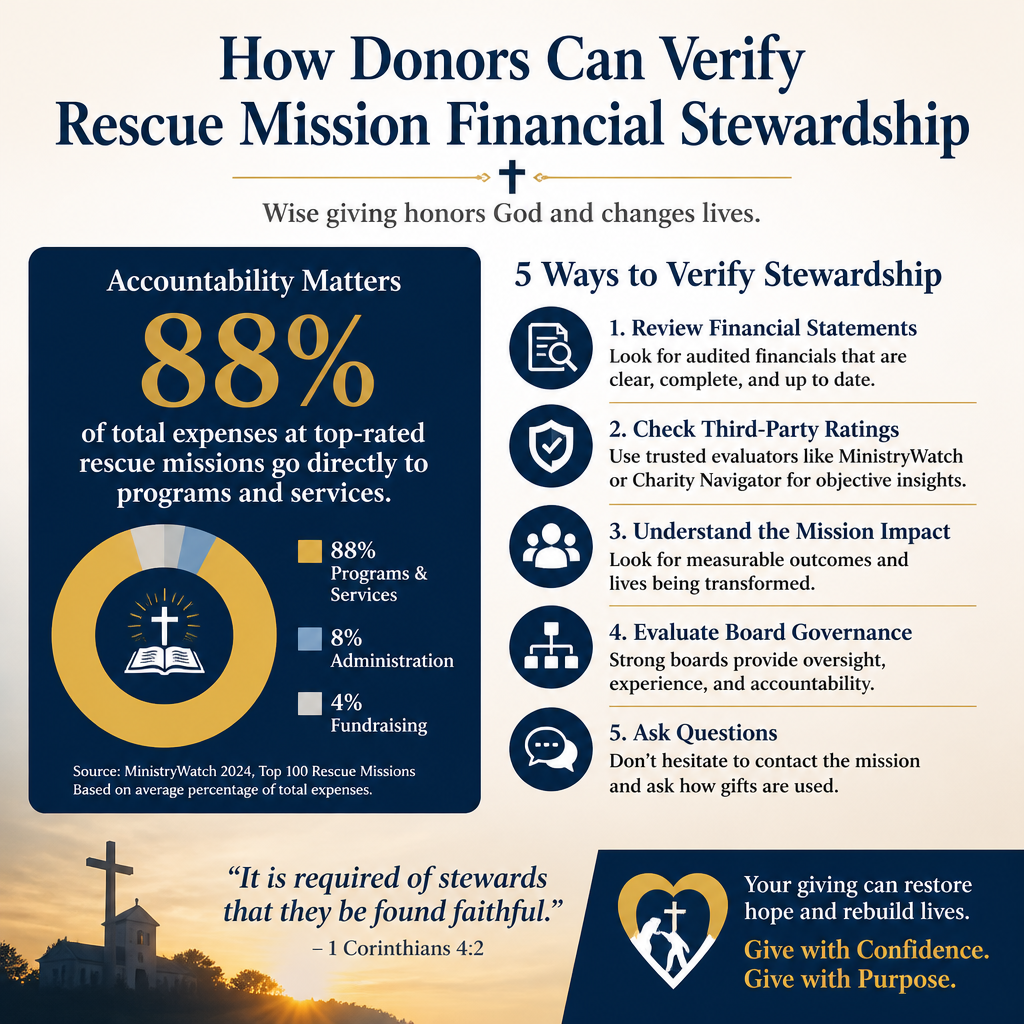
Begin with audited financials and the Form 990
For most U.S. rescue missions organized as nonprofits, two documents form the baseline: audited financial statements (for larger organizations) and the IRS Form 990. An audit is not a moral certification, but it does indicate that independent auditors tested financial statements against standards and examined internal controls. The Form 990 provides a standardized view into governance, compensation reporting, fundraising practices, and program descriptions. The IRS maintains general guidance on exempt organizations and filings, and donors should treat that framework as nonnegotiable Internal Revenue Service.
Donors should read these documents with a steady eye. Rescue missions often tell compelling stories because their work is inherently human and urgent. A credible ministry can support those stories with consistent numbers, reconciled categories, and clear explanations of how revenue and expenses map to actual programs.
Ask whether restrictions are honored and traceable
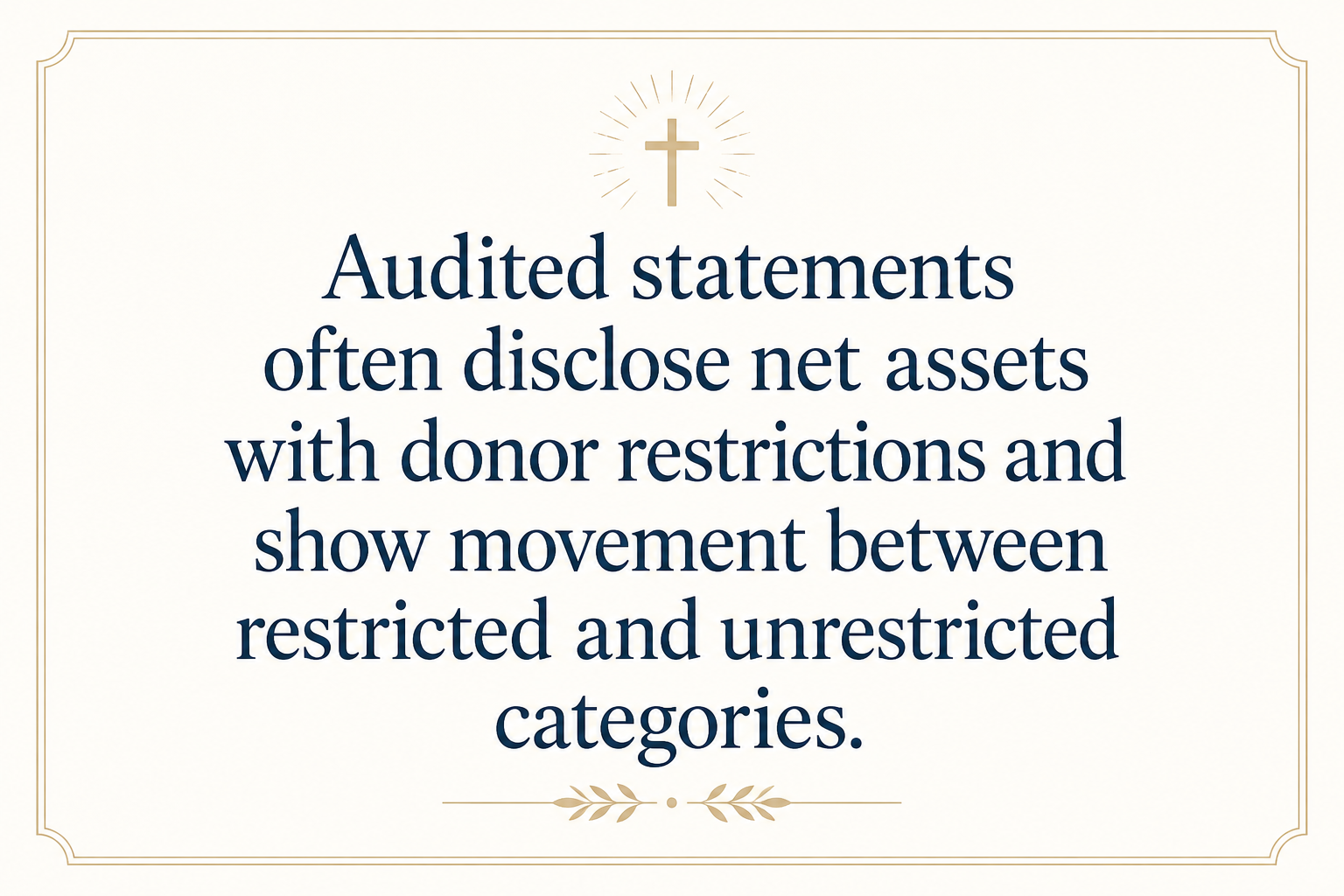
Many Christian donors give restricted gifts: “for the women’s program,” “for meals,” “for the transitional housing renovation,” “for Bibles and discipleship.” The stewardship question is whether the ministry can demonstrate that restricted funds are tracked, segregated as needed, and spent according to donor intent. Audited statements often disclose net assets with donor restrictions and show movement between restricted and unrestricted categories.
The harder question is operational: does the mission have the accounting discipline to handle dozens or hundreds of micro-restrictions without quietly blending everything into a general fund? A mission that cannot do that work should be candid with donors and encourage unrestricted giving rather than accepting restrictions it cannot faithfully administer.
Evaluate governance and leadership as financial safeguards
A credible board is not ceremonial
Financial stewardship is rarely lost in a single dramatic moment; it is more often eroded through years of weak oversight. Donors should pay attention to governance disclosures: board independence, conflict-of-interest policies, term limits or rotation practices, and whether the board meaningfully reviews budgets and financial statements. A board that is comprised primarily of insiders, family members, or employees is not automatically disqualified, but it should raise questions about independent accountability.
Across our verification work at Most Trusted, we observe that ministries meeting The Most Trusted Standard tend to treat governance as a spiritual duty, not merely a legal requirement. They can explain who holds authority, how decisions are documented, and how leaders are evaluated. That posture is not cynical; it is biblically realistic about human temptation.
Compensation and related-party transactions deserve clarity
Christian donors can feel tension here. On one hand, “the laborer deserves his wages” (1 Timothy 5:18). On the other, self-dealing has discredited ministries and harmed witness. Donors should expect transparent reporting of key employee compensation on the Form 990, and they should look for disclosures of related-party transactions: leases, consulting arrangements, vendors owned by insiders, or family employment.
These arrangements are not always improper. They can be reasonable and even beneficial if arms-length, competitively priced, and approved through a documented process with conflicts managed. The stewardship test is whether the ministry is willing to disclose the relationship and demonstrate a fair process rather than asking donors to accept ambiguity.
Test transparency by looking for consistency across channels
Program claims should match financial categories
Rescue missions often communicate impact through meals served, nights of shelter, graduates from recovery programs, job placements, and housing stability. Donors should not treat these as marketing numbers; they are assertions that can be checked for consistency with staffing, facilities, and budget allocations. If a mission claims a major expansion of services while expenses remain flat and staffing is unchanged, the story may be incomplete.
We recommend cross-checking three places: the annual report, the Form 990 program service accomplishments, and audited statements. A mission does not need to produce perfect alignment between narrative and accounting categories, but it should be able to reconcile the story of ministry with the realities of cost.
Watch for evasive language around failures and risk
Serious ministries speak honestly about risk: relapse in recovery programs, safety incidents, staff turnover, the difficulty of long-term housing stability, and the limits of what a shelter can do in a fragmented system. Christians genuinely disagree about the right mix of emergency shelter, recovery programming, and policy advocacy, but honesty about trade-offs is a mark of maturity.
When donor communications present only uninterrupted success, donors should ask what is missing. Transparency is not confessing every operational detail publicly; it is demonstrating that the ministry can tell the truth, measure what it claims to do, and correct course when it falls short.
Use a disciplined review process rather than intuition
A short stewardship checklist for donors
Financial stewardship is easier to evaluate when donors use consistent questions across ministries. We recommend the following as a starting point:
- Does the rescue mission provide a recent Form 990 and, when appropriate, audited financial statements?
- Are restricted gifts tracked and reported with clarity?
- Is the board meaningfully independent, and are conflicts of interest disclosed and managed?
- Do program claims align plausibly with the budget, staffing, and facilities described?
- Are leadership compensation and related-party transactions transparently reported?
When a third-party evaluation is warranted
Some donors have the time and expertise to conduct a serious review. Many do not, especially when they support multiple ministries across different fields. This is one reason Most Trusted exists: to help donors give with confidence by evaluating Christian nonprofits against The Most Trusted Standard, a 15-criteria framework across faith foundation, financial integrity, governance and leadership, and transparency and effectiveness.
What this means in practice is that donors can treat verification as an act of love: love for the people served, who deserve competent and honest care; love for faithful ministry leaders, who should not carry the burden of suspicion created by others’ failures; and love for the Church’s public witness. For donors seeking broader context on the ministry landscape itself, our coverage of Rescue Missions and Homeless Outreach situates financial stewardship within the larger realities of shelter, recovery, and long-term stabilization.
For donors comparing how different gifts translate into measurable service and long-term outcomes, our work on How Rescue Mission Donations Make Impact addresses the practical connection between dollars, programs, and verifiable results.
FAQs for How donors can verify rescue mission financial stewardship
Should Christian donors avoid ministries with higher administrative costs?
Not necessarily. Administrative spending can represent accountable staffing, strong controls, and safe operations, especially in high-risk environments like shelters and recovery programs. The better question is whether the mission can explain its spending in a way that is consistent with audited statements and credible program delivery. The sector’s leading evaluators have warned that “overhead” is a poor stand-in for effectiveness and can create pressure to underinvest in governance and infrastructure Charity Navigator.
What documents should a rescue mission provide if it is financially well-run?
At minimum, donors should expect ready access to the Form 990 and clear financial reporting appropriate to the organization’s size. Many established missions also provide audited financial statements and an annual report that reconciles program claims with financial realities. Donors can ground their expectations in the broader regulatory framework for exempt organizations maintained by the IRS Internal Revenue Service.
Giving with confidence is part of faithful mercy
Rescue mission work is costly because human restoration is costly. Donors do not honor the poor by demanding a ministry run on fumes, and they do not honor Christ by funding organizations that cannot demonstrate honesty and competent oversight. Verifying rescue mission financial stewardship is one of the ordinary disciplines through which Christian generosity becomes durable, truthful, and protective of those most at risk.



