
Why planned giving helps Christian anti-trafficking ministries is not a sentimental question about “leaving a legacy.” It is a governance and discipleship question about whether long-term resources will be available for costly, slow, trauma-informed work that cannot be sustained on irregular compassion alone.
Christian anti-trafficking ministries sit at the intersection of moral urgency and operational complexity. Their work often includes prevention, survivor care, legal advocacy, and collaboration with churches and civil authorities. The needs are immediate, but the pathway to lasting restoration is typically measured in years, not weeks. Planned giving can stabilize that time horizon without forcing ministries into crisis fundraising that distorts strategy.
Planned giving matches the time scale of restoration
Survivor care is rarely a short project
Many Christian donors rightly respond to trafficking with moral clarity. Yet the realities of recovery do not fit the cycle of annual campaigns. Effective survivor care commonly involves safe housing, case management, counseling, medical care, education, and employment pathways. Those are recurring commitments, and ministries that make them responsibly must be able to plan for continuity.
Verifiable evidence suggests that trafficking is both widespread and difficult to measure precisely, which creates pressure for ministries to tell simple stories while doing complex work. The U.S. National Human Trafficking Hotline identified 9,619 situations of human trafficking in 2023 in the United States, based on signals received through hotline and related channels, which underscores both scale and the limits of observed reporting (Polaris).
When cash flow dictates mission, care becomes fragile
The harder question is not whether a ministry cares, but whether its care is structurally durable. Anti-trafficking work is vulnerable to funding volatility because it can be expensive per participant and because outcomes are not always quick or linear. Planned gifts—bequests, beneficiary designations, charitable gift annuities, and other instruments—can function as patient capital that reduces the temptation to chase emotionally compelling but programmatically thin initiatives.

Planned giving rewards ministries that are serious about trust
Long-term gifts require more than inspiring storytelling
Planned giving is a form of trust transfer. Donors are not only funding programs; they are entrusting future resources to an organization’s governance, theology, and integrity. This is one reason donors evaluating Christian anti-trafficking ministries should weigh more than the visible front end of the work. Our team at Most Trusted exists to help donors test that trust with evidence by evaluating ministries against The Most Trusted Standard, a 15-criteria framework spanning Faith Foundation, Financial Integrity, Governance and Leadership, and Transparency and Effectiveness.
In practice, planned giving tends to be healthiest where donors can see mature governance: independent oversight, clear conflict-of-interest practices, transparent financial reporting, and sober claims about impact. Anti-trafficking ministries that resist exaggeration and document their methods are often better prepared to steward a donor’s legacy without drifting into reputational or legal risk.
A field marked by urgency also needs restraint
Christians genuinely disagree about some tactics in the anti-trafficking space, including the most effective balance between prevention, direct services, and various forms of intervention. There are also well-documented concerns across the broader humanitarian ecosystem about unintended harm when outside funding incentivizes the wrong outcomes. The When Helping Hurts framework, articulated by Steve Corbett and Brian Fikkert, has helped many Christian donors and ministries name these risks without abandoning the call to mercy (When Helping Hurts).
Planned giving can reinforce restraint by reducing the incentive to prioritize short-term donor appeal over patient, locally informed solutions. The ministries best suited to receive long-horizon gifts are usually those that can describe not only what they do, but what they refuse to do—and why.
Planned giving can protect mission clarity against crisis fundraising
Emergency appeals are sometimes necessary and often formative
Anti-trafficking organizations do face genuine emergencies: unexpected housing needs, urgent relocation, legal crises, or a sudden influx of referrals. Yet if a ministry must operate in a perpetual emergency posture to meet basic obligations, the work can become reactive. That reactivity increases staff burnout and can push leadership toward messaging that confuses a donor’s emotional response with durable program design.
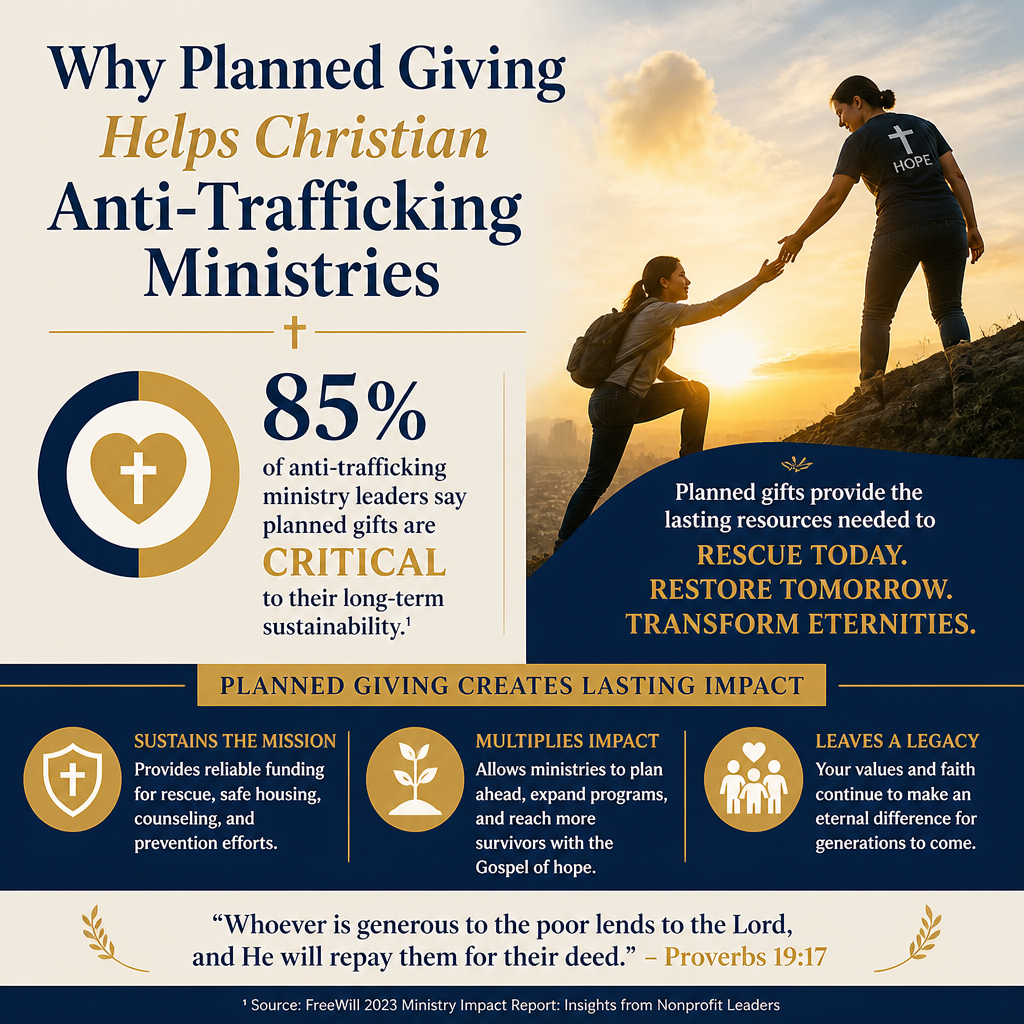
Planned gifts, when used wisely, can help underwrite infrastructure that makes care safer: training, clinical supervision, security protocols, data systems, and audited financial controls. These are not glamorous expenses, but they often determine whether a survivor experiences stable care or a revolving door.
Donors should not reduce discernment to overhead ratios
Some donors hesitate to support reserves or administrative capacity because they have been taught to equate “low overhead” with holiness. That assumption has been challenged publicly by major charity evaluators. The joint statement commonly known as the Overhead Myth—signed by GuideStar, Charity Navigator, and the BBB Wise Giving Alliance—argues that overhead ratios are a poor proxy for effectiveness and can create harmful incentives (Charity Navigator).
What this means in practice is that planned giving should not be directed only to highly visible programs. It can responsibly support the less visible structures that prevent harm and improve accountability, especially in ministries serving vulnerable people where confidentiality, safety, and compliance are non-negotiable.
How donors can approach planned giving with theological seriousness
Scripture frames wealth as stewardship, not private security
Christian planned giving is not a denial of family responsibility; it is a disciplined ordering of responsibility under God. Scripture consistently treats wealth as entrusted, not possessed. Jesus’ parable of the talents presses stewardship into the future, and the New Testament’s call to generosity assumes forethought rather than impulsiveness. A planned gift can be one concrete expression of seeking first the Kingdom in the way assets are allocated across time.
Many mature donors also find that planned giving clarifies priorities while they are still living. A beneficiary designation or will provision forces concrete decisions: which ministries merit long-term trust, what portion belongs to family, and what portion should be set apart for mercy and mission.
Due diligence becomes more important, not less
Because planned gifts often arrive after a donor’s death, they reduce the donor’s ability to respond to changes in leadership or mission. That is precisely why verification and ongoing transparency matter. Across our verification work, we observe that ministries that meet The Most Trusted Standard tend to document their theological commitments, publish accessible financials, maintain accountable boards, and communicate impact with a restraint that invites scrutiny rather than resisting it.
Donors considering this space may benefit from reviewing the wider landscape of Christian Anti-Trafficking Ministries so planned gifts reflect informed conviction rather than a single compelling story.
What planned giving can fund in anti-trafficking work without distorting it
Restricted gifts require careful drafting
Some donors prefer to restrict a planned gift to a particular purpose. That can be wise, but it should be done with humility about future conditions. Overly narrow restrictions can trap a ministry into obligations that no longer fit the legal environment, the needs of survivors, or the ministry’s evolving best practices. The goal is fidelity, not control from the grave.
A balanced approach often pairs a clear intent with a workable flexibility clause, allowing the board to redirect funds to the closest feasible purpose if circumstances change. Donors can also consider endowing a category of work—such as survivor aftercare or prevention training—rather than a single program model.
A practical checklist for donors
The following questions can help donors evaluate whether a Christian anti-trafficking ministry is a prudent recipient of a planned gift:
- Does the ministry clearly articulate its Christian commitments and how they shape care for survivors?
- Are audited financial statements or credible financial reviews available and understandable?
- Is governance transparent, including board independence and conflict-of-interest policies?
- Does the ministry describe outcomes and limitations with restraint rather than certainty?
- Are safeguarding, confidentiality, and trauma-informed practices explicit and credible?
Donors who want to place planned giving within a broader approach to discernment can also explore How to Give Wisely to Christian Anti-Trafficking Ministries as they weigh long-term commitments.
FAQs for Why planned giving helps Christian anti-trafficking ministries
Is a planned gift appropriate if we already give annually?
Yes. Annual giving and planned giving serve different purposes. Annual gifts fund current operations; planned gifts can strengthen long-term capacity, reserves, or future program stability. Many donors treat a planned gift as an additional act of stewardship rather than a replacement for present generosity.
Should a planned gift be restricted to a specific program?
Sometimes, but not automatically. Restrictions can protect donor intent, yet overly narrow restrictions can create practical and legal complications years later. A purpose-based restriction with measured flexibility—paired with confidence in governance and transparency—often honors both stewardship and the realities of long-horizon ministry work.
Planned giving as durable mercy
Christian anti-trafficking ministries need more than momentary resolve; they need durable mercy with structures strong enough to carry it. Planned giving helps when it is paired with rigorous discernment, credible oversight, and a theology of stewardship that treats future resources as part of present obedience. The donor’s aim is not simply to leave something behind, but to strengthen faithful work that will still be worthy of trust when the donor is no longer here to ask questions.



