
How Christian anti-trafficking legal clinics serve survivors is a test case for whether compassion is willing to be disciplined. Trafficking is not only a moral atrocity; it is also a legal reality that traps people in court records, immigration status, debt, custody disputes, and criminal charges that were often coerced. When the church funds legal care that is trauma-informed and properly governed, it can help survivors reclaim agency without turning their stories into fundraising commodities.
Christian donors often give first to rescue and immediate care, and those needs are real. Yet long-term freedom is frequently decided in administrative offices and courtrooms where deadlines, documentation, and legal strategy determine whether a survivor can work, live without fear of retaliation, or regain custody of children. Legal clinics are one of the least visible forms of anti-trafficking work and, at their best, among the most stabilizing.
Legal stability is often the difference between rescue and restoration
Trafficking leaves a legal afterlife
A survivor may be safe from an immediate trafficker and still be trapped by the downstream consequences: a criminal record from forced commercial sex, a protective order that was never filed, an eviction, a default judgment on debt opened in her name, or an immigration status that keeps her in the shadows. These issues are not peripheral; they shape employability, housing, eligibility for benefits, and whether a survivor can testify without self-incrimination.
U.S. federal law recognizes that justice responses must include survivor-centered protection. The Trafficking Victims Protection Act and subsequent reauthorizations created pathways and services that can include legal assistance, and the U.S. Department of Justice notes that victims may be eligible for immigration relief such as T visas in appropriate cases (U.S. Department of Justice). For donors, the key point is simple: legal remedies exist, but they are difficult to access without skilled counsel and coordinated case management.
The church’s role is not to replace the state but to insist on dignity
Christian legal clinics do not “save” survivors in a messianic sense; Christ saves. Clinics can, however, embody the biblical insistence that justice is part of righteousness. The prophets condemn those who “turn aside the needy from justice” (Isaiah 10:2). In the New Testament, the church is warned against partiality and urged to protect those without power in public life (James 2:1–7). Legal advocacy is one concrete way to resist the exploitation that thrives when people are unseen and unprotected.
This is also where donor discernment matters. The anti-trafficking field has had to reckon with inflated claims, sensational narratives, and interventions that unintentionally increase risk. Legal work is slower, less photographable, and harder to market, which is precisely why it can be more trustworthy when done with humility and professional accountability.

What competent survivor-centered legal care actually looks like
Trauma-informed representation with clear boundaries
Trauma affects memory, time perception, and trust. A legal clinic that understands this does not demand linear storytelling as the price of help. It sets expectations gently, explains confidentiality and mandatory reporting in plain language, and avoids coercing participation in prosecutions. Competent clinics coordinate with therapists and case managers while maintaining ethical boundaries that protect attorney-client privilege.
Many legal clinics operate through a model of limited scope representation, where an attorney helps with a specific matter—an expungement petition, a protective order, a name change, a benefits appeal—without promising comprehensive representation they cannot sustain. For donors, limited scope is not a weakness. It can be an expression of integrity when a clinic accurately matches capacity to commitments.
Integrated services without collapsing roles
Survivors rarely experience their needs in categories. Housing, safety planning, employment, addiction recovery, medical care, and legal status interact. Strong clinics are integrated into a wider network of service providers, but they do not blur roles. When legal staff also function as spiritual counselors, social workers, and fundraisers, risk rises: ethical lines get crossed, confidentiality gets compromised, and survivors are pressured to perform gratitude.
Clinics that maintain clear role separation tend to serve survivors better and protect the church’s witness. This is also where donors can ask practical questions about referral pathways, memoranda of understanding with partner agencies, and protocols for information sharing.
The legal issues clinics address and why they matter for long-term freedom
Criminal record relief and vacatur
Many survivors carry convictions for crimes they were compelled to commit—especially prostitution-related offenses. In a growing number of states, vacatur or expungement statutes allow survivors to clear or seal certain convictions connected to trafficking. The legal mechanisms vary widely by jurisdiction and typically require documentation, affidavits, and careful narrative framing to avoid unintended legal exposure. Clinics that specialize in this work can remove a major barrier to employment, housing, and licensure.
Donors should also recognize a tension: some vacatur processes implicitly require survivors to revisit traumatic events and re-disclose details to officials. A clinic’s quality is often revealed in how it prepares clients, how it limits unnecessary exposure, and whether it offers alternatives when a petition would be unsafe.
Immigration relief and lawful status
Traffickers routinely exploit immigration vulnerability. Legal clinics may help survivors pursue immigration remedies such as T visas or U visas, asylum in appropriate circumstances, or adjustment of status. These cases are document-heavy, time-sensitive, and emotionally costly. The U.S. Department of Homeland Security notes that T nonimmigrant status is designed for certain victims of severe forms of trafficking who assist law enforcement in the investigation or prosecution, with exceptions for trauma and age (U.S. Department of Homeland Security).
This is an area where Christian donors should avoid simplistic narratives. Cooperation with law enforcement can be wise and necessary, but it can also expose survivors to retaliation and re-traumatization. Clinics that honor survivor agency, explain risks, and coordinate safety planning are serving the biblical mandate to “seek justice” without instrumentalizing a person’s pain.
Family law, protection orders, and economic stabilization
Custody disputes and child welfare involvement are common. Traffickers may use children as leverage, and survivors may face skepticism from courts that do not understand coercion. Legal clinics can help survivors pursue protective orders, navigate family court, respond to CPS actions, and establish legal identity documents. Economic exploitation can also be addressed through consumer debt relief, wage claims, or identity theft remediation—uncelebrated work that materially reduces the likelihood of re-exploitation.
How donors can evaluate legal clinics with wisdom and spiritual seriousness
Verification requires more than moving stories
Christian donors are right to care about fruit. The question is what kind of evidence is appropriate in legal work, where confidentiality is not optional and outcomes may take years. A mature clinic will not publish identifiable case details, will avoid sensational storytelling, and will be cautious with numbers that can be manipulated. It will also be able to show disciplined operations: qualified leadership, ethical oversight, audited or reviewed financials where appropriate, and clear policies for safeguarding and privacy.
This is where Most Trusted’s work can serve donors. We evaluate ministries against The Most Trusted Standard, a 15-criteria framework focused on faith foundation, financial integrity, governance and leadership, and transparency and effectiveness. Legal clinics that meet the standard tend to be careful with claims, explicit about scope, and accountable in ways that protect survivors and donors alike.
Practical markers donors can ask about
Donors do not need a law degree to ask the questions that reveal whether a clinic is stable, ethical, and survivor-centered. The goal is not to interrogate, but to ensure that giving is aligned with faithful stewardship.
- Licensed attorneys provide or directly supervise legal representation, and the clinic follows state bar ethics rules.
- Written confidentiality, data security, and media policies protect client identity and story.
- Clear referral relationships exist with trauma counseling, shelter, and medical providers, without collapsing roles.
- Scope of services is defined, including what the clinic will not do, so survivors are not promised what cannot be delivered.
- Board oversight and financial controls are documented, with transparent reporting appropriate to the organization’s size.
Donors interested in the broader ecosystem of vetted work can place legal clinics within the wider landscape of Christian Anti-Trafficking Ministries, where approaches vary and partnerships matter.
Partnerships, governance, and the risks unique to legal advocacy
Partnership is not a brand strategy
Legal clinics seldom function well in isolation. They rely on shelters, survivor advocacy organizations, churches, and sometimes law enforcement task forces. But partnerships can drift into unhealthy patterns: a clinic becomes a captive service arm for a larger organization’s fundraising narrative, or it accepts referrals without adequate capacity, or it is pressured to prioritize “high-profile” cases.
Strong governance helps resist these pressures. Clear conflict-of-interest policies, board independence, and documented decision-making are not bureaucratic burdens; they are safeguards for survivors. Donors who want to understand these dynamics in a distinctly Christian anti-trafficking context will often find clarity by looking closely at Legal Support and Partnerships in Christian Anti-Trafficking Work, where good intentions either become disciplined collaboration or devolve into fragile coalitions.
Measuring effectiveness without violating dignity
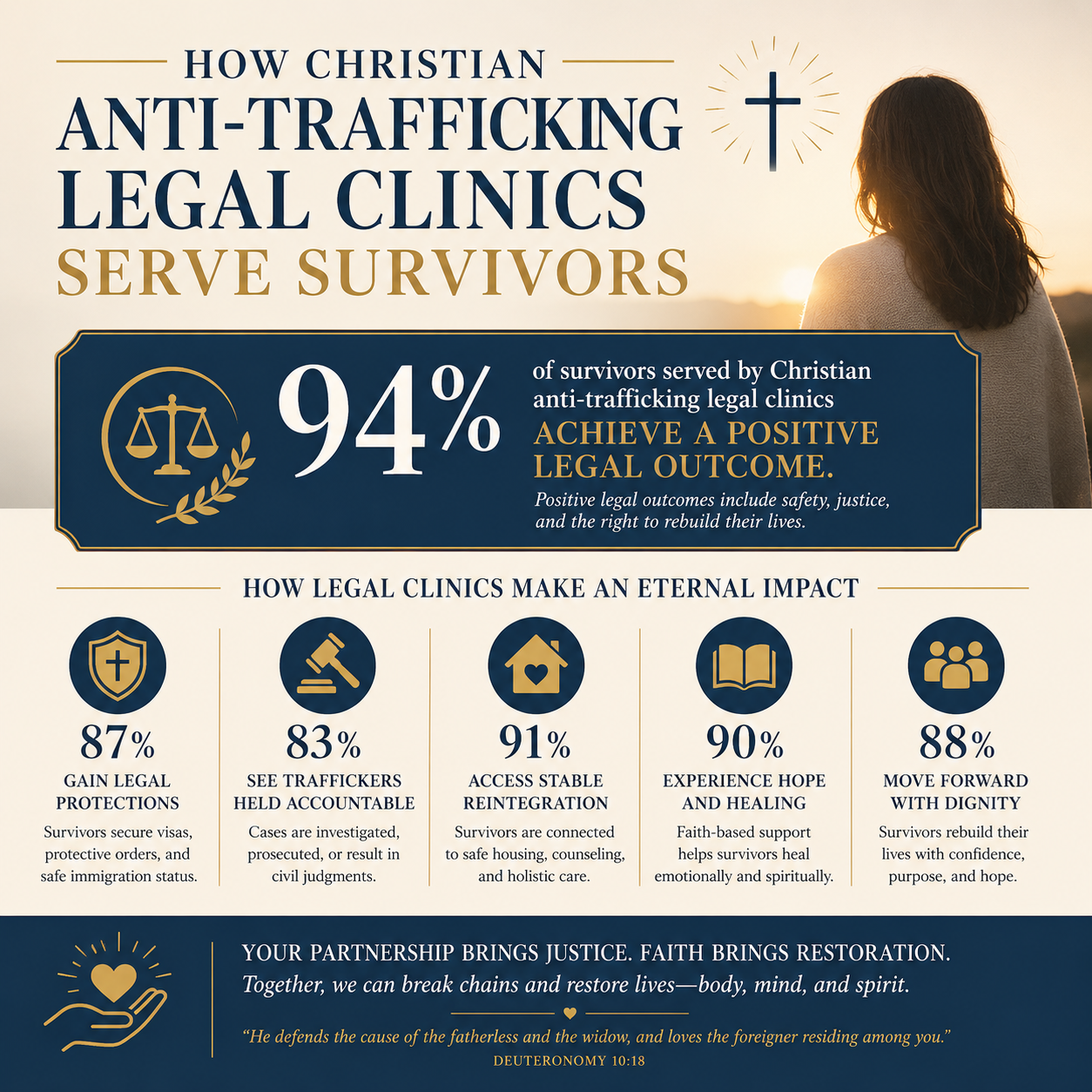
Outcome measurement in legal work is real, but it is not always simple. A “win” in court may not translate to safety if a trafficker retaliates. A decision to decline prosecution cooperation may be a healthy exercise of agency even if it reduces conviction statistics. Clinics can report responsibly on process measures (cases opened and closed, types of relief pursued, average time to resolution) and on de-identified outcomes (vacaturs granted, work authorization obtained) while maintaining confidentiality.
The deeper measure is whether the clinic’s work increases lawful stability and reduces vulnerability to re-exploitation. That is not sentiment; it is the practical shape of loving one’s neighbor in a world where paperwork, hearings, and identification documents govern access to ordinary life.
FAQs for How Christian anti-trafficking legal clinics serve survivors
Do legal clinics mainly help with prosecutions of traffickers?
Some clinics support survivors who choose to participate in investigations or prosecutions, but competent legal care is broader. It often focuses on survivor stability: record relief, protection orders, family law, immigration status, and addressing exploitation-related debt or identity theft. A clinic’s fidelity is shown in how it preserves survivor agency rather than treating a person primarily as a witness.
What should donors be cautious about when funding legal aid in anti-trafficking work?
Donors should be cautious about clinics that rely on sensational storytelling, promise rapid outcomes, or cannot explain supervision by licensed attorneys and compliance with legal ethics. Confidentiality and data security are non-negotiable. It is also wise to look for governance maturity and transparent finances, because legal work involves sensitive information and often intersects with public systems that require careful accountability.
Why this form of ministry deserves disciplined generosity
Christian anti-trafficking legal clinics serve survivors by turning compassion into durable protection: lawful status, cleared records, safer families, and reduced vulnerability to coercion. This work is rarely dramatic, and it is often expensive in time and expertise, but it aligns with Scripture’s insistence that love must be truthful and justice must be concrete. Donors who fund such clinics are not merely underwriting services; they are strengthening the conditions under which a survivor can live quietly, work honestly, worship freely, and walk without fear.



