

What questions donors should ask Christian anti-trafficking ministries is not a matter of skepticism for its own sake. It is a matter of spiritual and practical stewardship in a field where good intentions can unintentionally fund harm, inflate claims, or substitute sentiment for measurable care.
Trafficking is also a category that attracts urgency. That urgency can be holy, but it can also be exploited. Christian donors do not honor the image of God in survivors by demanding inspiring stories; we honor it by insisting on truth, protection, and long-term restoration. Scripture’s concern for the oppressed is not vague (Isaiah 1:17; Proverbs 31:8–9), and neither should our due diligence be.
1. What does the ministry mean by trafficking and exploitation
The first discipline is definitional clarity. The term “human trafficking” is used in fundraising to describe everything from online pornography consumption to migrant smuggling to commercial sexual exploitation of minors. Some of those realities overlap, but they are not interchangeable. A credible ministry can explain the specific harm it addresses, how it distinguishes trafficking from adjacent issues, and how it avoids exaggeration.
Ask for operational definitions and referral pathways
We recommend asking for the ministry’s working definitions, aligned to recognized legal and service frameworks, and then asking how those definitions shape practice: who they serve, how they screen, and how they refer cases outside their scope. In the United States, the federal definition is grounded in the Trafficking Victims Protection Act and the National Human Trafficking Hotline’s criteria; ministries should be conversant with these standards even when their work is explicitly pastoral.
One concrete question is whether the ministry has formal relationships with local agencies: child advocacy centers, victim services units, shelters, and trauma clinicians. Isolation is not a mark of faithfulness. In complex harm, the body of Christ often serves best through coordinated, accountable collaboration.
Distinguish awareness work from direct services
Awareness campaigns can be valuable, but donors should not confuse “awareness” with rescue or restoration. Ask what percentage of budget and staff time is dedicated to direct services, and what those services are: emergency housing, case management, legal advocacy, trauma-informed counseling, job readiness, or family reunification support. If the ministry’s primary deliverable is events, trainings, or social media content, it should say so plainly and describe how it evaluates impact beyond attendance and engagement.

2. How does the ministry protect survivors from spiritual and physical harm
Anti-trafficking work sits at the intersection of trauma, shame, fear, and often ongoing legal risk. Ministries that are serious about the dignity of survivors treat safeguarding as a core expression of Christian ethics, not a compliance appendix.
Safeguarding policies are a theological issue, not paperwork
We recommend asking to see written policies for background checks, two-adult rules, transportation, digital communication, mandatory reporting, and incident response. These are ordinary instruments of love of neighbor. The absence of such safeguards is not a neutral gap; it is a foreseeable risk.
In the United States, most children are trafficked by someone they know, which is one reason survivor services require careful screening, boundaries, and professional coordination. The U.S. Department of Homeland Security explicitly notes that traffickers commonly exploit existing relationships and vulnerabilities rather than kidnapping strangers.U.S. Department of Homeland Security
Ask how faith is offered without coercion
Christian donors rightly want ministries that name Christ without embarrassment. Yet trafficking survivors may have endured manipulation under spiritual language, or may be in legal contexts where coercion allegations carry real consequences. Ask how the ministry shares the gospel and offers prayer while protecting a survivor’s freedom of conscience and honoring trauma realities.
A mature answer usually includes informed consent, clear opt-in practices for spiritual activities, and a refusal to tie services to religious participation. That is not theological compromise. It is a recognition that spiritual authority must never be weaponized, and that Christ’s invitation is not administered through pressure.
3. What evidence shows the ministry is effective without inflating claims
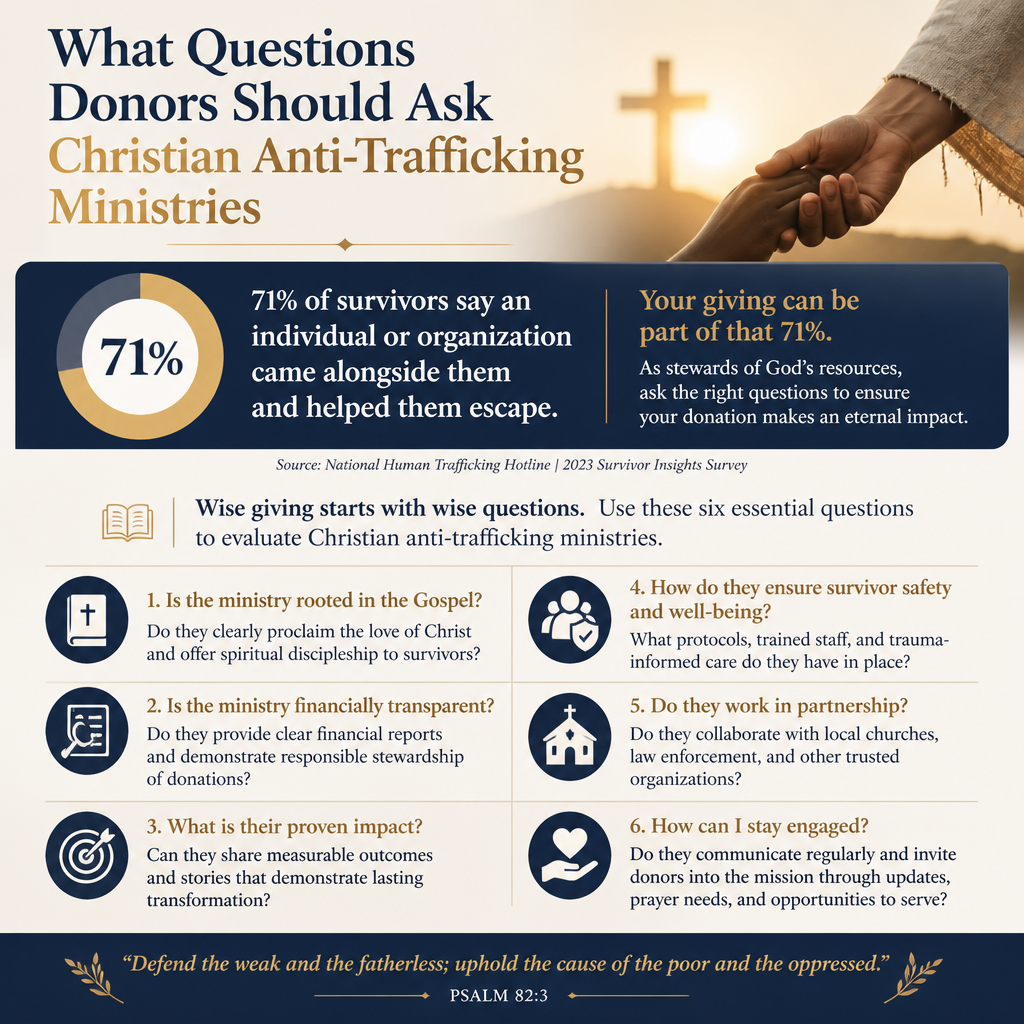
Christian donors are sometimes trained to ask, “How much goes to programs?” but the deeper question is whether the ministry’s claims correspond to verifiable outcomes. Anti-trafficking fundraising is especially prone to inflated “rescues,” dramatic anecdotes, and vague impact dashboards. Responsible ministries resist that temptation, even when it costs them attention.
Ask for outcome measures suited to the work
“Success” in survivor care is often slow and non-linear. A credible ministry can describe indicators such as stable housing retention, engagement in trauma counseling, sustained employment, progress toward legal relief, reduced re-victimization risk, family stabilization where appropriate, and healthy community integration. Ask which outcomes they track, why those were chosen, and what they do when outcomes are poor.
We recommend asking whether the ministry’s data is reviewed by leadership and board governance, and whether privacy protections are built into collection and reporting. Survivors are not metrics. But they are also not props for donor confidence.
Be wary of simplistic overhead narratives
Trauma-informed care requires competent staff, supervision, and often clinical partnerships. Low administrative cost can be a sign of underinvestment rather than virtue. The philanthropic sector has broadly warned donors away from treating “overhead” as a proxy for effectiveness, including the well-known statement signed by GuideStar, Charity Navigator, and the BBB Wise Giving Alliance.Candid GuideStar
What this means in practice is that donors should ask different questions: Are staff trained and supervised? Are survivor services consistent and documented? Are financial statements clean and accessible? Is there evidence of learning over time?
- What outcomes do you track, and how do you define each outcome?
- What is your process for evaluating programs and making changes?
- How do you protect survivor confidentiality when reporting impact?
- How do you handle relapse, re-contact with traffickers, or program exits?
- Can you provide anonymized, aggregated results for the past year?
4. How is the ministry governed and financially accountable
Trafficking ministries often attract strong personalities and strong emotions. That combination can produce courageous leadership, but it can also create environments where boards function as cheerleaders rather than fiduciaries. The donor’s task is not to punish risk-taking; it is to fund ministries that can sustain the weight of trust.
Ask who holds authority and how conflicts are managed
We recommend asking for the board roster, independence, and frequency of meetings, along with whether there are clear conflict-of-interest disclosures and recusal practices. If a ministry is founder-led, ask what accountability exists when difficult decisions arise, including personnel issues, safety incidents, or public claims that are later challenged.
Across our verification work at Most Trusted, ministries that meet The Most Trusted Standard tend to treat governance as a spiritual discipline: leadership under authority, not leadership beyond questioning.
Ask for financial statements that match the scale of the work
Request recent financials and ask how the ministry allocates restricted gifts, handles cash assistance to survivors, and controls reimbursement and vendor payments. Survivor support often includes rent, transportation, emergency needs, and legal expenses; donors should ask what internal controls protect against both misuse and unnecessary bureaucracy.
For larger organizations, audited financial statements are a meaningful indicator of financial maturity. For smaller ministries, a review or compilation may be more realistic, but even then, donors should expect transparent documentation and clear answers.
For donors wanting a broader view of the field, our research and verification approach is published alongside the topic of Christian Anti-Trafficking Ministries, where we emphasize evidence, governance, and faithfulness over spectacle.
5. How does the ministry integrate local churches and long-term restoration
Trafficking is not only a criminal-justice problem. It is a discipleship and community problem, bound up with pornography, family breakdown, coercion, addiction, homelessness, and the commodification of bodies. Christian ministries serve best when they understand restoration as more than extraction from crisis.
Ask how they partner with churches without outsourcing expertise
Healthy church partnership does not mean sending untrained volunteers into high-risk contexts. It means equipping congregations to respond wisely: hospitality with boundaries, mentoring with supervision, prayer with consent, and material support coordinated through case management. Ask whether the ministry trains churches in trauma-informed care and whether it provides clear volunteer role definitions.
Christians genuinely disagree about how to balance professional specialization and the church’s ordinary calling to care. But few dispute that the local church must be more than a donor base. A ministry with integrity can articulate what churches can do well and what requires specialized services.
Ask what restoration looks like five years later
Donors often fund what is immediate: rescues, raids, hotline numbers, emergency beds. Yet the deeper work is the slow rebuilding of life—education, employment, stable community, and spiritual healing that does not bypass trauma. Ask whether the ministry has an aftercare model, a step-down plan, and relationships that persist beyond a single program phase.
For donors weighing how to give wisely across different models of intervention, we maintain a parallel resource on How to Give Wisely to Christian Anti-Trafficking Ministries, including questions aligned to The Most Trusted Standard and the realities of survivor-centered practice.
FAQs for What questions donors should ask Christian anti-trafficking ministries
Should donors prioritize rescue operations over aftercare programs?
Rescue language can be compelling, but donor priorities should follow survivor outcomes. In many contexts, law enforcement holds the authority for raids and removals, and the highest-impact gap is sustained aftercare: safe housing, trauma treatment, legal support, and long-term stability. Donors should ask what role the ministry plays in the broader system and whether it has the competence and partnerships required for that role.
What red flags should donors watch for in Christian anti-trafficking fundraising?
Red flags include inflated rescue counts without documentation, public survivor stories that risk identification, pressure for quick gifts tied to emotionally charged claims, hostility toward reasonable questions, and lack of written safeguarding and governance policies. Another warning sign is a ministry that treats spiritual language as permission to avoid professional standards. Christian conviction should produce greater truthfulness and care, not less.
Stewardship that honors survivors and strengthens the church
Christian donors can support anti-trafficking work with both compassion and rigor. The aim is not to interrogate ministries as adversaries, but to refuse the false choice between urgency and accountability. When donors ask clear questions—about definitions, safeguarding, outcomes, governance, and long-term restoration—we help build a field that protects survivors, tells the truth, and reflects the character of the God we proclaim.



