
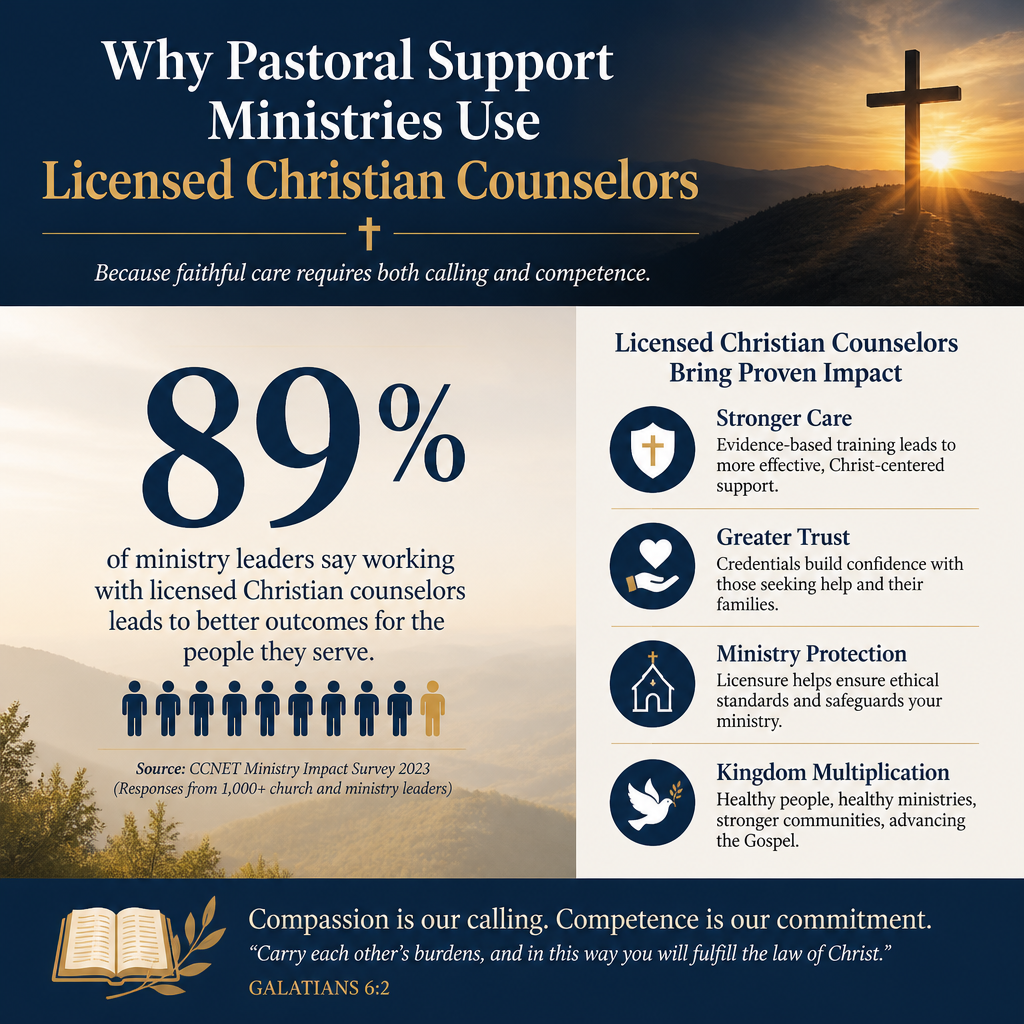
Pastoral support ministries use licensed Christian counselors because pastoral care and clinical care are not interchangeable, even when both are explicitly Christian. The gospel speaks to the whole person, but trauma, addiction, suicidality, and severe depression often require clinical competence alongside prayer, Scripture, and the ordinary means of grace.
For donors, this is not merely a program detail. It is a question of stewardship, risk, and faithfulness: whether a ministry is equipped to do good without unintentionally doing harm, and whether the people receiving care are being treated with dignity, wisdom, and appropriate safeguards.
Pastoral care is essential and it has limits
Two callings that should not be forced into competition
Many churches have learned, sometimes through painful experience, that a pastor can be spiritually present, biblically grounded, and deeply compassionate while still being out of depth clinically. Pastors are trained to preach, shepherd, and administer the sacraments. Some have additional counseling training; many do not. Even where pastors are skilled counselors, the pastoral role itself carries limits: congregational dynamics, spiritual authority, and proximity can complicate confidentiality and long-term therapeutic work.
Licensed counseling does not replace shepherding; it creates a clinical lane in which the ministry can address mental health conditions with recognized standards of care. When pastoral support ministries place licensed Christian counselors within reach of those they serve, they are often acknowledging what Scripture itself assumes: wisdom includes knowing the nature of a matter and seeking fitting help. “Without counsel plans fail, but with many advisers they succeed” (Proverbs 15:22).
Complex presenting issues are now common in ministry settings
The presenting concerns that come through crisis-care hotlines, pastoral support requests, or church-based referrals are rarely simple. People may describe anxiety while living with domestic violence. They may present spiritual doubt while also experiencing panic attacks, substance dependence, or suicidal ideation. A ministry that restricts itself to informal spiritual conversation can find itself unintentionally operating as an unregulated clinic.
Licensed Christian counselors help a ministry make a disciplined distinction: spiritual guidance offered as pastoral care, and clinical treatment offered as professional therapy. That distinction protects the person receiving help and clarifies responsibility for the ministry.

Licensure is a safeguard for the vulnerable
Accountability structures donors rarely see but should require
Licensure is not a guarantee of excellence or orthodoxy, and Christians genuinely disagree about how much weight to place on professional credentials. Yet licensure does provide several safeguards that matter in crisis care: enforceable ethical codes, mandated reporting requirements, continuing education expectations, and a formal complaint process through a state board. These are not merely bureaucratic requirements; they are protections for people who are often fragile, ashamed, or easily manipulated.
For a donor seeking to fund ministries that handle sensitive cases, licensure functions as a baseline indicator that a counselor has met external standards and is accountable to more than internal ministry culture. This becomes especially important in situations involving minors, sexual abuse disclosures, coercive control, or severe mental illness.
Clear boundaries reduce spiritual and clinical harm
Unlicensed counseling in ministry settings can drift into blurred roles: spiritual authority mixed with therapeutic dependency; “discipleship” that functions as treatment; confidentiality promises that do not account for legal duties. Licensed Christian counselors are trained to establish informed consent, clarify scope of practice, and document appropriately. These practices may feel formal compared with typical church life, but they help prevent the kinds of harm that have brought scandal and suffering to families and congregations.
When a pastoral support ministry serves across many churches, boundaries become even more critical. The counselor must be able to collaborate with pastors while maintaining clinical independence and protecting the counselee from becoming an object of congregational conversation.
Clinical excellence and theological fidelity can coexist
Integration is not a slogan, it is a disciplined practice
Some donors worry that “professional counseling” means secular therapy with a thin Christian veneer. That concern is not imaginary. The field has real tensions: differing anthropologies, differing accounts of the human person, and differing moral frameworks. Yet many licensed Christian counselors practice careful integration that is neither triumphalist nor embarrassed about Christian doctrine.
Sound integration treats Scripture as true and sufficient for salvation and godliness, while also recognizing that common grace has produced reliable observations about trauma, attachment, and behavioral change. A ministry can affirm that sin distorts human life and that suffering is real, while still using evidence-based practices where appropriate. Integration at its best is morally serious: it rejects techniques that violate conscience, and it refuses to reduce spiritual problems to mere symptoms.
What evidence-based care can contribute in crisis moments
In acute moments, the most faithful action may include assessment and stabilization: safety planning, screening for imminent self-harm risk, and appropriate referral pathways. The United States has seen a significant rise in suicide deaths in recent years, underscoring the urgency of competent crisis response Centers for Disease Control and Prevention.
Licensed counselors are trained to respond without panic and without false certainty. They can honor lament, prayer, and repentance where fitting, while also recognizing when a person needs psychiatric evaluation, a higher level of care, or emergency services. That is not faithlessness; it is love ordered by wisdom.
Donor stewardship includes assessing risk, not only outcomes
Why governance and oversight matter in counseling ministries
Pastoral support ministries that offer counseling hold unusually sensitive responsibilities. The risks include mishandled abuse reports, unethical dual relationships, poorly supervised interns, inadequate documentation, and spiritual coercion. Mature donors do not treat these as “back office” issues. They are the infrastructure of neighbor-love.
Across our verification work at Most Trusted, we observe that ministries providing counseling and crisis care tend to be healthier when they can demonstrate clear supervision structures, written policies, and transparent reporting lines. Those features are consistent with The Most Trusted Standard, which evaluates ministries across faith foundation, financial integrity, governance, and transparency. Donors should not have to guess whether a ministry is safe to partner with.
What prudent donors can look for
When evaluating a pastoral support ministry that employs licensed Christian counselors, a short set of due-diligence questions can clarify whether licensure is functioning as real protection or as a marketing signal:
- Are counselors licensed in the states where they practice, and does the ministry confirm licensure status?
- Is there documented clinical supervision for early-career counselors and interns?
- Are mandated reporting policies explicit, and are staff trained to follow them?
- Does the ministry have a clear statement of faith and a coherent approach to clinical-theological integration?
- Are there policies on confidentiality, data security, and record retention appropriate to counseling work?
These questions do not replace spiritual discernment; they discipline it. They also align with a broader commitment to responsible giving within Pastoral Support Ministries where ministry credibility depends on both compassion and competence.
Licensure also protects the ministry and the local church
Reducing preventable scandals and legal exposure
Some ministries pursue licensure requirements because insurers, referral partners, or state laws require them. That is not inherently a compromised motive. Prudence is a Christian virtue. Ministries that counsel in crisis settings can face litigation and reputational damage when they lack professional standards, particularly if they serve minors or respond to abuse allegations.
Churches also benefit. A church that refers a congregant to a vetted, licensed Christian counselor is less likely to place a volunteer or pastor in a role that exceeds their training. The goal is not institutional self-protection at the expense of people. The goal is to remove foreseeable hazards so that care can be offered with integrity.
Building a referral ecosystem rather than a single heroic ministry
Pastoral support ministries are often at their best when they strengthen the church’s long-term capacity to care, rather than presenting themselves as a replacement for the local congregation. Licensed counselors can train lay leaders to recognize warning signs, teach pastors about referral thresholds, and help churches establish appropriate care teams. In that sense, the ministry becomes a stabilizing presence within Pastoral Support Ministries for Counseling and Crisis Care, not a competitor for the church’s authority.
This approach also honors the reality that some needs exceed what any single ministry can provide. Wise ministries build relationships with psychiatrists, inpatient facilities, domestic violence resources, and community mental health providers, even when those partners are not explicitly Christian.
FAQs for Why pastoral support ministries use licensed Christian counselors
Does using licensed Christian counselors imply that Scripture is insufficient?
No. Historic Protestant theology has distinguished between the sufficiency of Scripture for salvation and godliness and the legitimate use of secondary means under God’s providence. The question is not whether Scripture is true, but whether a given situation involves clinical realities that call for specialized competence. A pastoral support ministry can uphold the authority of Scripture while also recognizing that trauma care, risk assessment, and treatment planning require training and accountability.
What if a ministry has devoted pastoral counselors who are not licensed?
Unlicensed counselors may offer wise, biblically grounded support within an appropriate scope, particularly in discipleship, spiritual direction, and short-term pastoral care. The concern arises when unlicensed counseling becomes de facto psychotherapy for complex conditions or crisis situations without external accountability. Donors can reasonably ask how the ministry defines scope, when it refers out, and what oversight mechanisms exist. In higher-risk contexts, licensure and clinical supervision are often prudent indicators of responsible practice.
A faithful ministry of care joins compassion to competence
The church is called to bear burdens, bind wounds, and speak the truth in love. Pastoral support ministries that use licensed Christian counselors are often trying to do that work with clearer boundaries, stronger safeguards, and greater clinical skill. For donors who want to fund care that is both biblically anchored and responsibly delivered, licensure is not the whole answer, but it is frequently one of the more visible signs that a ministry understands the weight of what it is handling.



