
Accountability and transparency in pregnancy resource centers are not secondary concerns for Christian donors; they are part of moral stewardship. A center may be sincerely pro-life and deeply compassionate, yet still handle funds, data, and public claims in ways that expose clients, mislead supporters, or weaken long-term witness. Scripture treats integrity as a theological category, not a public-relations strategy: “Whoever walks in integrity walks securely” (Prov. 10:9). Donors are right to ask for clarity that can be verified.
Pregnancy resource centers operate under unusual pressure. They serve clients in crisis, work amid contested public narratives, and often rely on a patchwork of churches, individuals, and small grants. Those conditions do not excuse weak controls; they make strong controls more necessary. The most credible centers do not only say they care for women and children. They demonstrate it through documented governance, careful financial practices, disciplined privacy protections, and truthful communication.
Accountability begins with a Christian view of stewardship and truth
Christian giving is a form of delegated trust. Donors are not purchasing outcomes, but they are entrusting resources that belong to the Lord (Ps. 24:1) to a ministry for a stated purpose. That moral reality creates a duty on both sides: donors should give thoughtfully, and ministries should make it possible for donors to evaluate faithfulness without suspicion or guesswork.
Transparency is often reduced to “How much goes to programs?” That is a thin standard, and it can be a misleading one. The “Overhead Myth” letter signed by GuideStar (now Candid), Charity Navigator, and the BBB Wise Giving Alliance warned that simplistic overhead ratios are a poor measure of nonprofit performance and can incentivize harmful underinvestment in administration and evaluation GuideStar by Candid. For pregnancy resource centers, underinvestment in qualified supervision, data security, training, and compliance can directly harm clients and expose the ministry to avoidable failure.
Why donors feel the tension
Many Christian donors want to support life-affirming ministry without funding politicized messaging or avoidable controversy. The tension is real: a center can be attacked unfairly, and a center can also stumble through preventable misstatements, sloppy financial handling, or informal counseling practices that would not withstand scrutiny. Mature accountability is not appeasement. It is a ministry’s willingness to be examined, corrected, and strengthened.
What accountability is not
Accountability is not equated with government dependence, ideological conformity, or endless reporting burdens. It is the ordinary Christian practice of walking in the light: telling the truth, keeping promises, protecting the vulnerable, and being willing to submit to oversight. Donors should not require a center to publish every internal detail, but they should reasonably expect the center to make verifiable information available.

Financial transparency that protects mission and donor intent
Financial integrity is one of the quickest ways a pregnancy resource center can either earn durable trust or lose it. Centers frequently receive a mix of unrestricted gifts, donor-restricted gifts, in-kind donations, baby items, event proceeds, and sometimes government or foundation grants. Each category introduces distinct accounting risks. The goal is not complexity for its own sake; it is faithful stewardship that can be explained clearly to the people who fund the work.
What credible financial reporting looks like
A trustworthy center can usually provide, at minimum, recent financial statements and a clear annual report describing sources of revenue and major categories of expense. Larger centers may publish audited financials; smaller centers may rely on reviewed statements or strong internal controls paired with board-level oversight. Donors should not assume “no audit” equals “untrustworthy,” but they should look for evidence that financial decisions are not resting on one person’s discretion.
Donors should also expect the center to handle restricted gifts with care. When a donor designates a gift for a specific purpose—such as ultrasound equipment, client material support, staff training, or a new location—the center should be able to describe how it tracks those funds and what happens if the purpose changes. Clarity here is a form of honoring the ninth commandment’s insistence on truthfulness (Ex. 20:16) applied to donor communication: the ministry’s words about the use of funds should match its accounting reality.
Common warning signs donors should not ignore
Some concerns are not proof of wrongdoing, but they are strong indicators that a center has not matured institutionally. These include: refusal to share basic financials with serious donors; inconsistent explanations of how funds are allocated; heavy dependence on a single fundraiser or personality; recurring emergency appeals without a plan to stabilize; and board members who appear functionally absent.
Transparency also requires disciplined claims about impact. If a center reports “clients served,” “appointments,” or “babies saved,” donors should ask what those terms mean operationally and whether the metrics are defined consistently over time. Good metrics can be spiritually and operationally meaningful; careless metrics can become a temptation toward exaggeration.
Governance and leadership that can withstand scrutiny
Most failures that scandalize donors begin as governance failures: unclear authority, weak oversight, unmanaged conflicts of interest, or a culture where questioning leadership is treated as disloyalty. Pregnancy resource centers often begin with a small group of motivated believers. That origin story can be a grace, but it can also leave a ministry with founder-centered patterns long after the work demands institutional maturity.
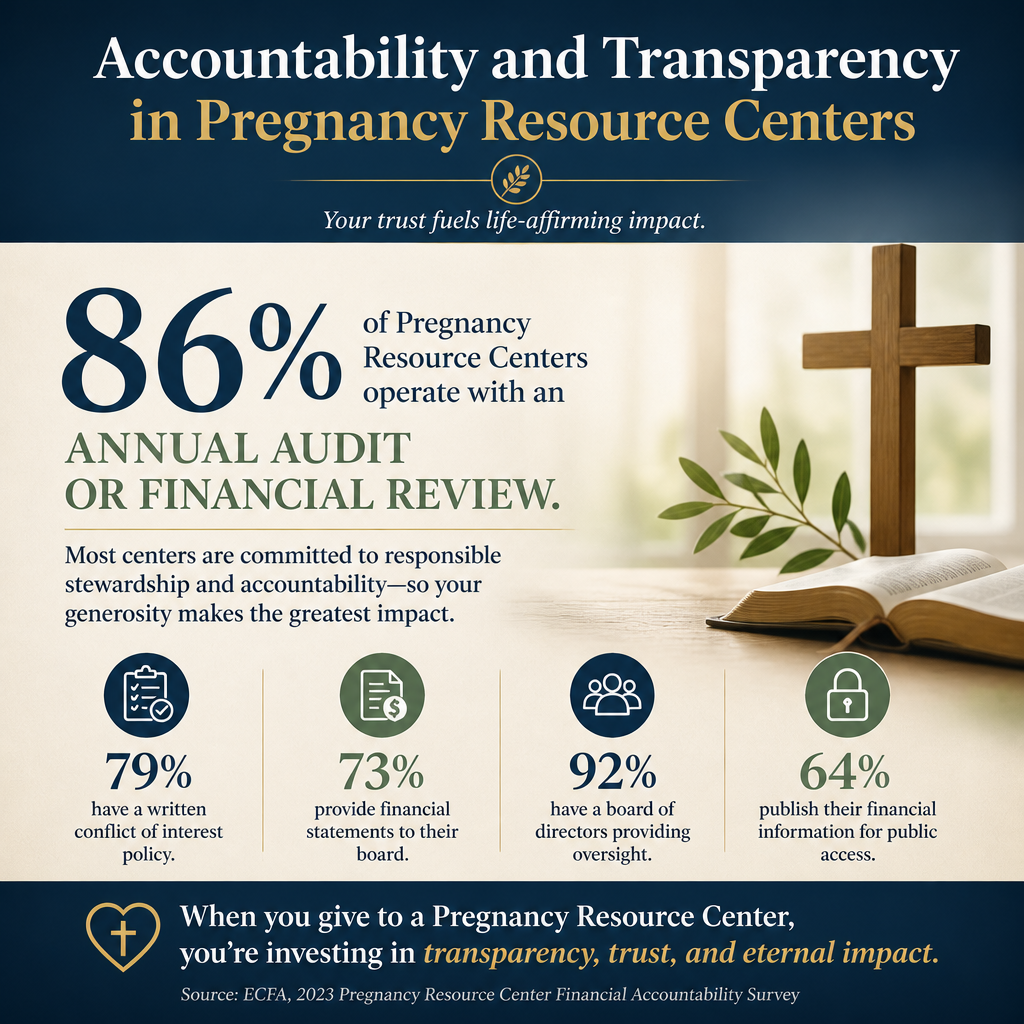
The ministries that meet The Most Trusted Standard tend to treat governance as a spiritual responsibility. Boards are not decorative. They hire and evaluate the executive, approve budgets, oversee policies, manage risk, and safeguard mission drift. They also protect staff and clients by ensuring that no individual becomes unaccountable.
Board oversight and conflicts of interest
Donors should look for a board that is active and appropriately independent. Independence does not mean hostility toward staff; it means the board can exercise judgment without undue pressure from employees or related parties. Conflict-of-interest policies matter here. A center can still contract with a board member’s company or employ a relative in some circumstances, but it should only do so through disclosed, documented, arm’s-length processes.
Ethical fundraising under spiritual pressure
Pregnancy resource centers frequently fundraise within churches where spiritual language carries weight. That creates a responsibility to avoid manipulative appeals. The question is not whether urgency is appropriate—pregnancy-related crises can be urgent—but whether messaging is accurate and proportionate. Mature centers avoid implying that a donor’s faithfulness is measured by a specific gift level, and they avoid presenting contested claims as settled fact.
Donors should expect straightforward policies for gift acceptance, receipting, and refunds, especially when events, online giving, and in-kind donations are involved. A ministry that cannot explain how it acknowledges gifts, values in-kind donations, and prevents misappropriation is not prepared for scale.
Client privacy, legal compliance, and truthful public communication
Pregnancy resource centers serve clients at a uniquely sensitive intersection of medical concerns, sexual history, family dynamics, and personal safety. Accountability and transparency therefore require two commitments that can feel in tension: protecting confidentiality, and still giving donors enough visibility to evaluate ethical practice.
Protecting client data as a pro-life duty
Confidentiality is not merely a legal concern; it is a neighbor-love concern. Centers should have written privacy policies, controlled access to client records, staff and volunteer training, and clear guidance on what information may be shared in prayer letters, testimonies, and fundraising materials. Even when a client consents to share a story, the center should consider whether the story could later expose the client to harm or regret.
Donors should also ask whether the center provides medical services and, if so, what licensure and clinical oversight exists. Some centers offer ultrasounds under medical supervision; others provide non-medical services and referrals. What matters is that the center’s public descriptions match the legal and clinical reality. Ambiguity in this area is not a minor marketing issue; it can become a serious ethical breach.
Truthful claims in a contested public arena
Pregnancy resource centers are often described in sweeping generalities—by supporters and critics alike. In that environment, a center’s credibility depends on precise language. If it claims to provide “medical care,” it should define what services are offered and by whom. If it claims specific outcomes, it should be prepared to explain the method used to count and verify them.
Public trust in nonprofit institutions has softened over time, and donors feel the downstream effect in their churches and families. Gallup has tracked confidence in major American institutions for decades, including religious and charitable organizations, and the long-term trend shows that confidence is not a given Gallup. Pregnancy resource centers that take transparency seriously are not conceding to cynicism; they are strengthening Christian witness in a skeptical age.
For donors seeking an external point of reference, independent verification can reduce the burden of doing case-by-case investigative work. Most Trusted evaluates ministries against The Most Trusted Standard, examining evidence across faith commitments, financial integrity, governance, and transparency and effectiveness. This kind of third-party diligence does not replace prayerful discernment, but it does bring documentary clarity to questions that are often left to informal assurances.
Donors who want to place pregnancy resource centers within the broader landscape of life-affirming ministry can also consult Pregnancy Resource Centers as a starting point for understanding common models, risks, and marks of credibility.
What accountability makes possible
Accountability and transparency in pregnancy resource centers ultimately serve the people donors most want to protect: women, children, and families at moments of real vulnerability. They also protect staff and volunteers from unmanageable pressure, and they protect the church’s witness from the corrosive effect of half-truths and avoidable scandals.
When a center can show clear governance, disciplined financial reporting, careful privacy protections, and truthful public claims, donors gain more than reassurance. They gain freedom to give with steadiness rather than suspicion, and to support life-affirming work without participating in practices they would not defend in the light.



