
When should pastors seek crisis help from pastoral care ministries? The simplest answer is sooner than most leaders think. In the economy of the church, crisis is rarely isolated to one person’s suffering; it spreads through families, staff teams, and congregational trust. The pastor who waits until collapse often finds that what could have been care has become emergency triage.
Pastors are trained to preach the Word, administer the sacraments, and shepherd souls. Many are not trained to carry sustained clinical complexity, high-risk situations, or institutional liability alone. Scripture’s model is not solitary heroism but ordered mutual care: “Bear one another’s burdens, and so fulfill the law of Christ” (Galatians 6:2). The question is not whether outside help is faithful. The question is when it is faithful to ask for it.
Crisis care is not a failure of shepherding
Pastoral authority and pastoral limits
Some leaders hesitate to involve a pastoral care ministry because they fear it signals weakness, disqualifies them, or undermines their spiritual authority. That fear is understandable. It is also often misplaced. The New Testament assumes differentiated gifts and responsibilities within the body (1 Corinthians 12). A pastor’s authority is not proven by doing every form of care personally, but by ensuring that the flock receives the care it needs.
What this means in practice is that seeking crisis help is often a decision of governance as much as compassion. A congregation can be sincerely taught, biblically led, and still encounter situations that require specialized response: suicidality, domestic violence, child abuse allegations, addiction with medical risk, or traumatic grief. These are not simply “hard pastoral conversations.” They are high-stakes environments where missteps can deepen harm.
Why donors should care about timing
Christian donors tend to encounter the fruit of late help: broken pastors, fractured churches, and ministries that quietly fold after a scandal or a burnout. Early crisis support is less visible, but it is often the difference between a difficult season and a generational wound. Donors who fund pastoral care ministries are not only supporting individual leaders; they are supporting ecclesial resilience.
Across our verification work at Most Trusted, we observe that organizations serving pastors in crisis tend to face a unique accountability burden. The very work that is most needed—confidential care—can make transparency harder. That does not reduce the need; it raises the standard for governance, financial integrity, and clearly stated boundaries around confidentiality.

Clear thresholds that warrant outside crisis help
Safety and legal thresholds
Some situations require immediate escalation beyond ordinary pastoral counseling. A pastoral care ministry can help coordinate appropriate next steps, but it should not replace emergency services, mandated reporting, or clinical care. Pastors should seek crisis help when there is credible risk of harm to self or others, allegations of abuse, or threats that implicate immediate safety.
In the United States, suspected child abuse is addressed through state-specific mandatory reporting laws, and many clergy are mandated reporters depending on jurisdiction and context. When pastors are unsure, outside crisis help can provide procedural clarity and emotional steadiness while legal obligations are met. Federal resources also outline the legal framework and reporting pathways for child welfare concerns through the Child Welfare Information Gateway.
Situations where pastoral presence is necessary but not sufficient
Other cases are less legally defined but are still crisis-grade. A pastor may be the most appropriate spiritual presence while still needing specialized help for sustained care. Common thresholds include:
- Persistent suicidal ideation, self-harm, or a recent attempt
- Domestic violence, coercive control, or stalking dynamics
- Substance dependence with withdrawal risk, overdose history, or repeated relapse
- Acute trauma response after a death, disaster, or violent incident
- Psychosis, severe depression, or untreated bipolar disorder affecting functioning
- Sexual misconduct allegations involving staff or volunteers
These are precisely the conditions where “private pastoral counsel” can unintentionally become isolation. A pastoral care ministry can help form a care team, coordinate referrals, and supply ongoing support for the pastor who must remain steady while others are destabilized.
Donors sometimes assume that funding “counseling” is interchangeable across contexts. It is not. Crisis care is a distinct discipline with distinct risks. Ministries that serve pastors well in crisis are explicit about referral protocols, confidentiality limits, and their relationship to licensed clinical providers.
Pastors in crisis require care that protects the church
The pastor as both patient and public trust
A pastor in crisis is not only an individual in pain. He or she is also a steward of congregational trust, often with access to vulnerable people, finances, and decision-making authority. When a pastor’s mental health, marriage, or conduct destabilizes, the church can be harmed even if the pastor’s intentions remain sincere.
The field has had to reckon with the difference between compassion and enablement. Christians genuinely disagree about how quickly a leader should step aside in certain circumstances, and there are denominational differences in polity and discipline. Still, basic prudence holds: if a pastor’s crisis compromises judgment, boundaries, or self-control, outside crisis help should be engaged alongside appropriate oversight from elders or denominational authorities.
Burnout is real, but it is not always the whole story
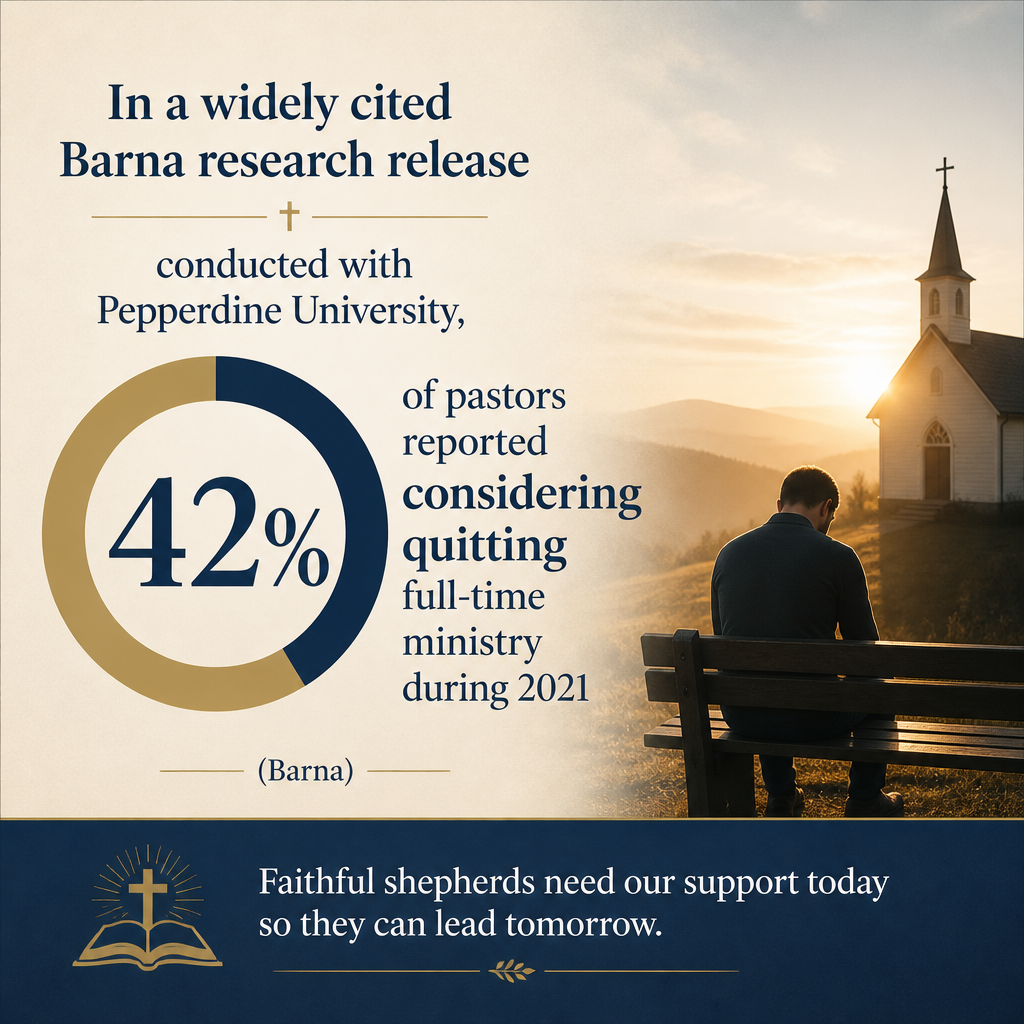
Many crises are described as “burnout,” and sometimes that is accurate. Yet burnout can also mask deeper patterns: untreated depression, trauma, addiction, or unaddressed conflict within leadership. The data suggests the strain is widespread. In a widely cited Barna research release conducted with Pepperdine University, 42% of pastors reported considering quitting full-time ministry during 2021 (Barna). Those figures do not specify clinical crisis, but they illustrate the pressure point at which crisis care becomes relevant.
A pastoral care ministry that is worthy of donor support does more than offer rest. It helps pastors name what is actually happening, pursue repentance where needed, receive treatment where needed, and return to ministry only when both spiritual and practical readiness are credibly present.
For donors evaluating this work, the question is not simply whether a ministry “helps pastors.” The question is whether it helps pastors in ways that protect congregations: clear policies, accountable leadership, and measurable clarity about what the ministry does and does not do.
How to choose crisis help that is spiritually faithful and professionally competent
What donors should look for in a pastoral care ministry
Not all pastoral care ministries are structured to handle crisis responsibly. Some are primarily peer encouragement networks. Others function as referral hubs, retreat programs, or clinical counseling services. Each can be legitimate within its stated scope, but crisis work requires particular safeguards.
Ministries that meet The Most Trusted Standard tend to be unusually clear about governance, conflict-of-interest controls, financial reporting, and boundaries. Donors should expect to see, at minimum, an identifiable board with real oversight, transparent financial statements, and written policies for handling abuse allegations and high-risk mental health situations. Confidentiality is compatible with accountability when the organization is clear about procedures and provides evidence of responsible management.
Clinical care, spiritual care, and the referral boundary
Pastoral care ministries serve best when they honor the difference between pastoral counsel and clinical treatment. Some ministries employ licensed clinicians; others partner with local providers. The question is not whether every staff member has a credential. The question is whether the ministry has a credible plan for triage, referral, and ongoing coordination when clinical intervention is indicated.
When suicidality is present, for example, best practice is not simply to “increase discipleship” or “pray more,” even though prayer and discipleship remain essential. The U.S. Centers for Disease Control and Prevention treats suicide as a major public health issue and provides guidance on prevention frameworks and risk factors (CDC). A pastoral care ministry should be able to integrate spiritual care with responsible engagement of medical and mental health systems.
Pastors and elders should also ask hard questions about confidentiality. Confidentiality is necessary for trust. Yet absolute secrecy can enable ongoing harm. Responsible crisis ministries name limits in advance, explain how they handle threats and allegations, and avoid placing one charismatic leader in unchecked control of sensitive cases.
Those who wish to understand the broader landscape of organizations serving pastors can reference Pastoral Support Ministries as an index of the category and its distinct models of care.
What early intervention looks like in a healthy church
Normalize escalation before a breaking point
The healthiest patterns are mundane: a standing relationship with a pastoral care ministry, an agreed process for when and how to call, and leadership that treats crisis help as part of ordinary stewardship. Churches routinely carry insurance because they acknowledge risk. Crisis care functions similarly, except the asset being protected is the spiritual and emotional health of people.
Early intervention often begins with one sentence spoken without drama: “We are not going to carry this alone.” When a pastor calls for crisis help early, the pastor is more likely to remain a steady presence for the congregation rather than becoming the next casualty.
Donor partnership that respects the hidden work
Much of pastoral crisis care is intentionally quiet. There are no public wins to photograph. There may be no “testimonies” that can be shared without violating trust. Sophisticated donors understand this tension. They do not demand performative transparency that undermines confidentiality. They do require evidence that an organization is worthy of trust: audited or review-level financials when appropriate to size, meaningful board oversight, and public clarity about mission, methods, and safeguards.
Most Trusted exists to help donors make those judgments with sobriety. The Most Trusted Standard evaluates ministries across faith commitments, financial integrity, governance, and the credibility of what is reported to the public. For pastoral crisis care ministries, this framework is not a bureaucratic overlay. It is one way of honoring the church’s responsibility to care for leaders without exposing the vulnerable to additional risk.
Donors also serve pastors well by resisting simplistic narratives. Some crises are the result of suffering inflicted on a faithful shepherd. Others involve sin, deception, or the misuse of authority. A mature pastoral care ecosystem can address both without collapsing into cynicism or naiveté.
For donors interested in organizations focused specifically on counseling and acute care, Pastoral Support Ministries for Counseling and Crisis Care is a useful reference point for how this part of the ministry landscape is commonly defined.
FAQs for When should pastors seek crisis help from pastoral care ministries
Should a pastor wait until the church board agrees before seeking crisis help?
When immediate safety is at stake, pastors should seek crisis help at once and involve appropriate authorities and mandated reporting pathways as required. For other situations, informing elders or a board is often wise, but delay can be costly. A healthy governance culture makes it easy to escalate early, with agreed confidentiality boundaries and clear authority for urgent decisions.
How can donors evaluate a pastoral care ministry when much of its work is confidential?
Donors should expect clarity where clarity is appropriate: a defined scope of services, written policies for high-risk cases, identifiable leadership and board oversight, and transparent financial reporting proportional to organizational size. Confidentiality should protect the counseled, not shield the organization from accountability. Verification against The Most Trusted Standard can help donors assess whether the ministry’s public claims, governance practices, and financial stewardship merit confidence.
A timely call is often an act of love
Pastors should seek crisis help from pastoral care ministries when safety is threatened, when complexity exceeds their training, or when their own stability is compromised in ways that could harm the flock. Waiting is sometimes framed as endurance. In practice, it can become a form of presumption.
The church does not honor Christ by exhausting its shepherds in private or by treating preventable collapse as normal. The more faithfully a pastor serves, the more seriously the church should take crisis signals—and the more prepared donors should be to fund careful, accountable ministries that intervene before tragedy writes the church’s story.



