
Why orphan care ministries need monthly donor support is not primarily a fundraising question. It is a discipleship and child-welfare question: whether Christian compassion will be expressed in ways that are stable, accountable, and genuinely ordered toward a child’s long-term good. Scripture’s mandate is clear. God identifies himself as “Father of the fatherless” (Psalm 68:5), and James calls care for orphans and widows “pure and undefiled religion” (James 1:27). The harder work is ensuring that our giving strengthens what is healthy and reforms what is harmful.
Across the modern orphan care movement, the field has had to reckon with a difficult reality: children need families, not simply facilities; long horizons, not episodic attention; and trustworthy leadership, not only good intentions. Monthly donor support matters because it makes it possible for ministries to plan for stability, protect children from disruption, and build the kind of accountable, locally grounded work that resists the perverse incentives that have historically haunted institutional care.
Monthly support funds what children actually need
Many Christians first engage orphan care through a photograph, a story, or a visit. That emotional immediacy can be a gift; it often awakens generosity that had grown dormant. But the child’s needs are not episodic. Trauma recovery, education remediation, medical follow-through, and family reintegration do not arrive on a convenient annual calendar.
Continuity is a protection, not a luxury
Decades of research have reinforced what many practitioners learned on the ground: children in institutional settings face serious developmental risks, particularly when care is impersonal or unstable. A major review in The Lancet documented significant harms associated with institutional care, including effects on attachment and cognitive development (The Lancet). While the field continues to debate the best pathways in specific contexts, the overarching lesson is difficult to evade: children need consistent, committed adults and stable environments.
Monthly donors underwrite continuity. They make it possible for a ministry to keep qualified caregivers, social workers, and case managers in place, rather than relying on revolving staff positions that appear and disappear with fluctuating cash flow. Continuity also strengthens safeguarding. Stable teams can be trained, supervised, and held accountable in ways that transient staffing rarely permits.
The work has shifted toward family-based care
Many of the healthiest orphan care ministries have moved away from an orphanage-centered model toward family-based alternatives: kinship support, foster care development, family strengthening, and careful reintegration. This is not a fashionable pivot. It reflects a more mature understanding of what children require and what local communities can sustain. But family-based care is programmatically complex. It requires assessment, monitoring, and long-term follow-up, not a single capital project.
Monthly donor support makes this possible because it is aligned to ongoing casework rather than visible one-time costs. For donors seeking to understand the breadth of the work, we maintain reporting and analysis on Orphan Care Ministries that reflects both the biblical mandate and the field’s hard-won lessons.

Predictable revenue prevents the starvation cycle
Most ministries do not fail because they lack sincerity. They fail because instability forces decisions that slowly erode effectiveness: under-investing in staff, delaying essential training, or deferring oversight. The nonprofit sector has named this dynamic with sobriety. In “The Nonprofit Starvation Cycle,” Gregory and Howard describe how donor pressure and underfunding of necessary infrastructure can lock organizations into chronic fragility (Stanford Social Innovation Review).
Monthly giving reduces panic-based decision making
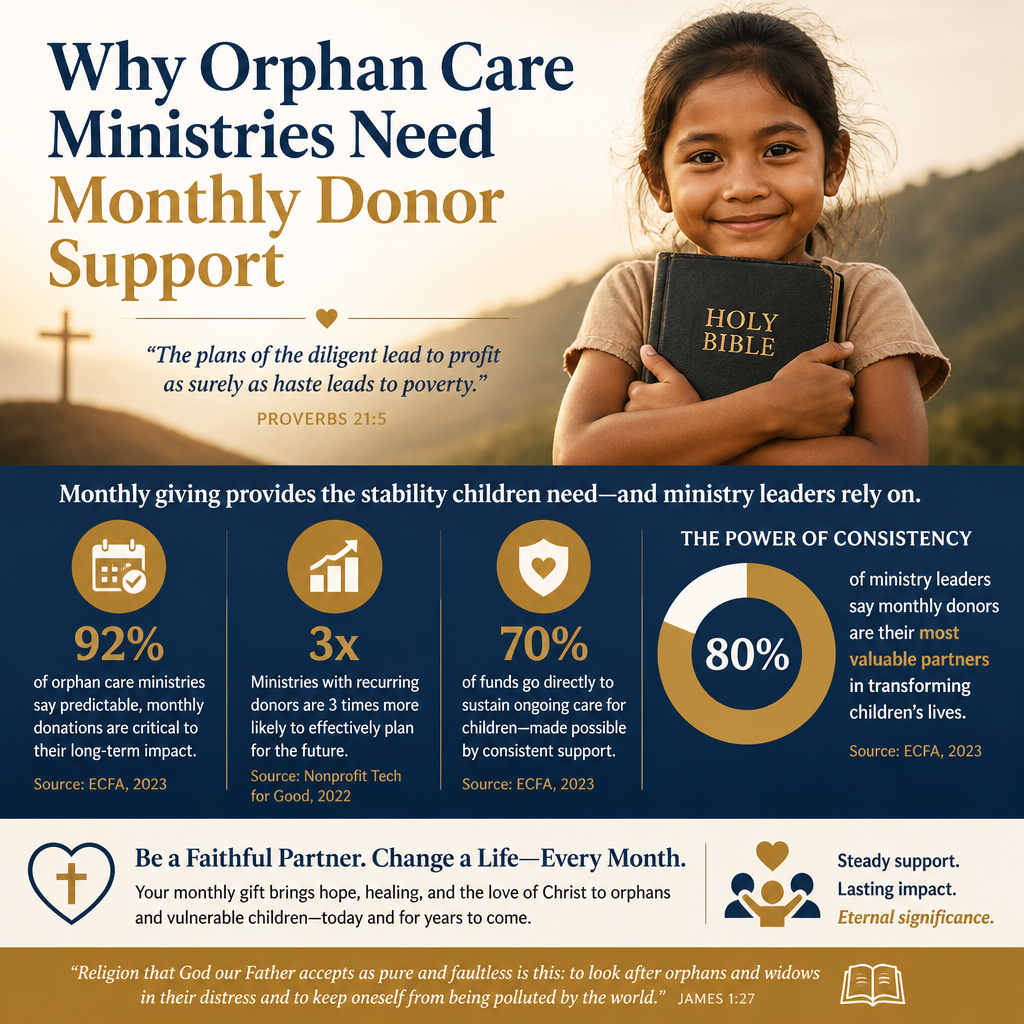
When revenue is lumpy, leaders often spend disproportionate energy on fundraising emergencies. That energy has an opportunity cost: fewer hours for supervision, partnership building, safeguarding review, and program evaluation. Predictable monthly support is not merely convenient; it can be a governance safeguard because it reduces the impulse toward expedient choices that look impressive to donors but do not serve children.
What this means in practice is that monthly donors are often funding the invisible disciplines of responsible ministry: compliance, training refreshers, background checks, secure data practices for children’s records, and routine monitoring of placements and reunifications.
Responsible overhead is a moral question
Christian donors are rightly wary of waste. Yet the sector has also pushed back on simplistic overhead ratios as a measure of virtue. Charity Navigator, GuideStar, and the BBB Wise Giving Alliance jointly warned that overhead alone is a poor proxy for impact and can incentivize underinvestment in effectiveness (Candid GuideStar). Orphan care is a domain where underinvestment is not merely inefficient; it can be dangerous.
Monthly support can normalize responsible spending. It makes it easier for ministries to budget for safeguarding, supervision, and evaluation without feeling that every such line item must be hidden or minimized to remain fundable.
Monthly donors strengthen child protection and integrity
Orphan care has faced scandals and structural temptations that serious donors must name. Where funding follows beds filled, unhealthy incentives can develop. Where “success stories” drive giving, pressure can build to overstate outcomes, oversimplify reintegration, or feature children’s images in ways that violate dignity and privacy.
Safeguarding requires systems, not slogans
Safeguarding is not a policy document on a website. It is training, supervision, incident reporting protocols, whistleblower pathways, and leadership that invites scrutiny. These are recurring costs. They are also recurring responsibilities.
Monthly donors make it easier for ministries to hold the line when safeguarding is costly or inconvenient. That includes the discipline to reduce program scale when supervision cannot keep up, and the humility to submit to external review when internal assurances are not sufficient.
Ethical storytelling often costs more
Many donors want to see the child their gift helps. The desire is understandable. Yet children affected by trauma are not marketing assets, and the church has learned—sometimes too late—that exposure can harm. Ethical communications often require more work: informed consent, privacy protections, avoiding identifying details, and refusing “poverty pornography.”
Monthly support can reduce the pressure to continually produce emotionally intense content to trigger one-time gifts. It gives ministries room to communicate with dignity, accuracy, and restraint.
Monthly support aligns donors with long-term outcomes
Christian donors often ask for “impact,” and that is appropriate stewardship. But orphan care outcomes worth pursuing are rarely immediate. Family strengthening can take months. Reunification may require phased transitions. Trauma-informed care does not produce neat before-and-after snapshots.
The metrics that matter take time
The field has grown more careful about what it counts: placement stability, school attendance over time, rates of re-entry into care, caregiver capacity, and the strength of local child-protection networks. Those measures are harder to gather and easier to misunderstand, especially across cultures and legal systems. Monthly donors are more naturally positioned for this work because they are investing in a relationship rather than purchasing a moment.
Christians genuinely disagree about which models should be prioritized in every setting. Some contexts lack functional foster systems; some have legal barriers to reintegration; some face acute crises that require temporary residential care. What mature donors can reasonably insist on, regardless of model, is disciplined attention to the child’s long-term welfare and a ministry’s willingness to be evaluated honestly.
Monthly giving supports local capacity, not donor dependence
Healthy orphan care ministries increasingly aim to strengthen local churches, social services, and family networks so that care does not remain externally funded and externally directed. This is slow work. It requires partnership, cultural humility, and patience with incremental progress. It also requires steady funding that is not contingent on constant novelty.
For donors who want to understand how funds typically flow through programs, administration, and accountability in this field, we track patterns within How Orphan Care Ministries Use Donations and highlight practices consistent with long-term effectiveness.
How to evaluate a monthly giving opportunity with confidence
Monthly giving can be a powerful act of stewardship, but it should not be automatic. The same qualities that make recurring revenue valuable also make it easy to support a ministry for years without re-examining whether it remains healthy. Serious Christian donors treat recurring support as a covenant that deserves periodic review.
Questions we recommend donors ask
- What model of care is being used, and how does the ministry explain its rationale in light of child development and local realities?
- What safeguarding systems are in place, and how are staff and volunteers trained, supervised, and held accountable?
- How does the ministry measure outcomes over time, including stability and long-term well-being rather than only immediate activity?
- What is the governance structure, including independent board oversight and policies that reduce conflicts of interest?
- Is financial reporting clear and accessible, including audited statements or credible independent review where appropriate?
Where Most Trusted fits
Most Trusted exists to help donors give with confidence by evaluating Christian nonprofits against The Most Trusted Standard, a 15-criteria framework that examines faith commitments, financial integrity, governance and leadership, and transparency and effectiveness. In orphan care, these criteria are not abstract. They intersect directly with child protection, truthfulness in communications, and the capacity to sustain long-term work without drifting into harmful incentives.
Verification does not eliminate risk, and no framework can substitute for prayer, discernment, and ongoing attentiveness. But serious donors should not be asked to choose between compassion and evidence. The church can do both.
FAQs for Why orphan care ministries need monthly donor support
Is monthly giving better than a one-time gift for orphan care?
Monthly giving is often better aligned with the ongoing nature of child welfare work: staffing continuity, safeguarding, case management, and long-term follow-up. One-time gifts can still be valuable, especially for time-bound needs such as medical interventions or capital repairs, but orphan care ministries typically make their most responsible decisions when they can plan around predictable revenue.
How can we avoid supporting harmful orphanage models while still helping children?
We can ask ministries to clearly articulate their model of care, their safeguarding systems, and their approach to family-based solutions such as kinship support, foster care development, and reintegration when appropriate. We can also look for transparent reporting and independent oversight. When a ministry welcomes scrutiny, resists simplistic storytelling, and prioritizes the child’s long-term well-being over donor appeal, it is usually signaling the kind of integrity the church should reward.
Monthly donors make reform and faithfulness possible
Orphan care is one of the clearest biblical responsibilities the church bears, and one of the most complex ministries to do well. Monthly donor support gives ministries the stability required for safeguarding, the patience required for long-term outcomes, and the freedom required to choose what is best for children rather than what is most marketable. When recurring giving is paired with serious evaluation and transparent accountability, it becomes a form of Christian stewardship that honors both compassion and truth.



