
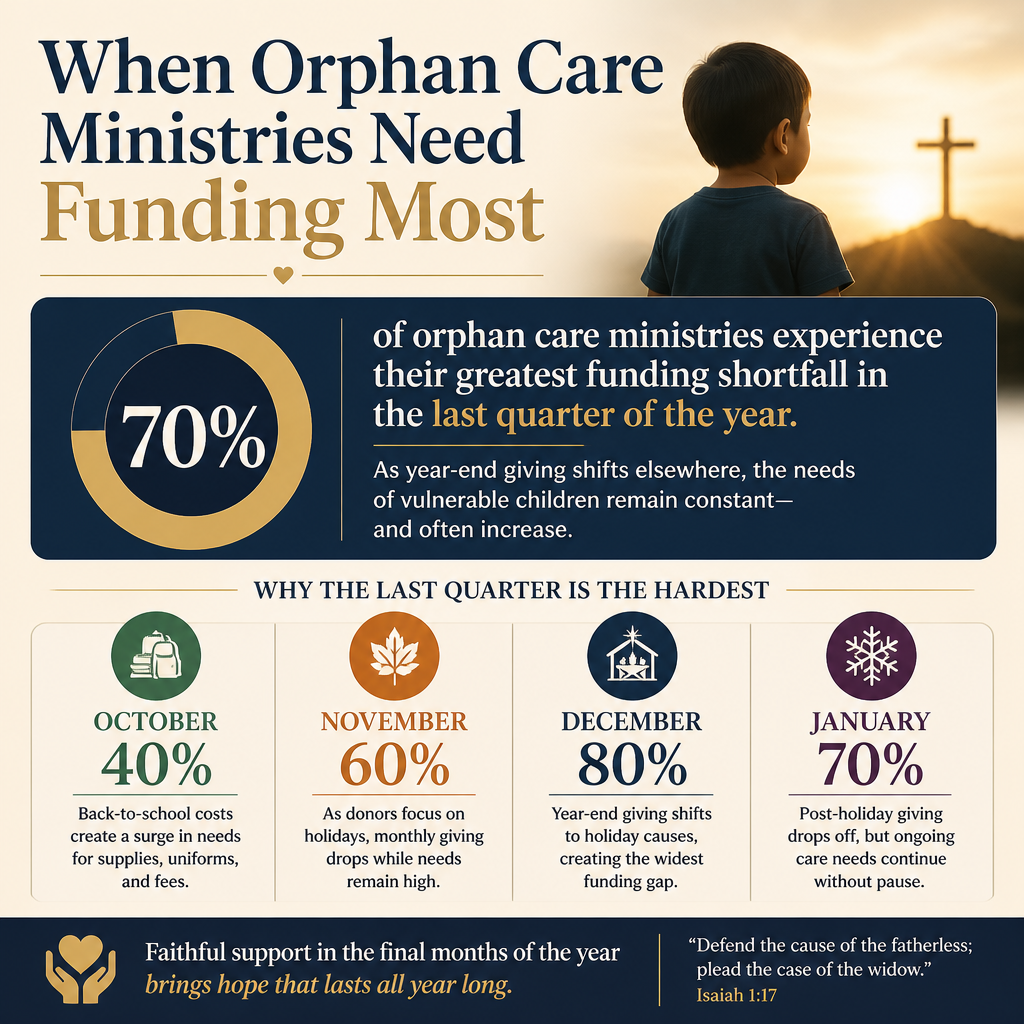
When orphan care ministries need funding most is rarely the moment a compelling photo goes viral or a short-term trip gets scheduled. It is more often the unglamorous season when a child’s situation changes quickly, a family placement becomes possible, or a local system is under strain and the ministry must respond without compromising its standards.
Christian donors rightly feel the force of Scripture’s command to protect the fatherless and to defend the vulnerable. Yet the orphan care movement has also had to reckon with hard lessons: money can unintentionally incentivize institutionalization, weaken families who might have stayed together, or push ministries into expansion that outpaces governance. What this means in practice is that “when funding is needed most” is not only a calendar question; it is a stewardship question shaped by risk, responsibility, and the slow work of durable care.
The moments that destabilize a child’s care are often sudden
Emergency placement and reunification windows do not wait for fundraising cycles
Funding pressure spikes when a child is removed from immediate danger, when a kinship placement is identified, or when a reunification plan becomes feasible but fragile. These windows often require immediate cash outlays: transport, documentation, temporary safe housing, medical exams, counseling intake, and trained staff time. Donors sometimes assume that “the need” is static. In reality, the decisive moments are frequently urgent and administrative, not cinematic.
In the United States, the foster care system itself reflects how common such volatility is. On a typical reporting year, hundreds of thousands of children are in foster care nationally, with entries and exits occurring continually; the scale is publicly documented by the Administration for Children and Families. Those system dynamics do not map neatly onto a ministry’s annual banquet schedule.
Trauma-informed care carries real costs when crises cluster
Crises tend to come in clusters: a court date accelerates, a placement disrupts, a caregiver becomes ill, a child decompensates after a triggering event. Ministries that serve children well under these pressures must have trained personnel and accessible clinical referrals. The more trauma-informed the care, the more it depends on stable staff, supervision, and continuity—precisely the areas most vulnerable when cash flow tightens.
Christians genuinely disagree about the right balance between direct relief and long-term development in crisis moments. Some donors prioritize immediate rescue; others emphasize careful pacing and measured interventions. The faithful path is not indifference to urgency, but disciplined urgency: acting quickly without abandoning safeguards that protect children from the unintended consequences of rushed decisions.
Family-based care creates funding needs that are less visible but more decisive
Kinship and family preservation work is often the highest-impact line item
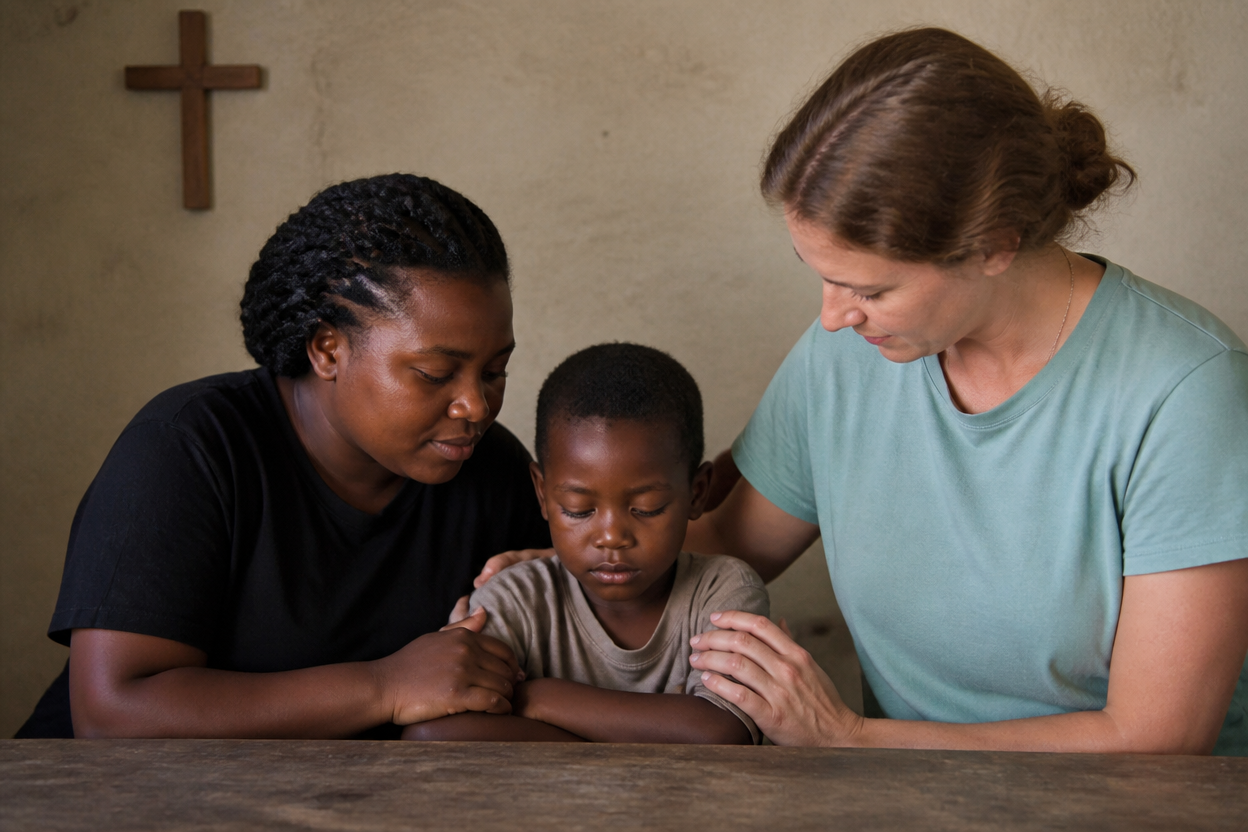
Much of today’s best orphan care work is not institutional care at all. It is family strengthening, kinship support, reunification assistance, and foster and adoptive family support. These interventions are less emotionally legible to donors because the “before and after” is quieter: a family stays intact, a grandmother can keep siblings together, a parent completes a plan and a child returns home safely.
Research and policy in multiple contexts have emphasized that children generally do best in safe, stable family environments rather than in institutions. The broad global movement away from institutionalization has been articulated by UNICEF and partners, including through their child protection work and advocacy for family-based care; donors can start with UNICEF’s home page and linked reports at unicef.org.
The hard costs are routine and relational, not episodic
Family-based models depend on ordinary expenses that do not look extraordinary: rent support for a temporary gap, school fees, transportation to court or counseling, childcare during job training, modest home repairs that make a placement viable, and ongoing case management. They also depend on relational time—trained staff who can build trust, mediate conflict, and assess risk. Those are the very costs that get squeezed when donors restrict gifts or fund only high-visibility projects.
Across our verification work at Most Trusted, we observe that ministries most committed to family-based care often face a paradox: they can demonstrate strong child outcomes over time, yet their most essential work does not produce the kind of immediate “campaign story” that generates fast, unrestricted cash. This is precisely where mature donors can strengthen the field by aligning funding with what actually preserves children.
The greatest pressure often comes from predictable financial strain, not surprise
The Starvation Cycle is common in child-serving work
Many ministries experience recurring strain because they are funded in a way that discourages healthy infrastructure. Donors can unintentionally reward low administrative spending while expecting high-quality safeguarding, strong reporting, and competent leadership. Stanford Social Innovation Review has described this dynamic as the “Nonprofit Starvation Cycle,” originally articulated by Ann Goggins Gregory and Don Howard; readers can locate the publication and the article archive through ssir.org.
In orphan care work, the cost of that cycle can be severe: overextended caseworkers, inadequate training, thin supervision, and weak financial controls. Those are not abstract problems. They are the conditions under which children are harmed, allegations are mishandled, and ministry credibility collapses.
Unrestricted support is frequently the difference between care and collapse
The ministries that sustain high standards in child protection typically have three financial characteristics: predictable revenue, adequate reserves, and meaningful unrestricted support. Restricted gifts can be appropriate for specific projects, but the daily reality of child welfare is that needs shift. A ministry may have funds earmarked for a building while lacking funds for background checks, staff training, clinical referrals, or independent audits.
Donors who want to understand how ministries manage these trade-offs often begin with the financial patterns described in How Orphan Care Ministries Use Donations. Funding is needed most when a ministry must protect essential capacities—safeguarding, case management, and oversight—even when those capacities are not “program” in the narrowest sense.
When growth is the temptation, funding is needed most for governance
Expansion can outpace accountability in child-focused work
Orphan care ministries often receive strong donor interest, and that attention can create pressure to scale. Yet growth is not automatically maturity. Adding new sites, launching new programs, or expanding internationally increases risk: more staff to vet, more partners to evaluate, more complex compliance obligations, and more opportunities for miscommunication and weak supervision.
The harder question is whether the ministry has the governance and leadership strength to grow without compromising child safety and ethical integrity. That question becomes acute precisely when funding appears abundant. A sudden influx of designated gifts can push a ministry into commitments it cannot sustain.
What donors should look for when funding growth
Across The Most Trusted Standard, the areas that most directly protect children during growth are the ones donors least often ask about: board oversight, conflict-of-interest discipline, incident reporting protocols, safeguarding training, and transparent evaluation. Strong ministries do not treat these as optional. They treat them as the cost of fidelity.
- Safeguarding policies that cover staff, volunteers, and partners, with clear reporting pathways
- Background checks and screening appropriate to the country and role, not merely symbolic
- Board governance that is active, independent where appropriate, and willing to ask hard questions
- Financial controls that match the complexity of the ministry’s footprint
- Outcome reporting that reflects child wellbeing and permanency, not only activity counts
Most Trusted exists to help donors evaluate these realities with clarity. Verification is not cynicism. It is a practical expression of stewardship: loving children enough to require ministries to be worthy of trust.
Funding is needed most when ethical tensions are highest
Institutions can be incentivized by donor money
The orphan care field has had to confront an uncomfortable truth: money can create perverse incentives. When donor funding is tied to headcount in residential care, it can encourage keeping beds full. When donors fund short-term experiences more readily than long-term family strengthening, ministries can drift toward what is marketable rather than what is best for children.
This is not an argument against giving. It is an argument for disciplined giving. Scripture’s insistence on justice includes honest weights and measures. For donors, that means asking how money shapes decisions: Does the ministry have a clear philosophy of care that prioritizes safe family-based solutions? Does it measure success in permanency and wellbeing? Does it have safeguards to prevent child recruitment or unnecessary separation?
Short-term missions can increase both cost and risk
Short-term teams can be a genuine blessing when properly structured, but they also introduce costs and risks: staff time diverted to hosting, increased child contact exposure, and potential attachment disruptions. Many experienced practitioners now limit direct child contact for visitors and focus teams on capacity-building, training, or projects that do not require relational churn. Donors should be prepared for a counterintuitive reality: a ministry may need funding most when it chooses a less “interactive” volunteer model because it is safer and more trauma-informed.
For donors seeking a broader view of the field’s complexity and the models that best protect children, we recommend reading Orphan Care Ministries with an eye toward the trade-offs ministries must manage.
FAQs for When orphan care ministries need funding most
Is it better to give to emergencies or to ongoing monthly support?
Both can be faithful, but ongoing unrestricted support is often what allows a ministry to respond to emergencies without lowering standards. Emergency gifts help when a crisis is acute; monthly support helps ensure staff continuity, training, safeguarding, and reserves so the crisis does not become a breakdown. Many mature donors do both: a baseline monthly commitment plus capacity to respond when vetted needs arise.
How can donors avoid unintentionally supporting harmful orphanage models?
Donors can ask whether the ministry prioritizes family preservation, kinship care, reunification, and foster or adoptive support where appropriate, and whether residential care is limited, time-bound, and governed by clear child protection standards. The most responsible ministries are transparent about their theory of care, how they prevent unnecessary family separation, and how they measure child wellbeing and permanency over time. Verification against The Most Trusted Standard can clarify whether those commitments are operational rather than rhetorical.
Funding that meets the moment
When orphan care ministries need funding most is often when the work is least visible: keeping a placement stable, supporting a kinship caregiver, retaining trained staff, maintaining safeguarding systems, and resisting incentives that put institutional growth ahead of child wellbeing. Christian donors who want their giving to be both compassionate and accountable can meet that moment by funding what protects children over time—governance, transparency, and family-centered care—rather than only what photographs well.



