
How to compare orphan care ministry impact reports is not a cosmetic question about communications quality. It is a stewardship question about whether a ministry’s claims can be tested, whether a child’s best interest is truly centered, and whether donors are being invited into truthful accountability rather than sentiment. Christians have good reason to be careful here: the biblical command to defend the fatherless is clear, and the orphan care movement has also had to reckon with ways well-intentioned giving can unintentionally create incentives that separate families.
Impact reporting in orphan care is difficult work because the outcomes that matter most are often slow, relational, and multi-causal. Permanency, attachment, family stability, and protection from abuse do not always fit neatly into quarterly dashboards. Yet the difficulty is not an excuse for vagueness. Donors can insist on reports that are both compassionate and verifiable, especially when ministries are serving children whose histories make them uniquely vulnerable.
1. Start with definitions that protect children and reduce perverse incentives
Impact begins with what a ministry counts
Before comparing numbers, compare definitions. A ministry may report “children served” while another reports “children placed in family care,” and those are not interchangeable. The best reports define the unit of service, the period of time, and the child protection boundaries around the service. Without definitions, metrics can quietly reward scale over appropriateness, or institutional care over family-based care.
We recommend looking for a simple statement of what “success” means in the ministry’s model: family reunification when safe, kinship care support, domestic adoption, foster care strengthening, or short-term crisis stabilization with a clear family plan. Reports that do not name a theory of change tend to drift toward the easiest story to tell: activity. Activity can be meaningful, but it is not the same as outcomes.
Family-based care should not be treated as a footnote
The global field has accumulated substantial evidence that institutionalization is associated with worse developmental outcomes, which is why careful reports explain when and why residential care is used and how it is time-limited. A widely cited multi-country study found significant developmental delays among young children in institutional settings compared to family care, and showed improvement with placement into families Science. That does not mean every residential program is abusive or unnecessary. It does mean donors should treat broad, indefinite institutional care as a high-risk model unless the ministry can demonstrate strong safeguarding, individualized case planning, and measured movement toward family settings.
This is also where Christians genuinely disagree about emphasis. Some donors prioritize immediate rescue from acute danger; others prioritize long-term family preservation and reunification. Impact reports worth comparing acknowledge these tensions directly and explain how the ministry makes decisions when goods compete.

2. Evaluate outcome claims before you evaluate outcome totals
Are outcomes distinguishable from outputs
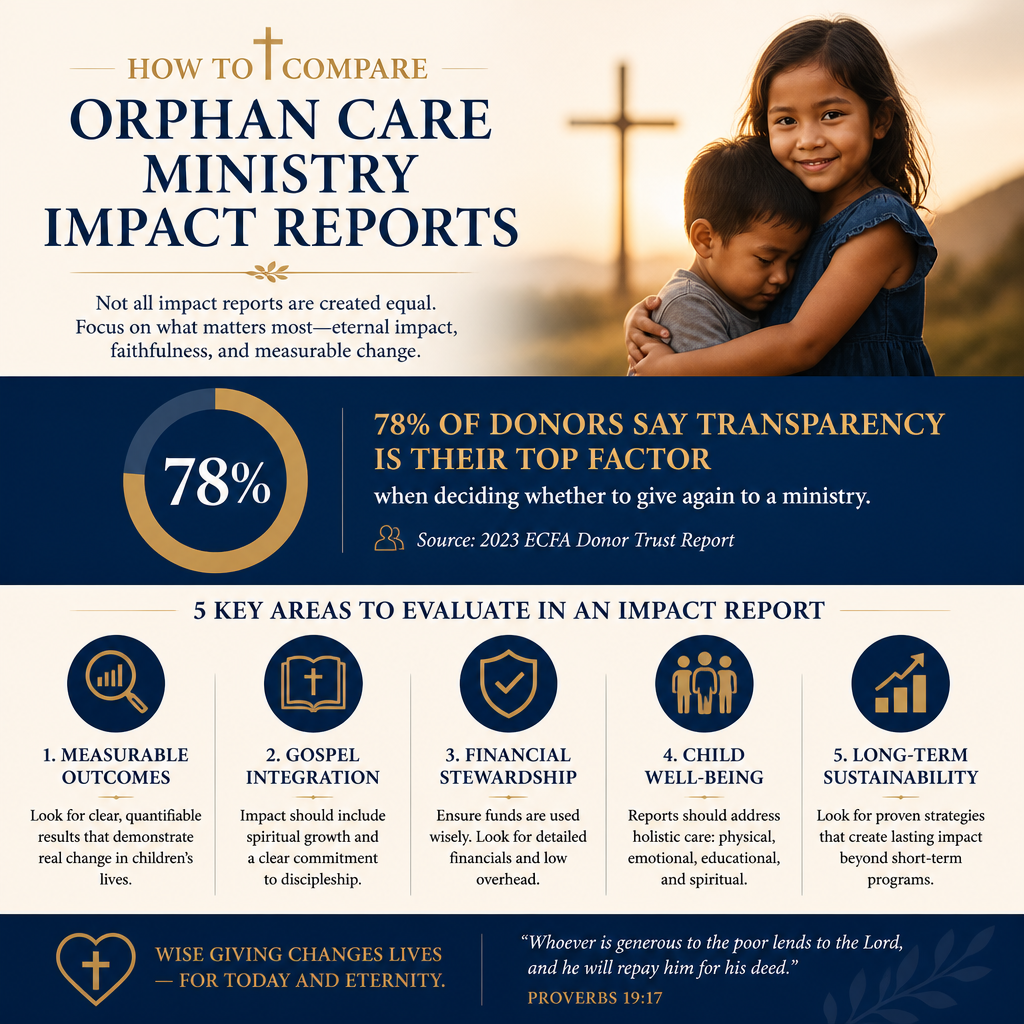
Many reports mix outputs and outcomes in ways that inflate perceived impact. “Counseling sessions delivered,” “meals provided,” and “volunteers mobilized” are outputs. Outputs matter, particularly in crisis response. But outcomes ask what changed: reduced re-entry into care, increased school retention, documented family stability, or verified safety plans maintained over time.
When comparing reports, ask whether the ministry can answer three questions with clarity: What changed, for whom, and how do you know. The last question is the discipline point. “How do you know” requires a data source: case management records, follow-up visits, school records where legally appropriate, standardized assessment tools, or third-party evaluations. The more vulnerable the population, the more careful the ministry should be about evidence quality and confidentiality.
Time horizons should match child welfare reality
Short reporting windows often reward superficial wins and penalize patient, complex casework. Ministries working toward reunification may appear “slower” than ministries counting bed-nights in residential care. A mature report separates short-term stabilization metrics from long-term permanency metrics. It also discloses attrition: how many cases were lost to follow-up, and what safeguards are in place when contact ends.
In our verification work at Most Trusted, the ministries that meet The Most Trusted Standard generally resist overstating early results. They name what has not yet been measured, what is still uncertain, and which outcomes are aspirational rather than demonstrated. That restraint is not marketing weakness; it is governance strength.
3. Look for safeguarding and ethics as impact, not compliance
Child protection is part of effectiveness
In orphan care, safeguarding failures are not side issues. A ministry can report impressive growth while exposing children to harm through weak screening, poor supervision, or unaccountable partnerships. For that reason, an impact report that does not address safeguarding is incomplete. Donors should expect to see, at minimum, documented child protection policies, background check practices where legally possible, reporting channels, and incident response protocols. Where the ministry works cross-culturally, it should explain how safeguarding is contextualized without being diluted.
We recommend weighing safeguarding disclosures more heavily than many donors instinctively do. A ministry that publicly acknowledges incidents, describes corrective actions, and demonstrates governance oversight is often more trustworthy than a ministry that reports only unbroken success.
Dignity and consent should shape storytelling
Impact reports are also moral documents. Images, child profiles, and testimonials can easily cross lines of consent and dignity, especially when trauma is involved. Compare whether the ministry uses de-identified stories, protects location data, and avoids portraying children as fundraising objects. Scripture’s insistence on truthful speech and the protection of the vulnerable applies to communications as much as to program design.
- Clear child protection policy and training disclosures
- Transparent incident reporting and corrective action summaries
- Consent standards for photos and stories, including guardian permissions
- Restrictions on short-term volunteer access to children
- Partnership due diligence for local homes, churches, and agencies
Donors who want broader context on the field and its major models will find it helpful to review Orphan Care Ministries alongside specific ministry reports, since model assumptions often explain reporting choices.
4. Compare transparency practices that make impact verifiable
Methodology should be readable and specific
A report can be visually impressive and still be methodologically thin. Strong reports state who collected the data, how often, with what tools, and what limitations apply. If a ministry reports “family reunifications,” donors should be able to discern whether reunification means a child returned home for 30 days, 6 months, or a full year with documented stability. If a ministry reports “children rescued,” donors should be able to see the legal and ethical basis for interventions and the partnership with authorized agencies.
Transparency also includes negative space: what is not being measured. A ministry that does not track re-entry into care after reunification may not know whether its reunifications are durable. When the stakes are children’s lives, not knowing is a program risk that should be named.
Financial and program reporting should connect
Donors often ask for “low overhead,” but the field has repeatedly warned that overhead ratios are a poor proxy for effectiveness. Charity Navigator, Candid, and the BBB Wise Giving Alliance published an open letter cautioning against using overhead as the primary measure of nonprofit performance Charity Navigator. In orphan care, under-investing in administration can mean under-investing in case management quality, safeguarding systems, and staff training.
What this means in practice is that the best impact reports show how program strategy, staffing, and costs fit together. If a ministry claims intensive family preservation, it should not show implausibly low personnel costs. If it claims national systems change, it should show investment in policy engagement, monitoring, and partner capacity. The numbers do not need to be perfect, but they should be coherent.
For donors comparing ministries within a similar focus area, How to Give Wisely to Orphan Care Ministries provides additional decision questions that sit alongside impact reporting, including governance and transparency considerations.
5. Use a disciplined set of comparison questions across ministries
Normalize for context before ranking results
Comparisons across countries, legal systems, and trauma profiles can mislead. A ministry working with high-risk trafficking survivors may show lower reunification rates than a ministry working with short-term economic crisis cases, and that difference may reflect case mix rather than performance. Serious impact comparison normalizes for context: what population, what risks, what legal constraints, what partner ecosystem, and what time horizon.
We recommend donors ask ministries to segment results by program type and child profile rather than present a single blended success rate. When reporting is segmented, a ministry can be held accountable for each program’s goals without flattening the complexity into a single number.
Independent verification strengthens donor confidence
There is a difference between a ministry’s internal measurement and an external evaluation of integrity and transparency. Both matter. At Most Trusted, our work is to evaluate Christian nonprofits against The Most Trusted Standard, a 15-criteria framework covering Faith Foundation, Financial Integrity, Governance and Leadership, and Transparency and Effectiveness. The aim is not to replace a donor’s prayerful discernment, but to strengthen it with evidence that a ministry’s claims, practices, and disclosures can bear weight.
When ministries welcome scrutiny, they signal something important: a willingness to be accountable for outcomes, for finances, and for the spiritual and ethical commitments they publicly profess. In orphan care, that posture is not a branding choice. It is a child protection choice.
FAQs for How to compare orphan care ministry impact reports
What if a ministry has compelling stories but very little data?
Stories can be truthful and still be insufficient as evidence. We recommend asking for a small set of defined outcomes, the data source for each, and a description of limitations. A ministry serving children in crisis may not be able to publish granular details, but it can still disclose methodology, safeguarding practices, and aggregated results that allow donors to assess credibility.
Should donors avoid ministries that use residential care?
Not automatically. Some contexts require short-term residential stabilization, and some specialized care cannot be delivered safely in a family placement without support. The question is whether residential care is time-limited, governed by individualized case plans, oriented toward family-based permanency where possible, and surrounded by strong safeguarding and transparent reporting. Reports that treat residential care as the end state, or that cannot explain exit pathways, deserve heightened scrutiny.
A standard for impact that is worthy of the cause
Comparing orphan care ministry impact reports requires more than counting children and celebrating growth. It requires examining definitions, evidence, safeguarding, and transparency with the seriousness the subject demands. When ministries report with humility and rigor, they honor children not as symbols but as image-bearers, and they invite donors into stewardship shaped by truth. That is the kind of accountability Christian giving should insist on, especially in work where the cost of confusion is borne by the vulnerable.



