

How to give wisely to Bible distribution ministries begins with a sober recognition: the Church has always treated access to Scripture as a matter of spiritual life and death, and yet modern funding can unintentionally reward the wrong outcomes. Donors who love the Word often want a simple question answered—how many Bibles did my gift put into someone’s hands?—but wise giving asks a prior question: what kind of distribution is faithful, verifiable, and likely to bear lasting fruit?
Scripture does not romanticize stewardship. Jesus ties faithfulness to entrusted resources (Luke 16:10), and Paul expects offerings to be handled in ways that avoid reproach (2 Corinthians 8:20–21). Bible distribution is a holy aim, but it still requires disciplined discernment about translation integrity, local church partnership, safety, reporting, and the difference between activity and spiritual effectiveness.
Begin with the ministry theory, not the appeal
Bible distribution ministries vary widely in what they mean by “distribute.” Some focus on direct-to-reader handoffs; others supply churches and seminaries; others prioritize high-security contexts where possession of Christian materials is dangerous. Some emphasize mass scale; others invest in slow, relational pathways of discipleship where Scripture is introduced and taught over time. Wise giving starts by asking what the ministry believes is happening when a Bible is placed, and how it expects that placement to strengthen the Church.
Clarify what “Bible access” means in their context
In many regions, the constraint is not printing capacity but trust, literacy, and local leadership. A ministry may report large distribution numbers yet operate in places where literacy barriers are significant, or where the local church lacks trained leaders to teach Scripture responsibly. In those settings, audio Scripture, Scripture engagement training, or support for local pastors may be the more faithful expression of “distribution,” even if the headline number of physical books is lower.
Some donors assume that if a country has low Bible ownership, the solution is simply more copies. But religious landscapes are more complex than scarcity alone. For example, global Christian populations continue to shift toward the Global South, with particular growth in sub-Saharan Africa and parts of Asia, which changes how ministries should think about language, leadership development, and denominational accountability. Pew Research has documented these long-term shifts in the center of gravity of Christianity, with projections showing continued growth of Christian populations in sub-Saharan Africa through 2050 (Pew Research Center).
Ask what they distribute and how they safeguard doctrine
Not every “Bible” product is equivalent. Faithful ministries can explain their translation philosophy, text base, and theological commitments without defensiveness. In some contexts, the questions include whether the translation is widely received by local churches, whether it is reviewed by qualified scholars and local pastors, and how the ministry avoids distributing materials that confuse core doctrine. In other contexts, the concern is not heterodoxy but fragmentation—multiple competing translations flooding a region without ecclesial alignment.
Wise donors ask how a ministry works with local church leaders rather than around them. In our view, the healthiest Bible distribution models treat the local church as the primary steward of disciple-making, not as a convenient distribution channel.
Require verifiable definitions for the numbers they report
“Distributed” can mean “shipped to a warehouse,” “handed to a partner,” or “received by an end user.” Those are not the same thing. A mature ministry will define its metrics and state their limitations. If the reporting never names constraints—loss, diversion, duplication, security disruptions—the reporting is usually more marketing than measurement.
The harder question is whether the ministry measures Scripture engagement rather than only throughput. Many credible organizations now treat “engagement” as a distinct outcome—reading, listening, group study, memorization, or participation in a church-based study—because mere possession is an incomplete proxy for discipleship. This does not mean every ministry must run randomized trials, but it does mean the ministry should demonstrate disciplined learning rather than relying on sentiment.
Discern trustworthiness by governance, finances, and transparency
Christian donors often ask whether they should evaluate “heart” or “efficiency.” Scripture insists on both. We are commanded to give generously, but also to give wisely, since the Church’s witness can be damaged by financial negligence and avoidable scandal. This is one place where independent verification matters. Most Trusted exists to help donors give with confidence by evaluating ministries against The Most Trusted Standard, a 15-criteria framework covering faith foundation, financial integrity, governance and leadership, and transparency and effectiveness.
If a donor wants a single shortcut, it is this: trustworthy Bible distribution ministries are not afraid of scrutiny. They publish meaningful financial information, they name their leadership and oversight structures, and they explain how they prevent conflicts of interest and how they handle restricted gifts.
Read the Form 990 or audited statements with discernment
For U.S.-based nonprofits, the Form 990 is not spiritual reading, but it is a moral document. It shows how an organization pays leaders, how it governs itself, and whether its story is consistent across years. If the ministry claims a global footprint, do its expenses reflect that reality? If it claims low overhead, does it underinvest in controls, security, and evaluation? There is a difference between frugality and fragility.
Donors should also resist simplistic overhead fixation. Major charity evaluators have publicly warned that focusing narrowly on overhead can mislead donors and pressure nonprofits toward unhealthy underinvestment in infrastructure. Charity Navigator explains why overhead ratios alone are a poor measure of effectiveness and can create perverse incentives (Charity Navigator).
Look for governance that prevents founder control and protects the mission
Bible distribution work can attract charismatic leaders with genuine zeal. Zeal is not a substitute for accountability. Wise donors look for boards that are independent, engaged, and willing to ask hard questions. The ministry should have clear policies on conflicts of interest, related-party transactions, whistleblower protections, and document retention. If these basics are missing, the risk is not only financial; it is spiritual, because disorder and secrecy deform Christian witness.
Assess transparency as a discipleship issue
Transparency is not only a compliance matter; it is a formation matter. When a ministry routinely communicates truthfully about challenges, security constraints, and trade-offs, it helps donors participate in reality rather than in a curated narrative. That posture is closer to the integrity Paul models when he insists on handling funds in a way that is “right not only in the Lord’s sight but also in the sight of man” (2 Corinthians 8:21).
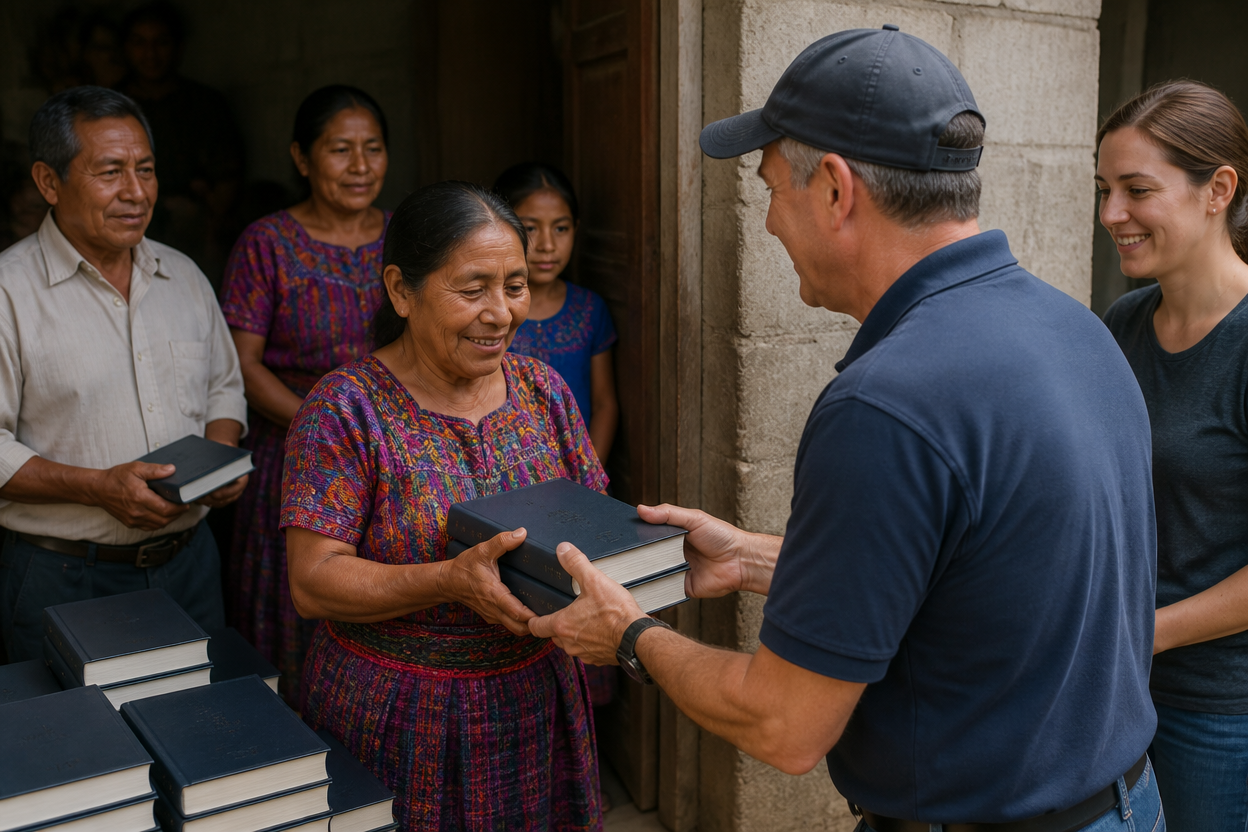
We encourage donors to ask for a clear explanation of how funds move from gift to outcome, including partners involved, printing and shipping arrangements, and accountability for inventory. A ministry that cannot describe the chain of custody with clarity should not be entrusted with large-scale distribution funding.
Fund what increases Scripture engagement and local church strength
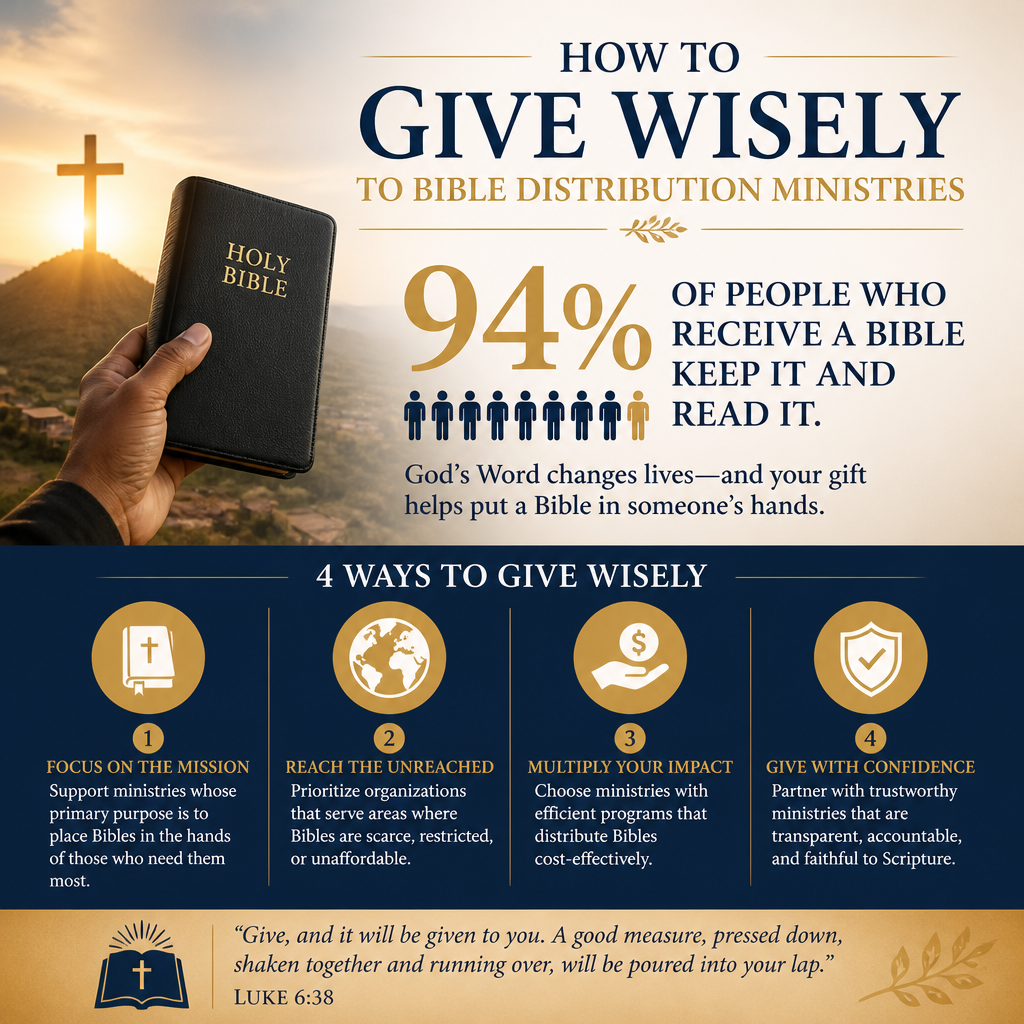
Physical distribution is sometimes the right priority, particularly where Bibles are scarce, where the church is emerging, or where disasters have disrupted access. But in many contexts the limiting factor is not a book; it is the capacity to read, understand, and obey it within the life of the church. Wise giving therefore supports models that strengthen the whole ecosystem of Scripture use.
Prioritize partnerships that treat local leaders as primary, not secondary
Healthy ministries can name their local partners and explain why they trust them, even if some details must remain confidential in hostile settings. They invest in local pastors, translators, and distribution networks that will remain after foreign funding fluctuates. The goal is not dependence on an external supply chain; it is a resilient local church rooted in the Word.
This also addresses a frequent donor pain point: the fear of waste or diversion. Strong local partnerships—paired with meaningful controls—are often the best protection against boxes of Bibles sitting unused or being redirected in ways the donor never intended.
Support the less visible work that makes distribution faithful
In secure and contested environments, the ministry’s highest costs may be the least photogenic: staff training, secure logistics, trauma-informed care for field workers, careful vetting of partners, and digital security. Donors who demand only “direct” spend can unintentionally punish the very practices that prevent harm. The question is not whether a ministry has non-program expenses; the question is whether those expenses are disciplined, proportional, and aligned with the mission.
Some donors also underestimate the cost and complexity of translation and revision work. Translation requires linguistic expertise, theological review, community testing, and long timelines. In many languages, the issue is not that Scripture has never been translated, but that existing translations are not widely understood, are not accepted by key church bodies, or are poorly distributed. Wise giving recognizes that “Bible access” is not only printing but long-term stewardship of texts and teaching.
Consider monthly giving as an instrument of stability and integrity
Bible distribution ministries often face seasonal giving patterns that can create volatility in printing schedules, staffing, and partner commitments. Monthly giving can fund inventory planning, reduce pressure to chase short-term campaigns, and strengthen accountability, because stable funding supports stable systems. For donors, recurring giving can be a disciplined expression of stewardship—an ordinary faithfulness rather than an occasional surge of generosity.
Christians genuinely disagree about whether donors should fund “where the need is greatest” or restrict gifts to specific projects. Both approaches can be faithful. What this means in practice is that restrictions should be used carefully and in conversation with the ministry’s actual constraints, not as a way to control outcomes from a distance.
Make giving decisions that hold together faith and evidence
Wise giving to Bible distribution ministries is not suspicion disguised as prudence. It is love of neighbor guided by truth. The Church has endured long enough to know that fervor without accountability can damage the very people we intend to serve. A donor can honor Scripture by insisting that ministries handle resources openly, govern themselves responsibly, and describe outcomes with clarity.
For donors evaluating the broader field of Bible Distribution Ministries, we encourage a disciplined process: define the outcome you mean by “distribution,” test the ministry’s claims against verifiable documents, and favor models that strengthen local churches and Scripture engagement over mere throughput. The ministries most worthy of trust tend to welcome these questions, because they understand that integrity is not an obstacle to mission; it is part of the mission itself.



