
How Christian addiction recovery leaders prevent staff burnout is not a secondary operational concern; it is a question of fidelity. In ministries where trauma, relapse, family breakdown, and spiritual warfare are daily realities, the people providing care can become casualties of the work if leaders treat endurance as a substitute for wise stewardship.
Donors tend to see the front-facing outcomes: men and women sober, families reconciled, church members mobilized. The harder work is often quieter: building a culture where staff can carry grief, setbacks, and complex pastoral cases without collapsing under the weight. Across our verification work at Most Trusted, we observe that ministries with durable fruit tend to handle staff care as a governance and discipleship issue, not a perk.
Burnout in recovery ministry is often a theological and organizational failure
Christian recovery work sits at the intersection of clinical realities and spiritual formation. That combination attracts staff and volunteers with a high capacity for compassion, but it also creates conditions where self-neglect can masquerade as sacrifice. Scripture commends costly love; it does not commend preventable exhaustion born from poor leadership.
Jesus’ own pattern is instructive. The Gospels repeatedly show him withdrawing to pray, even with urgent crowds and genuine needs pressing in (Mark 1:35). The point is not mere “work-life balance.” It is that leaders cannot claim to serve the Kingdom while ignoring creaturely limits.
Recovery ministry carries predictable stressors that leaders must name
Staff in residential programs, counseling centers, and discipleship communities routinely absorb secondary trauma, manage boundary-testing behaviors, and walk with clients through relapse. These are not anomalies; they are structural features of the work. When leaders treat them as occasional surprises, they set staff up for chronic overextension.
What this means in practice is that staffing models, supervision rhythms, and pastoral care must be designed for the normal load, not for an ideal week. A ministry can be spiritually vibrant and still be operationally naive.
Spiritual language can unintentionally pressure staff into silence
Christian cultures sometimes reward the appearance of unbroken strength. Staff may fear that admitting fatigue will be interpreted as weak faith, insufficient prayer, or lack of calling. Leaders prevent burnout partly by making it morally safe to say, “I am at capacity,” without career penalties or spiritual suspicion.
Christians genuinely disagree about where to draw lines between sacrificial service and prudent limits, especially in urgent mercy work. Yet Scripture consistently ties leadership to wisdom, not to performative intensity (James 3:17). Wise leadership listens for the early signals of strain and responds before damage becomes public.

Leaders prevent burnout by designing roles and workloads that match reality
The first anti-burnout intervention is structural: roles, schedules, and caseloads that reflect what the work actually demands. When job descriptions assume a stable client population, predictable crises, and uninterrupted rest, staff will carry hidden overtime in their bodies and homes.
Caseload clarity and on-call boundaries are non-negotiable
In addiction recovery, “availability” can become a ministry idol. Leaders who prevent burnout define what constitutes an emergency, who is on call, and how coverage rotates. They also train staff to hand off crises without shame. A ministry that depends on one heroic responder has built fragility into its care model.
Clinically informed programs also recognize the strain of high-acuity work. The National Academies of Sciences, Engineering, and Medicine notes that burnout is tied to workload and lack of control, among other organizational factors, not merely individual resilience.National Academies of Sciences, Engineering, and Medicine
Healthy ministries resist the starvation cycle in staffing
Some Christian nonprofits underfund staffing to keep reported overhead low, then ask staff to compensate with unpaid labor. The nonprofit sector has long had to reckon with the “overhead” fixation, and serious evaluators increasingly treat this as a governance problem rather than a virtue-signaling metric. The “Overhead Myth” letter, signed by GuideStar, BBB Wise Giving Alliance, and Charity Navigator, argued that simplistic overhead ratios can do real harm by incentivizing underinvestment in capacity.Candid GuideStar
For donors, the implication is direct: a low administrative percentage can conceal practices that slowly break staff. A well-governed recovery ministry spends appropriately on supervision, training, technology, and staffing depth because those investments protect clients as well as employees.
Supervision and pastoral care are not optional in trauma-exposed work
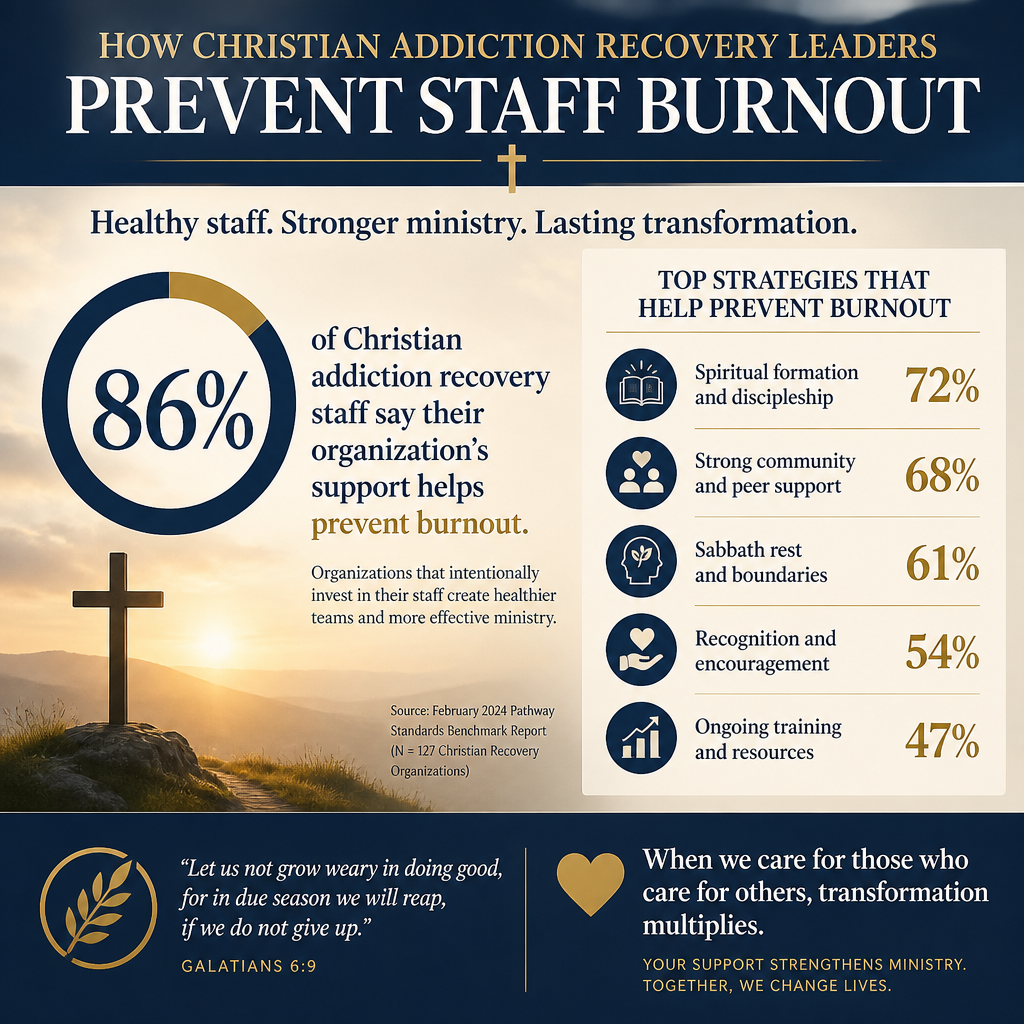
In addiction recovery, staff rarely burn out from a single hard week. They burn out from sustained exposure without processing, support, and correction. Leaders prevent burnout by creating layered care: clinical supervision where appropriate, pastoral oversight that is not merely managerial, and peer support that is structured rather than accidental.
Competent supervision reduces isolation and moral injury
Many staff members carry what clinicians describe as moral distress: the pain of wanting to provide more help than time, funding, or safety allows. Good supervision helps staff make decisions that are faithful, lawful, and clinically responsible, without bearing the burden alone. This is especially important where ministries interface with courts, child welfare, detox referrals, or mandated reporting.
Evidence from the broader caregiving field supports the link between organizational support and well-being. The U.S. Surgeon General’s advisory on health worker burnout emphasizes that workplace culture, leadership, and systems are central drivers of burnout and well-being—not simply individual coping habits.U.S. Department of Health and Human Services
Pastoral care must be real care, not an add-on devotion
Recovery staff often serve in spiritually contested spaces: deception, shame, anger, and despair are common. Leaders who prevent burnout provide pastoral care that includes confession, prayer, and spiritual counsel, but also includes permission to grieve and rest. Galatians 6 holds two truths together: “bear one another’s burdens” and “each will have to bear his own load.” Wise leadership helps staff discern the difference.
Donors sometimes assume that because a ministry is Christian, spiritual care happens automatically. In reality, leadership must plan for it: consistent check-ins, access to pastors or chaplains who are not in the employee’s reporting line, and a culture that does not penalize vulnerability.
Staff formation requires training, guardrails, and a culture of accountability
Burnout prevention is not only about reducing hours; it is about increasing maturity. Christian addiction recovery ministries often recruit staff from the recovery community itself, which can be powerful and appropriate. It can also be complicated. Leaders prevent burnout by pairing compassion with formation and guardrails, so staff do not confuse rescuing with loving.
Training should address boundaries, relapse dynamics, and secondary trauma
Effective ministries train staff to expect relapse as a clinical and discipleship reality without becoming cynical or personally shattered. They also train staff to recognize manipulation without losing mercy. These are learned skills, not intuitive gifts.
Across our verification work, we find that ministries aligned with Christian Addiction Recovery Ministries best practices tend to document training expectations and provide regular refreshers, especially for frontline roles. Written standards reduce the pressure on individual supervisors to “remember everything,” and they protect clients from inconsistent care.
A simple operating discipline prevents chronic overload
Leaders who prevent burnout establish a few disciplined practices and insist on them. These practices are not glamorous, but they are protective.
- Written role definitions that clarify what staff are not responsible to carry
- Regular case review or team consults for high-acuity situations
- Mandatory time off policies that leadership models without exception
- Clear escalation pathways for safety threats, relapse, and boundary violations
- Annual performance reviews that include spiritual health and sustainability, not only outputs
Accountability matters here. A ministry can speak frequently about grace and still allow quiet dysfunction: unaddressed conflict, unclear authority, or a leader who repeatedly violates rest norms while expecting staff to do the same. Donors should recognize that “culture” is not a soft concern; it is a governance outcome.
Donors can underwrite resilience by funding the right costs and asking better questions
Many burnout dynamics are downstream from funding signals. When donors reward only visible outcomes—beds filled, decisions made, baptisms counted—ministries feel pressure to grow faster than their staffing depth. When donors fund sustainability, ministries can treat staff as stewards of a calling rather than as consumable labor.
What verifiable leadership looks for when evaluating burnout risk
Most Trusted exists to help donors give with confidence by evaluating ministries against The Most Trusted Standard, a 15-criteria framework covering Faith Foundation, Financial Integrity, Governance and Leadership, and Transparency and Effectiveness. Burnout prevention is not a single checkbox in that framework; it shows up through evidence of prudent oversight, responsible budgeting, clear leadership accountability, and truthful reporting about limits.
For donors who want to discern wisely, the question is not, “Do they care about staff?” Nearly every ministry will say yes. The question is, “What practices prove it?” In many cases, the most honest ministries will describe trade-offs: waitlists they keep rather than expand irresponsibly, intake policies that protect staff capacity, or program limits that preserve quality.
Questions donors can ask without second-guessing the mission
Donors should not manage ministries from a distance, but donors can ask for clarity that protects the mission. These questions are especially relevant within Leadership and Operations in Christian Addiction Recovery contexts where the quality of internal systems directly affects client safety.
Consider asking:
- How do you define and manage on-call responsibilities for frontline staff?
- What supervision structure exists for counseling, case management, and residential staff?
- What is your approach to staff time off, and does leadership model it?
- How do you handle rapid growth without degrading care quality?
- What budget lines specifically support training and staff care?
These questions do not treat burnout as an internal HR matter. They treat it as a stewardship issue with direct implications for client outcomes, moral credibility, and long-term fruit.
FAQs for How Christian addiction recovery leaders prevent staff burnout
Is burnout mainly a personal discipleship problem or an organizational problem?
It is both, but it is rarely only personal. Scripture calls Christians to self-control, prayer, and wise limits, yet Scripture also holds leaders accountable for how they shepherd people under their care (1 Peter 5:2–3). In addiction recovery settings, organizational design—caseloads, coverage, supervision, conflict management, and expectations—often determines whether individual disciplines can realistically be practiced.
What should donors fund if they want to reduce burnout without diluting the mission?
Donors can fund the costs that make faithful care sustainable: supervision time, training, appropriate staffing levels, technology that reduces administrative burden, and leadership development. Donors can also support evaluation and transparency so ministries can tell the truth about capacity. Funding only direct program moments while discouraging the infrastructure that protects staff often creates hidden fragility.
Burnout prevention is part of faithful stewardship
Christian addiction recovery ministry is a long obedience in the same direction, and leaders who plan for endurance honor both clients and staff. The aim is not comfort. It is sustainability in love: leaders who tell the truth about limits, design humane roles, provide real supervision and pastoral care, and invite donors into responsible funding. When staff health is treated as an expression of stewardship, ministries are better positioned to offer the kind of patient, credible hope that recovery requires.



