
Tax receipts and reporting for donations to Christian financial service ministries are not merely administrative details. They are where Christian stewardship meets the government’s definitions of “charitable contribution,” and where a donor’s desire to give freely must be matched by records that can withstand scrutiny.
Most donors want to honor God with their resources without turning generosity into paperwork. Yet the IRS does not treat intention as evidence. The harder question is how to give confidently—especially to ministries offering financial counseling, lending, debt relief, or economic development—while maintaining documentation that is accurate, timely, and ethically clear.
Why tax receipts matter for Christian stewardship and public accountability
Jesus’ teaching makes money a discipleship matter, not a side issue. The same moral seriousness applies to the way Christians handle tax reporting. A donation receipt is not a spiritual validation of a gift, but it is a public claim: “This was given, to this organization, for charitable purposes, under these terms.”
What this means in practice is that receipts help protect both donor and ministry. Donors avoid disallowed deductions. Ministries reduce the likelihood of reputational damage when donors discover, too late, that a “receipt” was incomplete or that a benefit was not disclosed. Across our verification work at Most Trusted, we observe that ministries that meet The Most Trusted Standard tend to treat receipting as part of transparency and governance, not as a year-end afterthought.
The IRS standard is record-based, not intention-based
The IRS requires specific records for charitable deductions, and the required form of substantiation changes with the size and type of gift. For cash contributions, donors must generally have a bank record or a written communication from the charity that shows the organization’s name, the date, and the amount. The IRS states this plainly in its guidance on charitable contributions documentation at IRS.gov.
For larger gifts, the requirements become stricter. If a donor claims a deduction of $250 or more for any single contribution, the donor must obtain a contemporaneous written acknowledgment from the charity. That acknowledgment must say whether the donor received goods or services in exchange for the gift and, if so, include a good-faith estimate of their value. This requirement is part of the IRS’s substantiation rules described on IRS.gov.
Receipts also help donors evaluate ministries with moral clarity
Christian financial service ministries operate in a complex space: they may counsel, lend, invest, and provide direct assistance. Receipts are one window into whether the organization distinguishes clearly between a gift and a fee, and between a donation and a purchase. That distinction is not pedantry. It is one way donors avoid unintentionally subsidizing private benefit while believing they funded charitable work.
The fair market value problem is not optional
Some donors are surprised when a receipt references “fair market value” or states that “no goods or services were provided.” The language is not an exercise in legalism. It is the IRS framework for determining the deductible portion of a payment. If the donor receives something of value—books, event admission, membership benefits, or a benefit dinner—the deductible amount is generally reduced by the fair market value of what was received.

What a proper donation receipt should include and what to watch for
In Christian giving, we often emphasize trust. In tax substantiation, trust is strengthened by specificity. A proper receipt is not just a thank-you letter; it is a contemporaneous written acknowledgment that contains the information the IRS expects when a donor claims a deduction.
Core elements donors should expect
For a donation of $250 or more, donors should look for at least five elements:
- The legal name of the organization
- The date of the contribution
- The amount of cash contributed or a description of non-cash property
- A statement that no goods or services were provided in exchange for the donation, or a description and good-faith estimate of their value
- Language indicating the acknowledgment is contemporaneous (received by the time the donor files or by the tax deadline, whichever comes first)
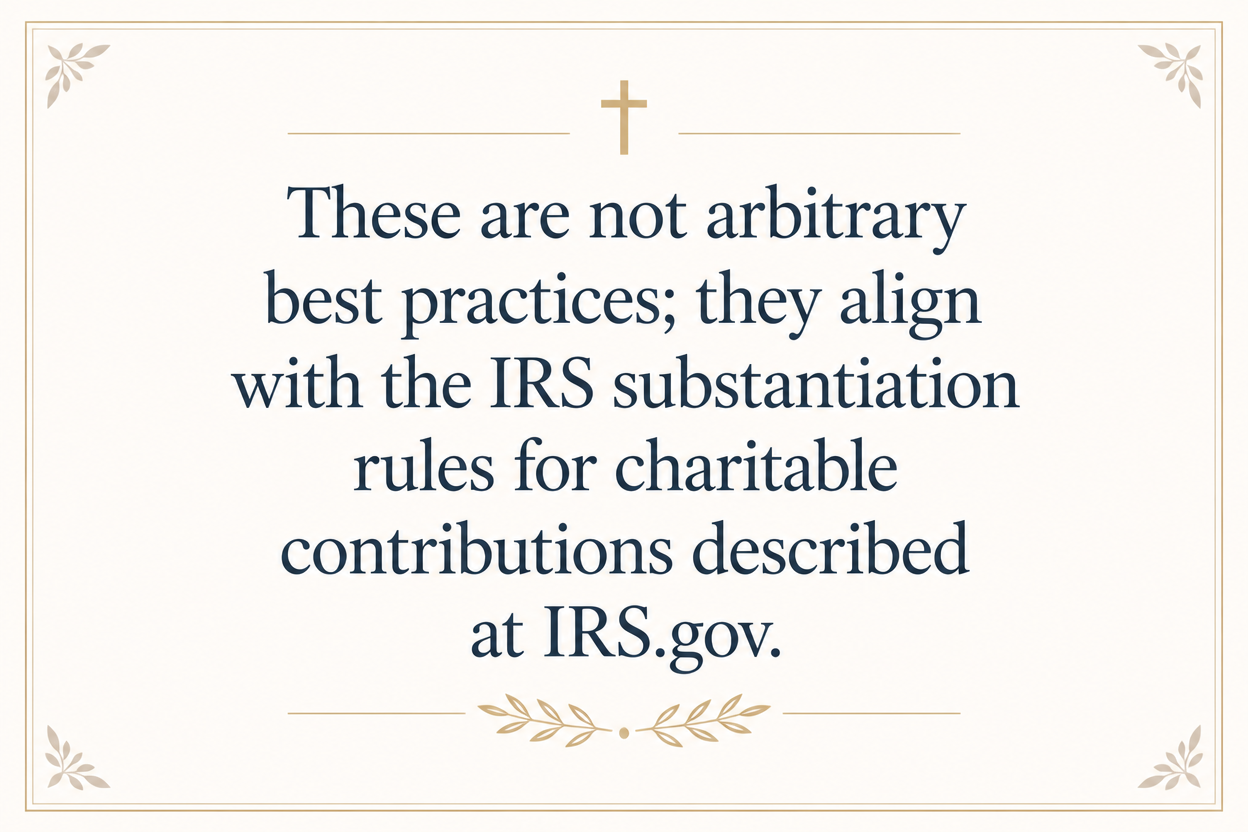
These are not arbitrary best practices; they align with the IRS substantiation rules for charitable contributions described at IRS.gov.
Common friction points with Christian financial service ministries
Financial service ministries sometimes create confusion because donors may interact with them in more than one capacity: as a donor, as a client receiving counseling, as a participant in a program, or as a borrower. The ministry may send multiple year-end summaries, invoices, or account statements. Donors should not assume that a year-end “statement” is a charitable receipt.
Three patterns deserve extra attention:
- Fees versus gifts: Counseling fees, program tuition, or service charges are typically not charitable contributions. If a ministry labels a fee payment as “tax-deductible” without clarifying what qualifies, donors should request clarification.
- Designated gifts: Donors often want to designate gifts to a specific purpose. A designation is not automatically disallowed, but the ministry must retain control and discretion over the funds for the gift to be a charitable contribution. Overly rigid “earmarking” can create risk.
- Benefits received: If a donor receives a tangible benefit (a conference ticket, a premium, a paid membership benefit), the receipt must disclose it and estimate its value.
When a receipt is accurate but still insufficient
Some receipts are factually correct yet still unhelpful to donors because they do not identify the entity clearly. Christian ministries may operate under a “doing business as” name while donations are processed by a different legal entity. Donors should ensure the receipt names the actual charitable organization recognized as eligible to receive tax-deductible contributions.
For donors evaluating ministries in this category, we recommend reviewing how the organization discloses its legal identity, governance, and finances. That work sits at the center of Christian Financial Service Ministries, where donors can think more clearly about both mission and mechanisms.
How to report these donations on taxes without overclaiming or underclaiming
Most donors do not struggle with the basic concept of charitable deductions; they struggle with edge cases. Christian financial service ministries generate edge cases because they can involve services, benefits, and non-cash gifts, and because donors sometimes assume that “ministry” automatically means “deductible.” The tax code is more precise than our instincts.
Claiming cash gifts and recurring giving
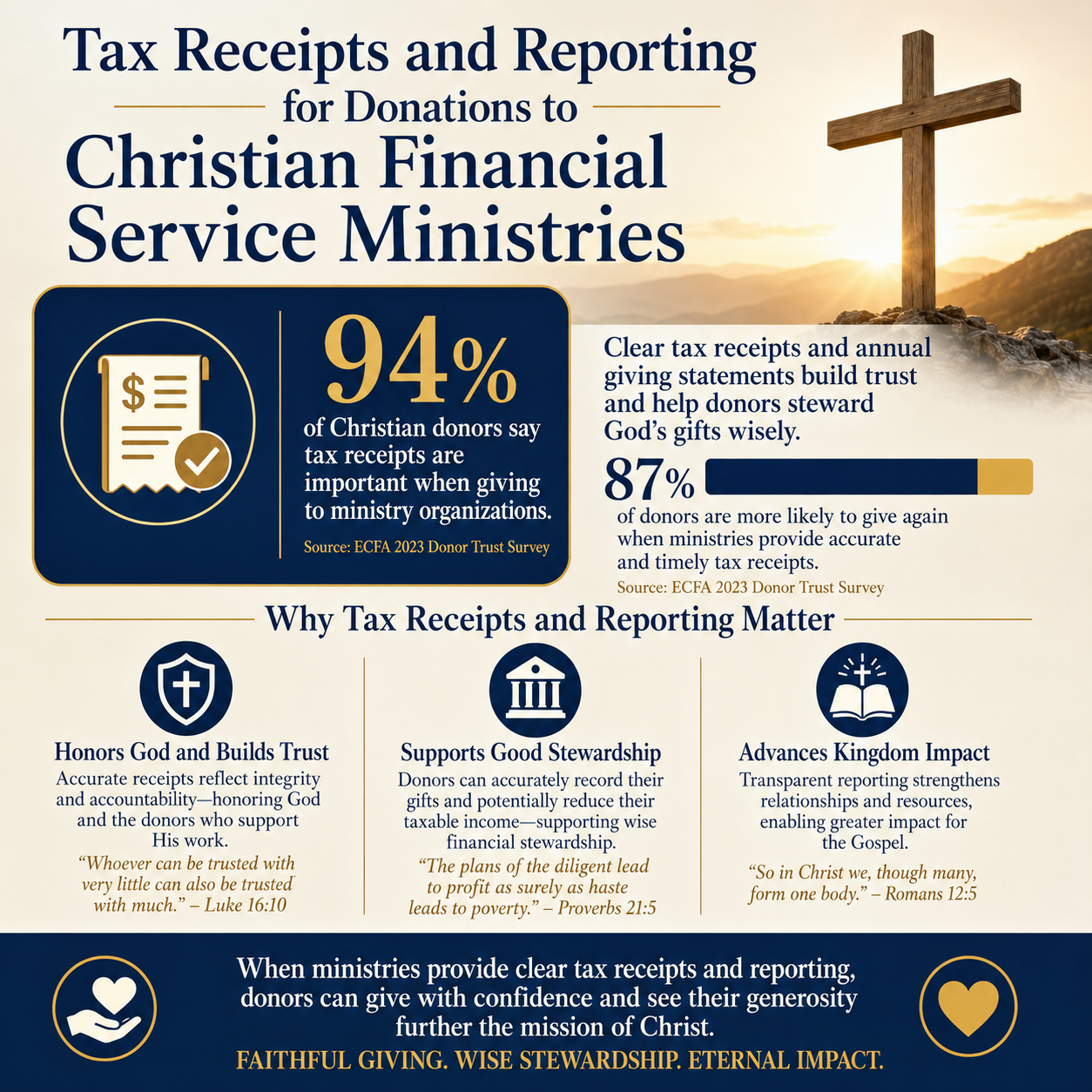
For cash gifts—checks, credit cards, electronic transfers—donors generally rely on bank records and receipts. Recurring gifts are usually substantiated by the same combination: bank records plus a year-end acknowledgment. Donors should keep the year-end acknowledgment even if every monthly gift produced an email receipt; a single consolidated acknowledgment often becomes the clearest record if questions arise later.
Donors who itemize deductions should also remember that the benefit of charitable deductions depends on the tax situation as a whole. The IRS provides current guidance on how charitable contributions fit within federal tax rules at IRS.gov.
Non-cash gifts and the ministry’s role in valuation
Non-cash gifts—vehicles, stock, household goods, equipment—raise a different set of issues. In many situations, the donor, not the ministry, is responsible for determining the value of the donated property. The ministry’s receipt typically describes the property but does not assign value. When donors expect the ministry to set the value, confusion follows, and occasionally improper deductions do as well.
For more significant non-cash gifts, the IRS may require specific forms and, in some cases, a qualified appraisal. Donors should treat this as an area where professional tax advice is often prudent, not because Christian giving is suspect, but because the rules are detailed and the penalties for misstatement can be meaningful.
Quid pro quo contributions and “partial deductibility”
Christian events and fundraising benefits remain common: banquets, conferences, premium resources, and donor appreciation gatherings. When a donor pays more than fair market value for something received, only the excess is typically deductible. Ministries should disclose this properly, and donors should retain that disclosure.
The tension is real: donors want ministries to raise funds efficiently, and ministries may fear that candid benefit disclosures will reduce giving. Yet the Christian standard for truthfulness is not conditioned on fundraising outcomes. Receipts that accurately disclose goods and services are not a hindrance to generosity; they are a guardrail against misrepresentation.
Recordkeeping practices that honor both conscience and compliance
Recordkeeping is rarely anyone’s spiritual gift, but it is a form of faithfulness. The donor who keeps orderly records is not less generous; that donor is more prepared to continue giving with confidence. And in an era of donor skepticism, sound documentation also signals that a ministry is willing to be examined.
What donors should keep and for how long
Donors should retain:
- Bank records for cash gifts (canceled checks, bank statements, credit card statements)
- Receipts or acknowledgments for contributions, especially those of $250 or more
- Correspondence related to any restrictions or designations
- Documentation for non-cash gifts, including descriptions, condition, and any appraisal paperwork if required
Retention periods can depend on the donor’s broader tax context. The IRS explains recordkeeping expectations in its publications and guidance at IRS.gov. When uncertainty exists, donors should generally retain records long enough to respond to questions about a filed return.
What to do when a receipt is missing or incorrect
Missing receipts are common, especially when gifts are made online through third-party platforms or when a donor moves. The most straightforward path is to request a corrected acknowledgment from the ministry. Donors should provide the date, amount, and payment method, and ask for a contemporaneous written acknowledgment that includes the required goods-and-services language.
If a ministry cannot or will not provide an accurate acknowledgment for a gift that requires it, the donor should assume the deduction may be disallowed and consult a qualified tax professional before claiming it. That is not cynicism; it is prudence.
How verification intersects with receipting practices
Receipting is only one signal, but it is a revealing one. Across our evaluation work, we find that ministries with clear governance, disciplined finance practices, and transparent communications tend to issue acknowledgments that meet IRS expectations and reduce donor confusion. The Most Trusted Standard assesses ministries across Faith Foundation, Financial Integrity, Governance and Leadership, and Transparency and Effectiveness, because donors rarely face a single isolated risk. Documentation, financial controls, and truthful reporting usually rise or fall together.
Giving freely and reporting carefully belong together
Christian donors do not give in order to receive a deduction. Yet when donors claim a deduction, they are making a public statement about the nature of a gift, and Scripture’s insistence on honesty applies to public statements as surely as to private ones. Tax receipts and reporting for donations to Christian financial service ministries are where generosity, governance, and truth meet in a concrete form.
We encourage donors to treat sound receipts as one indicator of a ministry’s maturity, and to keep records that allow generosity to continue untroubled by preventable disputes. The aim is not anxiety. It is confidence grounded in clarity.



