
Why mentoring is vital in juvenile justice ministry is not a sentimental claim; it is a disciplined response to what confinement cannot supply: stable, covenantal presence. Many young people in the juvenile justice system have learned that adults are unreliable, systems are conditional, and time is measured in disruptions. A mentor cannot undo the past, but faithful, consistent relationship can create the conditions for repentance, resilience, and durable reentry.
Christian donors often feel the weight of this work in two directions at once. There is the biblical summons to “remember those in prison, as though in prison with them” (Hebrews 13:3), and there is the sober awareness that youth justice work is complex, public, and subject to failure. Mentoring is one of the few interventions that can be both deeply Christian in posture and accountable in practice, because relationship can be described, supervised, and evaluated without reducing a child to a metric.
Mentoring names the real unit of change relationship not programming
Youth justice is often a story of broken attachment
Juvenile justice ministry operates at the intersection of trauma, family instability, educational disruption, and often untreated mental health needs. The field has had to reckon with how frequently “bad choices” are downstream of formative experiences that trained a young person to expect abandonment, violence, or exploitation. This does not excuse sin or diminish personal responsibility; it clarifies why exhortation alone rarely holds when a young person returns to the same relational vacuum.
Mentoring matters because it addresses this vacuum directly. A weekly visit, a letter that arrives when promised, and an adult who tells the truth without contempt are not small things inside a detention facility. They are counter-formative practices. They teach, over time, that authority can be exercised for someone’s good and that accountability can be joined to steadfast care.
Christian ministry is incarnational by nature
The gospel does not reach people merely as information; it reaches them through embodied witness. “The Word became flesh and dwelt among us” (John 1:14). In youth detention, where dignity is routinely pressured by uniformity and surveillance, the incarnational character of Christian presence becomes unmistakable. Mentoring is not the only expression of that presence, but it is one of the most direct.
This is also where donors sometimes hesitate: relationship feels “soft,” difficult to quantify, and exposed to boundary failures. Those risks are real. A serious ministry acknowledges them, trains mentors, and builds supervision that protects youth and volunteers. But the alternative is often a ministry model built on events and programming that can be impressive on paper while leaving the central wound untouched.

Mentoring provides moral formation when the system can only provide control
Detention can restrain behavior but cannot cultivate wisdom
Most juvenile facilities are designed to manage risk, not to cultivate virtue. They have rules, schedules, and consequences, and some have strong educational and therapeutic services. Yet even the best facility cannot become a family, a church, or a long-term community. Mentoring can bridge that gap by offering a steady adult who models repentance, patience, and truth-telling over time.
Christians genuinely disagree about how much emphasis to place on rehabilitation versus retribution in the justice system. But within juvenile justice, the moral case for rehabilitation is difficult to evade. Scripture’s vision of discipline is not merely punitive; it is ordered toward restoration. “The Lord disciplines the one he loves” (Hebrews 12:6). A mentor who holds a young person to the truth while refusing to abandon them is a lived parable of that discipline.
What mentors do that curricula cannot
Curricula can teach coping skills and decision-making frameworks, and these can be valuable. But a mentor reinforces those lessons when a young person is dysregulated, ashamed, or angry—precisely the moment when a worksheet is least persuasive. The mentor is not a therapist, and responsible ministries do not ask mentors to function as clinicians. Still, a well-supported mentor can help a young person practice the ordinary moral skills that make reentry possible: showing up, apologizing, asking for help, and telling the truth about relapse.

For donors evaluating juvenile justice ministries, this is one reason to pay attention to how mentoring is integrated with chaplaincy, case management, and local church relationships. Programs that treat mentoring as a peripheral volunteer activity often struggle to sustain it. Programs that treat mentoring as a core pastoral and discipleship practice tend to build the training and oversight that make it safe and durable.
Mentoring reduces isolation and strengthens reentry in practical ways
Reentry fails most often in the first relational miles
Youth reentering after confinement face immediate pressures: returning to school behind grade level, navigating probation requirements, rebuilding family trust, and avoiding peers or environments tied to the offense. Many are released into housing instability or family conflict. Even when a young person is motivated, the web of practical obstacles can be exhausting. A mentor cannot substitute for housing or legal advocacy, but mentors often become the human glue that helps a young person keep appointments, persist through setbacks, and remain connected to pro-social adults.
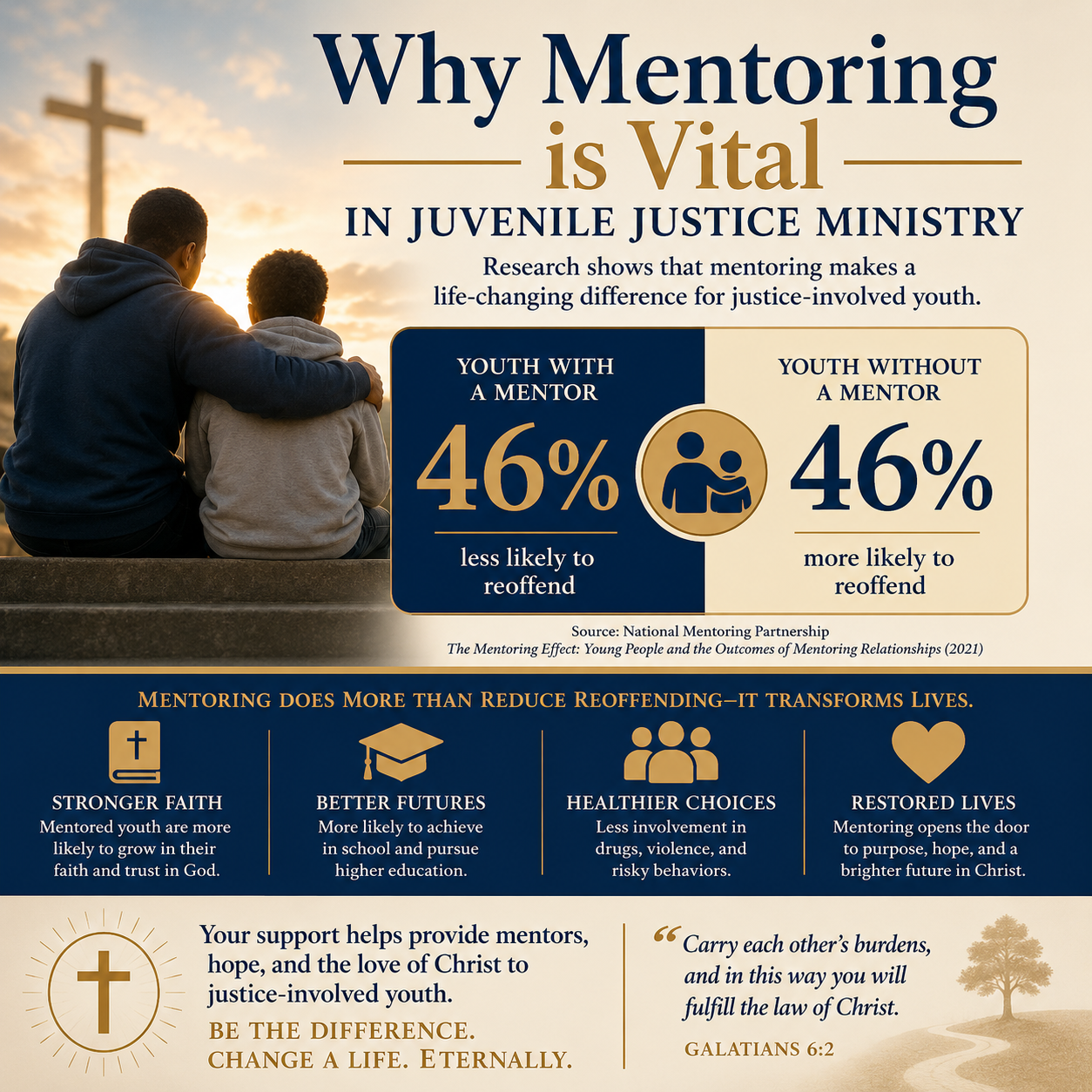
Research in the secular literature aligns with this common-sense reality: stable adult relationships are protective factors for youth development. The specific magnitude of mentoring effects varies widely by program quality and population; the field has learned that “mentoring” is not a single intervention but a family of practices with uneven fidelity. That is precisely why donors should fund mentoring that is structured, supervised, and connected to wraparound support rather than ad hoc goodwill.
What this means in practice for donor-funded mentoring
Across our verification work at Most Trusted, we observe that ministries with serious mentoring models are explicit about what mentors will and will not do. They protect youth from dependency, protect volunteers from overreach, and protect the ministry from avoidable harm. A credible mentoring program in juvenile justice commonly includes:
- Screening, including background checks, with clear disqualifiers and documented decisions
- Trauma-informed training and ongoing coaching rather than one-time orientation
- Written boundaries on contact, gifts, transportation, and social media
- Regular supervision, including case notes or check-ins that are reviewed
- Coordination with facility staff, probation, and family when appropriate and permitted
Donors who care about Prison Ministry for Youth and Juvenile Justice should resist the temptation to equate relational ministry with informality. Relationship is not the absence of structure. In high-risk environments, structure is a form of love.
Mentoring is also where harm can happen and strong governance matters
Boundaries are a theological issue not only a legal one
Mentoring involves spiritual authority, emotional attachment, and unequal power. That combination can be healing, and it can be exploited. The church has learned—often through grievous failure—that good intentions do not prevent harm. Youth in custody may be especially vulnerable to manipulation, and they may test boundaries because boundary-testing is part of how trauma and distrust express themselves. A ministry that treats this lightly should not be funded.
Scripture’s warnings about leaders who devour the vulnerable are not abstract. Jesus’ severe language about causing “one of these little ones who believe in me to sin” (Matthew 18:6) is a moral stake in the ground. It demands that ministries build protective practices that are both spiritually serious and professionally competent.
How donors can evaluate mentoring ministries with moral clarity
Most Trusted exists because donors should not have to choose between compassion and due diligence. Through The Most Trusted Standard, we evaluate ministries across faith foundation, financial integrity, governance and leadership, and transparency and effectiveness. In mentoring-heavy juvenile justice work, governance and safeguarding are not secondary concerns; they are integral to whether the ministry’s witness is credible.
Donors can ask concrete questions that reveal whether a mentoring program is accountable:
- How are mentors recruited, screened, trained, and supervised over time?
- What is the ministry’s incident reporting process, and who reviews reports?
- How does the ministry coordinate with facilities and comply with youth protection policies?
- What outcomes are tracked, and how does the ministry learn when matches fail?
- How are financial controls structured for programs that involve volunteer expenses and material support?
These questions are not a substitute for trust; they are how trust becomes responsible. The ministries that can answer them plainly are often the ministries that have endured long enough to learn where mentoring can go wrong and how to keep it aligned with Christian ethics.
Mentoring aligns donor intent with measurable faithfulness
Christian donors are not merely funding services they are funding witness
Juvenile justice ministry is a place where donors often want two things at once: a clear gospel posture and demonstrable integrity. That is not a contradiction. It is a mature instinct. Faithful ministries can preach Christ without coercion, respect institutional rules without losing pastoral courage, and serve youth without romanticizing their stories. Mentoring, when done well, is one of the clearest ways to embody that integrity because it makes the ministry’s love visible and testable.
Verifiable evidence suggests that youth benefit when programs are consistent and sustained, and consistency is where mentoring programs often succeed or fail. Youth do not need a brief burst of enthusiasm; they need adults who keep promises. Donors should therefore prioritize ministries that can demonstrate retention of mentors, continuity of matches, and concrete pathways from detention-based mentoring to community-based support.
Accountability without cynicism
There is a temptation among sophisticated donors to become cynical about “relationship ministry” because results can be slow and stories can be selectively told. The better response is disciplined hope: fund ministries that can show their work. Ask for policies, training materials, and outcome reporting. Ask how the ministry handles failure—because some mentoring matches will fail. A ministry that can name that reality without defensiveness is often a ministry that is honest enough to improve.
For donors thinking more broadly about Prison and Post-Prison Ministries, mentoring in juvenile justice is a strategic place to invest precisely because early intervention can alter a life trajectory before patterns harden. That strategy is not merely social science; it is consonant with a Christian moral imagination that believes grace can interrupt a story.
FAQs for Why mentoring is vital in juvenile justice ministry
Is mentoring effective for youth in detention or is it mostly inspirational?
Mentoring can be effective, but the evidence depends heavily on program quality, mentor training, match duration, and integration with broader supports. The field is clear that informal, poorly supervised mentoring can be inconsistent and sometimes harmful. Donors should look for structured programs with screening, ongoing supervision, and transparent reporting, because those features make “relationship” a responsible intervention rather than a vague aspiration.
What safeguards should a Christian donor require before funding a mentoring program?
At a minimum, donors should require written youth protection policies, background checks, trauma-informed training, clear boundaries on contact and gifts, documented supervision, and a transparent incident reporting process. Donors should also expect financial controls appropriate to the work and governance that can act decisively when concerns arise. These safeguards protect youth, volunteers, and the credibility of Christian witness.
Mentoring as disciplined mercy
Why mentoring is vital in juvenile justice ministry is ultimately a question about what kind of mercy Christians are called to practice. Mercy in Scripture is not indulgence; it is steadfast love ordered toward restoration. Mentoring can embody that love through consistent presence, truthful accountability, and practical support across the fragile threshold of reentry. When donors fund mentoring that is well-governed and transparent, they are not only helping a young person; they are strengthening a form of ministry that can bear the weight of the gospel in one of society’s most contested places.



