
What youth prison ministry programs help prevent reoffending is not finally a question about activity schedules or religious programming. It is a question about whether a young person leaves confinement with deeper formation, repaired relationships, and credible pathways back into community—supported long enough for new patterns to take root.
Christian donors often feel the weight of two truths that do not fit neatly together. Many incarcerated youth have caused real harm, and their victims deserve serious care and justice. Many of those same youth have also been harmed—by family instability, neglect, addiction in the home, and repeated exposure to violence—long before they ever entered a facility. A ministry that reduces reoffending must take both truths seriously: accountability without despair, mercy without naiveté. Scripture holds these together. God “executes justice for the fatherless” (Deuteronomy 10:18) and also calls his people to “remember those who are in prison” (Hebrews 13:3).
Programs that reduce reoffending are relational and long term
The youth prison ministries most plausibly associated with lower reoffending are not those that rely on occasional events or inspirational talks. They are structured around durable relationships, consistent presence, and a plan that continues after release. In juvenile justice, this “throughcare” logic matters because a young person’s highest-risk period is often the first weeks after returning to the same pressures that shaped earlier choices.
What this means for donors is that the strongest programs are rarely the most photogenic. They invest in volunteers who show up weekly, chaplains who coordinate with facility staff, and case managers who stay involved long after a youth is no longer “in the system.” These efforts are hard to measure quickly, but they align with the biblical pattern of discipleship: patient formation over time rather than a single decisive moment.
Mentoring that survives transitions
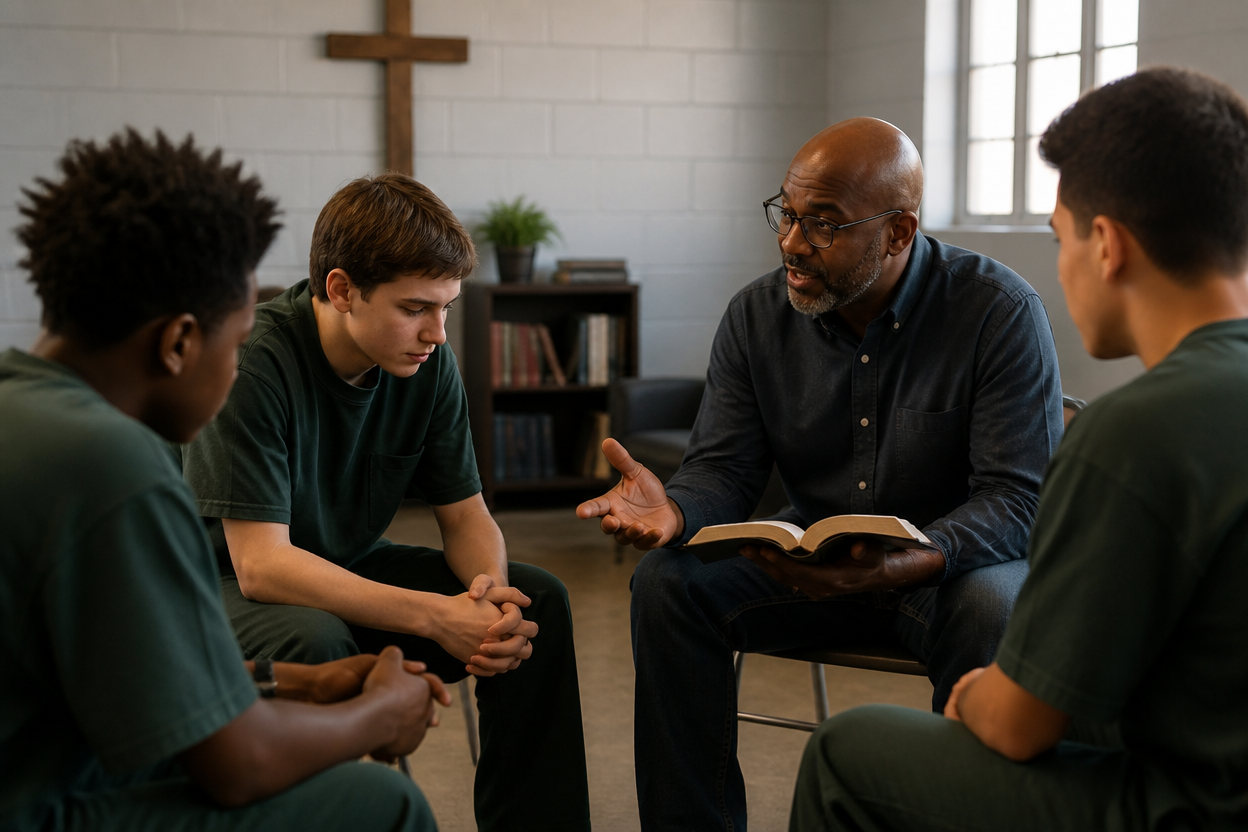
Many ministries use volunteer mentors, but the distinctive feature in stronger models is continuity. The mentor relationship begins in custody, continues through court events and reentry, and remains available when setbacks happen. Transitions are where systems drop youth; ministries can become a rare stable presence.
Volunteer mentoring is not automatically effective. Inconsistent contact can reinforce abandonment narratives for already-traumatized youth. Programs that take training, supervision, and appropriate boundaries seriously are more likely to help rather than harm. Donors should listen for language about screening, trauma awareness, mandated reporting, and collaboration with probation and social services.
Chaplaincy integrated with facility realities
Effective youth prison ministry also understands the daily realities of confinement: lockdowns, staff turnover, and the complex mix of safety and rehabilitation goals inside juvenile facilities. Chaplaincy that is respected by staff, consistent with policy, and attentive to security constraints is more likely to maintain access and build trust.
This is one reason many donors find it helpful to view juvenile work within the broader ecosystem of Prison and Post-Prison Ministries. The same questions arise across the field: continuity of care, responsible volunteer management, and alignment between spiritual formation and practical reentry support.
Faith formation helps most when it is paired with evidence-based practice
Christians genuinely disagree about how much weight to place on “evidence-based” language in ministry. Some fear that it can reduce people to outcomes, or pressure ministries to imitate secular programs. Others recognize that ministries serve real people in real systems, and that ignoring established knowledge about desistance and adolescent development can become a form of presumption rather than faith.
Our view is straightforward: Christian ministry does not need to surrender theological convictions to learn from credible research. The doctrine of common grace gives room to receive true insights wherever they are found. Effective youth prison ministry typically combines clear gospel proclamation with practices that align with what we know about adolescents: identity formation, impulse control still developing, high sensitivity to peer influence, and high responsiveness to stable adult attachment.
Addressing criminogenic needs without replacing the gospel
In juvenile justice, a widely used framework is the risk-needs-responsivity model. The idea is that interventions should match a youth’s risk level, target “criminogenic needs” (such as antisocial peers, substance misuse, and weak family support), and be delivered in ways the youth can receive. The model is commonly summarized in corrections research and practice resources from the National Institute of Corrections at nicic.gov.
Ministries do not have to become therapy providers to take this seriously. They can partner with clinicians, refer to services, and design discipleship that does not avoid the concrete places where sin, suffering, and learned behavior intersect. A Bible study that never speaks to anger, sexuality, substance use, or loyalty to violent peer groups is often too abstract to function as reformation.
Trauma-informed ministry that is not therapeutic posturing
Trauma-informed care has become a broad label, and donors should not accept it as a slogan. In youth facilities, trauma awareness should show up in practical commitments: predictable routines, de-escalation skills, careful use of touch, and refusal to manipulate emotional vulnerability for “spiritual” results.
The Centers for Disease Control and Prevention has long summarized how adverse childhood experiences correlate with later health and behavioral outcomes at cdc.gov. That correlation does not remove responsibility, but it clarifies why many youth respond more to stable presence than to heightened emotional pressure. Ministries that respect this complexity tend to produce more credible spiritual fruit.
Family engagement is often the hinge for long-term change
For many juvenile cases, the most spiritually and practically important “program” is not inside the facility. It is the rebuilding of family systems—or, when a home is unsafe, the formation of alternative support structures that can function like family. A youth may leave confinement with new intentions, but if their home environment remains chaotic or violent, the odds of sustained change drop sharply.
Faithful prison ministry for youth therefore does not romanticize family restoration, nor does it treat separation as a simple solution. The work is discerning, case-by-case, with a sober awareness of abuse, addiction, and manipulation. The Bible’s commitment to households and generations is real, but Scripture also tells the truth about families that wound.
Parent and caregiver discipleship alongside the youth
Programs that engage parents, grandparents, or foster caregivers—through pastoral care, practical support, and spiritual formation—often create the conditions for reentry to succeed. Some ministries coordinate family visitation support, provide transportation, or host caregiver support groups in partnership with local churches.
Donors should ask whether a ministry can articulate a clear safeguarding stance. Family engagement must never force reconciliation where there is ongoing danger. Responsible ministries collaborate with social workers and follow child protection protocols.
Victim awareness without coercive emotionalism
Lower reoffending is closely tied to genuine accountability. In juvenile contexts, this sometimes includes restorative justice practices, which can be beneficial when they are voluntary, well-facilitated, and attentive to victim safety. Poorly executed processes can re-traumatize victims and create shallow “performances” of remorse.
Christian ministry has a distinctive contribution here: a moral universe in which sin is named, restitution is taken seriously, and forgiveness is never demanded from victims as a condition of being “Christian.” A ministry that honors victims and holds youth to truthful confession is more likely to serve public safety and spiritual integrity together.
Education, workforce pathways, and church belonging reduce the reentry cliff
Reoffending is rarely only a spiritual problem, and it is never only an economic problem. It is a web: identity, peers, opportunity, supervision conditions, family stability, and spiritual formation. Youth prison ministry programs that help prevent reoffending typically do two things at once: they strengthen internal formation and they help build an external life that makes obedience plausible.
This is where donors can be tempted to fund what feels most “spiritual” while neglecting what is necessary. Scripture refuses that separation. James treats practical care as a test of living faith (James 2:14–17). Ministry that sends a young person back to a neighborhood with no schooling plan, no employment prospects, and no church community is often setting them up for a predictable collapse.
School continuity and credentialing
Juvenile facilities vary widely in educational quality. Strong ministries advocate for school continuity, support tutoring, and help youth obtain diplomas or GED preparation where appropriate. They also coordinate with reentry schools, alternative programs, and community colleges.
The U.S. Department of Education provides context on education in correctional settings and reentry considerations through resources at ed.gov. Donors do not need to become education experts, but they should look for concrete partnerships and realistic plans.
Church integration that is real belonging, not a photo opportunity
A local church can be one of the most stabilizing institutions in a young person’s life—if it is prepared. The healthiest models treat the church not as a stage for “testimonies,” but as a community that offers consistent worship, appropriate adult oversight, youth programming with clear boundaries, and practical help for the family.
We recommend asking whether a ministry has a church placement process and whether it trains congregations for reentry realities: curfews, ankle monitors, probation conditions, relapse risk, and the slow work of trust-building. For donors interested specifically in youth-focused efforts, Prison Ministry for Youth and Juvenile Justice is where we track patterns and evaluation questions unique to juvenile settings.
What donors should look for when funding youth prison ministry
Christian donors are rightly concerned about credibility. Juvenile justice is a field where outcomes are difficult to attribute, language can be inflated, and earnest intentions are sometimes substituted for accountable practice. The ministries most worthy of serious support tend to be transparent about what they can and cannot claim, and they welcome scrutiny.
At Most Trusted, our verification work focuses on whether a ministry meets The Most Trusted Standard, including faith commitments, financial integrity, governance, and truthful reporting about effectiveness. In youth prison ministry, those questions become especially concrete because vulnerable minors are involved and because the costs of failure are high for victims, families, and communities.
A practical donor checklist
- Continuity: Is there a defined plan from inside the facility through at least 6–12 months post-release, with named roles and handoffs?
- Safeguarding: Are volunteer screening, training, supervision, and mandated-reporting practices clearly stated and consistently followed?
- Partnerships: Does the ministry coordinate with facility staff, probation, schools, and treatment providers rather than operating in isolation?
- Family and victim seriousness: Is family engagement discerning and safety-aware, and does the ministry speak respectfully about victims and restitution?
- Truthful measurement: Does the ministry avoid claiming it “reduces recidivism” unless it can support that claim with appropriate data and methods?
Common tensions that deserve honest answers
First, reoffending is partly shaped by supervision intensity. Some youth are re-incarcerated for technical violations rather than new crimes, and ministries should be careful about how they define success. Second, program impact varies by risk level; what helps a high-risk youth may be unnecessary or counterproductive for a low-risk youth. Third, the spiritual dimension is real, but it is not a substitute for safe housing, school placement, and mental health care.
Donors should not penalize ministries for acknowledging these tensions. A ministry that speaks with restraint is often more credible than one that promises dramatic results without methodological clarity.
FAQs for What youth prison ministry programs help prevent reoffending
Do faith-based programs actually reduce youth recidivism?
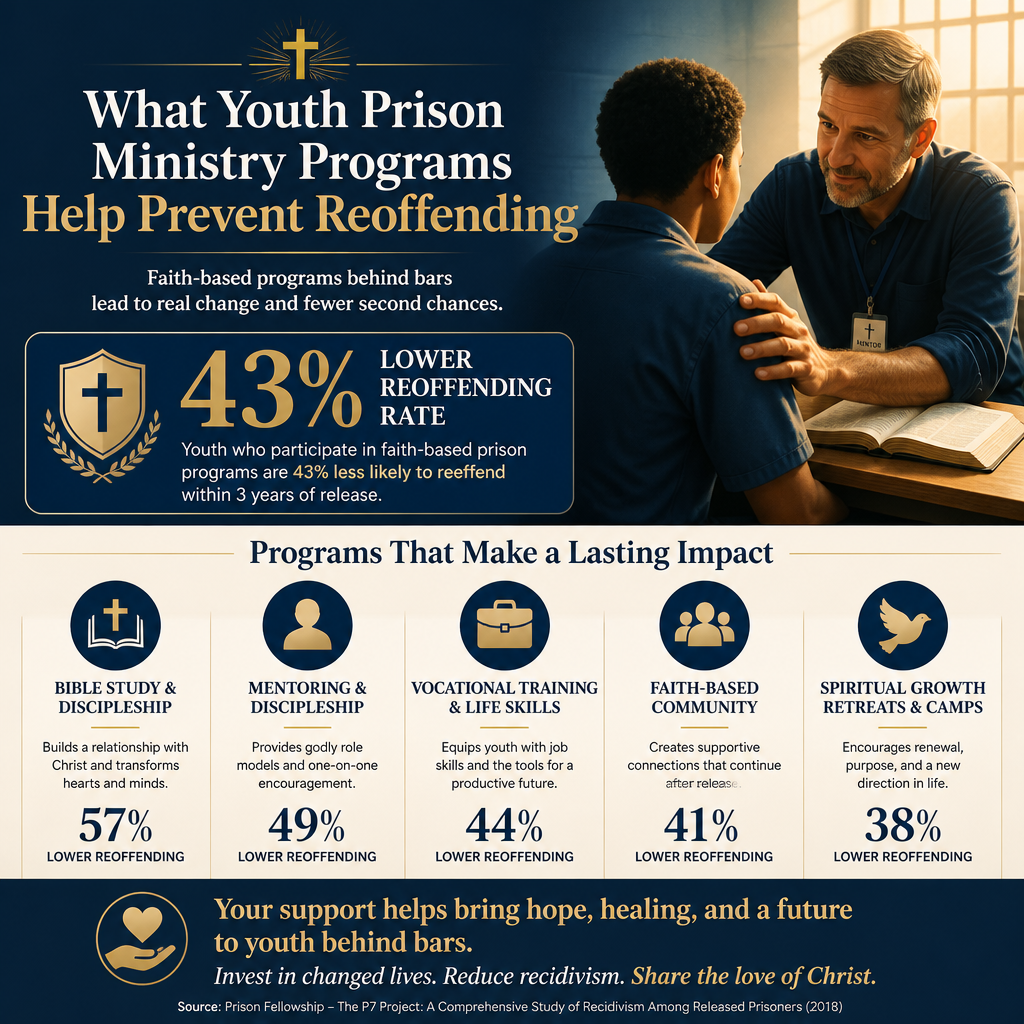
The research base is uneven because many faith-based programs do not have the resources to run rigorous evaluations, and “recidivism” is measured differently across jurisdictions. What we can say with confidence is that the program components most consistently associated with desistance in the broader juvenile justice literature—stable adult relationships, family engagement, educational continuity, and structured reentry support—are all compatible with explicitly Christian ministry, and often strengthened by it when discipleship is practiced with integrity. Donors should fund ministries that describe their theory of change plainly and report outcomes carefully rather than relying on inspirational claims.
What is the most effective use of donor dollars in youth prison ministry?
In many contexts, the highest-leverage funding supports throughcare: trained mentors, reentry case coordination, transportation for family contact and church connection, and partnerships that keep school and work pathways intact after release. Donors should also prioritize safeguarding systems, because ministries serving minors carry heightened ethical and legal responsibilities. Where a ministry has credible oversight and transparent reporting consistent with The Most Trusted Standard, donor dollars are more likely to translate into sustained care rather than short-lived programming.
Conclusion
What youth prison ministry programs help prevent reoffending are those that treat a young person as a moral agent in need of repentance and as a wounded neighbor in need of steadfast care. The most credible models combine gospel clarity with long-term relationships, family and community rebuilding, and practical reentry support that makes new obedience realistic. For Christian donors, the task is not only to fund compassion, but to fund ministries mature enough to tell the truth, protect the vulnerable, and stay present long after the moment of crisis has passed.



