

Why churches need legal advice on child safety is not a niche question for risk managers; it is a spiritual and fiduciary question for the whole Body. When a church receives children in the name of Christ, it assumes obligations that are both biblical and legal, and failures in either domain are not abstract. They carry a human cost for victims and families, and a credibility cost for the gospel in a watching world.
Donors who care about the integrity of Christian witness increasingly ask whether ministries are safe places for the vulnerable. That instinct is sound. Scripture pairs compassion with responsibility: “Whoever causes one of these little ones who believe in me to sin, it would be better for him to have a great millstone fastened around his neck” (Matthew 18:6). Churches should not outsource child safety to good intentions. Legal counsel is one of the ordinary means by which churches practice sober stewardship and neighbor-love.
Child safety is a discipleship issue with legal consequences
Churches are not merely event hosts; they are shepherds. Yet the activities that make churches feel like family—nurseries, youth groups, camps, counseling, transportation, mentoring—are precisely the contexts in which boundary violations can occur. Theologically, the church is called to protect the weak; legally, it is expected to act with reasonable care when it invites minors onto its premises and into its programs.
What this means in practice is that child protection policies are not optional “best practices.” They are part of what it means to be a credible institution. Legal advice helps a church translate moral responsibility into concrete systems: screening, supervision ratios, reporting procedures, documentation, training, and governance oversight.
Good theology does not cancel good process
Christians genuinely disagree about how much institutional formality is healthy for congregational life. Some fear that formal policies suggest distrust, or that they import corporate assumptions into pastoral ministry. The counterpoint is that Scripture is not embarrassed by ordered leadership and accountable structures. When leaders are entrusted with power, Scripture assumes scrutiny. “Moreover, it is required of stewards that they be found faithful” (1 Corinthians 4:2).
Legal counsel does not replace pastoral wisdom; it disciplines it. A child safety policy that lives only in a binder is not faithfulness. A policy that is trained, audited, and enforced is closer to the biblical pattern of guardrails around the vulnerable.
Mandatory reporting is not merely a legal technicality
Many churches learn too late that reporting obligations vary by state, by role, and by the facts known at the time. Legal advice helps clarify who is a mandatory reporter, what constitutes “reasonable suspicion,” when to contact civil authorities, and how to document decisions. That clarity matters because mishandled reporting can harm victims and expose a church to civil liability and criminal penalties.
Donors should also understand the operational reality: in many jurisdictions, child abuse reporting is designed to be made directly to civil authorities, not mediated through internal processes. Legal counsel can help churches build policies that honor both statutory requirements and pastoral care.
Abuse is tragically common, and churches operate in the same world
Churches sometimes assume that abuse is primarily “out there,” and that sincere faith communities are naturally insulated. Verifiable evidence suggests the opposite: child sexual abuse is widespread across society, and institutions that work with children must plan accordingly. The U.S. Centers for Disease Control and Prevention summarizes research indicating that about 1 in 4 girls and 1 in 13 boys experience child sexual abuse at some point in childhood, though prevalence estimates vary by methodology and definition CDC.
This is not a reason for panic; it is a reason for seriousness. If churches minister where children are, churches will inevitably minister where trauma is present. That reality increases the need for staff and volunteers who are trained, supervised, and supported by clear policies that are legally informed.
Institutional trust is fragile, and safeguarding is part of witness
Public trust in institutions has weakened across many sectors, including religious organizations. In 2024, Gallup reported that confidence in “church or organized religion” remained low compared to historical levels Gallup. While trust surveys cannot diagnose root causes on their own, they frame the environment in which churches operate: credibility is not assumed.
For donors, this means that safeguarding is not only an internal compliance matter. It is part of external credibility. Churches that treat child safety as a central governance priority communicate that they understand the moral weight of their calling.
Abuse risk concentrates where access and isolation exist
Most child safety failures do not begin with obvious criminality. They begin with blurred boundaries: informal transportation, unobserved counseling, single-adult supervision, unclear digital communication norms, or a reluctance to ask hard questions about a charismatic volunteer. Legal counsel can help churches identify where access and isolation occur in their specific ministry model and then develop enforceable rules.
There is a tension here worth naming. Churches rightly prize hospitality. Yet hospitality that is not structured becomes a cover for predation. Wise structures are not inhospitable; they are protective.
Legal advice helps churches govern well, not merely avoid lawsuits
When churches seek legal counsel, the motivating fear is often litigation. The deeper opportunity is governance maturity. Strong child protection work requires oversight by elders, boards, or appropriate committees, with clear delegation and clear accountability. Legal advice helps align policies with governing documents, insurance requirements, employment law, and state-specific reporting statutes.
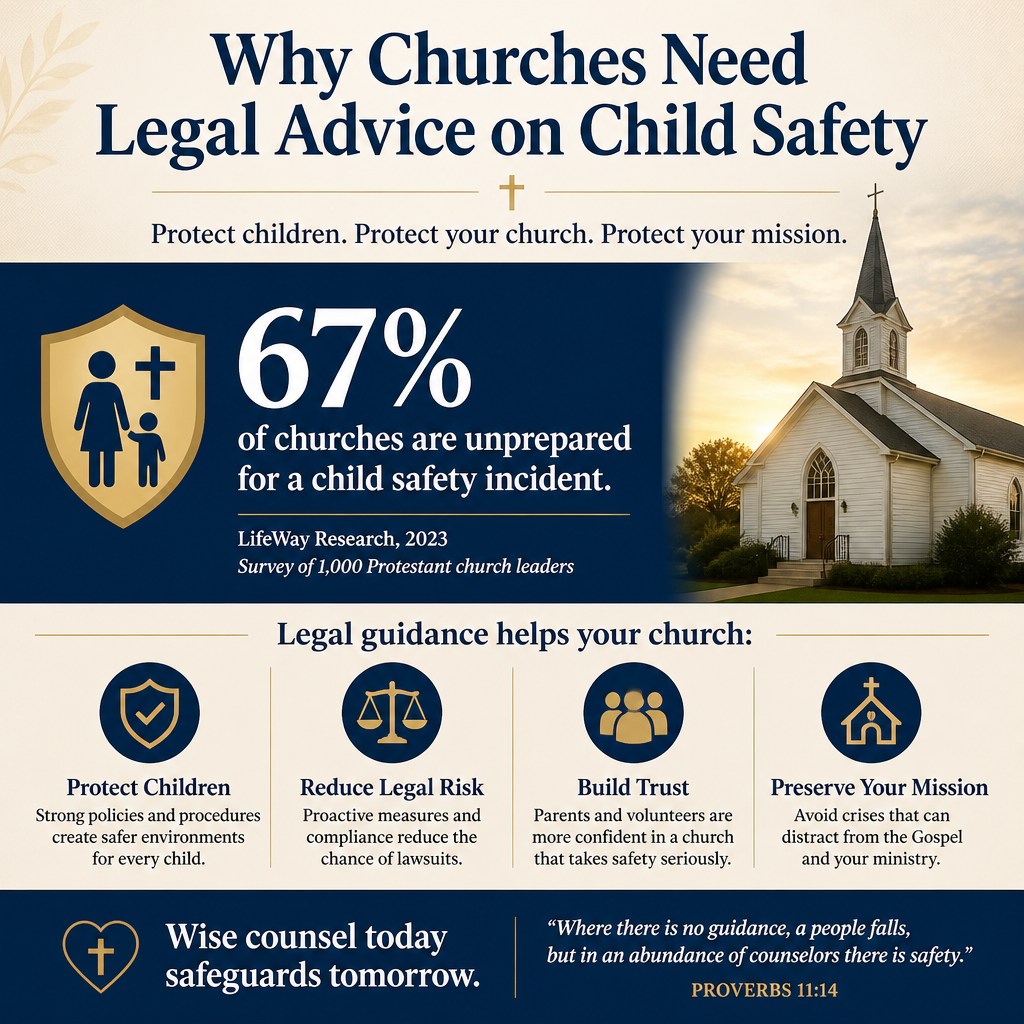
Across our verification work at Most Trusted, we observe that ministries that meet The Most Trusted Standard tend to treat safeguarding as a governance responsibility, not an administrative afterthought. They can describe who owns the policy, how incidents are escalated, how training is tracked, and how exceptions are handled. They do not rely on informal memory or personality-driven enforcement.
Clear roles prevent both harm and confusion
One of the most common failure points is role ambiguity: Who receives allegations? Who contacts authorities? Who informs parents? Who preserves records? Who restricts access to the accused pending investigation? Who communicates with the congregation? Churches are relational by design, which can make role clarity feel cold. In a crisis, role clarity is mercy.
Legal counsel can help churches map responsibilities in a way that respects pastoral care while ensuring that legal duties are met. That includes helping churches avoid retaliation, defamation pitfalls, and inappropriate promises of confidentiality.
Documentation is an act of honesty
Many Christian leaders dislike documentation because it can feel like distrust. Yet documentation is often the difference between credible action and confusion. Training logs, background check records, incident reports, and board minutes are the institutional memory of a church’s integrity. Legal advice helps churches document without violating privacy laws or mishandling sensitive information.
Donors should not confuse documentation with bureaucracy. A church can be warm and well-documented. In fact, a church that refuses documentation often forces survivors to carry the burden of proof alone.
Policies are only as strong as implementation, training, and culture
Even well-written child protection policies fail when training is sporadic, volunteer turnover is high, or leaders avoid enforcement because “we know them.” Legal counsel helps establish minimum standards, but the church must also cultivate a culture where reporting is honored and boundaries are normal.
For donors evaluating a ministry, the question is not merely whether a policy exists. The question is whether it is lived. The Most Trusted Standard emphasizes governance, transparency, and effectiveness because the difference between paper compliance and actual protection is often found in follow-through.
What mature safeguarding systems commonly include
- Background screening and reference checks appropriate to the role, repeated on a defined schedule
- Two-adult or observable-environment rules for children’s and youth programming
- Clear boundaries for digital communication, transportation, and one-on-one meetings
- Mandatory training with documented completion for staff and volunteers
- A reporting and escalation process that prioritizes child safety and compliance with civil law
These are not exhaustive, and they are not identical for every context. Rural churches, multi-site congregations, and specialized ministries face different constraints. Legal advice helps contextualize safeguards without lowering the standard of care.
Third-party support can strengthen credibility
Some churches also rely on outside organizations for training, hotline services, and independent reviews. That can be wise, particularly when internal relationships could compromise objectivity. Yet outsourcing can become a substitute for leadership responsibility if the church treats a vendor as a shield rather than a support.
Where donors see a church investing in competent legal counsel and independent expertise, the more important question is whether leaders are willing to act on what they learn. Legal advice creates clarity; courage creates change.
Donors should fund safeguarding as mission, not overhead
Many churches hesitate to spend money on legal advice, background checks, and training because it feels like money diverted from “real ministry.” The church should reject that false divide. Protecting children is ministry. It is a work of justice and mercy, and it is part of what it means to be trustworthy with the least powerful.
This is also a place where donor expectations matter. When donors implicitly reward only visible programs, churches learn to underinvest in systems that prevent harm. Mature donors ask about safeguarding and accept that meaningful protection costs time and money.
What donors can responsibly ask without micromanaging
Churches vary widely in size and sophistication, and donors should be cautious about imposing one-size demands. Yet basic questions are appropriate:
How does the church screen and train volunteers who work with minors? Who is responsible for handling allegations, and what is the reporting process? Does leadership receive regular safeguarding reports? Is there access to qualified legal counsel when policies are drafted or incidents occur?
Donors who want a wider lens on these questions across the sector can consult our coverage of Christian Legal Services Ministries, where we examine how legal support strengthens governance and public credibility for Christian organizations.
Verification helps donors distinguish aspiration from evidence
Many ministries sincerely believe they are safe because they are well-intentioned. Donors should not confuse sincerity with safeguards. Most Trusted exists to help donors give with confidence by evaluating ministries against The Most Trusted Standard, a 15-criteria framework spanning faith commitments, financial integrity, governance, and public transparency.
When churches and ministries are willing to be examined, they are practicing a form of institutional humility. That humility is not weakness. It is a refusal to treat reputation management as more important than truth.
FAQs for Why churches need legal advice on child safety
Does seeking legal advice signal that a church expects abuse to happen?
No. Seeking legal advice signals that a church takes responsibility for foreseeable risks in any setting where adults have access to children. A seatbelt is not a prediction of an accident; it is a recognition that love includes preparation. In the same way, legal counsel helps churches build systems that reduce risk, clarify reporting obligations, and respond credibly when concerns arise.
What should donors do if a ministry refuses to discuss safeguarding?
Donors should treat silence or defensiveness as a serious concern. A church does not need to disclose confidential details, but it should be able to describe its safeguarding policies, training expectations, and reporting posture. When donors want to compare how ministries approach governance and risk, our work in Christian Legal Services for Churches and Ministries provides a practical reference point for what mature institutional accountability tends to look like.
Safeguarding is part of the church’s public faithfulness
Churches need legal advice on child safety because the church’s calling is not merely to gather people, but to protect them. Faithful ministry requires more than sincere hearts; it requires structures that restrain sin, expose wrongdoing, and defend the vulnerable. Legal counsel is not a substitute for holiness, but it is often one of the means by which a church practices moral clarity, responsible governance, and credible witness in a world that has learned to ask hard questions.



