
How Christian attorneys assist with adoption is often misunderstood as a narrow technical service: getting documents signed, appearing at a hearing, and moving a family across a legal finish line. In practice, the legal work is frequently where spiritual commitments meet the realities of courts, agencies, and cross-border systems. Donors who care about orphan care, family preservation, and the integrity of Christian witness should care about legal excellence because adoption is, inescapably, a public act.
Scripture is unembarrassed about law as a moral instrument. God defends the fatherless and commands his people to do the same, including through just systems that restrain exploitation and protect the vulnerable (Deuteronomy 10:18–19). Adoption ministry that bypasses legal rigor can accidentally empower the very injustices Christians intend to oppose: coercion, document fraud, trafficking, or the quiet erosion of a child’s identity and history. The deeper question for donors is not whether law is “spiritual enough,” but whether ministry partners treat law as neighbor-love made concrete.
Adoption is a legal covenant before it is a sentimental story
What the court is actually doing
Adoption does not simply bless an existing relationship; it creates a new legal parent-child relationship and severs or reshapes prior rights. That is why courts, agencies, and foreign governments require due process, verified consent, and documentation that can withstand scrutiny years later when questions arise about identity, inheritance, or citizenship. Christian attorneys serve families by helping them understand that the hearing is not a formality; it is the state’s attempt—imperfect but necessary—to protect a child from being treated as transferable property.
The need for careful process is not theoretical. The U.S. Department of State has repeatedly warned about adoption-related fraud in some intercountry contexts and has described common abuses, including falsified relinquishment documents and misrepresentation of a child’s orphan status U.S. Department of State. When donors support legal help that insists on documentation integrity, they are not funding bureaucracy; they are funding safeguards.
Where Christian attorneys fit in the adoption ecosystem
Families often assume their agency will “handle the legal part.” Many agencies do handle significant compliance work, but attorneys add a different kind of accountability: they owe duties to clients, are trained to identify legal risk, and can press for clarity when interests conflict. The best Christian legal services ministries also know their lane. They do not sell outcomes they cannot guarantee. They tell the truth about timelines, evidentiary burdens, and the consequences of shortcuts.
Across our verification work at Most Trusted, we observe that ministries serving adoptive families well tend to treat legal services as one part of a larger ethical posture. They can describe their standards for informed consent, child welfare best practices, and anti-exploitation safeguards with specificity rather than sentiment. This is one reason donors gravitate toward organizations that can be evaluated against The Most Trusted Standard, where clarity and accountability are not optional virtues.

Competent legal work protects children and honors birth families
Consent, coercion, and the hard questions
Christians genuinely disagree about how to weigh adoption and family preservation in various settings, especially where poverty is the primary pressure on parents. The debate is not solved by slogans. It requires careful distinctions: voluntary relinquishment versus coerced relinquishment; temporary caregiving versus permanent termination of parental rights; the difference between a crisis pregnancy and long-term incapacity.
Attorneys cannot resolve every moral tension, but they can insist on legal and ethical clarity. Competent counsel asks whether consent was informed, whether translation was adequate, whether alternatives were explained, and whether any party gained financially in a way that creates improper incentives. When lawyers press these questions, they protect children from being separated from their families unnecessarily and protect birth parents from being treated as obstacles to someone else’s dream.
Documentation that will still matter in twenty years
Many adult adoptees describe the ache of missing information: original names, medical history, the true circumstances of relinquishment. Legal work is one of the few places where that information can be preserved with integrity. Christian attorneys can help families request records appropriately, comply with confidentiality laws, and advocate for documentation practices that respect the child’s future right to understand their own story.
Donors sometimes prefer visible, immediate ministry outcomes. Legal documentation is not visible. Yet it can be an act of long-term mercy. When a child later seeks citizenship proof, a passport renewal, or access to medical history, the paper trail becomes a practical form of neighbor-love.
Christian attorneys help families comply without losing their moral bearings
Domestic adoption, foster care adoption, and intercountry adoption
Each adoption pathway carries distinct legal complexities. Domestic infant adoption involves state-by-state variation in consent periods, termination procedures, advertising rules, and allowable expenses. Foster care adoption is bound up with child welfare statutes, reasonable efforts requirements, and the rights of biological parents. Intercountry adoption intersects with U.S. immigration law, foreign legal systems, and international treaties.
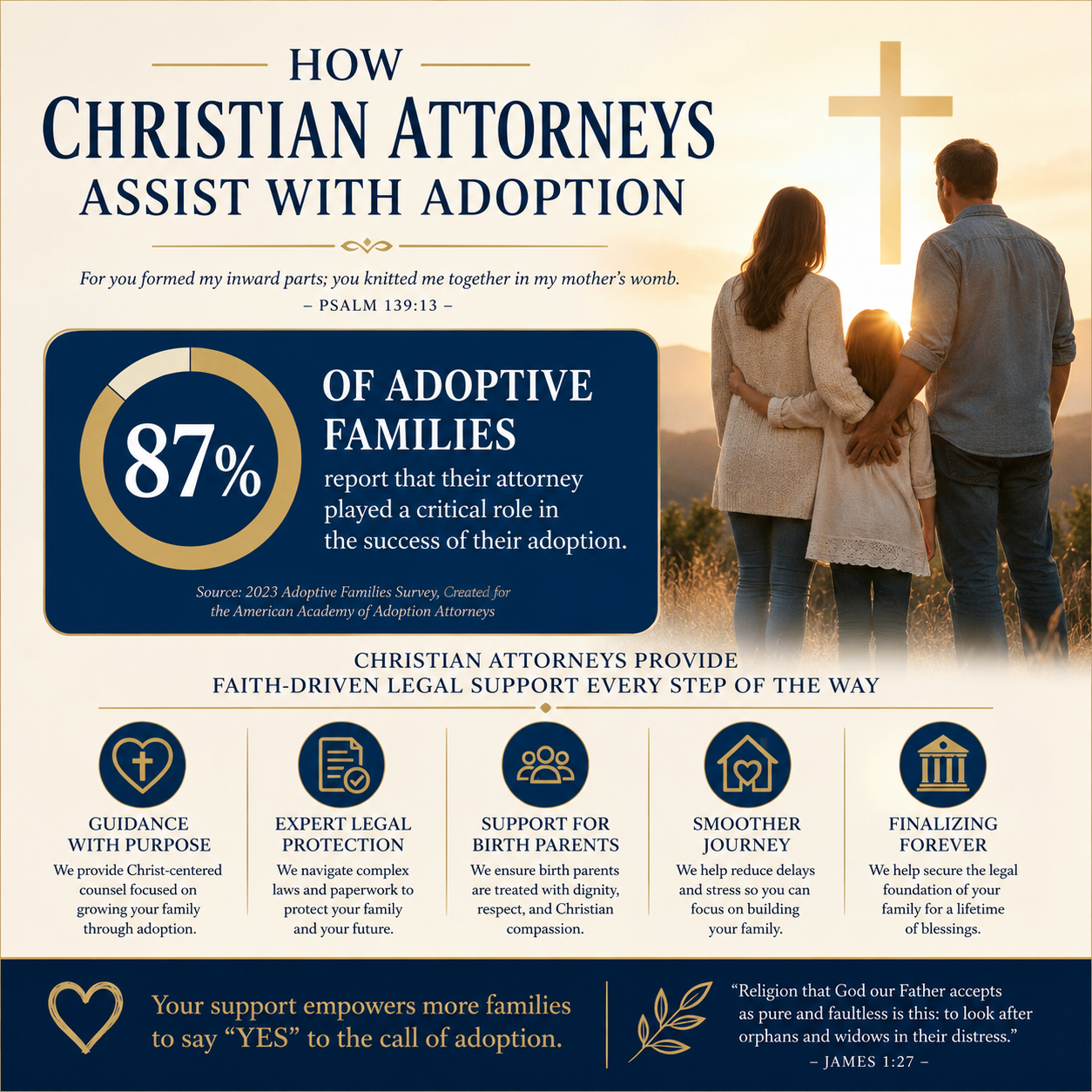
The Hague Adoption Convention, for example, establishes standards intended to prevent abduction, sale, and trafficking and to ensure adoptions take place in the child’s best interests Hague Conference on Private International Law. Attorneys who understand these frameworks protect families from well-intentioned mistakes that can jeopardize a child’s status or expose the family to later challenges.
When the law is not the enemy, but it is not the savior
Christian donors tend to hold two instincts in tension: gratitude for ordered institutions and skepticism about systems that can dehumanize. Both instincts are warranted. The law can be used to protect the vulnerable; it can also be used to obscure injustice behind procedure. Wise Christian legal counsel helps families comply with requirements without confusing compliance with righteousness.
This is also where donor support matters. When ministries can subsidize competent legal help for lower-income families, they reduce the temptation to seek cheaper, riskier paths. Legal aid can become a stabilizing force that keeps good intentions from turning into preventable harm.
What donors should look for in Christian legal services ministries
Signals of integrity that are not marketing claims
Adoption is emotionally charged, and that makes the field vulnerable to overpromising. The ministries most worthy of donor confidence are usually not the loudest. They are the ones that can articulate policies, safeguards, and accountability structures in plain language. They can also name what they will not do.
For donors evaluating ministries in the wider ecosystem of Christian legal support, we recommend starting with the broader landscape of Christian Legal Services Ministries and then narrowing to the family-focused categories where adoption-related work is more concentrated. Clarity about an organization’s scope—legal representation, education, referral networks, or funding—prevents misplaced expectations and helps donors fund what actually exists.
A short due diligence checklist for adoption-related legal work
The following questions tend to reveal whether an organization is committed to ethical, child-centered practice:
- Do they explain how they guard against coercion and document fraud, especially in intercountry contexts?
- Do they provide written fee policies and limits on allowable expenses, with transparency about who pays whom?
- Do they describe their qualifications and supervisory structures for legal work, including referral standards when they cannot represent a family?
- Do they have clear conflict-of-interest policies, especially when partnering with agencies or facilitators?
- Do they address post-adoption legal needs such as readoption, citizenship, and name changes?
Some donors hesitate to fund legal work because it feels indirect. Yet legal services often prevent downstream crises that are expensive in money and devastating in human cost.
How verification strengthens adoption-related giving
Why trust requires more than a compelling story
Many adoption-related appeals are sincere, and sincerity is not enough. The adoption field has had to reckon with scandals, misaligned incentives, and avoidable harm. Donors who want to love wisely need tools to separate a ministry’s public narrative from its operational realities.
Most Trusted exists for that purpose. We evaluate Christian nonprofits against The Most Trusted Standard, a 15-criteria framework that tests whether an organization’s faith commitments are coherent, its finances are handled with integrity, its leadership and governance are accountable, and its transparency and effectiveness claims can be substantiated. For adoption-related legal services, these criteria translate into concrete questions: Are funds restricted and reported clearly? Are outcomes described truthfully? Are safeguarding policies enforced? Are partnerships vetted?
Funding the long middle of the adoption journey
Donor attention often clusters around the moment of placement. But much of adoption’s difficulty lies in the long middle: paperwork delays, contested terminations, immigration complications, post-placement supervision, and post-adoption legal corrections. For example, U.S. Citizenship and Immigration Services provides formal guidance on how children adopted abroad acquire citizenship and when additional steps may be required USCIS. Ministries that can competently support families through these realities are serving the church’s long-term health, not merely its emotional peak moments.
Donors who want to strengthen Christian witness in adoption should consider whether their giving supports durable competence, not only heartfelt desire. The church’s credibility is strengthened when our families are helped to do hard things lawfully, truthfully, and with humility.
FAQs for How Christian attorneys assist with adoption
Do Christian attorneys make adoption faster?
Sometimes they remove preventable delays by ensuring documents are complete, deadlines are met, and filings match statutory requirements. They cannot control agency backlogs, court calendars, or foreign government processes. The more reliable contribution is risk reduction: preventing errors that create years-long complications for a child’s legal status, identity records, or citizenship.
What is a responsible way for donors to fund adoption-related legal work?
Responsible funding is specific and accountable. Many donors choose to support legal aid funds administered with written eligibility criteria, clear restrictions, and transparent reporting. Others fund ministries that provide vetted referrals and education so families avoid unethical facilitators. In either case, donors should prioritize organizations that can demonstrate governance, financial integrity, and safeguarding practices consistent with The Most Trusted Standard, including honest communication about what legal services can and cannot accomplish.
Legal excellence as a form of Christian neighbor-love
When Christian attorneys assist with adoption well, they do more than manage paperwork. They help ensure that a child’s story is handled with truth, that a birth family’s rights are treated with seriousness, and that adoptive parents enter their covenant with sober clarity. Donors who fund this work are not merely underwriting legal process; they are strengthening the church’s capacity to pursue mercy without enabling harm, and to welcome children with integrity that can endure public scrutiny.
For donors focusing on giving in this area, it is often helpful to assess adoption-related work within the broader field of Christian Legal Services for Family and Life Issues, where the same commitment to truth, protection, and accountable practice applies across many contested and consequential questions.



