
Why Christians choose faith-based donor-advised funds is ultimately a question about formation as much as finance. A donor-advised fund can either reinforce the habits of consumer choice or deepen the habits of Christian stewardship, depending on the convictions and accountability structures built into it.
Many donors come to this tool after years of faithful giving and a growing recognition that generosity is not only a moment of compassion but also a long obedience. The modern giving landscape is crowded with urgent appeals, strong branding, and uneven ministry quality. A serious Christian donor is not merely asking, “Where can we send money?” but, “How can our giving remain faithful, credible, and fruitful over decades?”
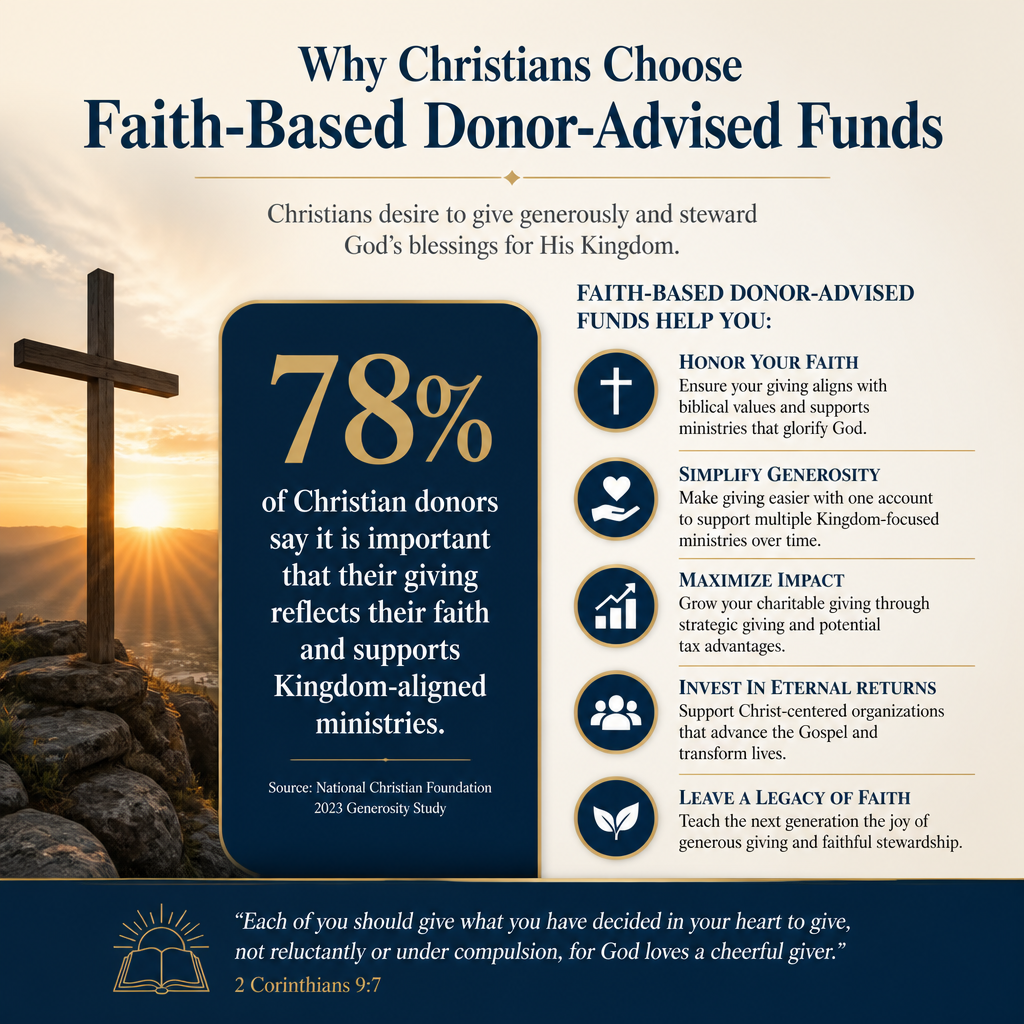
Faith-based donor-advised funds connect giving to discipleship
Stewardship is a spiritual question before it is a tax question
Scripture treats money as a window into the heart. Jesus’ warnings about wealth and divided allegiance are not marginal teachings; they sit near the center of his public ministry. “Where your treasure is, there your heart will be also” (Matthew 6:21). For many Christian donors, a faith-based donor-advised fund is appealing because it treats giving as moral and theological, not merely transactional.
A mainstream donor-advised fund can be an administratively efficient tool, and some Christians use one with clarity and integrity. The harder question is whether the platform itself encourages distinctly Christian discernment. A faith-based donor-advised fund signals, at minimum, that biblical priorities matter: the nature of the organizations we support, the ends we seek, and the means we consider permissible.
Many donors want guardrails aligned with Christian conscience
Christians genuinely disagree about the appropriate boundaries for giving. Some donors want strict screens against organizations that contradict historic Christian teaching on life, marriage, and the nature of the human person. Others prioritize shared mercy outcomes even when institutional commitments are less aligned. Faith-based donor-advised funds tend to address this tension directly by offering values-based grantmaking policies and curated ministry options, rather than leaving donors to do all discernment alone.
That said, “faith-based” is not a guarantee of theological seriousness. Donors still need to ask: Which doctrine is assumed? Which accountability structures exist? How are disputes handled? Mature stewardship does not outsource conscience; it seeks wise counsel and transparent standards.

They offer simplicity without surrendering discernment
Administrative clarity can strengthen long-term generosity
Many Christian households give to a local church, support several ministries, respond to crisis appeals, and make periodic gifts in memory or honor of others. Over time, the administrative friction is real: receipts, year-end summaries, recurring gift management, and the question of how to give appreciated assets responsibly. A donor-advised fund can reduce that friction by separating the act of contributing to the fund from the act of recommending grants.
The aim is not convenience for its own sake. It is the cultivation of consistent generosity. When the logistical burden is lowered, donors often find it easier to sustain faithful patterns of giving across seasons of life, including seasons when decisions are emotionally costly or time is limited.
Discernment still requires evidence, not impressions
Ease can also create spiritual risk. When grant recommendations become quick clicks, donors may drift from careful evaluation into reactive giving. The contemporary nonprofit environment rewards compelling stories and polished messaging, even when programs are weak or governance is brittle. This is one reason many sophisticated Christian donors pair a donor-advised fund with independent verification and disciplined research.
At Most Trusted, we exist for that purpose: helping donors give with confidence by evaluating ministries against The Most Trusted Standard, a 15-criteria framework spanning Faith Foundation, Financial Integrity, Governance and Leadership, and Transparency and Effectiveness. Across our verification work, we observe that the ministries most worthy of long-term partnership tend to communicate clearly, document outcomes honestly, and welcome scrutiny as a form of accountability rather than a threat.
They help donors address the trust problem in Christian philanthropy
Christian donors are not wrong to feel cautious
Christian giving is shaped by love of neighbor, but it is also shaped by a sober doctrine of sin. Organizations can drift, leaders can misuse funds, and good intentions can produce unintended harm. A donor’s caution is not cynicism; it can be prudence. The New Testament repeatedly calls for tested character and visible integrity in leadership, especially where resources are involved.
Public trust in institutions has weakened broadly, and ministries operate within that environment. When donors have seen moral failure, financial misconduct, or manipulated reporting—whether in a local context or a nationally visible one—they often respond by tightening their giving or retreating into a small circle of familiar organizations. The tragedy is that retreat can reduce support for faithful work that deserves it.
Verification strengthens both courage and restraint
Faith-based donor-advised funds often attract donors who want both theological alignment and credible oversight. Yet alignment is not the same as integrity. A ministry can share orthodox language and still fail at governance, financial controls, or honest reporting. Conversely, a ministry can be less polished and still be deeply accountable.
What this means in practice is that donors need signals that are verifiable. When evaluating a ministry for long-term support, many donors look for a small set of indicators that are not easily staged:
- Clear doctrinal commitments that are more than marketing language
- Board governance with independence and documented oversight
- Financial statements that are timely, consistent, and reviewable
- Fundraising practices that avoid manipulation and disclose restrictions
- Program reporting that names both outcomes and limitations
A donor-advised fund does not solve these questions by itself, but a faith-based setting can encourage them, and independent verification can make them actionable. Donors looking for a broader orientation to this space can also review Christian Donor-Advised Funds as a reference point for the distinct decisions Christian families face.
They can reflect a theology of time, not only a strategy for taxes
Planning is not a lack of faith
Some Christians hesitate to plan giving because they fear it resembles worldly control. Yet Scripture commends prudent preparation. Joseph’s stewardship in Genesis is not portrayed as unbelief but as wisdom under God’s providence. Planning can be a form of humility: acknowledging that resources are finite, needs are enduring, and clarity helps prevent both neglect and impulse.
Donor-advised funds are sometimes associated in the public mind with tax strategy. That association is not entirely wrong; a DAF can be tax-efficient. But the Christian question is not whether a tool has financial benefits. The question is whether those benefits are pursued in a way that serves love of God and neighbor. Many donors choose faith-based donor-advised funds because they want planning to remain accountable to mission, not to self-preservation.
A DAF can help families give across generations
Christian donors frequently carry a second burden beyond due diligence: formation of children and grandchildren. Many families have seen that wealth, unmanaged, can deform the soul. They want generosity to be taught, practiced, and normalized. A donor-advised fund can become a practical setting for that formation: children participating in research, discussing priorities, and learning how the church and global mission actually operate.
This generational dimension is also where tensions emerge. Some families want to bind future grantmaking tightly to specific doctrinal commitments; others want to allow flexibility as callings and global needs change. A wise approach usually distinguishes between convictions that are non-negotiable and preferences that are contextual, then documents both with clarity. The goal is not control for its own sake, but faithfulness over time.
They concentrate attention on faithful ends and faithful means
Christian ethics cares about how ministry is done
Donors often focus on outcomes: people fed, churches planted, prisoners discipled, children educated. Outcomes matter, but Christian ethics also asks whether the ministry’s methods honor the image of God in those served. The field has had to reckon with the reality that charity can unintentionally create dependency, undermine local agency, or displace local institutions.
The When Helping Hurts framework, articulated by Steve Corbett and Brian Fikkert, has helped many Christian donors and practitioners name these patterns and pursue more dignifying approaches to poverty alleviation (When Helping Hurts). This is part of why some donors prefer faith-based donor-advised funds that curate ministries with a clear theology of poverty, development, and local partnership rather than treating generosity as a simple transfer of resources.
Donors are increasingly wary of simplistic financial ratios
Christian donors also face the temptation to treat overhead ratios as a proxy for integrity. That instinct is understandable, but it is incomplete. The nonprofit sector has repeatedly warned donors against using overhead as the primary measure of effectiveness; in 2013, Charity Navigator, GuideStar, and the BBB Wise Giving Alliance issued a joint letter urging donors to consider results, transparency, and governance rather than overhead alone (Charity Navigator). A mature donor uses financial data, but reads it as part of a fuller picture.
Most Trusted’s verification approach reflects this broader view. The Most Trusted Standard examines governance, financial integrity, and transparency alongside faith commitments because Christian donors are responsible for more than avoiding scandal. We are responsible for partnering with ministries whose practices match their stated theology and whose reporting enables honest accountability.
For donors assessing whether a faith-based giving approach is consistent with their values, Faith-Based Stewardship in Christian Donor-Advised Funds offers a focused way to consider how theological convictions and financial decisions intersect.
FAQs for Why Christians choose faith-based donor-advised funds
Are faith-based donor-advised funds only about aligning with “Christian causes”?
No. Many donors choose a faith-based donor-advised fund because they want their giving practices shaped by Christian moral reasoning: clarity about mission, honesty in reporting, governance that resists celebrity culture, and grantmaking that honors the dignity of people served. Cause alignment matters, but Christian stewardship also weighs the character of institutions and the integrity of methods.
Does using a donor-advised fund reduce a donor’s responsibility to vet ministries?
A DAF can reduce administrative workload, but it does not remove moral responsibility. Christian donors still need to assess doctrine, governance, financial integrity, and transparency. A faith-based platform may offer helpful screens or curated options, but due diligence remains essential—especially for larger or recurring grants where long-term partnership and reputational association are involved.
A tool is only as faithful as the stewardship behind it
Faith-based donor-advised funds appeal to Christians because they can hold together two commitments that often drift apart: thoughtful planning and theological accountability. They can simplify the mechanics of giving while raising the standard for discernment, helping donors pursue generosity that is both joyful and credible.
For mature Christian donors, the central question is not whether a donor-advised fund is available, but whether our giving is being formed toward faithfulness. When donors pair wise tools with verifiable standards and transparent ministry partners, generosity becomes less reactive and more enduring—an expression of love ordered by truth.



