
Investment screens Christian donor-advised funds use are not a peripheral detail for Christian donors. They are a moral and theological question about participation: what we own, and what we profit from, forms us, and it can either align with love of neighbor or quietly contradict it.
Donor-advised funds are frequently discussed as a vehicle for generosity. Mature stewardship asks a prior question: what is the donor-advised fund doing with the assets while gifts are being planned and grants are being made? The logic of Christian stewardship is not only about where money goes, but also about how money is held.
Why investment screens matter for Christian donors
Stewardship includes the means as well as the ends
Scripture treats money as spiritually consequential, not neutral. Jesus’ repeated warnings about wealth are not only about donation size; they address what money does to the heart, the imagination, and the conscience. Christian donors often feel this tension when a ministry gift is intended to honor Christ, yet the investment platform underneath it benefits industries that degrade human dignity.
What this means in practice is that “mission-aligned giving” can be undermined by “mission-misaligned holding.” If a Christian donor-advised fund is invested in companies connected to pornography, predatory lending, abortion services, or human-rights abuses, the account may generate returns that are difficult to reconcile with the donor’s discipleship commitments, even if grants ultimately go to faithful ministries.
Christians disagree about boundaries, but not about accountability
Christians genuinely disagree about where to draw some lines. For example, some prioritize strict sector exclusions; others prioritize engagement and shareholder influence; still others emphasize broad market exposure to maximize long-term grantmaking. The field has had to reckon with a second-order question: when does cooperation become complicity, and when does distance become a substitute for costly obedience?
Even with disagreement, serious Christian stewardship insists on accountability. A fund sponsor should be able to explain what is screened, how it is screened, how often screens are reviewed, and what happens when a holding falls out of compliance.

The main types of screens Christian donor-advised funds use
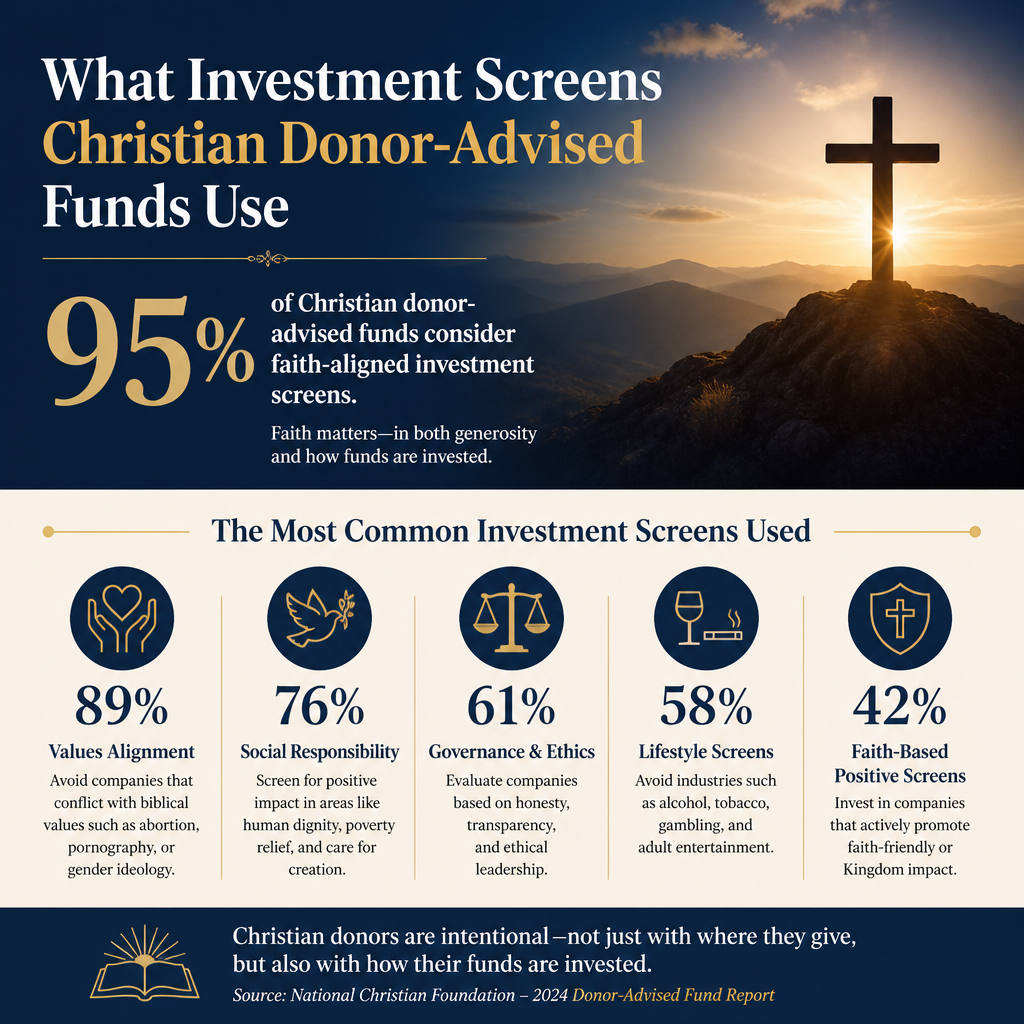
Negative screens and values-based exclusions
The most common approach is a set of negative screens that exclude defined categories of companies. These policies often draw from historic socially responsible investing, but in explicitly Christian form. The strength is clarity: donors can see what the sponsor is unwilling to profit from. The weakness is that clarity depends on definitions and data, and definitions are where sponsors often differ.
Common exclusion categories include abortion providers and manufacturers of abortifacients, pornography and adult entertainment, gambling, tobacco, cannabis, and weapons. Some Christian sponsors also screen for human trafficking risk, severe labor violations, and certain forms of predatory lending. Because corporate structures vary and revenue streams can be mixed, sponsors may set thresholds, such as excluding companies that derive more than a stated percentage of revenue from a prohibited activity.
Positive screens and faith-consistent inclusion
Some funds add positive screens, seeking companies that demonstrate strong practices in areas like family-supportive employment, integrity in advertising, fair lending, or reduced exposure to exploitative supply chains. Positive screens can better reflect the biblical theme that righteousness is not merely the absence of evil, but the active pursuit of good.
However, positive screens are typically more interpretive. They rely on measurement frameworks and data providers that may not share Christian moral reasoning, and they require a sponsor to explain how it translates general corporate metrics into faith-consistent judgments.
How screens are implemented in actual DAF portfolios
Mutual funds and ETFs versus custom-managed accounts
Many Christian donor-advised funds offer prebuilt model portfolios using mutual funds and ETFs, sometimes from large providers and sometimes from faith-based managers. Screens are then applied at the fund selection level: the sponsor selects funds that claim a values-based methodology and excludes funds that do not.
Other sponsors offer separately managed accounts in which individual securities can be screened directly. This can allow tighter adherence to stated standards and quicker removal of a non-compliant holding. It also tends to require higher account minimums and can introduce tracking error compared to broad indexes.
Direct indexing and the promise of greater precision
Direct indexing has become more visible in the broader market. In principle, it allows a sponsor to approximate an index while removing objectionable companies and reweighting the remainder. For Christian donors, the attraction is moral precision without abandoning diversification. The trade-off is complexity: screens must be translated into rules, exceptions must be managed, and donors should understand that “index-like” is not the same as “index-identical.”
When evaluating a sponsor’s claims, donors should ask whether screens operate at the marketing level or at the actual holdings level. A statement of values is not the same as a verified investment policy.
What Christian donors should ask before opening or funding a DAF
Policy transparency and definitional clarity
Christian donors often discover too late that a sponsor’s “faith-based” label lacks clear definitions. Some policies exclude only a small set of categories, while others address a broader moral landscape. Some remove a company entirely if it touches a prohibited area; others use revenue thresholds that may allow meaningful exposure.
A prudent set of questions includes:
- What categories are excluded, and how are the categories defined?
- Do screens use revenue thresholds, and if so, what are they?
- Who is the data provider, and how often is the screen updated?
- Are screens applied to every portfolio option, or only to select models?
- What happens when a holding is later found to violate the policy?
Trade-offs: diversification, performance, and moral witness
Donors should not be surprised that rigorous screens can create trade-offs. Excluding sectors can increase concentration in remaining industries and can lead to performance differences relative to the broad market. Christian donors differ on how to weigh those outcomes. Some will accept lower expected returns as part of moral witness; others will seek approaches that remain broadly diversified while still avoiding clear participation in grave wrongs.
The field’s debates here are not merely technical. They are rooted in different readings of prudence, neighbor love, and the purpose of wealth. A donor-advised fund sponsor earns credibility by naming these trade-offs plainly rather than promising moral purity with no cost.
Where Most Trusted fits in a Christian donor due diligence process
Aligning your giving vehicle and your giving targets
Christian donors typically evaluate ministries for theological fidelity and operational integrity. The giving vehicle deserves parallel scrutiny. A fund can be administratively excellent and yet ethically thin in its investment discipline. Conversely, a sponsor may offer strong screening and still leave donors with questions about which ministries to support and how to verify them.
Across our verification work at Most Trusted, we see donors gain confidence when diligence is applied consistently. A Christian donor-advised fund may help with grantmaking workflow and investment stewardship. Most donors still want a disciplined way to evaluate recipient ministries.
Most Trusted exists to serve that need. We evaluate Christian nonprofits against The Most Trusted Standard, a 15-criteria framework across Faith Foundation, Financial Integrity, Governance and Leadership, and Transparency and Effectiveness. The goal is not to replace pastoral discernment, but to ground generosity in verifiable evidence where evidence is available and to name risk where it is not.
Integrating faith-based stewardship across the whole generosity strategy
DAF screens address how assets are held. Verification addresses where grants go. Mature stewardship holds both together. For donors building a long-term plan, it is often helpful to step back and consider the broader landscape of Christian Donor-Advised Funds as well as the practical discipline of Faith-Based Stewardship in Christian Donor-Advised Funds. The same moral seriousness that motivates generosity should also shape the structures that carry it.
One additional tension deserves candor: even the best screening methodologies depend on imperfect data. Corporate disclosures are uneven, subsidiaries can obscure revenue sources, and index funds can change holdings rapidly. Donors should favor sponsors that are honest about limits, publish their methodology, and demonstrate governance that treats screens as a fiduciary and moral responsibility rather than a marketing feature.
FAQs for What investment screens Christian donor-advised funds use
Do Christian donor-advised funds all screen out the same categories?
No. Many Christian donor-advised funds share core exclusions such as pornography and abortion-related exposure, but policies vary widely in scope, definitions, and revenue thresholds. The responsible approach is to ask for the sponsor’s written screening policy, the data source used to apply it, and how frequently holdings are reviewed for compliance.
Is shareholder engagement a substitute for exclusionary screens?
It can be a meaningful complement, but it is not the same thing. Engagement strategies seek change through voting, dialogue, and shareholder proposals. Exclusion seeks distance from profit participation in defined activities. Christian donors differ on which approach best fits conscience and calling, and some sponsors offer both. A credible sponsor should explain when it chooses engagement, what outcomes it seeks, and where it draws a line that requires divestment.
A disciplined approach to investment screening is part of Christian witness
Christian donor-advised funds can be a constructive tool for long-term generosity, but only if the underlying investment practice is treated as moral action, not administrative detail. Investment screens are where stated convictions become operational. For Christian donors who want their giving to reflect the Lordship of Christ, that operational layer deserves careful questions, documented answers, and a willingness to accept the real trade-offs that integrity sometimes requires.



