
Why Christian senior care ministries invest in spiritual care is ultimately a question about what we believe a human person is, and what faithfulness looks like near the end of life. If older adults are created in the image of God, then care that addresses only the body and neglects the soul is not neutral; it is incomplete.
Donors often feel this tension acutely. We want to relieve suffering in tangible ways, and we also want ministries to honor Christ’s command to “visit” and to remain present with the vulnerable (Matthew 25:36). Yet spiritual care can be misunderstood as either a marketing flourish or a private matter best left to families and local churches. Mature senior care ministries invest in spiritual care because aging raises questions medicine cannot answer, and because the Church has always understood mercy as both practical and pastoral.
Spiritual care is not an add on to healthcare but a core part of Christian mercy
A biblical account of the whole person
Christian senior care rests on a theological claim: the elderly are not a problem to manage but neighbors to honor. Scripture repeatedly binds reverence for God to concrete care for the vulnerable, including those whose strength has diminished. The command to “honor your father and your mother” does not expire when dependence increases; it becomes more demanding. Christian compassion refuses the modern instinct to treat weakness as a failure of productivity.
For that reason, spiritual care is not simply “religious programming.” At its best, it is the ministry of presence, prayer, Scripture, confession, assurance, and hope offered in the very places where fear, grief, and isolation concentrate. When a resident loses mobility, a spouse, or memory, the questions that surface are often explicitly spiritual: What has my life meant? Has God abandoned me? What do I do with guilt? What happens when I die?
Mercy that acknowledges suffering without surrendering hope
Christians genuinely disagree about how overtly evangelistic a senior care setting should be, especially when serving residents from multiple faith backgrounds. But there is broad Christian agreement that suffering is not merely a technical problem. Even excellent clinical care cannot provide forgiveness, reconcile estranged families, or prepare a soul for death. Ministries that treat spiritual care as core are acknowledging the actual terrain older adults inhabit.
Donors should also recognize what spiritual care is not. It is not coercion. It is not a substitute for licensed mental health care. It is not an excuse to underfund nursing, therapy, or safety. Properly ordered, it complements clinical care and strengthens it, because it addresses meaning, relationships, and conscience rather than pretending those realities are irrelevant.

What aging does to a person is also spiritual and relational
Loneliness is a clinical risk and a pastoral burden
Late life often brings a narrowing of social circles through bereavement, disability, and relocation. Loneliness is not merely sad; it is associated with measurable health consequences. The U.S. Surgeon General has warned that social disconnection is linked with increased risk of premature mortality, with impact comparable to established health risks, and has called it a public health concern (U.S. Department of Health and Human Services).
Christian senior care ministries invest in spiritual care because isolation is not only a risk factor but a spiritual condition. A faithful chaplaincy and congregational life within a community can create rhythms of belonging: worship, shared prayer, pastoral visitation, and simple conversation that reminds a resident they are still seen. Many donors have watched loneliness erode a parent’s resilience faster than disease. Spiritual care is one of the few interventions aimed directly at that erosion.
Dementia and the question of personhood
Cognitive decline confronts families with questions of identity and dignity. When memory frays, does a person still bear responsibility, still have worth, still deserve spiritual nurture? Christian theology answers with clarity: the image of God is not earned by cognition. Ministries that invest in spiritual care often do so because dementia care without spiritual grounding can drift toward custodial management rather than humane accompaniment.
Practical spiritual care for residents with dementia may include familiar hymns, short Scripture readings, sensory reminders of God’s promises, and clergy trained to avoid shame-based spiritual pressure. This work is quiet and patient. It is also costly, because it requires staffing, training, and time that cannot be reduced to a neat clinical metric.
Spiritual care strengthens families and staff, not only residents
Families need moral clarity and pastoral steadiness
Senior care decisions rarely feel clean. Adult children must weigh safety against autonomy, financial realities against ideal care, and competing medical opinions. When a family has never discussed end-of-life wishes, the resulting conflict can be severe. A ministry committed to spiritual care can provide a framework for hard decisions that are both ethically responsible and spiritually attentive: truth-telling without cruelty, comfort without denial, and the refusal to treat death as either taboo or mere biology.
This is one reason we encourage donors to view spiritual care as a family service, not simply a resident amenity. When chaplains facilitate conversations about reconciliation, forgiveness, and grief, families often experience fewer regrets and more peace, even when outcomes remain painful.
Staff carry grief and moral distress
Caregivers in senior communities witness repeated decline and death. They also face moral distress when time, staffing ratios, or family conflict prevent the care they want to give. A spiritually serious ministry does not assume staff are endless reservoirs of compassion. It trains and supports them as whole people, recognizing that spiritual formation, prayer, and pastoral support can reduce burnout and deepen vocation.
Donors sometimes ask whether spiritual care funds “religious activities” that could be cut without consequence. The harder truth is that strong spiritual care can be part of workforce stability. When staff understand their work as service to Christ and neighbor, and when they have pastoral support for grief, they are more likely to endure in roles that are difficult to fill.
Donors should ask what spiritual care actually includes and how it is governed
What mature spiritual care programs tend to include
Spiritual care varies widely in quality. Some ministries have a well-defined chaplaincy model with documented practices, supervision, and clear boundaries. Others use the language of spiritual care but provide little more than occasional worship. For donors seeking to give with confidence, specificity matters.
In senior care settings that take formation seriously, spiritual care commonly includes:
- Regular worship services and sacraments appropriate to the community’s tradition
- One-to-one pastoral visitation, especially during crisis and end-of-life transitions
- Grief care for residents, families, and staff
- Ethics support and advance care planning conversations shaped by Christian teaching
- Training for staff on spiritual sensitivity, boundaries, and trauma-informed care
Accountability questions donors should not avoid
Because spiritual care is harder to quantify than clinical outputs, it can become a hiding place for vague claims. Sophisticated donors do not confuse the immeasurable with the unverifiable. Strong ministries can still provide evidence: chaplain staffing levels, training standards, resident access, policies that protect religious freedom, and clear processes for consent and referral to clinical mental health care when needed.
This is where independent verification can serve donors. Most Trusted evaluates ministries against The Most Trusted Standard, a 15-criteria framework covering faith commitments, financial integrity, governance, and transparency and effectiveness. In our work, the ministries that meet The Most Trusted Standard tend to describe spiritual care with operational clarity rather than inspirational generalities, and they can show how spiritual care fits within a broader model of safe, competent elder care.
Donors exploring the wider landscape of Christian Senior Care Ministries can often discern maturity by the way a ministry speaks about spiritual care alongside clinical excellence and governance safeguards. The presence of spiritual language is not the question; the integrity of the ministry’s practices is.
Spiritual care is also a stewardship question, not only a theological one
The temptation to fund what is visible
Many donors prefer tangible line items: a building renovation, a therapy wing, a van for transportation. Those are worthy needs. Yet spiritual care often funds people rather than projects: chaplains, training, time for presence, and the steady administration required for continuity. This can feel less satisfying because it is less photographable. But Christian stewardship has never been limited to the visible. The Church invests in pastors precisely because the most consequential work is often unseen.
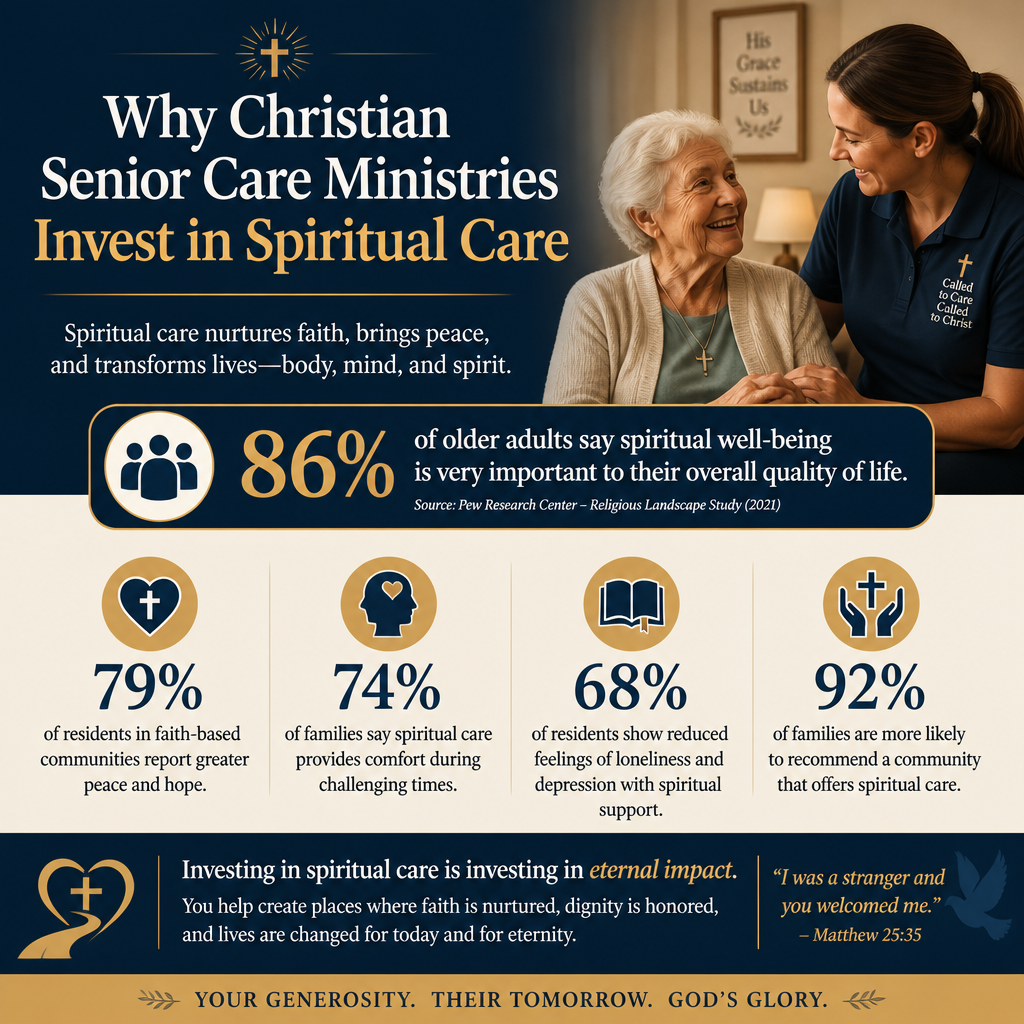
The research on the relationship between religion and health outcomes is complex, and claims should be made carefully. Still, there is credible evidence that many older adults treat faith as a significant coping resource. Pew Research Center reports that religion remains important in the lives of many older Americans, with older adults more likely than younger adults to say religion is very important (Pew Research Center). Ministries that invest in spiritual care are responding to this lived reality, not imposing a novelty.
How donors can evaluate whether spiritual care is integrated or performative
The field has had to reckon with a real danger: using “Christian” language to attract giving while failing to deliver dignified care. Donors are right to insist on both compassion and competence. What this means in practice is that spiritual care should be integrated into care planning and crisis response, not merely scheduled as an optional activity.
When donors review a ministry, we recommend asking whether the organization’s Programs and Services in Christian Senior Care Ministries show coherence. Are staffing and budgets consistent with the promises being made? Do governance structures provide oversight for both financial decisions and resident safety? Does the ministry report outcomes and tell the truth about limitations, especially around staffing constraints and the realities of aging?
Spiritual care is expensive in a particular way: it requires sustained attention. A ministry can reduce costs by shrinking chaplaincy hours or replacing trained staff with volunteers who are not supervised. That may still produce a worship calendar, but it rarely produces faithful care for residents in crisis. Stewardship is not only about minimizing overhead; it is about funding what love of neighbor requires.
FAQs for Why Christian senior care ministries invest in spiritual care
Is spiritual care appropriate in senior care settings that also serve non Christians?
It can be, provided the ministry practices clear consent, respects religious freedom, and avoids coercion. Mature ministries distinguish between faithful witness and pressure. They offer spiritual care openly, make it accessible for those who desire it, and protect residents’ ability to decline without penalty. Donors should look for written policies and staff training that demonstrate this commitment in practice.
How can donors verify that spiritual care claims are more than marketing?
Donors can ask for concrete indicators: chaplain qualifications and supervision, resident access to pastoral care, documented practices for end-of-life support, partnerships with local churches, and clear boundaries with clinical mental health services. Financial transparency matters as well, since underfunded staffing is often where care quality erodes. Most Trusted’s verification process, built on The Most Trusted Standard, is designed to help donors assess whether a ministry’s faith commitments are matched by governance, financial integrity, and credible reporting.
A faithful investment in the soul does not excuse neglect of the body
Christian senior care ministries invest in spiritual care because older adults face spiritual questions with heightened urgency, and because the Church’s works of mercy have always been both practical and pastoral. The wisest ministries refuse the false choice between competent clinical care and serious Christian formation. Donors should demand both, and should fund both, because faithful elder care requires nothing less.



