
Why Christian relief ministries avoid harmful donations is not a public-relations posture; it is a moral and operational necessity. Donors often assume that anything given in the name of compassion will help. Disaster settings expose the limits of that assumption because poorly chosen gifts can increase suffering, divert local capacity, and undermine long-term recovery.
The harder question is not whether Christians should give—Scripture is clear about openhanded mercy—but how to give in a way that honors the dignity of affected people and strengthens what is already good in a community. “Let us not love in word or talk but in deed and in truth” (1 John 3:18) is a demand for real help, not merely sincere intent.
Harmful donations are usually well-intentioned
The gap between intent and impact widens in crisis
Relief environments are defined by scarcity, urgency, and disrupted systems. In that context, a donated item that would be neutral at home can become costly: it may require sorting, storage, translation, specialized distribution, or disposal. Every hour spent managing unsuitable goods is an hour not spent on shelter, clean water, medical care, or protection for children.
Christian donors also carry a specific pressure: we want our giving to be personal. A box packed by a small group feels more tangible than a wire transfer. But tangibility is not the same as effectiveness. Relief leaders have learned to distinguish “felt compassion” from “field-ready compassion,” not because they have grown colder, but because they have been forced to face preventable harm.
Unsolicited goods can impede the supply chain
Emergency logistics is a discipline. The global humanitarian sector has repeatedly documented the “second disaster” created by unrequested in-kind donations that clog ports, warehouses, and roads. The United Nations Office for the Coordination of Humanitarian Affairs describes how unsolicited goods can overwhelm local authorities and delay priority relief shipments (UNOCHA). That dynamic is not limited to large-scale international disasters; it appears after regional floods, hurricanes, and fires as well.
This is one reason many mature ministries publish tight donation lists, reject certain categories of goods, or route in-kind giving through vetted partners. The refusal is not ingratitude. It is triage.
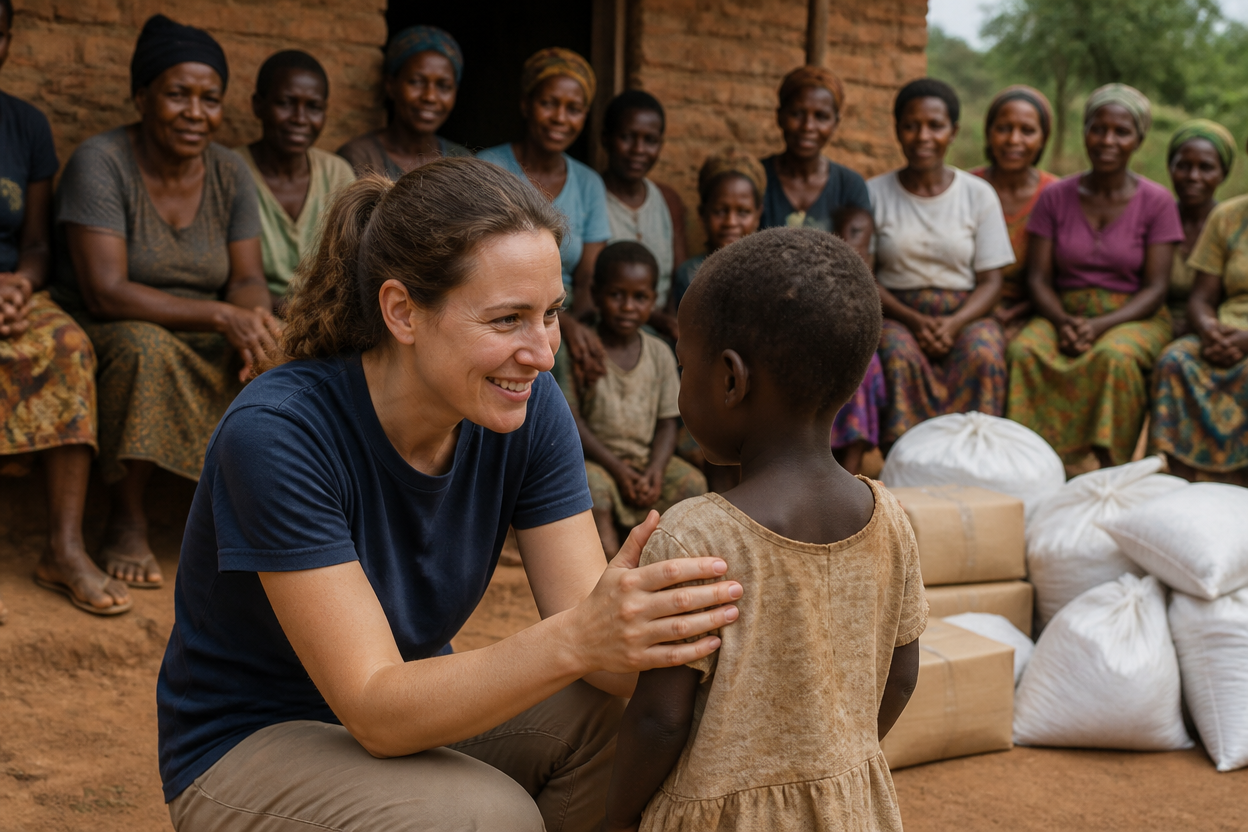
Some donations create dependency and distort local markets
Free goods can injure the very economies recovery depends on
Economic recovery after a disaster is rarely a secondary concern. When local vendors and tradespeople collapse, families lose income, and the community’s ability to rebuild slows. Large inflows of free goods—especially clothing, building materials, and food—can undercut local businesses that are trying to reopen.
Christian relief and development has had to reckon with this tension for decades. The When Helping Hurts framework, articulated by Steve Corbett and Brian Fikkert, has reshaped how many Christian leaders think about poverty alleviation by naming common harms: dependency, paternalism, and the crowding out of local problem-solving (When Helping Hurts). Christians genuinely disagree about specific applications, but the central insight stands: aid that replaces local capacity can leave a community weaker.
Cash is not always best, but it is often more dignifying
Many donors hesitate at cash because it feels less controllable. Yet in multiple settings, cash-based responses allow families to prioritize their own needs and purchase from local markets, supporting recovery rather than competing with it. That does not mean “send cash” is the only faithful answer. In conflict zones, highly corrupt environments, or places with collapsed markets, cash may be unsafe or inflationary. Mature ministries weigh these risks instead of applying a single rule everywhere.
Across our verification work at Most Trusted, we observe that ministries meeting The Most Trusted Standard tend to explain these trade-offs with clarity. They do not treat donor control as the highest value. They treat neighbor-love, stewardship, and accountability as integrated commitments.
Certain gifts increase protection risks and trauma
In-kind giving can create unsafe distribution dynamics
Distribution is not merely “handing things out.” Who receives goods, where they queue, how lists are verified, and what happens when supplies run out all shape safety. Poorly designed distributions can expose women and children to harassment, fuel community conflict, or incentivize exploitation.
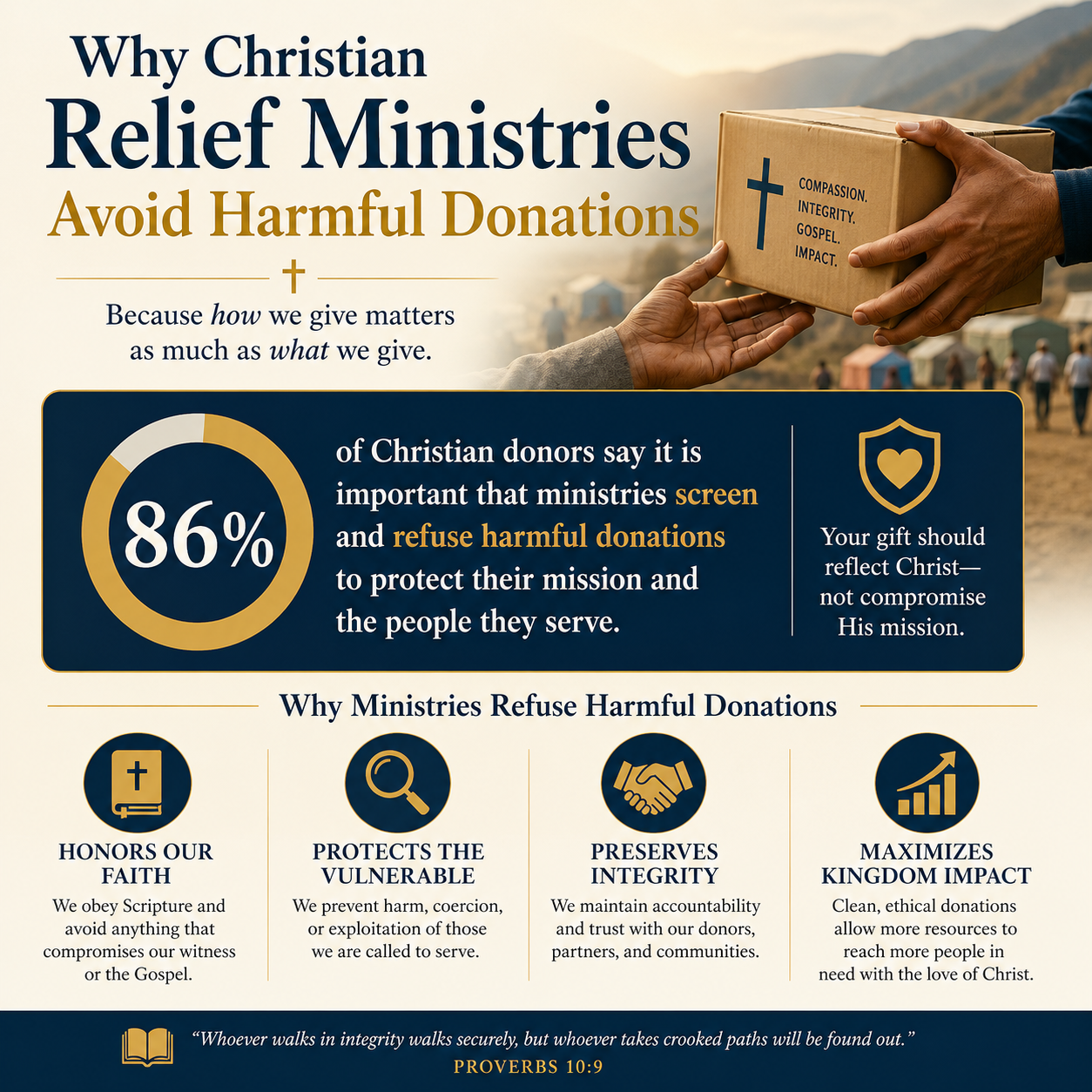
For this reason, reputable relief ministries increasingly operate within formal protection standards and coordinate with local leaders. Many of those practices are borrowed from the broader humanitarian sector, but Christian ministries adopt them for theological reasons as well: every person bears the image of God, and relief that ignores foreseeable harm fails that dignity test.
Used clothing and unsolicited items carry hidden costs
Donors often assume used clothing is an unqualified good. In practice, it is frequently one of the least useful items in disasters because it arrives unsorted, seasonally mismatched, culturally inappropriate, or in poor condition. Large volumes also create waste-management burdens for communities already under strain. Good intentions can become a public health and municipal cleanup problem.
What this means in practice is that ministries may prioritize hygiene kits assembled to a specified list, locally procured supplies, or funding for locally staffed case management over “whatever we can gather.” That choice can disappoint sincere donors, but it is an attempt to love with precision.
Healthy ministries set boundaries because accountability demands it
Boundaries are part of stewardship, not a lack of compassion
Christian donors rightly ask whether a ministry is acting with integrity when it declines certain donations. The most credible answer is not sentiment but governance: clear policies, documented decision-making, and measurable outcomes. This is where serious donors should pay attention to the underlying systems that shape behavior when the cameras are off.
In the category of How Christian Disaster Relief Ministries Respond, the most dependable organizations typically share several common features: they coordinate with local authorities, they publish precise giving needs, and they maintain disciplined financial and operational controls for rapid deployments.
Practical signals donors can look for
Donors do not need to be logistics experts to give well. A few concrete signals often separate ministries that avoid harmful donations from those that simply accept everything:
- Specific donation guidance tied to an assessed need, not a generic wish list
- Local partnership with churches, community leaders, or vetted agencies on the ground
- Protection-minded distribution practices that account for vulnerable populations
- Clear financial controls for restricted gifts and emergency spending
- Post-response reporting that explains what was done, where, and with what results
These signals are not a substitute for full due diligence, but they are a meaningful start. They also align with the kinds of evidence we evaluate at Most Trusted when we assess ministries against The Most Trusted Standard.
What faithful donors can do instead of sending harmful donations
Give in ways that respect the local church and local expertise
Many Christian donors want to help in ways that honor the local church. That desire is sound, and it should not be abandoned. But it should be expressed with humility: local believers and community leaders usually understand the real constraints better than outsiders do, including what will cause friction, shame, or conflict.
This is also why some ministries place a high priority on local procurement and locally led recovery planning. Done well, these approaches treat affected people as agents, not projects. They also accord with Paul’s emphasis on mutuality in Christian generosity, where giving strengthens the whole body rather than creating permanent dependence (2 Corinthians 8:13–15).
Support vetted response capacity, not just visible items
The donations that most often prevent harm are the ones donors do not see: trained staff, accountable partners, monitoring systems, secure warehousing, and careful casework for families. These are the quiet structures that enable relief to be both swift and safe.
For donors looking to place their giving within a broader framework of discernment, Christian Relief and Development Ministries is a useful place to consider the range of program models—from immediate relief to long-term rehabilitation—and the kinds of accountability evidence that should accompany each.
FAQs for Why Christian relief ministries avoid harmful donations
Is refusing certain donated goods unbiblical or ungrateful?
No. Scripture commends generous giving, but it also commends wise stewardship and love that seeks a neighbor’s good. A ministry’s responsibility includes preventing foreseeable harm, protecting vulnerable people, and using limited staff time for the most urgent needs. Declining unsuitable goods can be a form of moral seriousness, not ingratitude.
Should Christian donors always give cash instead of items?
Not always. Cash can be highly effective when markets are functioning and when strong controls are in place, but some contexts require specific goods, specialized services, or restricted procurement. The more reliable approach is to follow a vetted ministry’s assessed needs and to prioritize organizations that explain their rationale, safeguards, and results with clarity.
Giving that heals rather than harms
Christian relief ministries avoid harmful donations because love must be accountable to reality. Disaster survivors need more than sympathy; they need help that is timely, safe, and fitted to what is actually happening on the ground. The donor’s calling is not to send whatever feels meaningful, but to give in a way that strengthens neighbors, honors the image of God, and withstands scrutiny when compassion meets complexity.



