
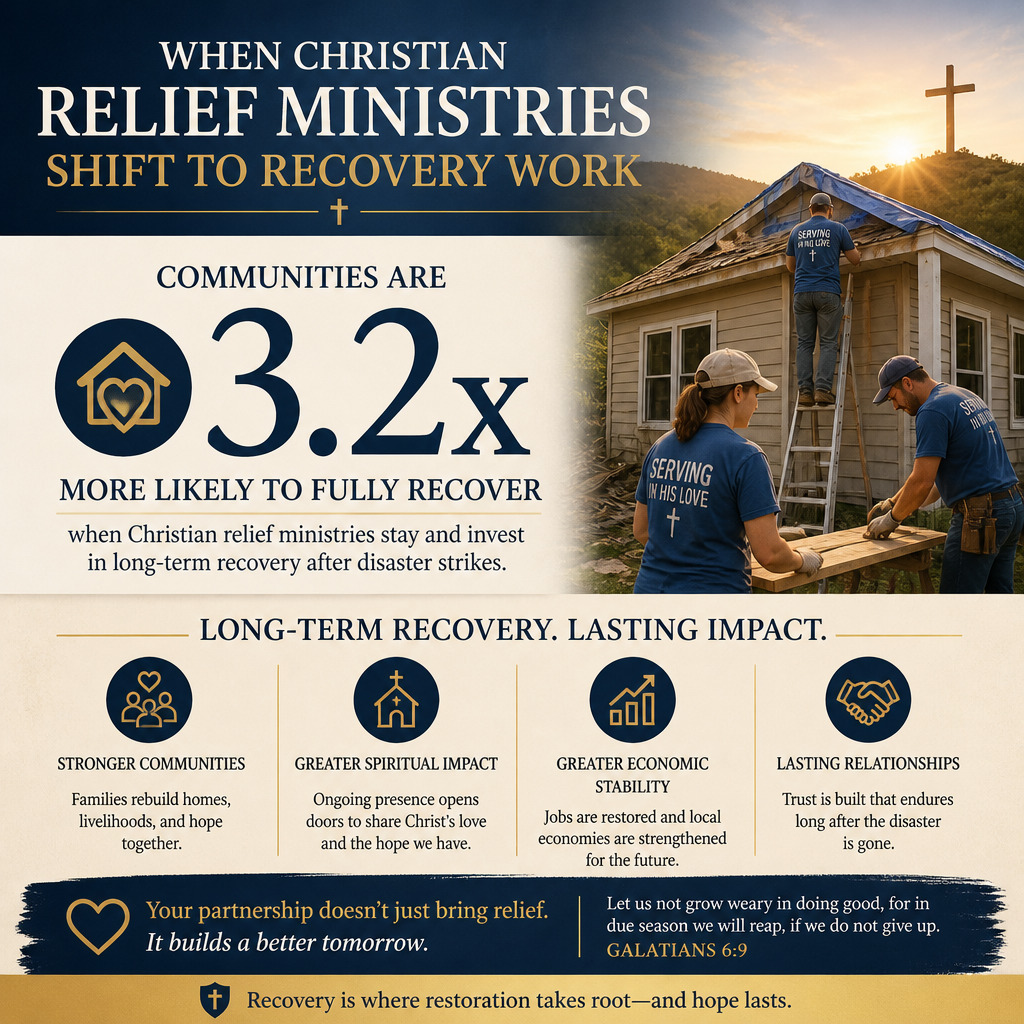
When Christian relief ministries shift to recovery work, the donor questions change from “Did we get help there quickly?” to “Did we stay long enough to do good?” Relief is urgent and visible. Recovery is slower, more complex, and often less photogenic, yet it is where the long obedience of love is tested.
Scripture gives language for both moments. The Good Samaritan responded immediately to blood and danger on the road, then made a longer commitment that required structure, accountability, and partnership: “Take care of him, and whatever more you spend, I will repay you when I come back” (Luke 10:35). Mature Christian giving has to ask not only whether a ministry can respond in crisis, but whether it can honor neighbors afterward with patient competence.
Relief and recovery are different callings that require different disciplines
Relief is defined by speed and triage
In the first hours and days after a disaster, Christian relief ministries rightly prioritize rapid distribution: clean water, food, temporary shelter, emergency medical care, and basic protection. Decisions are made with incomplete information and under intense pressure. In that environment, the primary risks are logistical failure and duplicated effort, not slow institutional drift.
Even in relief, coordination matters. The humanitarian system distinguishes “life-saving” interventions from everything that follows, and Christian ministries that work well in this phase usually have pre-positioned relationships, trained personnel, and clear incident leadership. Donors should not confuse speed with improvisation; the best rapid response typically reflects years of preparation.
Recovery is defined by durability and local ownership
Recovery begins when the immediate threat to life recedes and communities face the longer work of rebuilding homes, restoring livelihoods, repairing schools and clinics, and addressing trauma. This phase turns on different competencies: procurement integrity, long-term case management, local church partnership, and program evaluation that is honest about what worked and what did not.
The field has also had to reckon with unintended harms when outside aid lingers without a clear handoff. The “When Helping Hurts” framework, articulated by Steve Corbett and Brian Fikkert, has shaped much of the modern Christian conversation by naming how paternalism and dependency can undermine the dignity and agency of the people we intend to serve.

Recovery work raises harder stewardship questions for donors
The timelines are longer, and the outcomes are harder to count
Christian donors are often fluent in the metrics of relief: meals served, water filters distributed, tarps installed. Recovery asks for a different kind of patience. Housing reconstruction, livelihood restoration, and trauma care do not resolve on a quarterly schedule, and their outcomes can be difficult to quantify without reducing people to numbers.
The tension is real: donors want evidence, but recovery resists simplistic measurement. The strongest ministries tend to combine two forms of accountability: clear operational reporting (budgets, procurement controls, timelines) and community-defined outcomes (what families and local leaders identify as meaningful restoration). Ministries that only offer stories without operational proof invite skepticism; ministries that only offer dashboards without human context risk treating neighbors as projects.
Cash, in-kind goods, and contractor-heavy programs each carry distinct risks
Recovery usually increases the flow of larger-dollar transactions: building materials, skilled labor, equipment rental, and sometimes cash assistance to affected families. That is a natural evolution, but it elevates risks donors should name plainly: fraud, vendor favoritism, cost overruns, and poorly supervised subcontracting. These are not accusations; they are predictable pressures when money moves quickly into stressed environments.
We also encourage donors to avoid simplistic judgments about administrative costs. The “overhead ratio” often rises in recovery because monitoring, financial controls, safeguarding, and community engagement require staff time. The broader sector has argued for years that overhead alone is not a proxy for effectiveness; Charity Navigator, GuideStar, and the BBB Wise Giving Alliance made this case publicly in their joint “Overhead Myth” letter (Charity Navigator).
Healthy recovery transitions are usually planned before the disaster happens
The best ministries build a phased response model in advance
Across our verification work at Most Trusted, we observe that the most dependable ministries do not treat recovery as an improvisation. They anticipate transition points: when distributions taper, when case management ramps up, when local partners take the lead, and when the ministry exits without abandoning the community.
What this means in practice is that donors can ask a few concrete questions early, even while relief is still underway. A ministry should be able to describe its criteria for moving from relief to recovery, who decides, and what local consultation looks like. A vague promise to “stay as long as it takes” can be sincere, but it can also mask the absence of planning.
Partnership with local churches can strengthen recovery, but it must be handled with care
Many Christian donors hope to see recovery rooted in the local church, and rightly so. The local church remains when cameras leave, and it often knows which households are most vulnerable. Yet church partnership does not automatically solve technical or safeguarding challenges. A ministry still needs policies for beneficiary selection, conflict of interest, child protection, and financial controls that protect both the community and the church’s witness.
Christians genuinely disagree about the line between evangelism and aid, especially in crisis. Serious ministries do not pretend the question is simple. They articulate a theological rationale for mercy ministry that honors human dignity, and they adopt safeguarding practices that prevent coercion, manipulation, or quid-pro-quo dynamics.
What donors should look for when a ministry shifts from relief to recovery
Signals of maturity that are verifiable
Donors should expect recovery programs to become more administratively demanding, not less. The question is whether that complexity is governed well. The Most Trusted Standard evaluates ministries across Faith Foundation, Financial Integrity, Governance and Leadership, and Transparency and Effectiveness, because recovery failures are often failures of leadership and controls as much as failures of compassion.
Several signals tend to distinguish ministries that are prepared for recovery:
- Clear transition criteria for moving from emergency distributions to longer-term rebuilding and case management
- Documented procurement practices that reduce vendor favoritism and manage cost overruns
- Local partner due diligence, including safeguarding expectations and financial accountability
- Beneficiary selection transparency that explains how households are chosen and how complaints are handled
- A defined exit and handoff plan that avoids both abandonment and indefinite dependency
Where to deepen your understanding as a donor
Donors who give regularly to disaster response often develop an implicit “theory of help” shaped by early relief experiences: fast, tangible, decisive. Recovery invites a more complete theology of restoration. It is not only the alleviation of pain, but the rebuilding of ordinary life—work, home, school, community trust—under God’s providence.
For donors who want a broader view of how Christian ministries approach development alongside relief, we have compiled related work within Christian Relief and Development Ministries. A focused look at disaster-specific patterns, including how ministries phase their response, is also available within How Christian Disaster Relief Ministries Respond.
Recovery is where effectiveness and ethics meet
The risk of doing something is not the only risk
The moral pressure after a disaster can create a false binary: act now or be indifferent. But recovery ethics include additional questions: Are local markets being strengthened or displaced? Are landlords and contractors capturing disproportionate benefits? Are women, children, the elderly, and people with disabilities protected in temporary housing and distribution systems?
The global humanitarian community has tried to codify these concerns in widely adopted norms. The Sphere Handbook, for example, outlines minimum standards in humanitarian response and emphasizes accountability to affected populations (Sphere Association). Christian ministries may not use the same language, but donors should want the same substance: quality, safety, and accountability under pressure.
Trauma and spiritual care require long horizons and careful boundaries
Recovery is never only material. Disaster survivors often carry grief, disorientation, and fear that outlast reconstruction projects. Christian ministries frequently provide pastoral presence, prayer, and counseling referrals, and many donors see this as part of a distinctly Christian response.
Here, too, seriousness requires boundaries. Healthy spiritual care does not exploit vulnerability. It is offered freely, with respect for conscience, and with safeguarding for children and survivors of abuse. Ministries that treat spiritual care as a tool for institutional growth rather than an expression of neighbor-love risk harming the very people they seek to serve.
FAQs for When Christian relief ministries shift to recovery work
How long should a Christian relief ministry stay in a community after the headlines fade?
There is no single faithful timeline. The better question is whether the ministry has a defined recovery scope, local consultation, and an exit plan that hands durable capacity to local institutions rather than creating dependence. Donors can ask for the ministry’s transition criteria, recovery milestones, and the governance processes used to decide when to scale down.
What is the most responsible way to give when a ministry begins rebuilding and long-term recovery?
Restricted giving can be appropriate when a donor has high confidence in a specific recovery program and wants to support it. Unrestricted or flexible giving can also be responsible because recovery requires adaptive decisions as needs evolve. In either case, donors should expect verifiable reporting on budgets, procurement, safeguarding, and community feedback mechanisms—especially as transaction sizes increase.
A faithful shift is marked by patience, competence, and accountability
Relief is often where compassion is most visible. Recovery is where love becomes institutional: ordered, accountable, and willing to do quiet work for years. Christian donors should not feel obligated to choose between urgency and prudence. The mature path is to give in ways that honor immediate need and also demand the governance and transparency that protect neighbors in the long aftermath.



