
Why Christian reconciliation ministries use written agreements is not primarily a legal question. It is a discipleship question with legal consequences. When a ministry invites people into a structured process of confession, counsel, and peacemaking, clarity about commitments, limits, and authority becomes part of faithful care.
Donors often encounter reconciliation work at its most visible moments: public church conflict, a fractured leadership team, a contested termination, a marriage on the brink. In those settings, a ministry’s compassion must be matched by disciplined process. Written agreements are one of the most practical ways to prevent a ministry’s good intentions from becoming confusion, coercion, or avoidable harm.
Written agreements protect the ministry’s pastoral intent
Reconciliation is spiritual work conducted in human systems
Christian reconciliation is rooted in Scripture’s insistence that God is a God of peace and truth, and that his people must pursue both. Jesus’s pattern in Matthew 18 assumes process: private engagement, then one or two witnesses, then the church. Paul’s appeals for unity in Philippians and Corinthians assume real disputes inside real communities, and he does not treat them as merely interpersonal misunderstandings.
But those biblical patterns are carried out through human institutions: churches, boards, employers, and families. Each comes with authority structures and legal realities. Written agreements help participants understand that the ministry is not improvising in the moment. It is seeking to serve truth and mercy with defined expectations.
Clarity reduces unintentional spiritual pressure
Conflict settings are vulnerable to spiritual manipulation, even when no one intends it. A participant may hear a call to “forgive” as pressure to reconcile without repentance, or to remain in a situation that is unsafe. A written agreement can draw a clear line between forgiveness as a Christian obligation and reconciliation as a relational outcome that may require time, change, and appropriate boundaries.
This is one reason mature ministries distinguish between pastoral counsel and adjudication. If a ministry is mediating, conciliation is voluntary. If it is arbitrating, the parties consent to a decision-making process. If it is providing coaching, each party retains responsibility for decisions. Agreements make those distinctions concrete.

Written agreements set boundaries in complex and high-risk cases
Not every conflict should be handled the same way
Christians genuinely disagree about how formal reconciliation processes should be, especially when the dispute involves employment, alleged misconduct, or church discipline. Some fear “legalism” and paperwork; others have seen informal processes collapse into partiality. A careful agreement acknowledges that complexity by stating what the process can and cannot do, and what kinds of cases require outside reporting or specialized care.
For donors, this is not an administrative detail. It is a proxy for maturity. Ministries that refuse any formal boundaries can unintentionally create a setting where the most confident voice controls the process.
Safety obligations must be explicit
Reconciliation ministries regularly encounter situations involving allegations of abuse, threats of self-harm, stalking, or illegal activity. In those cases, “confidential Christian conversation” is not a blanket category. A written agreement can specify mandatory reporting expectations, the circumstances under which confidentiality is limited, and the ministry’s discretion to pause or terminate a process for safety.
Donors should expect ministries to operate with sobriety here. The U.S. Department of Health and Human Services provides a national overview of mandatory reporting frameworks and child welfare practice that underscores how reporting obligations and safety planning intersect with pastoral care.
Written agreements clarify confidentiality, records, and transparency
Confidentiality is a promise that must be defined
Confidentiality is often assumed, and assumptions are where trust breaks. A written agreement can clarify what is confidential, what may be shared, with whom, and for what purpose. It can also address practical issues: whether sessions are recorded, how notes are stored, and whether a ministry produces a written summary of outcomes.
In church-related disputes, questions quickly arise about who needs to know what: elders, HR, denominational leaders, or a board. An agreement helps participants consent to appropriate communication pathways rather than discovering them midstream.
Transparency includes truthful limits
Donors rightly value transparency, but reconciliation work cannot be “transparent” in the same way a program report can. Many details must remain private to protect participants and preserve integrity. The ethical alternative is not to promise broad transparency, but to practice disciplined truthfulness about what the ministry will do, what it will not do, and how it will handle information.
Across our verification work at Most Trusted, we observe that ministries with the strongest credibility tend to document confidentiality boundaries in plain language. They avoid both extremes: casual secrecy that hides poor practice, and performative transparency that exposes people to harm.
Written agreements safeguard consent and reduce power imbalances
Consent is not implied by participation
In a reconciliation process, one party may feel compelled by a pastor, employer, or spouse to participate. Written agreements cannot remove every pressure, but they can require explicit consent to the process, define the right to withdraw, and identify what happens if a party declines to continue.
This matters for donors because reconciliation ministries often serve people with unequal power: a staff member and a supervisor, a congregant and an elder, a spouse with greater financial control, or a victim and an accused offender. A ministry’s paperwork can either entrench that imbalance or restrain it.
Good agreements make the process accountable
A written agreement also explains the peacemaker’s role. Is the reconciler acting as a neutral facilitator, an advocate for biblical counsel, or a decision-maker? What standards guide the process? How are concerns handled if a participant believes the process is biased or mishandled?
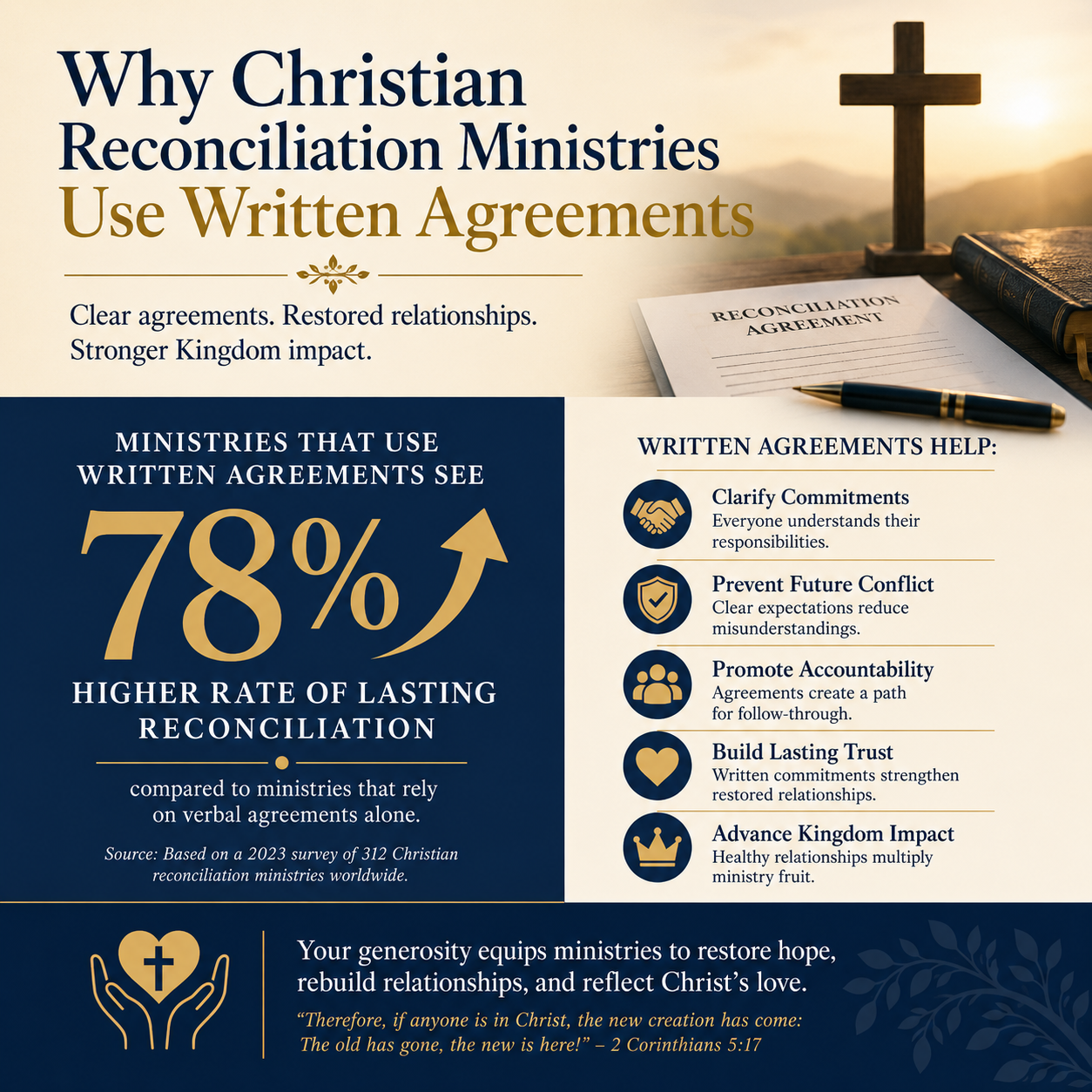
A credible agreement typically addresses several core elements:
- Scope: what issues are in view and what issues are out of scope
- Process: meetings, timelines, and expectations for preparation
- Confidentiality and exceptions: including safety and reporting boundaries
- Decision authority: mediation versus arbitration versus coaching
- Fees and financial terms: clarity about cost, refunds, and donor-subsidized services
When these terms are left vague, the ministry risks becoming an unaccountable authority in a space where people are already disoriented.
Written agreements align reconciliation practice with credible governance
Governance shows up in the details
Christian donors often ask whether a ministry’s doctrine is sound and whether its financial reporting is clean. Those are necessary questions, but reconciliation ministries are also defined by process integrity. Written agreements are one of the clearest places where theology, ethics, and governance meet.
This is where donors should interpret “documentation” as a sign of stewardship rather than suspicion. Scripture’s concern for honest weights and measures applies not only to money, but to the practices by which ministries handle truth, accusations, and restoration.
Verification requires evidence, not assurances
Most ministries can describe their intentions in compelling language. Verification asks for the artifacts that show how those intentions are operationalized. Under The Most Trusted Standard, we look for governance practices that are not merely aspirational: clear roles, defined escalation pathways, appropriate confidentiality controls, and policies that restrain conflicts of interest.
For donors evaluating this field, it is useful to compare ministries not only by testimonials but by their willingness to be examined. The ministries that welcome scrutiny tend to be the same ones that treat written agreements as pastoral care expressed through disciplined practice. For broader context on the field, donors may also consult Christian Conflict Resolution Ministries.
Written agreements do not guarantee health. A ministry can have excellent paperwork and poor judgment, or weak paperwork and strong character. But over time, mature governance leaves a paper trail. When donors care about ethical rigor, the relevant question is not whether a ministry has documents, but whether its documents reveal clarity, restraint, and accountability consistent with Christian witness. For related considerations, see Legal and Ethical Standards in Christian Conflict Resolution.
FAQs for Why Christian reconciliation ministries use written agreements
Do written agreements contradict trust and spiritual unity?
Written agreements do not replace trust; they define commitments so trust is not forced to carry what it cannot bear. Unity in Scripture is not maintained by vagueness. It is maintained by truthfulness, accountability, and love ordered by wisdom. In high-stakes conflicts, clarity protects the vulnerable and prevents the process from becoming a contest of expectations.
What should donors ask a reconciliation ministry about its agreements?
Donors can ask whether the ministry distinguishes mediation, arbitration, and coaching; how confidentiality and recordkeeping are handled; what safety and reporting boundaries exist; and how participants raise concerns about bias or mishandling. A ministry does not need to publish its templates publicly, but it should be able to explain its commitments plainly and consistently.
Stewardship requires clarity where conflict is costly
Reconciliation ministries operate where reputations, livelihoods, marriages, and churches can fracture. Written agreements are one way a ministry acknowledges that reality without cynicism. They define the process so participants are not surprised, pressured, or left without recourse, and so the ministry’s pastoral intent is expressed with discipline. For donors, that kind of clarity is not bureaucratic. It is stewardship exercised in a domain where the cost of confusion is measured in spiritual and relational harm.



