
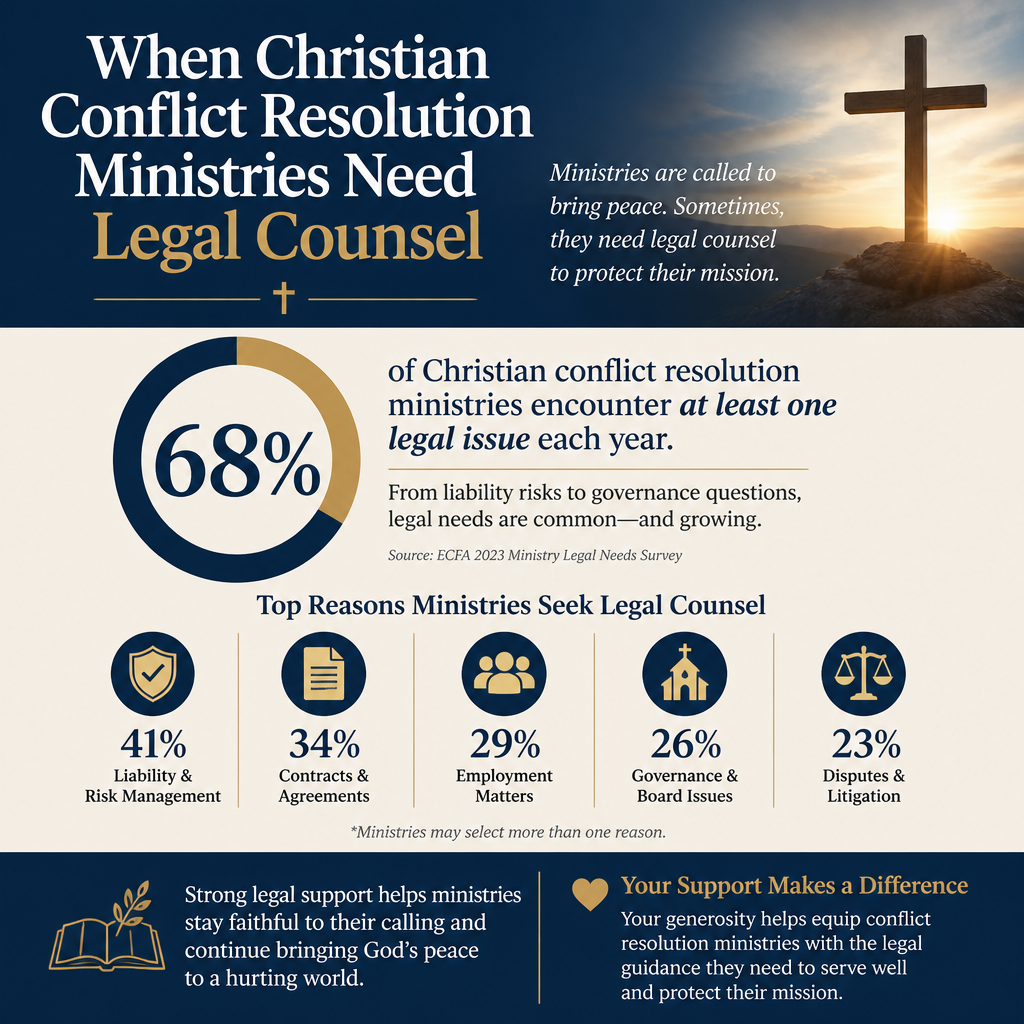
When Christian conflict resolution ministries need legal counsel, the decision is rarely about a lack of faith. It is about recognizing that peacemaking happens in a world of real liabilities, contested facts, and vulnerable people, and that wise stewardship requires more than good intentions.
Christian donors tend to hope that ministries devoted to reconciliation will be the least likely to face legal trouble. In practice, these ministries often sit at the intersection of employment conflict, allegations of abuse, counseling-adjacent care, ecclesial discipline, and emotionally charged narratives. When a ministry’s calling is to enter conflict, it should not be surprised that conflict sometimes enters the ministry’s own governance.
Legal counsel is not a rival to spiritual authority
Peacemaking is biblical, and so is prudence
Scripture’s summons to pursue peace is unambiguous. “If possible, so far as it depends on you, live peaceably with all” (Romans 12:18). Yet Scripture also assumes prudence in complex situations: Jesus commends wise discernment in the face of wolves (Matthew 10:16), and Proverbs consistently treats counsel and foresight as moral goods rather than compromises.
Legal counsel, properly understood, is one form of counsel. It does not replace pastors, elders, or mediators; it clarifies duties, risks, and documentation so that Christian leaders do not unintentionally harm the people they intend to serve. What this means in practice is that the most mature ministries hold together two commitments: a theological refusal to weaponize law against people, and a sober willingness to use law to protect people.
The donor question is stewardship, not suspicion
Donors are not wrong to ask why a ministry that teaches reconciliation sometimes retains attorneys. The question is simply incomplete unless it also asks whether the ministry is prepared to handle allegations responsibly, to protect victims, to honor due process, and to preserve the credibility of Christian witness in the public square.
Across our verification work at Most Trusted, we observe that ministries that meet The Most Trusted Standard tend to treat legal counsel as part of governance discipline: clear policies, clear decision rights, and clear lines between pastoral care and regulated professional services. These are not symptoms of distrust. They are evidence of leadership that expects real-world complexity.

Common situations that legitimately require legal counsel
Allegations that trigger mandatory reporting or institutional duty
Christian conflict resolution ministries can receive disclosures that implicate abuse, neglect, exploitation, or credible threats of harm. The ministry’s staff may be trained in mediation, but that does not automatically equip them to interpret mandatory reporting statutes, confidentiality limits, or cross-jurisdictional requirements.
Many adults do not even know what “mandatory reporting” covers in their state, and nonprofits can compound confusion when they serve across state lines. The legal exposure is not only about what leaders do; it can also be about what leaders fail to do. Federal guidance underscores that child abuse reporting frameworks are largely state-based and vary substantially, which is why counsel familiar with local law matters Child Welfare Information Gateway.
Employment conflicts and workplace investigations
Some ministries exist precisely because workplace conflict becomes entrenched and corrosive. That means they may also face internal staff conflicts, whistleblower allegations, or claims of retaliation. When a board receives a complaint about a senior leader, it is no longer a “mediation issue” in the ordinary sense. It is a governance event.
Legal counsel can help a board commission a properly scoped investigation, preserve evidence, avoid defamation, and apply employment law consistently. For donors, the question is not whether conflict exists—conflict exists in every human institution—but whether the board has the independence and competence to respond when conflict touches leadership.
Discipline processes, defamation risk, and public communication
Christian reconciliation work often involves confronting sin, naming harm, and calling people to repentance. That theological clarity can collide with legal realities when communications become public, when a ministry shares an “official statement,” or when it publishes a narrative that identifies individuals. Defamation law is not suspended because the subject is morally serious.
The harder question is how to tell the truth without violating privacy, escalating harm, or exposing the ministry to preventable legal action. Counsel can help ministries communicate with restraint: enough disclosure to be honest with stakeholders, and enough confidentiality to protect vulnerable parties.
Where ministries unintentionally create legal risk
Confusing mediation, counseling, and pastoral care
Christian conflict resolution ministries often work in emotionally intense settings: marriages in crisis, allegations of spiritual abuse, fractured leadership teams, and traumatized families. Without careful boundaries, the work can drift from mediation into counseling or clinical territory, especially when participants expect therapeutic outcomes.
Legal counsel helps leaders define what the ministry is and is not providing, how records are kept, and how informed consent is handled. This is not bureaucratic fussiness. It is protecting people from misunderstandings about confidentiality, privilege, and professional responsibility.
Documentation practices that either overexpose or under-protect
Many ministries assume that more documentation is always better. Others assume that avoiding documentation prevents liability. Both instincts can be costly. Notes can become discoverable in litigation. Sparse records can also undermine an organization’s credibility when serious allegations arise.
Prudent counsel can help establish record-retention schedules, incident reporting protocols, and secure storage practices. When these practices are absent, ministries often discover their weakness at the worst possible time: after a crisis, under public scrutiny, with competing narratives hardening.
Boards that are spiritually earnest but procedurally thin
Donors often love ministries for their theological conviction, but governance requires more than conviction. A board that cannot distinguish oversight from management, or that lacks independence from the founding leader, will struggle to respond when legal counsel is most needed. The resulting failures are not merely operational; they can become moral failures when they silence victims or protect reputations at the expense of truth.
For donors assessing this space, the category of Legal and Ethical Standards in Christian Conflict Resolution is not peripheral. It is part of how we honor the Ninth Commandment, protect the vulnerable, and preserve integrity in Christian witness.
What donors should look for before a crisis
Signals that legal counsel is integrated into healthy oversight
Donors generally do not need to know a ministry’s attorney’s name. But donors should expect evidence that the ministry has thought through risk, boundaries, and accountability in advance. The goal is not to make ministries litigation-ready in a worldly sense, but to make them responsibility-ready in a biblical sense.
- Written policies on confidentiality, reporting, and participant consent that match the ministry’s actual practice
- Board minutes or governance documentation showing that complaints involving leadership are handled with independent oversight
- Clear role boundaries distinguishing mediation services from counseling or clinical care
- A conflict-of-interest policy applied to board members, senior staff, and significant related-party relationships
- A communications posture that favors truthfulness and restraint over reputation management
How legal expenses should be interpreted
Some donors treat legal fees as inherently suspect overhead. That assumption is too simple. Legal spending can reflect mission drift, internal dysfunction, or adversarial posture. It can also reflect appropriate safeguards: employment compliance, policy development, contract review, and crisis response when allegations are serious.
The more reliable donor question is whether legal spending is governed. Does the board approve significant engagements? Are there documented reasons? Is the ministry willing to explain, at least at a high level, why counsel was retained and what guardrails were applied? For donors who want to go deeper, our work in Christian Conflict Resolution Ministries emphasizes verification that connects governance discipline to spiritual credibility.
How ministries should choose counsel without compromising their calling
Counsel should understand both nonprofit law and the ministry’s ecclesial context
Many disputes in Christian reconciliation work are not only legal disputes; they are disputes over authority, doctrine, and ecclesial responsibility. Counsel must be competent in nonprofit governance, employment law, and liability, but also literate in how churches and Christian organizations function. Ministries can create confusion when they assume a corporate template fits pastoral realities, or when they assume pastoral language exempts them from corporate duties.
Christians genuinely disagree about how Matthew 18 applies in cases involving crime, abuse, or institutional power. That disagreement is precisely why counsel should help leaders distinguish between internal reconciliation processes and actions that protect potential victims and comply with civil law. The ministry’s calling is not undermined by acknowledging that the state bears real authority to punish wrongdoing (Romans 13:1–4).
Good counsel strengthens transparency rather than strangling it
A common fear is that attorneys will recommend silence. Sometimes discretion is necessary, especially to protect victims, preserve due process, or avoid contaminating an investigation. Yet excessive secrecy can also become a moral hazard, especially when it becomes a pattern rather than a case-specific judgment.
Wise ministries use counsel to pursue truthful, bounded transparency: what stakeholders need to know, what the ministry can responsibly say, and what will be disclosed when facts are established. This is a governance discipline as much as a communications practice. It is also a credibility discipline, because Christian donors increasingly recognize that institutional opacity often precedes institutional collapse.
FAQs for When Christian conflict resolution ministries need legal counsel
Is hiring a lawyer a sign that a Christian peacemaking ministry has failed?
No. Hiring counsel can be a sign that a ministry is taking responsibility for real obligations: protecting the vulnerable, complying with mandatory reporting and employment law, and governing itself with due care. The more telling issue is how counsel is used—whether as a shield for reputation or as a safeguard for truth, due process, and neighbor-love.
What should donors do if a ministry will not explain its legal situation?
Some discretion is legitimate during investigations or litigation, especially when victims’ privacy is at stake. Still, donors can reasonably expect a ministry to disclose its governance posture: who is overseeing the response, what policies are guiding decisions, and what commitments the ministry is making regarding transparency when facts are established. If a ministry consistently refuses any meaningful accountability signals, donors should consider pausing gifts until governance clarity improves.
Stewardship that honors both peace and protection
Christian conflict resolution ministries serve the church by pursuing reconciliation where relationships and institutions fracture. Because the work is high-stakes, legal counsel is sometimes a necessary instrument of love: protecting the vulnerable, clarifying duties, and helping leaders speak truthfully without causing avoidable harm.
Donors who want to give with confidence should not ask whether a ministry ever needs attorneys. The more discerning question is whether the ministry’s theology, governance, and transparency are strong enough to engage legal counsel without surrendering its calling. That is the kind of institutional maturity The Most Trusted Standard is designed to verify.



