
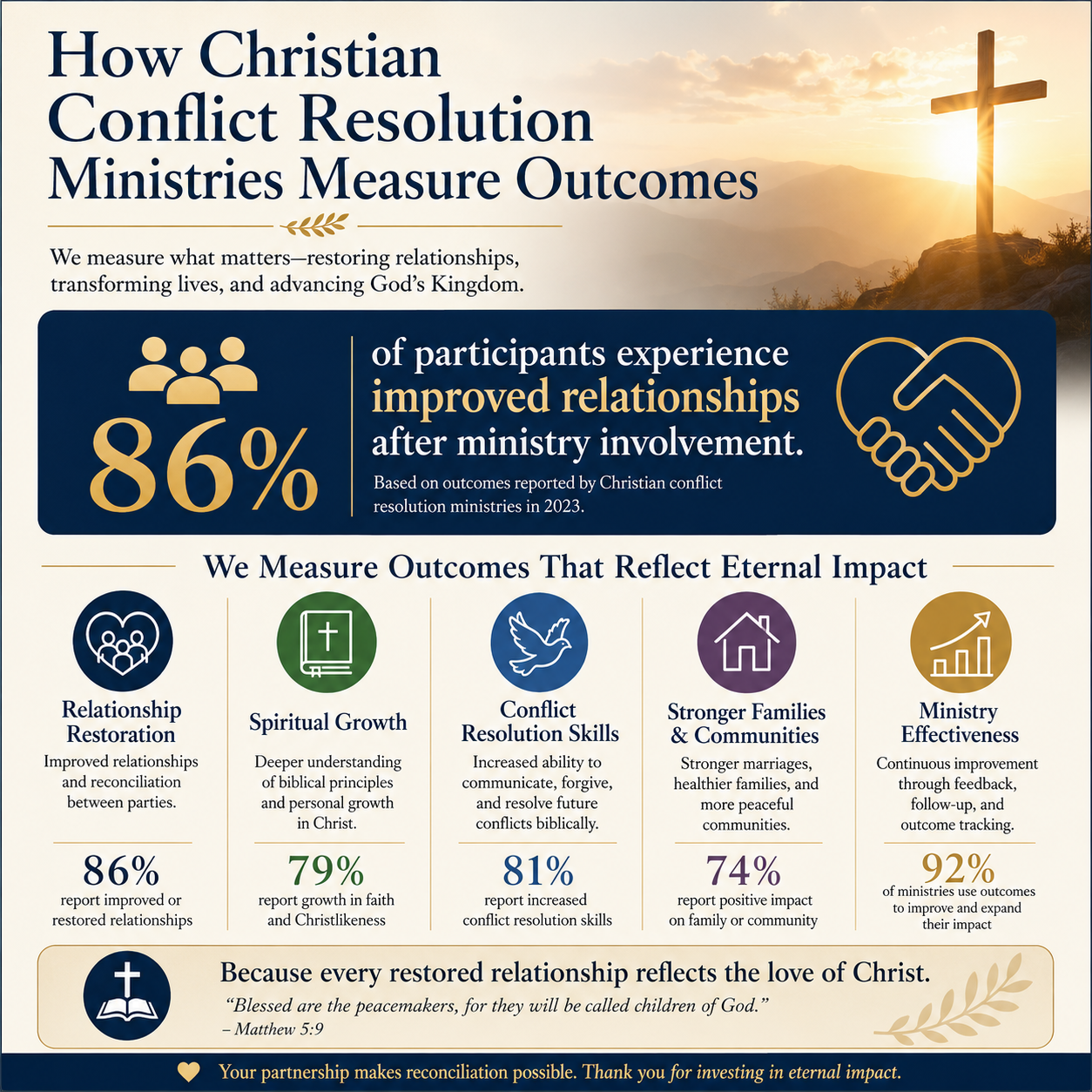
How Christian conflict resolution ministries measure outcomes is not a secondary question for serious Christian donors. The New Testament treats reconciliation as both a gospel reality and a lived discipline: “God… gave us the ministry of reconciliation” (2 Corinthians 5:18). Donors who fund peacemaking work are not merely underwriting services; they are supporting ministries that claim, implicitly or explicitly, to bear witness to Christ’s reconciling work in relationships, congregations, and communities.
The harder question is that reconciliation is not always easy to quantify. A dispute can “resolve” on paper while bitterness hardens. A mediated agreement can protect the vulnerable or merely pressure them into silence. Christian donors need ministries to show more than activity. We should expect credible signals that a ministry is doing what it says it does, in ways consistent with Scripture and accountable to the people it serves.
Outcomes in peacemaking are more than case closure
Scripture sets a standard beyond peacekeeping
Christian conflict resolution is not simply the management of tension. Jesus names reconciliation as a moral obligation that touches worship itself: “First be reconciled to your brother, and then come and offer your gift” (Matthew 5:24). Paul insists that unity is not a public-relations exercise but a fruit of the Spirit’s work among a people who “bear with one another in love” (Ephesians 4:2–3). These texts do not yield a simple metric, but they do clarify what faithful outcomes must include: truthfulness, repentance where needed, restoration where possible, and protection of the vulnerable.
What this means in practice is that ministries should measure more than “how many cases we handled.” A Christian ministry may report the number of mediations completed, trainings delivered, or calls answered, but donors should press for outcomes that reflect actual reconciliation processes: changed patterns of communication, reduced escalation, durable agreements, restored participation in church life, or safer relational boundaries when restoration is not wise.
Not every conflict should end the same way
Christians genuinely disagree about how quickly reconciliation should be pursued and what “restoration” ought to mean in complex situations. Abuse, coercive control, and serious misconduct create moral asymmetries that must shape both process and measurement. A wise ministry does not treat “keeping people together” as the highest good. Some outcomes worth measuring are protective rather than reunifying: clear no-contact agreements, documented safety plans, accountability structures for leaders, and referrals to qualified trauma care.
Across our verification work at Most Trusted, the ministries that meet The Most Trusted Standard tend to articulate outcome definitions that are both theologically serious and operationally clear. They can name what “success” means in a way that does not collapse discipleship into data, yet still allows accountability.

What can be measured credibly in reconciliation work
Inputs and outputs matter, but they are not outcomes
Serious ministries should track basic operational measures: number of cases received, time from intake to first contact, number of sessions delivered, or percentage of parties who complete a process. Those are necessary for stewardship and capacity planning. Donors should not confuse them with outcomes. A ministry can grow its activity while producing shallow or even harmful resolutions.
The field has also had to reckon with the wider philanthropic correction against simplistic ratios. The “Overhead Myth” statement signed by Charity Navigator, Candid, and BBB Wise Giving Alliance warned donors not to use overhead ratios as a proxy for effectiveness and urged attention to transparency, governance, and results instead Charity Navigator. For conflict resolution ministries, that translates into asking whether staff training, safeguarding, supervision, and follow-up are adequately resourced, even if they do not look “efficient” in a narrow accounting sense.
Outcome indicators that respect the complexity
Reconciliation work is often best measured with a small set of indicators collected consistently, interpreted humbly, and paired with qualitative evidence. Ministries can track participant-reported change without pretending to read hearts. Donors should expect ministries to distinguish between immediate outcomes (what changed by the end of the process) and sustained outcomes (what remains true months later).
Common measurable outcome categories include:
- Durability: whether agreements or action plans are still being followed after a defined period.
- Relational functioning: participant-reported improvements in communication, clarity, and reduced escalation.
- Recurrence: whether the same conflict returns in the same form, and at what intensity.
- Participation: restoration of appropriate engagement in church or community life when safe and wise.
- Protection: safety outcomes such as boundaries honored, reduced contact, or validated safeguarding steps.
These are not flawless measures. Self-report can be biased, and durability can be hard to assess when parties disengage. But disciplined measurement, even with limitations, is more trustworthy than inspirational storytelling alone.
Sound measurement begins with faithful case design and follow-up
Intake clarity prevents distorted reporting
Ministries cannot measure outcomes well if their intake process is vague. A case must be categorized with enough precision to evaluate what an appropriate outcome would be. Was this a marriage conflict, a congregational leadership dispute, a workplace grievance, or an allegation of abuse? What authority structures exist, and who is accountable for enforcement? If a ministry treats every case as a generic “conflict,” its outcome data will be confusing at best and misleading at worst.
Good outcome practice includes baseline data collected at intake, such as the level of escalation, prior attempts at resolution, and agreed-upon goals for the process. The baseline does not need to be numerically elaborate. It needs to be stable, repeatable, and ethically collected.
Follow-up is where many ministries quietly fail
Conflict resolution ministries often operate under real constraints: confidentiality, reluctance of parties to re-engage, and the emotional fatigue that follows hard conversations. Yet sustained outcomes require follow-up. A ministry that only measures “case closed” cannot credibly claim reconciliation impact.
Donors should look for a defined follow-up cadence (for example, at 30, 90, and 180 days) and clear rules for when follow-up is not appropriate. In cases involving abuse allegations or severe power imbalance, follow-up should include safeguarding checks and referrals rather than pressure for relational restoration.
Programs that invest in follow-up also tend to invest in recordkeeping and privacy controls. That becomes a governance and integrity issue, not merely a program preference, and it aligns with the standards we look for in verified ministries.
How donors can evaluate reported outcomes without becoming cynical
Watch for theological depth and moral seriousness
Because reconciliation language can be spiritualized, donors should listen for whether a ministry’s outcome reporting reflects Scripture’s moral texture: truth-telling, repentance, justice, mercy, and protection of the weak. “Unity” can become an idol when it is pursued without truth. “Forgiveness” can be weaponized when it is demanded without repentance or accountability. Ministries that measure outcomes responsibly will name these tensions, not evade them.
In our review work, we find it helpful to ask whether the ministry’s outcomes align with the biblical aim of peace that is not merely the absence of conflict but the presence of right-ordered relationships. James describes “the wisdom from above” as “pure, then peaceable, gentle… full of mercy and good fruits” (James 3:17). That provides a doctrinal frame for outcomes that are not sentimental.
Ask for evidence that can be verified
Donors do not need ministries to publish confidential details. We should expect aggregated reporting and clear methodologies. A credible outcomes report might include the number of cases in each category, completion rates, follow-up response rates, and a definition of what counts as “resolved.” It should also disclose what is not known. If follow-up response rates are low, a truthful ministry will say so and explain why.
Donors should also assess whether claims are proportionate to evidence. A ministry may rightly testify to gospel fruit, but it should be cautious about asserting broad social impact without data. For readers exploring the broader landscape, Christian Conflict Resolution Ministries is a useful place to compare how different organizations define their work and report results.
Where outcomes measurement intersects with integrity and trust
Transparency and effectiveness are inseparable
Outcome reporting is not merely a communications function. It is a spiritual and fiduciary discipline. Donors fund peacemaking because they want to participate in God’s reconciling work, and that participation should be marked by truthfulness. Ministries that only report successes, or that collapse serious harm into “conflict,” undermine trust and risk further harm.
Outcome credibility increases when it is supported by governance practices: independent board oversight, clear safeguarding policies, conflict-of-interest controls, and documented decision-making for difficult cases. These are not distractions from ministry. They are part of faithful stewardship in a world where spiritual authority can be misused.
Most Trusted and The Most Trusted Standard
Most Trusted exists to help donors give with confidence by evaluating Christian nonprofits against The Most Trusted Standard, a 15-criteria framework spanning faith commitments, financial integrity, governance and leadership, and transparency and effectiveness. For conflict resolution ministries, the transparency and effectiveness portion is often where outcome measurement comes into view most directly, but it must be interpreted alongside governance and safeguarding. A polished outcomes dashboard cannot compensate for weak accountability structures.
Donors who want to fund peacemaking at depth should expect ministries to report outcomes with humility, methodological clarity, and theological seriousness. For a wider perspective on how impact is assessed across peacemaking work, The Mission and Impact of Christian Peacemaking Ministries offers additional context for evaluating claims and evidence.
FAQs for How Christian conflict resolution ministries measure outcomes
What outcomes should a Christian conflict resolution ministry report to donors?
A responsible ministry can report operational measures (cases served, sessions delivered) but should prioritize outcomes such as completion rates, participant-reported changes in communication and clarity, durability of agreements at follow-up intervals, recurrence of the same dispute, and protective outcomes where restoration is not appropriate. Credible reporting defines terms, discloses limitations, and avoids triumphal claims that cannot be supported with evidence.
How can donors assess outcomes when confidentiality prevents detailed reporting?
Confidentiality should not prevent aggregated transparency. Donors can ask for anonymized, summary-level reporting: case categories, definitions of “resolved,” follow-up methods and response rates, and the safeguards used in high-risk situations. Donors can also look for independent accountability through governance practices, published policies, and external evaluation where appropriate.
Funding reconciliation with clear-eyed stewardship
Christian conflict resolution ministries are often asked to do holy work in morally complex settings. Donors best serve that calling by refusing both naïveté and cynicism: expecting measurable outcomes where measurement is possible, insisting on safeguarding and accountability where power is at stake, and honoring the reality that true reconciliation is deeper than a closed file. When ministries measure outcomes with truthfulness and humility, they strengthen donor trust and, more importantly, they bear more faithful witness to the God who reconciles sinners to himself and to one another.



