

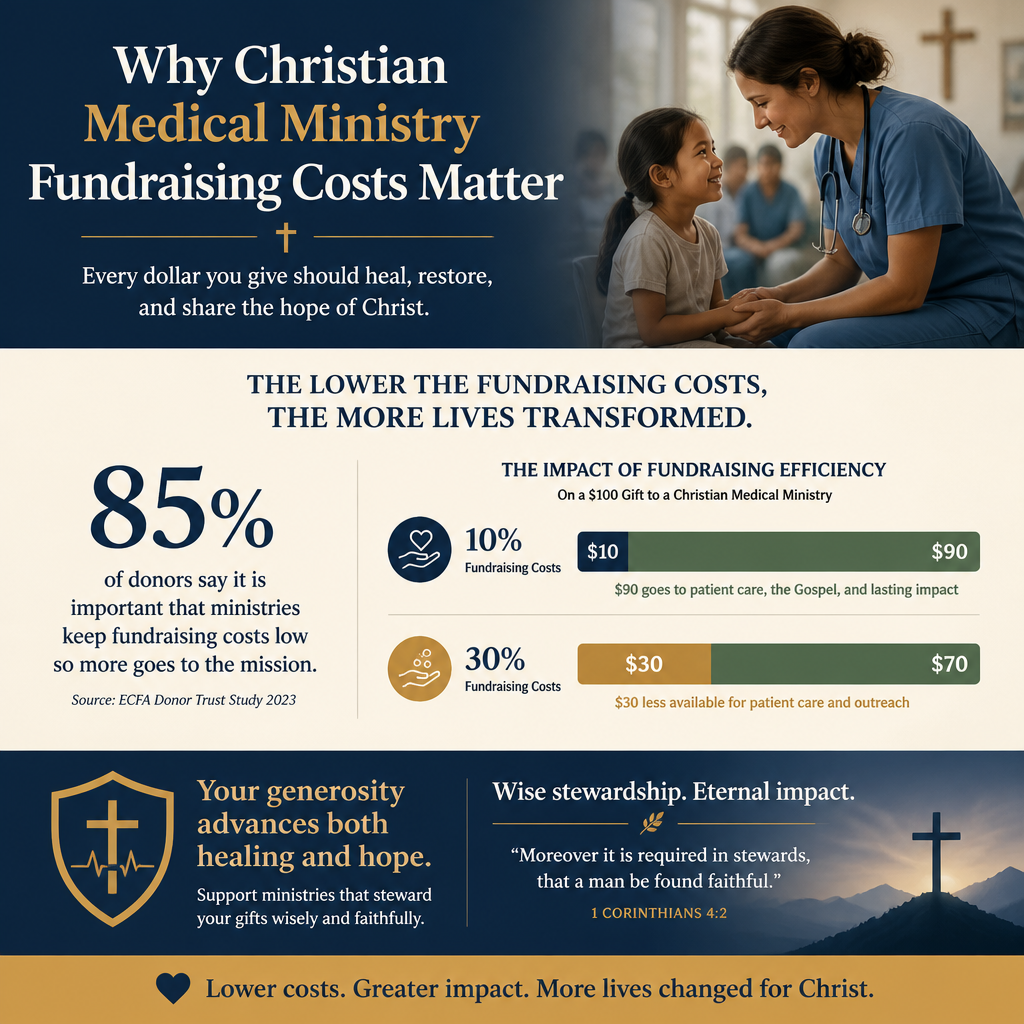
Christian medical ministry fundraising costs matter because they sit at the intersection of stewardship and mercy. Donors are not merely buying outcomes; we are offering worship through giving, and Scripture consistently treats money as a moral matter rather than a technical one.
Yet fundraising cost is also one of the most misunderstood lines in a ministry’s financial story. Some ministries spend too much to raise too little. Others spend what appears to be a great deal because they are reaching new partners, building durable support, and reducing long-term risk. The harder question is not whether fundraising should cost money, but whether the costs are truthful, proportionate, and governed with integrity.
Fundraising costs are a stewardship question before they are a ratio
Why Scripture presses donors toward discernment
Jesus’ warnings about wealth are not incidental; they expose how money reveals what we trust. Christian donors rightly ask whether resources are being handled with fear of the Lord, because ministries are accountable to God for the way they solicit, receive, and spend gifts. The apostolic pattern also assumes financial integrity is observable: churches appointed trustworthy people to handle relief funds so that “no one should blame us about this generous gift” (2 Corinthians 8:20).
Fundraising costs belong to that same category of observable integrity. A medical ministry may speak movingly about serving patients, but its fundraising methods can either honor or distort the ministry’s testimony. When appeals rely on manipulation, exaggeration, or pressure, donors should treat the tactics as a spiritual concern, not simply a marketing style.
Why “low overhead” is not the same as faithful stewardship
Christians genuinely disagree about how much a ministry should spend to raise support. Some donors view any substantial fundraising spend as suspect. Others recognize that growth and stability often require investment. What has become clearer in the broader nonprofit field is that overhead ratios alone can mislead donors into underfunding the very capacities that prevent harm and waste.
That critique is reflected in the widely cited “Overhead Myth” letter signed by Charity Navigator, GuideStar, and BBB Wise Giving Alliance, which argues that overhead percentages are a poor sole measure of nonprofit performance and can create perverse incentives to underinvest in infrastructure and evaluation Charity Navigator.

In Christian medical ministries, fundraising touches mission delivery
Medical work is expensive, and communication must match reality
Medical ministry is not abstract compassion. It is licensed personnel, regulated facilities, supply chains, cold storage, and the ethical responsibilities that follow. A ministry that provides surgeries, mobile clinics, maternal health programs, or medical shipments will often carry costs that do not feel like “program” to donors but are inseparable from faithful care.
Fundraising communications should respect that reality. When ministries imply that nearly every dollar goes “straight to the field,” they may be trying to reassure donors, but they also risk creating expectations that punish necessary spending on compliance, quality control, safeguarding, and follow-up care. Mature donors should ask whether a ministry’s public claims align with audited financial statements and with the practical requirements of medical service.
Some fundraising models create predictable pressures
Different fundraising strategies carry different temptations. Compassion-driven imagery can become emotional extraction. “Urgent” appeals can become routine, training donors to respond only to crisis language. Commission-heavy fundraising can incentivize volume over accuracy. None of these problems are unique to Christian organizations, but the name of Christ raises the stakes.

For donors who want a broader view of the landscape, our coverage of Christian Medical Ministries is designed to help place any single fundraising practice within the ministry’s overall integrity and effectiveness.
What responsible fundraising costs tend to include
The legitimate work donors rarely see
It is reasonable for donors to expect that fundraising dollars fund more than glossy mail. In well-governed ministries, fundraising supports systems that make truthfulness and accountability possible: clean donor data, receipting and compliance, restricted gift tracking, ethical storytelling practices, and careful coordination between field teams and communicators.
In practice, responsible fundraising costs often include:
- Donor services and gift processing that are accurate, timely, and compliant with applicable regulations
- Communication expenses that reflect real program realities rather than manufactured urgency
- Technology and security to protect donor information and reduce fraud risk
- Staff training and internal controls that reduce the likelihood of misrepresentation or misuse of funds
- Reporting and impact documentation that can be verified, not merely narrated
What should trigger scrutiny
Some fundraising expenses are not merely inefficient; they are structurally dangerous. When a ministry relies on high-cost acquisition year after year with weak retention, the donor base becomes a treadmill. When fundraising costs rise but net revenue stagnates, leaders may be masking an unhealthy model with ever-louder appeals. When fundraising materials contain claims that cannot be substantiated, costs become part of a deeper credibility problem.
There is a related financial pattern the sector has named directly: the “nonprofit starvation cycle,” described by Gregory and Howard, where unrealistic expectations about overhead push organizations to underinvest in capacity, which then undermines results and erodes trust Stanford Social Innovation Review. Christian donors can unintentionally reinforce this cycle when we reward ministries for appearing inexpensive rather than for being truthful and durable.
How we evaluate fundraising costs under The Most Trusted Standard
We treat fundraising as an integrity issue, not a branding issue
Most Trusted exists to help donors give with confidence by evaluating ministries against The Most Trusted Standard, a 15-criteria framework spanning faith commitments, financial integrity, governance, and transparency and effectiveness. Within that work, fundraising costs are assessed in context: how they relate to governance decisions, financial reporting clarity, donor communications, and measurable ministry outcomes.
We do not treat a single percentage as decisive. A ministry with modest fundraising spend can still mislead donors, and a ministry with higher fundraising spend can still be honest, disciplined, and effective. The question is whether leaders can justify the spending with clear reporting, prudent controls, and credible evidence that fundraising is producing sustainable net support for mission.
What strong ministries tend to show in their documentation
Across our verification work, ministries that meet The Most Trusted Standard tend to make fundraising legible. They publish audited financial statements when appropriate, explain major expense drivers without defensiveness, and avoid vague categories that prevent donor understanding. They also present fundraising results in a way that highlights net contribution to mission, not only gross receipts.
For donors exploring how gifts are put to work across different ministries, our analysis within How Christian Medical Ministries Use Donations aims to clarify what is normal, what is concerning, and what deserves further inquiry.
Practical questions donors should ask before funding growth
Questions that reveal whether costs are proportionate and governed
Donors often want a simple answer: “What percentage is acceptable?” But Christian stewardship is rarely reducible to a single number. Better questions test whether leaders are acting with prudence and truth.
Consider asking:
- Is the ministry’s fundraising clearly reported, with categories that match audited or board-reviewed financials?
- Is fundraising spend producing durable net revenue, or is the ministry replacing donors faster than it retains them?
- Are appeals accurate about what a gift can reasonably accomplish in medical contexts?
- Do leaders and the board set guardrails on outside vendors, commissions, and list rentals?
- Does the ministry show evidence of outcomes and learning, not only growth in giving?
How to hold urgency and honesty together
Medical needs are often urgent. Children die from preventable causes. Mothers lack basic obstetric care. Clinics run out of essential medicines. Donors should not respond to urgency with cynicism. But urgency does not excuse distortion. A ministry can call donors to sacrificial generosity without implying guarantees it cannot control, and without using imagery or language that treats suffering as a fundraising asset.
Theologically, this is a question of truthfulness and neighbor-love. The patient in front of the camera is not a tool; he or she bears the image of God. The donor is not a revenue source; he or she is a steward. Fundraising costs matter because fundraising practices shape how both parties are treated.
FAQs for Why Christian medical ministry fundraising costs matter
What is a reasonable fundraising cost for a Christian medical ministry?
A single benchmark is rarely reliable because the right level of spending depends on maturity, growth stage, donor mix, and the complexity of medical programming. The more defensible approach is to look for transparent reporting, evidence that fundraising produces sustainable net support, and governance oversight that prevents incentives from drifting toward manipulation or inefficiency.
Should donors avoid ministries with higher fundraising costs?
Not automatically. Higher costs may reflect donor acquisition, major campaign investments, or necessary compliance and reporting systems. The concern is not merely cost but credibility: whether the ministry can explain the spending plainly, avoid misleading appeals, and demonstrate that fundraising ultimately strengthens mission delivery rather than crowding it out.
Why this scrutiny serves both mercy and witness
Christian medical ministry fundraising costs matter because they affect whether generosity is translated into durable, truthful service to the sick. Donors should resist both naïveté and suspicion, asking for the kind of clarity that honors Christ and protects patients. When fundraising is governed with integrity and reported without evasion, it strengthens the ministry’s witness and frees donors to give with confidence.



