

Why Christian donors give to rescue missions is not primarily a question of sentiment; it is a question of discipleship, ecclesial responsibility, and moral clarity in the face of visible suffering. Rescue missions sit at the intersection of mercy and truth, meeting immediate physical need while insisting that human beings are more than bodies to be sustained.
That intersection is also where Christian giving becomes complicated. Christians genuinely disagree about the best models of homeless outreach, the limits of charity, and the proper relationship between evangelism and social service. Yet rescue missions continue to draw sustained donor commitment because they address needs Scripture refuses to treat as optional: hunger, shelter, welcome for the stranger, and dignified care for those who have been cast aside.
Rescue missions align with the biblical logic of mercy and justice
Mercy is not a secondary ministry
When Jesus described the final judgment, he did not speak in abstractions. He named concrete works of mercy: feeding the hungry, welcoming the stranger, clothing the naked, visiting the sick and imprisoned (Matthew 25). Rescue missions exist because those needs are present in every city, and because Christians have long understood mercy ministry as a public witness to the character of God.
Christian donors give to rescue missions because many of us have been formed by Scripture to see the poor not as a problem to be managed but as neighbors to be loved. Proverbs repeatedly ties generosity to righteousness, and the prophets repeatedly tie neglect of the vulnerable to national corruption. That moral logic still presses on the Christian conscience.
Justice requires more than a meal, but never less
Some donors hesitate because they rightly want structural change: affordable housing, mental health capacity, substance-use treatment, and labor markets that do not discard the fragile. Those concerns are not distractions. They are part of a serious Christian moral account of society. But Scripture does not permit us to treat long-term reform as an excuse for withholding immediate care.
Rescue missions are often one of the few institutions willing to maintain daily, local presence with people the rest of society avoids. That daily presence is why many Christian donors continue to give even when the public conversation about homelessness becomes politicized or cynical.

Christian donors give because rescue missions offer a concrete answer to visible need
The need is not theoretical
Homelessness is not evenly distributed across communities, and it is not always visible in suburban life. But for many churches and donors, the need is seen on commutes, outside hospitals, near transit hubs, and around shelters. When need is visible, Christian responsibility feels immediate.
On a single night in January 2023, roughly 653,000 people were experiencing homelessness in the United States, according to the U.S. Department of Housing and Urban Development’s Annual Homeless Assessment Report (AHAR) (HUD). Numbers like that do not capture every dimension of hidden homelessness, but they do underscore why rescue missions remain a durable part of the Christian charitable landscape.
Local accountability matters to mature donors
Many Christian donors prefer ministries where impact can be traced locally: a shelter bed funded, a meal served, a case manager hired, a recovery program sustained. The appeal is not transactional; it is moral. Donors want to know their giving is not evaporating into administrative fog or distant bureaucracy.

This is one reason rescue missions often receive support across denominational lines. They are present, measurable, and open to inspection. Donors can volunteer, visit, and observe the ethos of the ministry. For sophisticated givers, this kind of proximity is not a substitute for due diligence, but it is an important signal.
Many donors are drawn to the integrated model of rescue missions
Body and soul are not competitors
Christian donors give to rescue missions because missions often refuse the false choice between meeting physical needs and addressing spiritual realities. A meal without relationship can become mere service delivery; preaching without tangible care can become disembodied rhetoric. The historic strength of many rescue missions is their insistence on both.
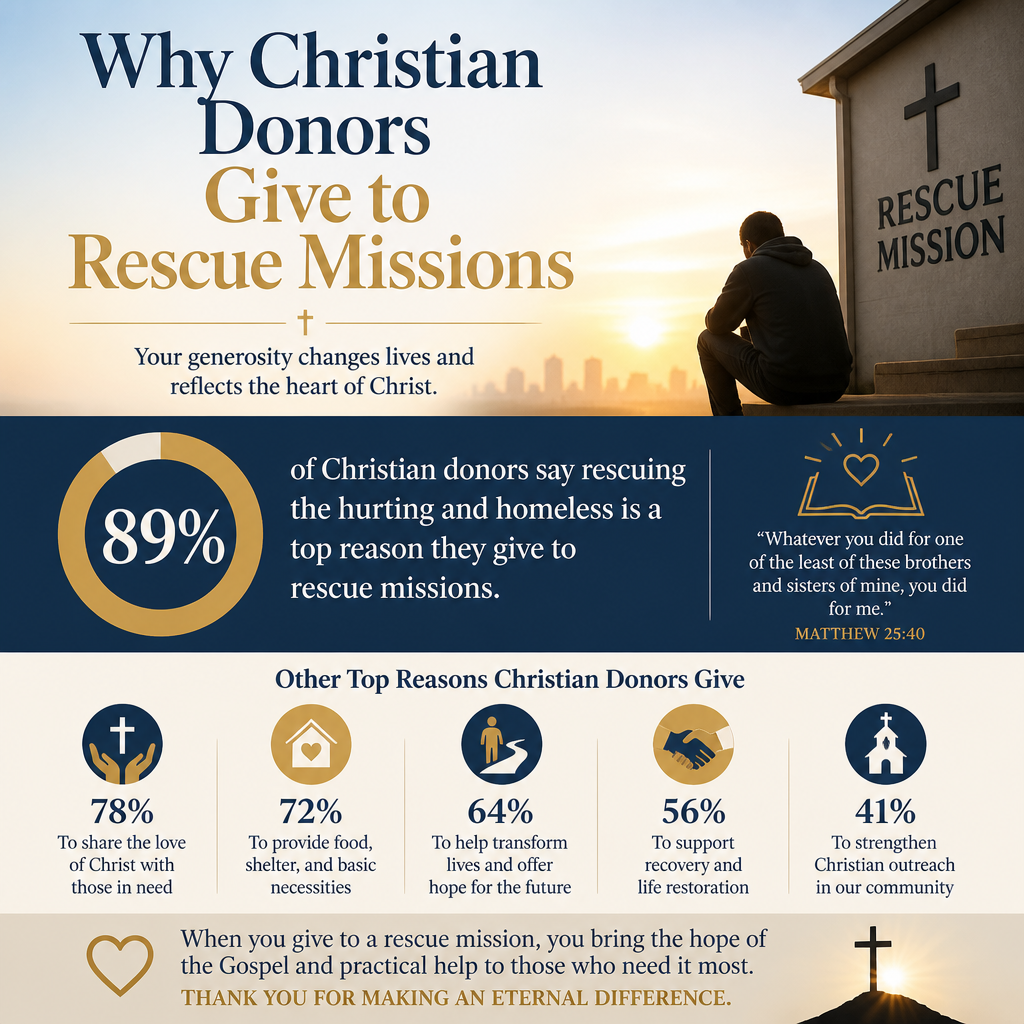
Christians differ on how explicitly evangelistic publicly funded services should be, and legal constraints vary by jurisdiction. Yet even where missions operate distinct tracks—separating chapel participation from shelter access, for example—many donors recognize the underlying Christian conviction: people experiencing homelessness often face layered crises that include shame, fractured community, addiction, trauma, and spiritual desolation. A comprehensive response must be humane enough to engage the whole person.
Discipleship-shaped recovery is a distinctive contribution
Secular service systems do important work, and many rescue missions partner constructively with them. But Christian donors often see rescue missions as offering something distinctive: a community of accountability rooted in repentance, forgiveness, and new identity in Christ. This does not guarantee outcomes, and it should not be romanticized. Recovery is difficult, relapse is real, and some mission programs have been criticized for being overly rigid or insufficiently clinical.
Still, the Christian story of transformation continues to animate rescue mission support. It offers a moral frame that neither reduces a person to a diagnosis nor treats long-term change as impossible.
Donors also give because the field has learned hard lessons about what helps
Wise compassion is not the same as sentiment
Rescue missions have had to reckon with a central tension in mercy ministry: it is possible to relieve immediate suffering while inadvertently reinforcing dependence or disengagement from long-term supports. The When Helping Hurts framework, articulated by Steve Corbett and Brian Fikkert, has shaped how many Christian leaders think about paternalism, unhealthy dependency, and the dignity of work and community.
This is where mature donors often shift from emotional giving to disciplined stewardship. Many donors still respond to urgent appeals, but they increasingly ask: Does this mission have a coherent model? Does it partner with appropriate clinicians and social service providers? Does it distinguish emergency shelter from long-term recovery? Does it treat guests as image-bearers with agency?
Responsible donors evaluate both compassion and competence
The deeper question is not whether rescue missions are necessary, but whether a specific rescue mission is trustworthy. That includes theology and governance, program integrity and financial integrity, leadership character and organizational transparency. Donors have seen enough high-profile failures across the nonprofit sector to know that good intentions do not eliminate the need for verifiable standards.
Across our verification work at Most Trusted, we observe that ministries that meet The Most Trusted Standard tend to document outcomes with care, communicate finances without defensiveness, and demonstrate leadership accountability beyond a single charismatic figure. Donors looking for this level of clarity often benefit from engaging the broader landscape of Rescue Missions and Homeless Outreach, where the practical questions of trust, effectiveness, and theological coherence come into sharper focus.
Christian donors want confidence that their giving honors God and the people served
Stewardship is spiritual, not merely financial
Jesus’ teaching on money is unambiguous: stewardship reveals allegiance. Christian donors give to rescue missions because many of us are seeking to align our budgets with the Kingdom of God rather than with cultural comfort. Yet mature stewardship is not only about generosity; it is about faithfulness. Faithfulness requires attention to how money is handled, how power is exercised, and how people are treated.
That is why sophisticated donors increasingly look for verification that goes beyond overhead ratios. The nonprofit sector has repeatedly warned against simplistic overhead benchmarks; the “Overhead Myth” letter—signed by Charity Navigator, GuideStar, and the BBB Wise Giving Alliance—made the case that donors should focus on governance, transparency, and results rather than administrative percentages alone (Charity Navigator).
What donors should look for in a rescue mission
Rescue missions vary widely: in theology, in programming, in clinical competence, in partnerships, and in financial discipline. Donors should expect differences, but we should not accept opacity. A prudent donor posture asks for enough information to give without naïveté and without cynicism.
- Clear statement of faith and clarity about how faith is expressed in programming
- Independent board governance with meaningful oversight of senior leadership
- Transparent financial reporting, including audited statements when appropriate
- Defined program model that distinguishes emergency care from long-term recovery
- Safeguards for vulnerable adults, including trauma-informed practices and referral pathways
Within How Rescue Mission Donations Make Impact, donors can engage the practical realities behind these criteria: what measurable faithfulness can look like in homeless outreach, and how to evaluate claims without reducing ministry to metrics.
FAQs for Why Christian donors give to rescue missions
Do rescue missions actually help people exit homelessness long term?
Some do, and some primarily provide emergency stabilization. Long-term exits often depend on factors beyond a mission’s control: housing supply, employment access, disability status, family systems, and the availability of clinical care. Donors should ask missions to define what success means in their context, report outcomes with humility, and demonstrate credible partnerships for needs they cannot meet alone.
Is it appropriate for a rescue mission to share the gospel while providing shelter and meals?
Christians have long understood mercy and proclamation as related expressions of love of neighbor, but faithful practice requires care. Coercion is inconsistent with Christian ethics, and the practical constraints of public funding and nondiscrimination law must be respected. Donors should look for missions that maintain a clear Christian identity, offer spiritual care with integrity, and protect the dignity and agency of those served.
Why this pattern of giving persists
Christian donors give to rescue missions because the needs are immediate, the biblical mandate is durable, and the work embodies a form of public discipleship that cannot be outsourced to sentiment or to the state. The most credible missions hold together compassion and competence, proclamation and dignity, urgency and patience. For donors seeking to honor God with their giving, the task is not merely to give more, but to give with clearer moral and institutional confidence.



