
When rescue missions need funding most, donors often assume the answer is simple: winter, holidays, or the moment a local crisis hits the news. Those seasons do strain shelters. Yet the deeper pattern is that rescue missions tend to need funding most when faithful, non-photogenic work must be sustained: staffing, follow-up care, and the slow rebuilding of lives that do not resolve on a holiday timeline.
Christian donors give into a moral landscape shaped by Matthew 25, where Jesus identifies himself with the hungry, the stranger, and the prisoner. That passage does not frame mercy as a seasonal gesture; it frames it as a settled posture of discipleship. The question is not whether rescue missions deserve support, but how to recognize the moments when funding is most likely to prevent harm, preserve capacity, and keep Christ-centered care intact.
1. The highest need is often when demand rises but attention does not
Cold weather is real but it is not the only pressure point
Winter matters because exposure kills, and shelters absorb the surge. But rescue missions can also face acute demand in shoulder seasons when people are displaced by rent increases, job loss, family breakdown, or release from incarceration. The pressure is intensified when public concern fades and emergency appeals no longer land with the same force.
Research does not always translate neatly into local forecasting, but it does establish the scale of housing insecurity that feeds shelter demand. For example, the point-in-time count reported by HUD estimates more than 653,000 people experienced homelessness in the United States on a single night in 2023, a figure that rose materially from the prior year and signals system-wide strain, including shelters and missions (U.S. Department of Housing and Urban Development).
The hidden surge after major news cycles
After a natural disaster, a violent incident, or a highly publicized encampment sweep, communities often mobilize. The harder period can come later, when short-term giving has already moved on but the downstream consequences arrive at the mission: traumatized guests, disrupted routines, loss of IDs and medications, and higher conflict in crowded dorms. Missions need flexible funding precisely when care becomes more complex and less visible.
2. Rescue missions need funding most when staffing and retention are at risk
Bed counts do not represent the real capacity constraint
A shelter can add mats; it cannot easily add seasoned staff, trained case managers, or sober living mentors on short notice. The capacity constraint is often relational and clinical rather than architectural. If a mission loses its best staff to burnout or wage pressure, the ministry may still be open while the quality of care quietly deteriorates.
What this means in practice is that donors who care about outcomes should care about payroll stability, supervision, training, and adequate staff-to-guest ratios. Those line items rarely excite donors, yet they protect the mission’s ability to offer safe overnight shelter, consistent discipleship, and credible pathways to stability.
Burnout is a spiritual and operational vulnerability
Christians rightly emphasize compassion, but compassion without sustainability becomes brittle. Rescue mission staff routinely encounter untreated mental illness, addiction relapse, domestic violence histories, and the effects of incarceration. Understaffing can increase safety incidents, reduce follow-up, and shorten the time available for the very conversations where pastoral care and case planning intersect.
Across our verification work at Most Trusted, we observe that ministries meeting The Most Trusted Standard tend to treat staff health as an integrity issue, not a luxury. They build policies that protect vulnerable guests and staff alike: incident reporting, supervision, clear boundaries, and training that respects trauma. Restricted gifts that exclude “overhead” can unintentionally weaken precisely those protections.

3. The most consequential gap is often aftercare and long-term formation
Emergency shelter is necessary but rarely sufficient
Rescue missions exist because emergency shelter is a moral necessity, yet the biblical vision of restoration is larger than a bed for the night. Many missions attempt to pair shelter with recovery programming, life-skills training, employment support, and pastoral discipleship. Those services cost money that is harder to raise than a meal appeal.
The field has had to reckon with a persistent tension: donors want quick, measurable stories, while many guests require long, uneven progress. Some will relapse. Some will leave and return. Christian donors can affirm repentance and new life while still acknowledging that trauma and addiction often involve cycles that do not fit neat timelines.
The “Starvation Cycle” shows why underfunded operations can regress
Nonprofits commonly face pressure to underinvest in administration and capacity, which can create a downward spiral: weak systems, diminished effectiveness, and increased difficulty raising funds. Stanford Social Innovation Review has described this dynamic as the “Nonprofit Starvation Cycle,” a pattern that can be especially damaging for frontline ministries that must maintain safety and consistency (Stanford Social Innovation Review).
For rescue missions, underinvestment shows up as inadequate case management coverage, outdated facilities that compromise dignity and safety, and limited ability to track whether guests actually reach stable housing, recovery milestones, and durable employment. If donors want ministries to be both merciful and responsible, funding must include the less visible work that makes visible mercy dependable.
4. Donors should watch the calendar Christians actually give by
Year-end giving helps but can distort cash flow
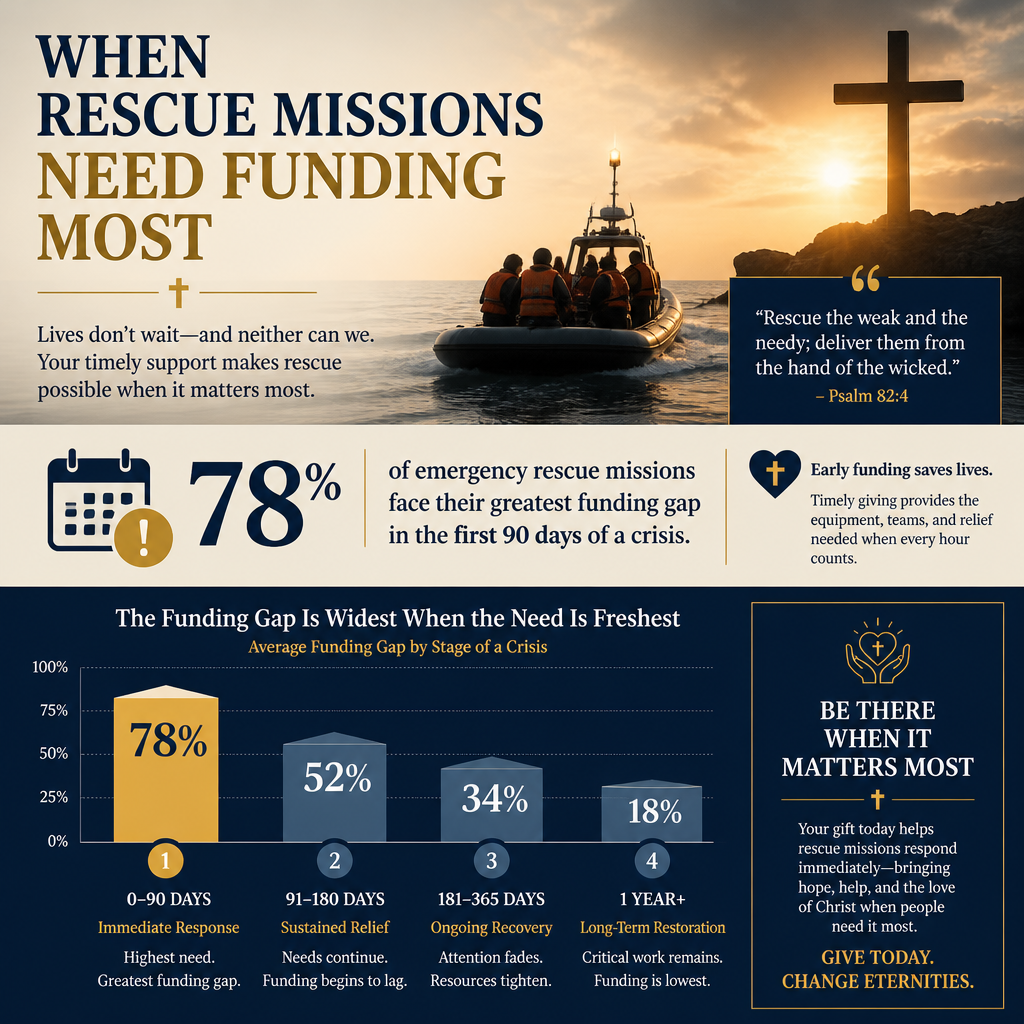
Many missions receive a disproportionate share of giving in November and December. That generosity is meaningful, but it creates a predictable tension: rent, utilities, staffing, and insurance are due in every month, while gifts can arrive in a seasonal surge. When reserves are thin, missions may limp through late winter and spring, cutting services just as cold-weather strain and crisis aftereffects persist.
Households also face competing demands at the end of the year, and ministries feel that pressure. National patterns in charitable giving have shown that giving is often concentrated in the final months of the year, which can magnify the mismatch between monthly expenses and seasonal income (Indiana University Lilly Family School of Philanthropy).
What to fund when the mailers stop coming
Christian donors who want to strengthen rescue missions can ask a simple, revealing question: “Which months are hardest to cover, and why?” In many communities the answer is not December. The hardest months are often those when winter appeals are past, when summer travel distracts, or when a capital project has absorbed attention while operating costs keep accumulating.
For donors seeking context on the broader landscape of ministries serving neighbors in crisis, our coverage of Rescue Missions and Homeless Outreach tracks recurring pressures and the practices that tend to protect integrity and effectiveness.
5. The best giving meets urgent need without weakening accountability
Funding needs are legitimate, but not every appeal is equally trustworthy
Christians genuinely disagree about what models of homelessness response are most effective: emergency shelter expansion, Housing First approaches, recovery-first programs, or mixed systems. Rescue missions themselves vary widely in theology, program design, and relationship to public funding. Because the work is morally urgent, it can also attract rhetoric that outpaces reality. Mature giving insists on both compassion and verification.
At Most Trusted, we evaluate Christian nonprofits against The Most Trusted Standard, a 15-criteria framework focused on Faith Foundation, Financial Integrity, Governance and Leadership, and Transparency and Effectiveness. Donors do not need perfection to give; they need honest information about whether a ministry is credible, well-governed, and candid about what it can and cannot claim.
Questions that identify the moment a mission needs funding most
The clearest funding needs are not always the loudest. We recommend asking targeted questions that connect urgency to stewardship:
- Are we funding overnight shelter only, or also case management, recovery support, and spiritual care that reduce repeat homelessness?
- Does the mission have adequate reserves for payroll and emergencies, or is it one shortfall away from cutting services?
- How does the mission ensure guest safety, staff training, and incident reporting during surge periods?
- Are program outcomes tracked with appropriate humility, distinguishing “participation” from durable change?
- Does leadership communicate candidly about constraints, including mental health and addiction complexity?
Donors who want their giving to produce durable mercy often find that the most strategic gifts are those that shore up capacity: case management coverage, staff retention, facility safety, and the systems that ensure the ministry can tell the truth about its results.
Readers looking for giving considerations grounded in measurable stewardship and ministry practice can also review How Rescue Mission Donations Make Impact, where we address common donor assumptions and where they tend to break down under scrutiny.
FAQs for When rescue missions need funding most
Is winter always the time rescue missions need funding most?
Winter often brings a real increase in shelter demand and a higher risk of injury or death from exposure. Yet missions frequently experience their sharpest funding vulnerability after peak giving seasons, when public attention recedes but operating costs remain steady. The most strategic donors ask which months produce the largest cash-flow gap and what services are at risk if that gap persists.
Should Christian donors prefer restricted gifts for meals and beds, or unrestricted support?
Restricted gifts can be appropriate when a donor understands the full cost of the program being funded, including staffing, supervision, and safety. Unrestricted support is often what allows missions to respond to unpredictable surges, retain trained staff, and maintain integrity in reporting. Wise stewardship is not simply restricting a gift; it is funding what is actually required for faithful, competent care.
Giving for the moments that do not announce themselves
When rescue missions need funding most is often when the work is hardest to see: the months after seasonal generosity, the weeks after a crisis headline fades, and the years when restoration requires patient, accountable care. Christian donors can honor Matthew 25 without abandoning prudence, strengthening ministries that serve neighbors in acute need while insisting on governance, financial integrity, and truthful reporting.
The most faithful giving is not only reactive. It sustains the quiet infrastructure of mercy so that when the next person arrives at the door—cold, ashamed, detoxing, or newly released—there is a prepared place, a competent staff, and a Christ-centered pathway that treats them as a bearer of God’s image rather than a problem to be managed.



