
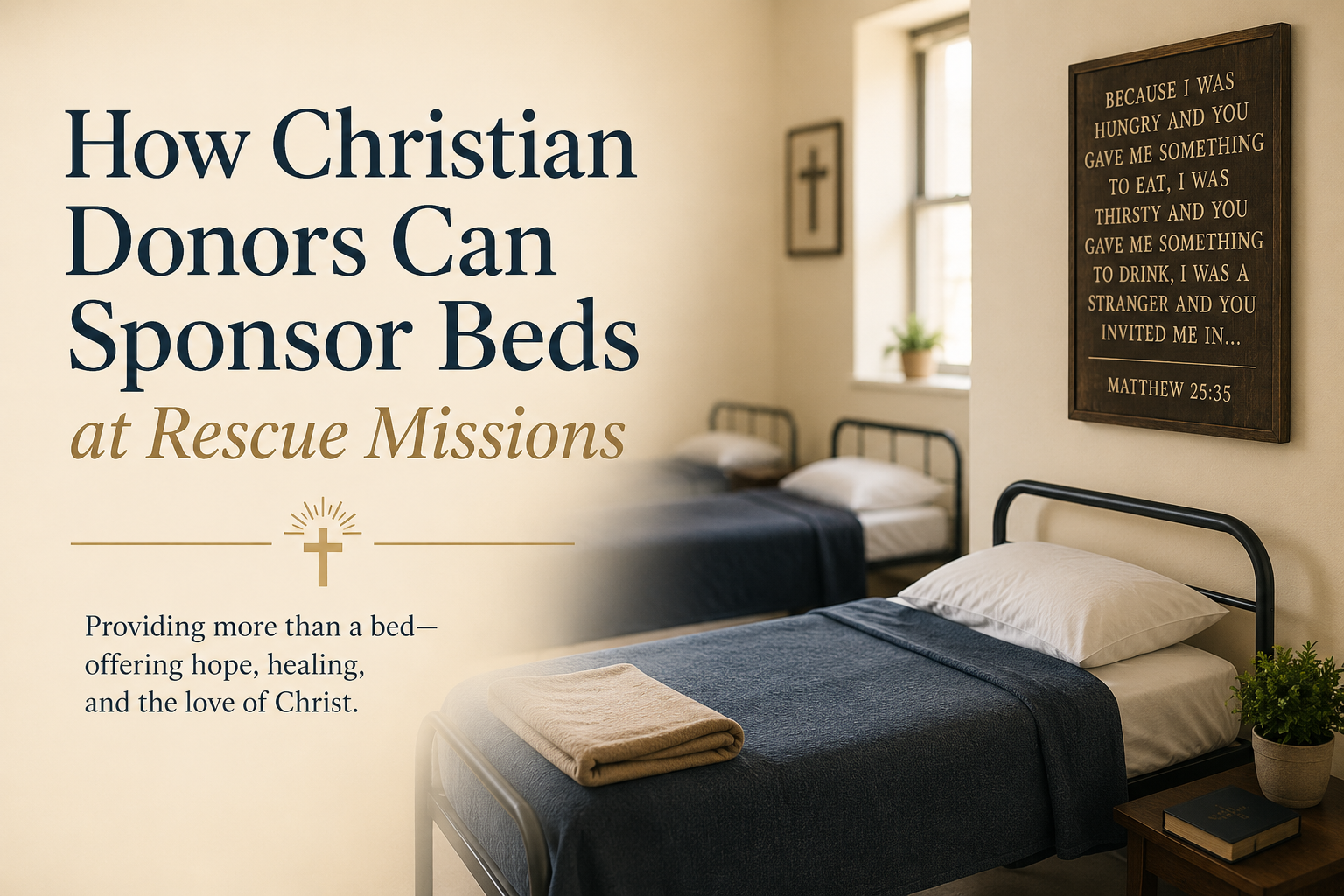
When Christian donors sponsor beds at rescue missions, the appeal is immediate: a concrete gift tied to a concrete mercy. A bed suggests shelter, safety, and dignity for a neighbor whose life has narrowed to survival. Yet the harder stewardship question is whether “sponsoring a bed” reflects the true work of a rescue mission, or whether it unintentionally reduces a complex ministry of presence, recovery, and discipleship to a single line item.
Scripture does not treat shelter as optional. The prophets condemn those who “hide yourself from your own flesh” (Isaiah 58:7), and Jesus identifies himself with the hungry, the stranger, and the naked (Matthew 25:35–40). Rescue missions have long stood in that stream of mercy. But Christian giving shaped by discipleship also asks sober questions: What outcomes are pursued? What safeguards protect guests? Is the gospel proclaimed with integrity rather than coercion? And is a donor’s sponsorship language accurate and accountable?
What a sponsored bed actually represents in rescue mission work
Most rescue missions do not operate like hotels with a fixed cost per night and a fixed “bed inventory” that can be neatly underwritten. A bed sits within an ecosystem: staffing, security, trauma-informed care, meals, case management, chapel services, addiction recovery supports, and referrals to housing and employment. When a mission invites donors to sponsor beds, it is usually offering a fundraising metaphor for underwriting that larger system.
That metaphor is not inherently manipulative. Christian donors often want a tangible expression of mercy, and missions need unrestricted revenue to keep doors open. The tension arises when sponsorship language becomes overly transactional—suggesting that a donor has “covered” the full cost of a person’s stay, or that a fixed gift produces a guaranteed outcome.
Why missions use bed sponsorship language
Bed sponsorship appeals because it gives form to compassion. It also aligns with a ministry’s daily operational reality: people do, in fact, sleep in those beds tonight. But missions also need support for services donors cannot see—training, background checks, clinical partnerships, facility maintenance, insurance, and compliance. If a mission’s messaging implies that overhead is morally suspect, it can push donors toward the wrong expectations.
The field has had to reckon with the “overhead ratio” fixation. Charity Navigator, Candid (formerly GuideStar), and the BBB Wise Giving Alliance publicly warned donors that overhead metrics alone are a poor measure of nonprofit effectiveness in their joint statement commonly known as the Overhead Myth letter https://www.guidestar.org. Rescue missions, which carry real facilities and staffing burdens, are a clear example of why simplistic ratios do not serve thoughtful stewardship.
What a donor is truly funding
A mature sponsorship program should tell the truth: a gift helps keep a mission’s doors open and strengthens the ministry offered there. A bed is not merely furniture. It is a point of stability that allows a guest to take the next step—detox support, counseling, reconciliation, work readiness, or connection to longer-term housing. The bed is the threshold; the ministry is what happens after the door closes and before it opens again the next morning.

Questions serious Christian donors should ask before sponsoring a bed
Christian donors are not called to cynicism, but to discernment. Rescue missions operate under pressure—public scrutiny, safety concerns, and the unpredictable realities of addiction and mental illness. That makes clear governance, financial integrity, and transparent reporting more, not less, important.
Across our verification work at Most Trusted, we observe that strong missions are not the ones with the most polished slogans. They are the ones that can articulate their theology of mercy, describe their program model in plain terms, and show verifiable evidence of responsible stewardship and measured outcomes consistent with their mission.
Mission clarity and theological integrity
Christians genuinely disagree about some practical boundaries: what counts as “Christian” programming, how chapel participation is handled, and how to serve guests who do not share the mission’s faith commitments. A trustworthy mission will not evade these questions. It will explain how it proclaims Christ while honoring human dignity and avoiding manipulative practices.
We also recommend asking how the mission understands the relationship between mercy and discipleship. Some missions emphasize emergency shelter as a first step; others focus on longer-term recovery programs. Both can be faithful, but donors should know which they are supporting and why.
Safeguards, staffing, and guest safety
A bed sponsorship appeal can sound simple; shelter work is not. Ask about staffing ratios, volunteer screening, security policies, and partnerships with local mental health and substance use providers. For ministries serving women and children, ask about trauma-informed practices and facility layout. For all ministries, ask about grievance procedures and how guests can report concerns without retaliation.
If a mission cannot explain basic safety and accountability practices, that is not a minor gap. It is a warning sign that “beds” are being marketed without sufficient attention to what shelter requires.
- What services are offered alongside overnight shelter, and which are optional versus required?
- How are staff and volunteers screened, trained, and supervised?
- How does the mission track outcomes appropriate to its model (stability, recovery milestones, housing placement, employment)?
- What financial statements and annual reports are publicly available?
- How does the mission partner with churches, local agencies, and clinical providers?
How to evaluate a bed sponsorship program with clarity and charity
The goal is not to demand laboratory-grade proof for every act of mercy. The goal is to give in a way that is truthful about what a mission can claim, and disciplined about how resources are stewarded. Bed sponsorship works best when it is framed as shared support for a ministry’s capacity rather than a guarantee of a particular person’s story.
Donors who want to think more broadly about the ecosystem of shelter, recovery, and long-term stability will find helpful context in Rescue Missions and Homeless Outreach. Bed sponsorship is one on-ramp into that wider work; it should not become the only lens through which donors see the field.
Distinguish between emergency shelter and programmatic change
Emergency shelter is essential, and it will always include repeat nights for some guests. That does not automatically mean failure. The question is whether the mission is honest about what it exists to do. Some are primarily crisis-response ministries. Others operate structured residential programs with defined phases and expectations.
The research community has long noted how homelessness is shaped by intersecting factors—housing affordability, mental health, substance use, family breakdown, and local policy. Serious donors should resist simplistic narratives. A faithful mission can offer durable help without claiming to solve every causal layer of homelessness in its city.
Ask for transparency that matches the claim
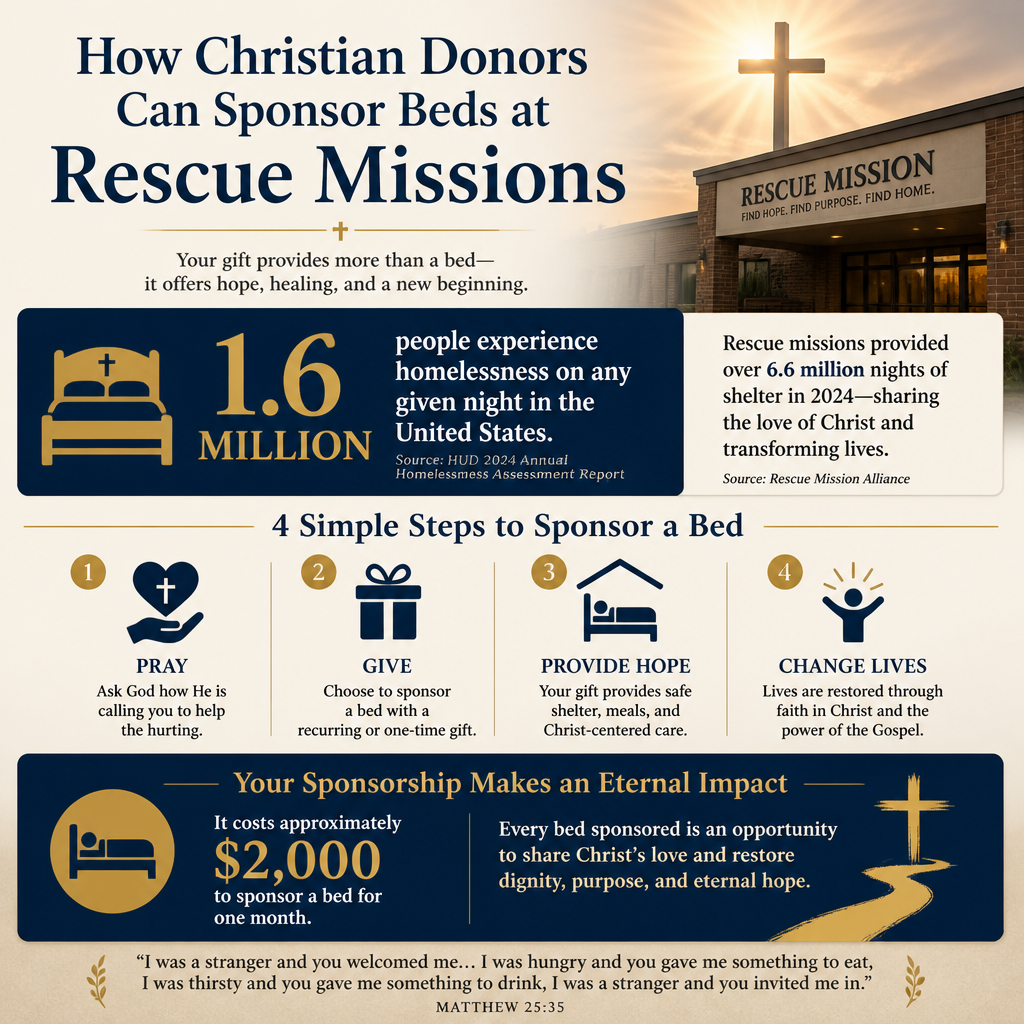
If a mission advertises that “$X sponsors a bed for a night,” ask how that figure is calculated and what it includes. A credible answer might reference average costs, occupancy rates, and shared services. An evasive answer often signals marketing language untethered from financial reality.
Transparency also includes how restricted gifts are handled. If you “sponsor a bed,” is the gift restricted to shelter operations, or is it treated as unrestricted to support the mission’s overall work? Both can be legitimate, but donors should not be surprised later.
Giving strategies that strengthen rescue missions beyond the bed
Bed sponsorship can be a faithful entry point, especially for donors who want a defined commitment and a recurring rhythm of generosity. But many missions are most strengthened by gifts that support the less visible drivers of long-term fruit: staff development, facilities, data systems, pastoral care capacity, and partnerships that move people toward stable housing.
Within How to Give Wisely to Rescue Missions, we consistently see that donors gain confidence when they align the form of their giving with a ministry’s operating realities. Shelter work is cash-flow sensitive. Monthly support can be more stabilizing than one-time gifts, even when the one-time gifts are larger.
Recurring sponsorship and unrestricted support
A monthly “bed sponsorship” commitment can function as a disciplined form of unrestricted giving, provided the mission represents it honestly. Unrestricted funds are not a lack of accountability; they are what allows leaders to respond to urgent needs: a boiler failure in winter, increased security needs, or hiring a qualified case manager who can coordinate housing placements.
We recommend treating unrestricted support as a vote of confidence that should be earned. When a mission meets The Most Trusted Standard, it is typically because it can show clear faith commitments, strong financial integrity, responsible governance, and transparent reporting on what it does and what it can reasonably claim.
Targeted investments that address bottlenecks
Some donors want a gift that is tangible without being simplistic. In that case, consider asking mission leadership about operational bottlenecks: transportation to ID appointments, funding for professional counseling hours, job training partnerships, or the cost of additional staff to extend case management capacity.
These are not as marketable as “a bed,” but they often determine whether a guest can move from shelter to stability. The point is not to chase novelty; it is to strengthen what actually helps people take the next step.
FAQs for How Christian donors can sponsor beds at rescue missions
Is sponsoring a bed the same as paying for one person to stay overnight?
Usually not. In most missions, “sponsoring a bed” is a way of describing shared support for shelter operations and the services that make shelter safe and constructive. A trustworthy mission will explain whether the amount is an average cost estimate, what it includes, and whether the gift is restricted or unrestricted.
Should Christian donors prioritize bed sponsorship or long-term recovery programs?
Both can be faithful forms of giving, and the right emphasis depends on the mission’s calling and your stewardship goals. Emergency shelter addresses immediate vulnerability; recovery and residential programs often require higher staffing and longer commitments. The better question is whether the mission is clear about its model, truthful about outcomes, and accountable in its governance and finances.
A faithful bed sponsorship is truthful, accountable, and oriented to restoration
Sponsoring beds at rescue missions can express biblical mercy in a form that is concrete and disciplined. The most responsible sponsorships, however, refuse to romanticize shelter work. They treat the bed as a threshold into a larger ministry of safety, presence, and restoration, and they insist on governance, transparency, and theological integrity that honor both donors and guests.
When donors pair generosity with verification—asking the right questions and supporting missions that can bear the weight of their claims—bed sponsorship becomes more than a symbol. It becomes a steady contribution to the kind of mercy Scripture commends: practical, truthful, and ordered toward human dignity under God.



