
Why Christian donors choose faith-based DAF sponsors is ultimately a question of spiritual authority and moral formation as much as administrative convenience. A donor-advised fund can be a disciplined way to set money apart for the Lord’s purposes, but it also introduces a new set of intermediaries whose values quietly shape what “good” giving looks like.
Christians are rarely asking only, “Can this sponsor process grants?” Mature donors are also asking, “Will this sponsor help us give in a way that is faithful to Scripture, careful with money, and honest about impact?” Those questions become sharper as giving grows more complex: multi-year commitments, international work, controversial causes, and the uncomfortable reality that sincere ministries can still mishandle funds or harm the people they intend to serve.
Faith-based DAF sponsors offer moral alignment, not just a financial account
DAFs inevitably catechize donors in a philosophy of giving
A donor-advised fund is not a neutral container. The sponsor’s policies, grant guidelines, and even recommended charities communicate a theology of money—sometimes explicitly, often implicitly. Christians who choose a faith-based DAF sponsor are usually seeking alignment with a moral vision that treats wealth as stewardship rather than self-expression.
Jesus’ teaching about money is not peripheral. “Where your treasure is, there your heart will be also” (Matthew 6:21). A sponsor that understands giving as discipleship will tend to emphasize prayerful discernment, accountability, and long-term faithfulness rather than novelty and personal branding.
Donors want a sponsor that can name moral boundaries with clarity
Christians genuinely disagree about some applications of moral reasoning in philanthropy. But most Christian donors do not want their giving routed through an institution that treats moral boundaries as a private preference. A faith-based sponsor may be better positioned to provide clear guidance on contested areas—particularly where a grant could indirectly support activities that conflict with Christian convictions.
That clarity can be costly. A sponsor that draws lines will sometimes frustrate donors who want maximal flexibility. Yet many donors accept that trade-off because they want the sponsor’s constraints to serve as guardrails, not hurdles.

Complex giving increases the value of spiritually informed due diligence
Scale and distance increase the risk of unexamined assumptions
As giving moves beyond local relationships, donors face information asymmetry. International relief, church-planting networks, crisis fundraising, and highly mediated online appeals can separate a donor from verifiable realities on the ground. A faith-based DAF sponsor often appeals because it signals a willingness to do more than process transactions—to ask the harder questions about governance, finances, and ministry practice.
This is not cynicism. It is a sober response to what the field has learned. Christian compassion is commanded, but it must be joined to wisdom. “Let the wise hear and increase in learning” (Proverbs 1:5). Donors who have watched public ministry failures unfold tend to value sponsors that treat diligence as a form of love for both donors and beneficiaries.
Donors are seeking credible signals of trustworthiness
Donors often ask whether there are objective markers that a ministry is well-governed and financially honest. This is one place where independent verification can serve the Church. At Most Trusted, our work evaluates ministries against The Most Trusted Standard, a 15-criteria framework spanning Faith Foundation, Financial Integrity, Governance and Leadership, and Transparency and Effectiveness. The goal is not to replace spiritual discernment, but to strengthen it with evidence that can be checked.
In practice, donors are trying to avoid two opposite errors. The first is credulity—assuming a Christian brand implies integrity. The second is cynicism—assuming no one can be trusted and therefore refusing to commit meaningfully. Responsible verification helps donors inhabit the middle space: hopeful, careful, and accountable.
Many donors are responding to a credibility crisis in institutions
Trust has weakened across the nonprofit landscape
The larger context matters. Americans’ confidence in institutions has been under strain for decades, and philanthropy is not immune. When confidence is low, donors naturally look for anchors—institutions that can credibly explain how they make decisions and why they are worthy of trust. A faith-based DAF sponsor can feel like an anchor precisely because it signals shared commitments about truthfulness, accountability, and the moral weight of money.
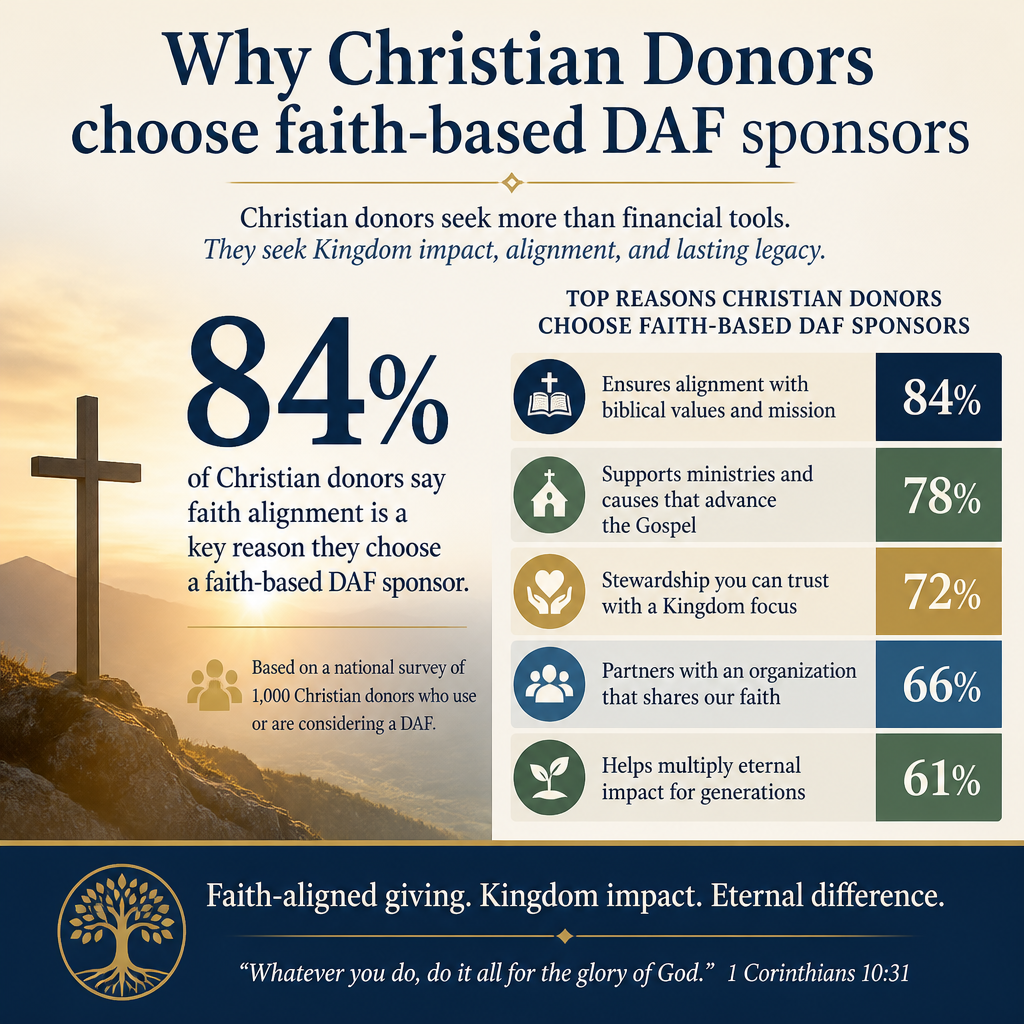
That instinct is supported by broader data about declining institutional trust. For example, Gallup has reported long-term declines in confidence across major institutions in the United States, including churches and organized religion as categories within its tracking work Gallup.
Christian donors want accountability that is more than compliance
Legal compliance is necessary; it is not sufficient. A sponsor can meet the law and still enable poor stewardship through weak standards, thin documentation, or a culture that discourages scrutiny. Many Christian donors choose faith-based DAF sponsors because they are looking for accountability that is grounded in moral obligation, not merely regulatory minimums.
What this means in practice is that donors pay attention to questions like: Does the sponsor have a coherent approach to vetting ministries? Does it address conflicts of interest? Does it have clear policies on restricted gifts, overseas partners, and crises? Does it treat transparency as a duty to the Body of Christ?
Faith-based sponsors can better support distinctively Christian grantmaking patterns
Donors often want to give to churches and explicitly Christian work
Many Christian donors want their giving to support the local church as well as mission work, theological education, evangelism, and mercy ministries carried out in Jesus’ name. A faith-based DAF sponsor may be more familiar with how churches function financially, what healthy governance looks like in ministry settings, and how to interpret ministry reporting without forcing it into categories designed for secular nonprofits.
This also intersects with how Americans actually give. Giving to religion remains a major share of U.S. charitable giving in many years, as tracked in the annual Giving USA report published by the Giving USA Foundation Giving USA.
Donors want help avoiding predictable stewardship mistakes
Across our verification work, we observe recurring patterns that sophisticated donors learn to take seriously: charismatic leadership without meaningful oversight, financial reporting that obscures reality, impact claims that are not measurable, and boards that function as supporters rather than governors. Faith-based sponsors that take their fiduciary and moral responsibilities seriously can help donors resist these patterns, especially when urgency and emotion are high.
Several practical considerations tend to rise to the surface for Christian donors choosing a sponsor:
- Whether the sponsor’s grant policies align with the donor’s convictions on contested social issues
- Whether the sponsor can help evaluate ministries beyond reputation and compelling storytelling
- Whether international grants receive careful scrutiny regarding partners, controls, and reporting
- Whether the sponsor encourages long-term commitments over reactive, crisis-driven giving
- Whether the sponsor’s fees and investment options are understandable and appropriately disclosed
These are not merely administrative. They are questions about what kind of person and what kind of Church our giving is forming.
Independent verification complements a faith-based sponsor’s role
Verification addresses the gap between sincere intent and verifiable practice
Faith-based DAF sponsors vary widely. Some do meaningful diligence; others function mainly as a granting conduit with a Christian identity. For donors who want more than branding, independent verification can provide a second set of eyes—especially when a ministry’s claims are difficult to assess from the outside.
Most Trusted exists for that reason. We evaluate Christian nonprofits against The Most Trusted Standard to help donors give with confidence. We are not a DAF sponsor, and we do not replace pastoral counsel or personal discernment. We do provide verifiable criteria that donors can use to ask better questions and to distinguish between trustworthy ministries and those that warrant caution.
A donor’s strategy should account for both theology and governance
Christians do not honor God by divorcing “spiritual” aims from practical stewardship. Scripture repeatedly joins the two. “It is required of stewards that they be found faithful” (1 Corinthians 4:2). Faithfulness includes financial honesty, competent leadership, and truthful communication—not as secondary matters, but as expressions of love of neighbor and fear of the Lord.
Donors who want to think more clearly about the ecosystem around donor-advised funds often benefit from comparing how different approaches handle diligence, accountability, and faith commitments. For a broader view of the landscape, we address related questions under Christian Stewardship Services as donors consider how best to structure disciplined generosity.
FAQs for Why Christian donors choose faith-based DAF sponsors
Are faith-based DAF sponsors always more trustworthy than mainstream sponsors?
No. A Christian identity claim is not the same as verifiable integrity. Some faith-based sponsors maintain strong governance, clear policies, and serious diligence; others do not. The wise approach is to ask for evidence: audited financials, conflict-of-interest policies, board oversight practices, clear grant standards, and transparent fee disclosures. Independent evaluation can help donors compare institutions on more than reputation.
What should Christian donors ask before opening a donor-advised fund with a faith-based sponsor?
Donors should ask how the sponsor vets grantees, how it handles international grants, what moral or doctrinal boundaries shape its policies, and what documentation is required for complex gifts. Donors should also request clarity on fees, investment options, and whether the sponsor provides meaningful reporting on grants. For donors assessing how sponsors manage these mechanics over time, our analysis of How Christian Stewardship Services Manage Donor-Advised Funds addresses common operational differences that affect real stewardship outcomes.
Choosing a sponsor is choosing a formation environment
Why Christian donors choose faith-based DAF sponsors is not reducible to convenience. A DAF sponsor helps shape what donors notice, what they ignore, and what they reward. The most serious Christian donors recognize that giving forms the giver, and that money set apart for the Lord deserves institutions that treat stewardship as a moral trust.
When donors pair a faith-based sponsor with independent verification, they are not chasing perfection. They are pursuing faithfulness: honoring Christ in both the intention of their generosity and the governance structures that carry it into the world.



