
Funding missionaries through Christian stewardship services is, at its best, a disciplined way to align long-term generosity with long-term faithfulness. For many Christian donors, the question is not whether missions matter, but how to support gospel work without drifting into impulse giving, opaque accountability, or a pattern of short-term enthusiasm followed by fatigue.
Scripture does not treat financial stewardship as a technical sidebar to discipleship. Jesus’ teaching repeatedly exposes money as a spiritual diagnostic: “Where your treasure is, there your heart will be also” (Matthew 6:21). Stewardship services can help donors move from reactive giving to deliberate, prayerful funding of missionaries with clear expectations, traceable flows of funds, and governance that can withstand scrutiny.
Why stewardship services belong in a serious missions funding strategy
Modern missionary support sits at the intersection of theology, administration, and risk. Donors are often asked to underwrite a person’s calling while also ensuring that funds are handled with integrity across borders, currencies, and partner organizations. The complexity is real, and the moral stakes are high.
Stewardship services exist to shoulder some of that complexity. They can consolidate receipts, structure recurring commitments, facilitate grants from donor-advised funds, and create records that strengthen both donor confidence and ministry accountability. Used well, they also reduce the temptation to treat giving as episodic charity rather than sustained partnership in gospel labor.
Stewardship is a theological category, not merely an administrative one
Paul’s language of “stewards of the mysteries of God” (1 Corinthians 4:1–2) carries an expectation of proven trustworthiness. That expectation applies to money as well as doctrine. A stewardship service is not a substitute for spiritual discernment; it is a tool that can honor it, particularly when a donor’s desire to help outpaces their ability to verify.
Serious donors plan for longevity, not only urgency
Missions is often presented through urgent needs: airfare, a new church plant, crisis relief, a training cohort. Those needs are frequently legitimate. But a donor’s faithfulness is tested over time, and missionaries experience the consequences when support fluctuates. Stewardship services can help donors translate conviction into stable, predictable support, which often matters more to the missionary than one-time surges.
How funds typically flow to missionaries through stewardship services
The phrase “funding a missionary” can describe several distinct financial pathways. Some donors give to a sending agency that pays the missionary. Others give to a church that supports the missionary. Still others provide project-specific funding through a ministry that oversees the work. Stewardship services often function as connective tissue, enabling donors to support these pathways with better documentation and fewer operational surprises.
Common structures donors encounter
- Sending agency support: gifts go to an established missions organization that employs or oversees the missionary.
- Church-based support: gifts go to a local church that disburses to the missionary or partner ministries.
- Project grants: gifts are designated for a defined program or initiative under a ministry’s oversight.
- Fiscal sponsorship: gifts flow through a sponsor organization that provides administrative and compliance coverage.
- Donor-advised fund grants: donors recommend grants from a DAF to qualified ministries that support missions work.
Each structure carries trade-offs. Sending agencies often provide stronger oversight but may restrict how funds can be used. Church-based support can embody pastoral care and relationship, but administrative controls vary widely. Project grants can sharpen accountability, yet they can also unintentionally pressure missionaries to chase fundable outputs at the expense of patient discipleship.
DAFs are increasingly common, and they change the donor’s responsibilities
Donor-advised funds have become a central vehicle for many serious givers. The National Philanthropic Trust reports that DAF charitable assets reached $251.52 billion in 2023, reflecting the scale of the tool and its role in contemporary giving (National Philanthropic Trust).
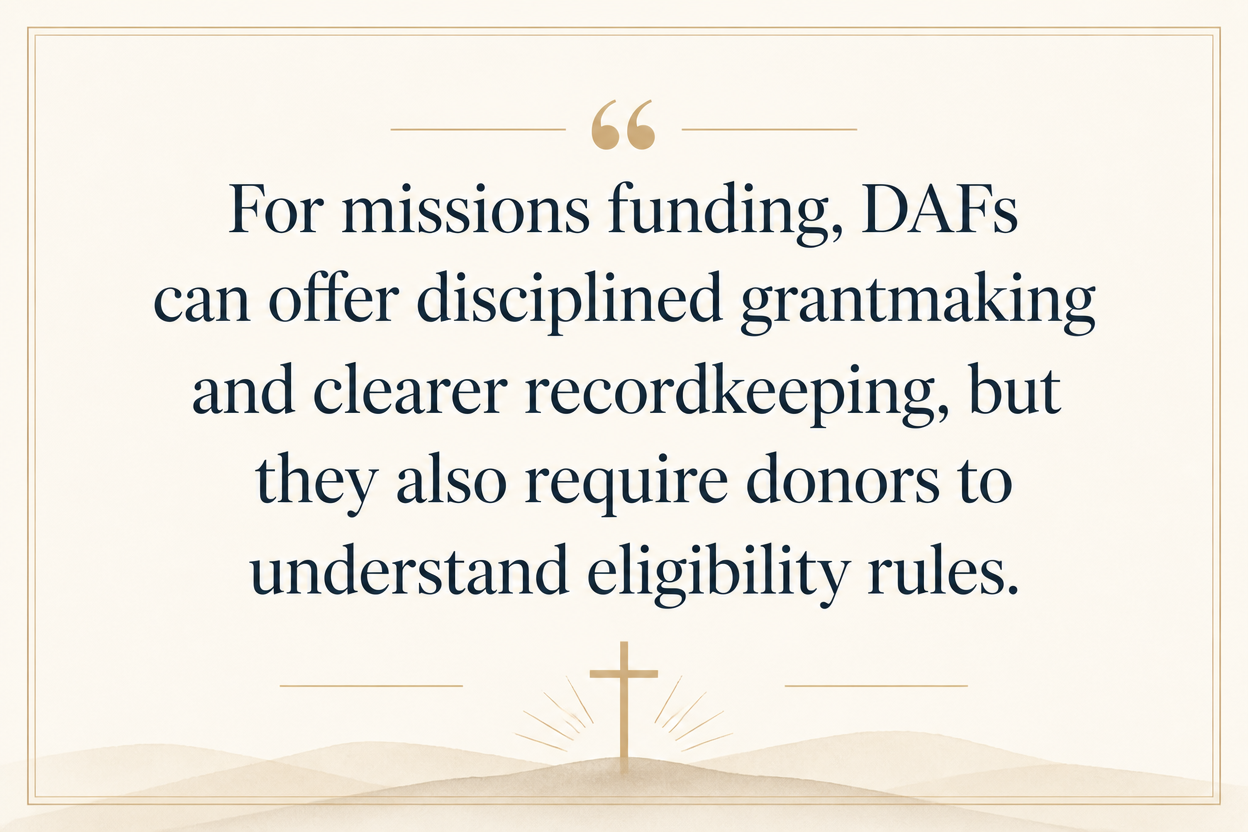
For missions funding, DAFs can offer disciplined grantmaking and clearer recordkeeping, but they also require donors to understand eligibility rules. A DAF grant generally must go to a qualified public charity, not to an individual missionary. That constraint is not a bureaucratic inconvenience; it is a safeguard against treating tax-advantaged accounts as personal pass-throughs. Stewardship services can help donors keep those lines clear.
What trustworthy missionary funding requires beyond good intentions
Christians genuinely disagree about some questions in missions funding: the appropriateness of certain fundraising styles, how to measure “impact” without importing a business scorecard, and how much administrative overhead is faithful stewardship rather than waste. But mature donors can agree on several non-negotiables: financial integrity, honest reporting, accountable leadership, and theological clarity.
Verification matters because missions work can be hard to see
Distance amplifies information asymmetry. A donor in the United States may be asked to fund work in a country they have never visited, with outcomes that are not easily summarized. That does not make the work suspect; it makes verification necessary. This is where Most Trusted’s role fits naturally: we evaluate Christian nonprofits against The Most Trusted Standard, a 15-criteria framework across Faith Foundation, Financial Integrity, Governance and Leadership, and Transparency and Effectiveness. Donors cannot eliminate risk, but they can insist on evidence of trustworthy practice.
Across our verification work, the ministries that meet The Most Trusted Standard tend to document policies before crises force the issue: conflict-of-interest standards, board governance practices, financial controls, and truthful public communication. Those practices protect donors, but they also protect missionaries from avoidable suspicion and from the moral injury of serving under weak oversight.
Do not confuse low overhead with faithfulness
The sector has had to reckon with a persistent misunderstanding: that the lowest administrative cost is automatically the most virtuous. Major charity evaluators and standards bodies have publicly warned against this reduction. Charity Navigator, Candid (formerly GuideStar), and the Better Business Bureau’s Wise Giving Alliance jointly argued that “overhead ratios are not the sole indicator of charity performance” and can mislead donors when used as a primary decision rule (Charity Navigator).
For missions, appropriate “overhead” can include member care, safeguarding, compliance, translation, financial controls, and security protocols. Underfunding these functions can harm people. A stewardship service should help donors ask better questions, not merely demand thinner administration.
How Christian stewardship services can strengthen missionary care and accountability
Missionaries are not only project managers. They are people under spiritual and emotional strain, often serving in isolation. Funding mechanisms can either dignify that reality or ignore it. Stewardship services, when integrated with responsible sending structures, can contribute to healthier missions ecosystems.
Stability is a form of care
Regular, predictable support reduces anxiety and allows missionaries to plan. It also reduces the pressure to maintain a constant public fundraising tempo. Some donors prefer to give to whatever story is most compelling this month; stewardship services can support a different posture, one closer to covenant partnership than to episodic sponsorship.
For donors who hold appreciated assets, complex tax situations, or family foundations, stewardship services can help coordinate giving without fragmenting it. The point is not financial sophistication for its own sake; it is the freedom to sustain support without being governed by administrative friction.
Accountability should be clear enough to protect the vulnerable
When money crosses borders and cultures, the risk of misuse rises, and the consequences fall first on local communities. The When Helping Hurts framework, articulated by Steve Corbett and Brian Fikkert, has reshaped Christian development conversations by pressing donors to consider unintended harm, dependency dynamics, and dignity in aid relationships. Missions funding is not identical to development funding, but the moral principle transfers: donors should not fund approaches that displace local agency or reward distorted reporting.
Stewardship services can support accountability by requiring clear designations, documented approvals, and audited trails. They can also encourage donors to fund structures—training, pastoral oversight, safeguarding, and local partnership—that are harder to romanticize but often more faithful.
Due diligence for donors who want to fund missionaries with confidence
Due diligence is not cynicism. It is stewardship in the presence of human sin and institutional weakness. The goal is not to interrogate missionaries as if they were suspects; it is to ensure that the ministries receiving funds are worthy of trust, and that missionaries are supported in ways that honor both the gospel and the people they serve.
Questions that clarify whether a ministry is fundable
When donors use stewardship services, the most consequential decisions still happen upstream: Which ministry receives the funds? Who governs it? What theological commitments guide it? What evidence exists that funds are handled with integrity? What safeguards protect children and other vulnerable people? The answers should be available in writing, not only conveyed through personal relationships.
Many donors find it useful to situate missions giving within the broader discipline of Christian stewardship, because missionary support is rarely a standalone line item. It competes with local church giving, mercy ministries, tuition obligations, eldercare, and retirement realities. For donors building a coherent plan, the wider landscape of Christian Stewardship Services can help frame what stewardship tools exist and how they relate to one another.
Verification complements stewardship services rather than replacing them
Stewardship services can manage the mechanics of giving. Verification speaks to the trustworthiness of the recipient ministry. These functions are distinct. A donor can have pristine receipts while still funding a ministry with weak governance, vague reporting, or theological confusion. Conversely, a faithful ministry can be hindered by poor administrative systems. Mature Christian giving attends to both.
Most Trusted’s evaluations are designed for donors who want to give with confidence and who understand that accountability is a form of love. Where donors are supporting mission agencies, church-based missions funds, or specialized ministries, our work can help donors distinguish between marketing and verifiable practice, particularly as mission work becomes more professionally complex and more publicly scrutinized.
FAQs for How Christian donors can fund missionaries through stewardship services
Can a donor-advised fund give directly to an individual missionary?
In general, a donor-advised fund grant must go to a qualified public charity rather than to an individual. For missionary support, that typically means giving to a sending agency, a church missions fund, or a qualified ministry that oversees the missionary’s work. Stewardship services can help ensure the structure is compliant and that records clearly show the charitable recipient.
What reporting should donors reasonably expect from missionaries or their agencies?
Reasonable reporting is specific enough to show faithful use of funds without forcing missionaries into performative metrics. Donors can expect clear descriptions of ministry activity, financial accountability through the overseeing organization, and candor about challenges and limitations. Where security concerns limit detail, donors should still expect governance transparency, documented policies, and oversight that can be independently examined.
Funding missionaries with disciplined stewardship
Christian donors are called to generosity, and also to wisdom. Stewardship services can help translate conviction into stable support, clearer accountability, and better long-term planning, especially when giving involves DAFs, complex assets, or multi-ministry grantmaking. The harder work is ensuring that the ministries receiving those funds are worthy of trust, with governance and financial integrity that can bear the weight of the gospel they proclaim.
For donors who want to place missionary support within a coherent grantmaking approach, How Christian Stewardship Services Support Grantmaking is the broader context in which these tools become most effective, because disciplined giving is rarely accidental.



