

Why Christian aviation ministries prioritize discipleship partners is not a secondary question about strategy; it is a theological question about what the Church exists to do. Aviation can move people and cargo across difficult terrain, but it cannot, by itself, form mature disciples or establish healthy local churches. When aviation ministries place discipleship partnerships at the center, they are acknowledging a basic New Testament pattern: gospel proclamation and spiritual formation are entrusted to the Church in community, not to a transport service operating in isolation.
For donors, this emphasis is also a safeguard. Aviation is dramatic, expensive, and easy to romanticize. Discipleship partnerships force a harder discipline: asking whether aircraft time is ordered toward the Great Commission rather than toward organizational growth or compelling storytelling. Across our verification work at Most Trusted, ministries that meet The Most Trusted Standard tend to articulate this ordering clearly and then substantiate it with governance, reporting, and field practices that keep aviation in its proper place as a servant to mission.
Aviation is a means, not the mission
The Great Commission defines the end
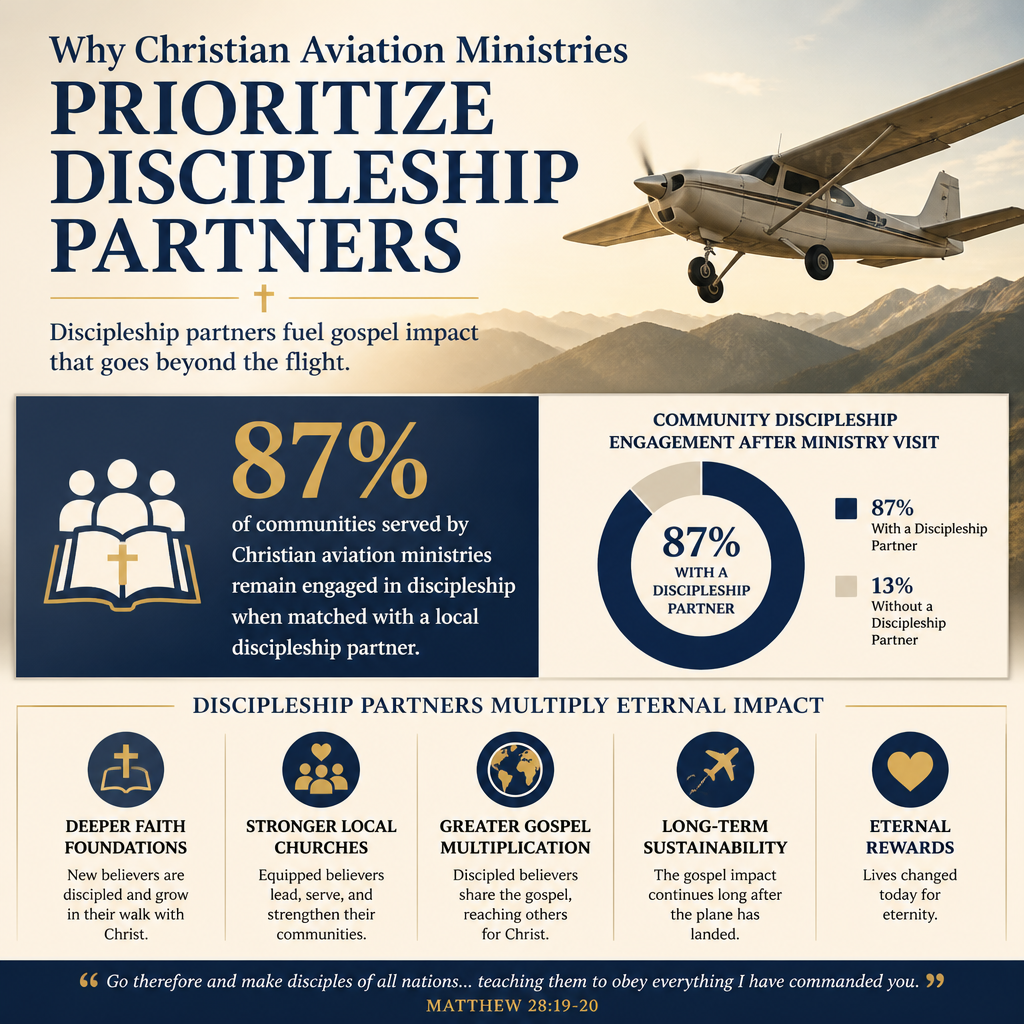
Jesus’ Great Commission is not “go” as an end in itself, but “make disciples” as the defining task (Matthew 28:19–20). Christian aviation exists, at its best, to remove barriers that hinder that disciple-making work: distance, terrain, cost, insecurity, and medical or logistical constraints. This is why many mature aviation organizations describe themselves as “support” ministries. They exist to enable the Church’s primary work to proceed with greater faithfulness and less fragility.
The distinction matters because aviation naturally draws attention to the means: aircraft, pilots, airstrips, and stories of rescue. A discipleship partner re-centers the purpose. When a local church, a Bible translation team, a theological training program, or an indigenous mission movement defines the spiritual objective, aviation can be evaluated by whether it served that objective responsibly.
Instrumental ministries require stronger guardrails
When a ministry’s core service is instrumental—transport, communications, construction, water systems—the risk is that outputs displace outcomes. Flights completed can quietly become the definition of faithfulness. Discipleship partnerships create a necessary external reference point: a shared plan for what the flights are for, how long a route should exist, and what success looks like spiritually and institutionally.
The Christian tradition has long insisted that means must be governed by ends. The apostolic pattern in Acts shows logistics serving proclamation, not replacing it. Aviation is a powerful instrument, but it remains an instrument.

Discipleship partners provide theological and cultural accountability
Local authority is not optional
Christian aviation ministries often work in contexts where Western money, Western expertise, and Western mobility can distort local agency. Discipleship partners—especially local churches and indigenous leaders—provide a form of accountability that is both theological and cultural. They help ensure that aviation support does not become a parallel church, a foreign-controlled gatekeeper, or an unexamined source of dependence.
This is not merely a development concern; it is an ecclesiological one. The New Testament assumes recognizable local leadership and accountable community life (Titus 1; 1 Peter 5). When aviation ministries submit their services to local Christian authority where possible, they are honoring the Church as the steward of the gospel in that place.
Complex contexts require discernment, not hero narratives
Aviation frequently intersects with security constraints, humanitarian emergencies, and fragile governance. In such environments, donors can be tempted to support the most dramatic story rather than the most prudent mission posture. Discipleship partners temper this impulse. They can ask whether a flight creates new risk for local believers, whether an airstrip draws unwanted attention, or whether certain aid patterns undermine local livelihoods.
Christians genuinely disagree about how to weigh urgent relief against long-term formation, and real trade-offs exist. A mature aviation ministry does not deny those tensions; it builds relationships with discipleship partners who can hold the ministry to wise decisions that neither idolize risk nor avoid it out of self-protection.
Partnership protects against dependency and mission drift
The temptation to become indispensable
Any highly specialized ministry can drift toward indispensability. When an aviation organization becomes the only reliable connector for a region, it may unintentionally accumulate influence over where pastors travel, which conferences happen, and what projects are considered feasible. Discipleship partners reduce that risk by keeping decision authority closer to spiritual responsibility. They also help define exit strategies: when a road is built, when local aviation capacity grows, or when patterns of ministry shift.
This aligns with a core lesson in cross-cultural mission practice: durable ministry strengthens local capacity rather than perpetuating permanent reliance. The “When Helping Hurts” framework, articulated by Steve Corbett and Brian Fikkert, has shaped many evangelical conversations about avoiding harmful dependency and pursuing wise, dignifying partnership rather than paternalism.
Mission drift often begins with funding logic
Donor expectations can unintentionally reshape aviation ministries. Large gifts often prefer visible assets and immediate outputs: aircraft purchased, flights logged, cargo delivered. Without disciplined partnerships, the organization can start selecting routes or projects based on what raises support rather than what best serves disciple-making priorities. This is not a cynical claim; it is a predictable organizational pressure.
Thoughtful donors already know the difference between a restricted gift that strengthens a mission and one that quietly commandeers it. Partnership with discipleship-focused ministries creates a counterweight to funding logic, because it introduces stakeholders who care first about the church’s health, pastoral formation, Scripture access, and the long obedience of Christian community life.
What donors should look for when aviation ministries emphasize discipleship partners
Evidence that partnership governs decisions
It is easy for a ministry to say it “supports local churches.” The more trustworthy question is whether partnership actually governs decisions. Donors should expect to see formal agreements, clear criteria for prioritizing requests, and reporting that distinguishes between activity and spiritual purpose. This is one reason we encourage donors to use independent verification. Most Trusted evaluates ministries against The Most Trusted Standard, which examines whether a ministry’s faith commitments, governance, finances, and public reporting align with its stated mission in verifiable ways.
Within Christian Aviation Ministries, donors will find organizations that range from direct-operational flight services to mission aviation training to maintenance hubs. The partnership question applies across that range: Who defines the spiritual ends, and how is the aviation service accountable to them?
A short set of donor due diligence questions
The goal is not to burden a ministry with donor bureaucracy, but to ensure aviation’s real costs are justified by spiritual and humanitarian ends that are coherent and accountable. The following questions tend to clarify whether discipleship partnerships are substantive:
- Which discipleship partners regularly shape flight priorities, and how are those decisions documented?
- How does the ministry prevent preferential access based on donor influence, organizational convenience, or visibility?
- What safeguards protect local believers and local leaders when aviation increases access to sensitive regions?
- How does the ministry measure effectiveness beyond flights and payload, especially regarding the partner’s disciple-making objectives?
- Under what conditions would the ministry reduce service or exit a route to avoid dependency?
Where these answers are clear, donors can give with greater confidence that aircraft are being stewarded as instruments of love of neighbor and service to the Church, rather than as symbols of scale.
Discipleship partnerships clarify outcomes in a world shaped by the Overhead Myth
Aviation forces donors to think beyond simplistic ratios
Christian aviation is expensive in ways that do not fit common donor shortcuts. Maintenance, safety standards, training, insurance, and compliance costs can look like “overhead” even when they are essential to mission integrity. For mature donors, this creates a tension: how to pursue financial responsibility without punishing the very costs that keep pilots, passengers, and local communities safe.
The philanthropic sector has increasingly warned donors against using overhead ratios as a primary measure of effectiveness. The “Overhead Myth” open letter—signed by organizations including Charity Navigator and BBB Wise Giving Alliance—argues that administrative ratios are a poor proxy for impact and can create harmful incentives for nonprofits to underinvest in systems and accountability (Charity Navigator).
Partnership creates measurable spiritual and mission clarity
Discipleship partnerships help translate aviation spending into intelligible outcomes. A donor may not be equipped to evaluate turbine maintenance schedules, but a donor can evaluate whether an aviation ministry consistently serves coherent disciple-making aims: supporting pastoral training cohorts, enabling Bible translation teams to reach language communities, transporting medical teams embedded in local church witness, or sustaining church-to-church collaboration across inaccessible terrain.
Within How Christian Aviation Ministries Support Other Mission Work, the central question is not whether aviation is inspiring, but whether it is ordered toward mission ends the Church recognizes as faithful. Partnerships are the mechanism by which that ordering becomes public, accountable, and repeatable rather than episodic.
FAQs for Why Christian aviation ministries prioritize discipleship partners
Do discipleship partnerships mean aviation ministries should not do evangelism directly?
Not necessarily. Some aviation teams include chaplains, serve as evangelistic witnesses in daily operations, or participate in local church life. The priority is that direct evangelism does not eclipse accountability to the Church or substitute for the long-term pastoral and communal formation that Scripture envisions. Partnerships help ensure that any direct spiritual engagement is integrated with local discipleship pathways rather than detached from them.
How can donors evaluate partnership quality without traveling to the field?
Donors can look for governance and reporting signals that partnership is real: written partnership agreements, clear criteria for accepting flight requests, evidence of local leadership consultation, and public reporting that ties aviation activity to partner-defined ministry objectives. Independent verification can also assist. Most Trusted assesses whether a ministry’s stated commitments are supported by verifiable practices consistent with The Most Trusted Standard, which helps donors distinguish between partnership as language and partnership as accountable reality.
Discipleship partners keep aviation in its rightful place
Christian aviation is a gift to the Church when it is governed by the Church’s calling rather than by aviation’s inherent drama. Discipleship partnerships create that governance. They locate authority near spiritual responsibility, reduce dependency, clarify outcomes, and strengthen donor confidence that costly assets are being stewarded for ends Scripture makes plain. For donors who want generosity to be both faithful and careful, partnership is not a slogan; it is a form of accountability worthy of support.



