

How Christian aviation ministries use designated donations is not a technical footnote. It is one of the primary places where a donor’s intention meets a ministry’s operational reality, and where misunderstandings can quietly erode trust. Aviation is capital-intensive, safety-sensitive, and often deployed in volatile environments; the way restricted gifts are received and honored will reveal a great deal about a ministry’s integrity.
Designations can be a form of faithful stewardship. They can also become an inadvertent constraint that burdens a mission with administrative complexity, distorts priorities, or pressures leaders to promise more specificity than they can responsibly deliver. Mature Christian giving learns to ask not only, “Can we fund this?” but also, “Should this be funded this way?”
What designated donations are and why aviation makes them complicated
Designation is a moral promise, not a marketing label
A designated or restricted donation is money given for a particular purpose: a specific aircraft, a scholarship for pilot training, a named mechanic’s salary, a defined route, or a particular people group. In many ministries, restricted funds are governed by donor intent and by nonprofit law; they are not interchangeable with general operating support. What this means in practice is that a ministry must track restricted funds separately and use them only for the stated purpose, or work with donors to modify the restriction if circumstances change.
Christian donors should not treat restriction as a mere preference. Scripture frames giving as an act of truthfulness before God and neighbor. “Therefore, having put away falsehood, let each one of you speak the truth with his neighbor” (Ephesians 4:25). When a ministry implicitly encourages a donor to believe a designation guarantees a specific outcome that cannot be assured, the problem is not only administrative. It is ethical.
Aviation costs do not behave like most donors assume
Aviation ministries typically operate with high fixed costs and unpredictable variables: fuel price swings, parts availability, insurance, regulatory compliance, and the steady burden of safety management. Flight hours cannot be treated like a simple “per trip” expense. A donor may want to fund “one flight to a remote village,” yet the mission’s true cost sits inside a wider system—maintenance cycles, pilot training, hangar infrastructure, and dispatch capacity.
When restricted giving is paired with simplistic assumptions, it can unintentionally underwrite a narrative rather than the mission itself. The ministry that explains this candidly is not being evasive; it is being honest about what it takes to keep people alive in the air.

Common designation types and how they typically function
Aircraft acquisition and major maintenance
Some donors want to underwrite a plane purchase, a major overhaul, avionics upgrades, or a new hangar. These are straightforward to designate in principle but challenging in timing. Acquisition may be delayed by regulatory approvals, shipping constraints, or changes in field need. When that happens, a responsible ministry will already have language in place about what occurs if the named project is delayed, overfunded, or no longer feasible.
Donors should pay attention to whether a ministry treats capital giving as a one-time event or as part of a long-term stewardship plan. A new aircraft without a funded maintenance reserve and trained personnel can become a liability rather than a gift.
Staff support, training, and scholarship funding
Other donors prefer to support a pilot, mechanic, or dispatcher, or to fund training for national staff. Designations here can be spiritually meaningful—many Christians have long embraced the Pauline model of sustaining workers for the gospel (Philippians 4:15–17). Yet staffing designations also create obligations: payroll must be met, staff transitions occur, and training timelines shift.
Christian donors also differ on whether “support raising” models create unhealthy incentives. Some see them as a faithful invitation into shared ministry; others worry about inequity between roles that are easier to fundraise for and roles that are essential but less visible. The mature question is whether the ministry’s system aligns fundraising practice with organizational fairness and operational need.
Route, program, or field designations
Many aviation ministries describe their impact in terms of medevac flights, disaster response, Bible translation support, pastoral transport, or community health logistics. Donors may designate to a region or program category rather than an individual flight. This is often a healthier form of restriction because it gives the ministry operational flexibility while still honoring donor intent.
When donors want the highest confidence that a designation will be honored without distorting the mission, program-level restrictions generally travel better than hyper-specific micro-designations.
Where designated giving can go wrong and what to ask instead
The temptation to over-promise specificity
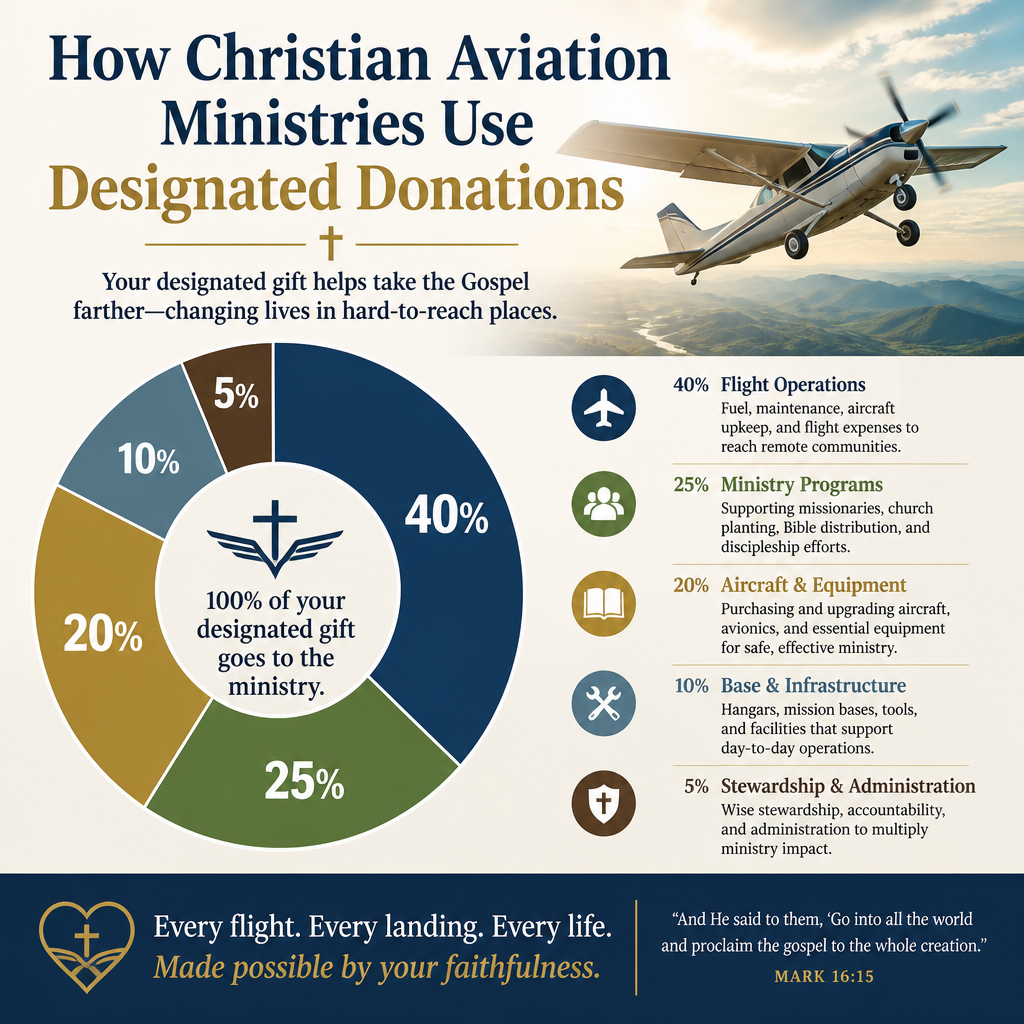
Aviation fundraising can slide toward transaction language: “$X sends one missionary,” “$Y buys one hour of flight.” Sometimes these figures are earnest estimates; sometimes they are impressionistic. A credible ministry will clarify what such amounts represent and whether they are averages, marginal costs, or a portion of an integrated budget.
Donors should not be embarrassed to ask for precision. “Whoever is faithful in a very little is also faithful in much” (Luke 16:10). Faithfulness includes accuracy in how a ministry communicates financial realities.
Restriction that starves core operations
Even when a restricted project is worthy, an organization can be financially weakened if too little money is available for what cannot be easily designated: safety management systems, accounting, leadership oversight, compliance, and maintenance planning. Christian donors are sometimes trained to suspect “overhead,” but the field has had to reckon with how that suspicion can punish the very systems that prevent harm. The “Overhead Myth” statement—signed by major evaluators and philanthropic institutions—argues that administrative cost ratios are a poor proxy for impact and can create perverse incentives GuideStar.
The harder question is whether the ministry can explain how its operating expenses protect mission delivery and human life. In aviation, those expenses are not optional.
Designations that create inequity or mission drift
Restricted giving can subtly reward what is most emotionally compelling rather than what is most strategic. Disaster response imagery may attract quick restricted gifts while long-term logistics for local church partners remain underfunded. Some donors want to designate to international work while domestic training infrastructure is what sustains that international work. These pressures can cause real leadership strain.
Across our verification work at Most Trusted, we observe that ministries with disciplined governance tend to hold a clear line between donor communication and operational decision-making. They do not treat fundraising preferences as the primary driver of strategy.
- What happens if my designated project is delayed, fully funded, or no longer needed?
- Where is this restriction described in writing and how is it tracked in your accounting system?
- Does this designation include an appropriate share of indirect costs that make the work possible?
- Who approves exceptions and what board oversight exists for restricted funds?
- How do you report back to donors without implying guarantees you cannot control?
How trustworthy ministries handle designated funds in practice
Clear gift acceptance policies and written disclosure
Healthy aviation ministries document how they accept gifts, what kinds of restrictions they can honor, and what they will not promise. They define how they treat “designated” versus “preferred” gifts, and they disclose reallocation policies for overfunded or obsolete projects. In US contexts, donors can reasonably ask whether the organization’s policies align with well-established nonprofit accounting guidance for donor restrictions Financial Accounting Standards Board.
These policies protect donors from confusion and protect ministries from moral hazard. They also create internal clarity, which is essential when staff turnover occurs or when field conditions change.
Restricted fund accounting that can be audited
For aviation ministries, restricted funds should not be tracked with improvised spreadsheets alone. Segregation in the general ledger, documented approvals, and reconciliation practices should be strong enough to withstand external audit scrutiny. Not every ministry will have a full independent audit, but the principles of verifiability still apply.
The point is not bureaucratic perfection. The point is that donor intent is honored with evidence, not assurances.
Reporting that is both honest and spiritually serious
Designated giving often comes with expectations of vivid stories. Storytelling has a proper place in Christian ministry, but it must not become a substitute for truthfulness. Aviation ministries should report outcomes in ways that do not imply that a donor “bought” a conversion or “funded” a particular person’s faith. God is not a line item.
When reporting is sober, specific, and careful about causal claims, it tends to be more credible to sophisticated donors and more consistent with Christian humility.
Giving wisely to aviation ministries without weakening the mission
When to designate and when to give unrestricted
Designation is often wise when a ministry has demonstrated operational maturity, has a clear plan for the project, and can show that restricted funds will not create starvation elsewhere. Unrestricted giving is often wise when a ministry is steady, transparent, and clearly communicating its strategic priorities—especially in aviation, where safety and readiness must be continuously funded.
Donors sometimes worry that unrestricted gifts are “less accountable.” That concern is understandable. Yet accountability should be measured by governance, transparency, and demonstrated effectiveness, not by whether every dollar is pinned to a dramatic story.
A framework donors can use
Most Trusted exists because donors deserve more than vague reassurances. We evaluate Christian nonprofits against The Most Trusted Standard, a 15-criteria framework that examines faith commitments, financial integrity, governance and leadership, and transparency and effectiveness. In aviation ministries, these questions become especially concrete: Who is accountable for safety? How are restricted funds tracked? How does the board oversee risk? What evidence exists that the ministry’s claims match its financial reality?
Many donors begin by understanding the unique role of aviation in missions and humanitarian logistics; our overview of Christian Aviation Ministries provides that broader context. But wise giving also requires attention to the mechanics of the gift itself, including how restrictions are communicated and honored.
For donors seeking practical discernment about budgets, reporting, and the trade-offs between restricted and unrestricted support, How to Give Wisely to Christian Aviation Ministries addresses the questions that typically surface after the first check is written.
FAQs for How Christian aviation ministries use designated donations
Can a ministry legally move my designated gift to another purpose?
In general, a ministry should not redirect a restricted gift without donor permission, because donor restrictions create real obligations in nonprofit accounting and often in state law. Responsible ministries anticipate changing circumstances and disclose in writing what will happen if a project is delayed, overfunded, or no longer possible, including whether they will contact donors for consent or apply a pre-disclosed fallback purpose. If a ministry cannot explain this clearly, the risk is not merely administrative; it is a trust issue.
Is it unwise to designate gifts in aviation ministry because of safety and overhead needs?
Designation is not inherently unwise. It can fund critical assets and expand mission capacity. The concern is whether highly restricted giving starves the systems that keep operations safe and accountable: maintenance planning, compliance, training, leadership oversight, and financial controls. Aviation makes those needs unavoidable. Many donors find that a balanced approach—some program-specific giving alongside meaningful unrestricted support—best aligns donor intent with the realities of keeping aircraft, crews, and passengers safe.
Stewardship that honors both intent and integrity
Designated donations can be a disciplined expression of Christian stewardship when they are grounded in truthful communication, governed with evidence, and integrated into a ministry’s real operating requirements. The donor’s responsibility is not only to fund what is inspiring, but to fund what is faithful. The ministry’s responsibility is not only to receive gifts gratefully, but to honor them with the kind of integrity that can bear scrutiny in the light.



