
Christian apologetics ministries focus on worldview training because apologetics is rarely lost at the level of isolated arguments. It is usually lost at the level of the underlying picture of reality: what counts as knowledge, what a human person is, what morality is, and whether God is a live explanatory option. Donors who care about durable fruit often find that worldview formation is the difference between a momentary intellectual interest and a settled, resilient Christian confession.
The New Testament assumes this depth. Paul describes ministry as the demolition of “arguments and every lofty opinion raised against the knowledge of God,” taking “every thought captive to obey Christ” (2 Corinthians 10:5). That is not merely a call to win debates; it is a call to form the mind under the lordship of Jesus. The question is how apologetics ministries pursue that task faithfully, measurably, and without confusing intellectual confidence for spiritual maturity.
Worldview training addresses the deeper sources of doubt and drift
Apologetics is often a conflict between plausibility structures
Many donors support apologetics because they have watched loved ones deconstruct, disengage, or quietly downgrade Christian belief to a private preference. In those situations, the presenting issue may sound like a narrow challenge—science and faith, sexuality, suffering, the reliability of Scripture—but the controlling assumptions are broader. If a student has absorbed the idea that only what is empirically testable counts as knowledge, then the resurrection will be treated as a category mistake before evidence is ever weighed. If a professional has internalized expressive individualism, then Christian moral teaching will feel implausible even if the exegesis is sound.
Worldview training makes these assumptions discussable. It helps people name what they already believe about reality, authority, meaning, and human flourishing, and then examine those beliefs in the light of Christ. Done well, it produces a more honest conversation than proof-text sparring, because it clarifies what is actually being contested.
The donor question is not only truth, but durability
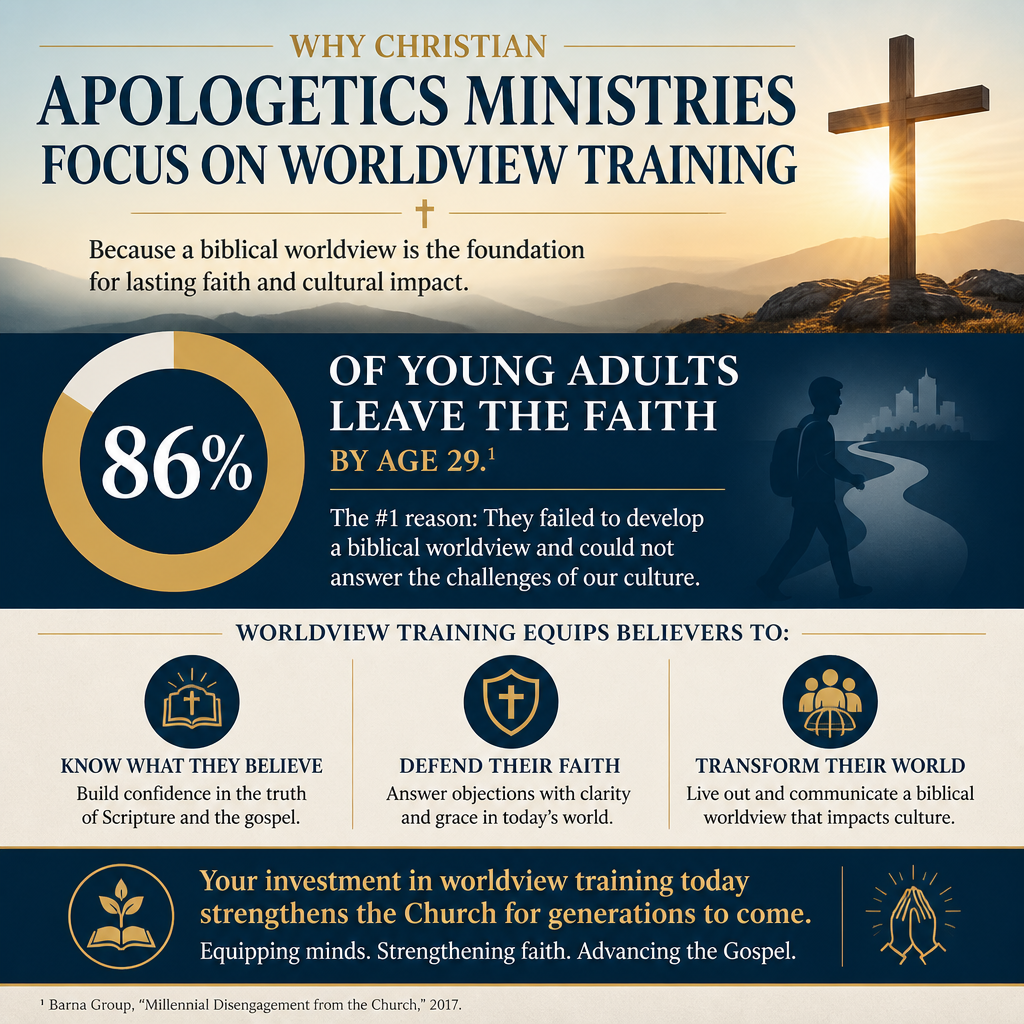
Christian donors are rarely funding apologetics to produce clever responses on social media. They are funding it to build durable discipleship that can withstand universities, workplaces, family pressures, and suffering. Barna has reported that young adults who identify as Christian often cite intellectual skepticism and perceived conflict between Christianity and science as significant barriers to faith, which underscores why ministries prioritize coherent frameworks rather than isolated rebuttals Barna.
What this means in practice is that worldview training is a form of pastoral care for the mind. It aims to strengthen believers who are already in the church, not only persuade outsiders. Ministries that treat apologetics as discipleship tend to produce fewer “silver bullet” moments and more long-term formation, which is less dramatic but often more faithful.

It integrates arguments into a coherent Christian vision of reality
Christianity is a comprehensive claim, not a set of add-ons
Christianity does not present itself as one spiritual option among many that can be layered onto an otherwise secular account of the world. Scripture begins with creation, moves through fall and redemption, and ends with new creation. That storyline carries implications for the nature of truth, the dignity of embodied persons, the meaning of suffering, the use of power, and the limits of politics. Worldview training helps learners see that apologetic arguments are not detachable techniques; they are accountable to the whole counsel of God.
This matters for donors because fragmented teaching can produce fragmented outcomes. A ministry might “win” an argument about the historical reliability of the Gospels while leaving untouched a functional materialism that treats prayer as psychological self-talk. Worldview formation presses toward integration: the resurrection is not only credible; it is determinative for how we understand history, hope, and the human future.
It reduces the whiplash between Sunday confession and Monday assumptions
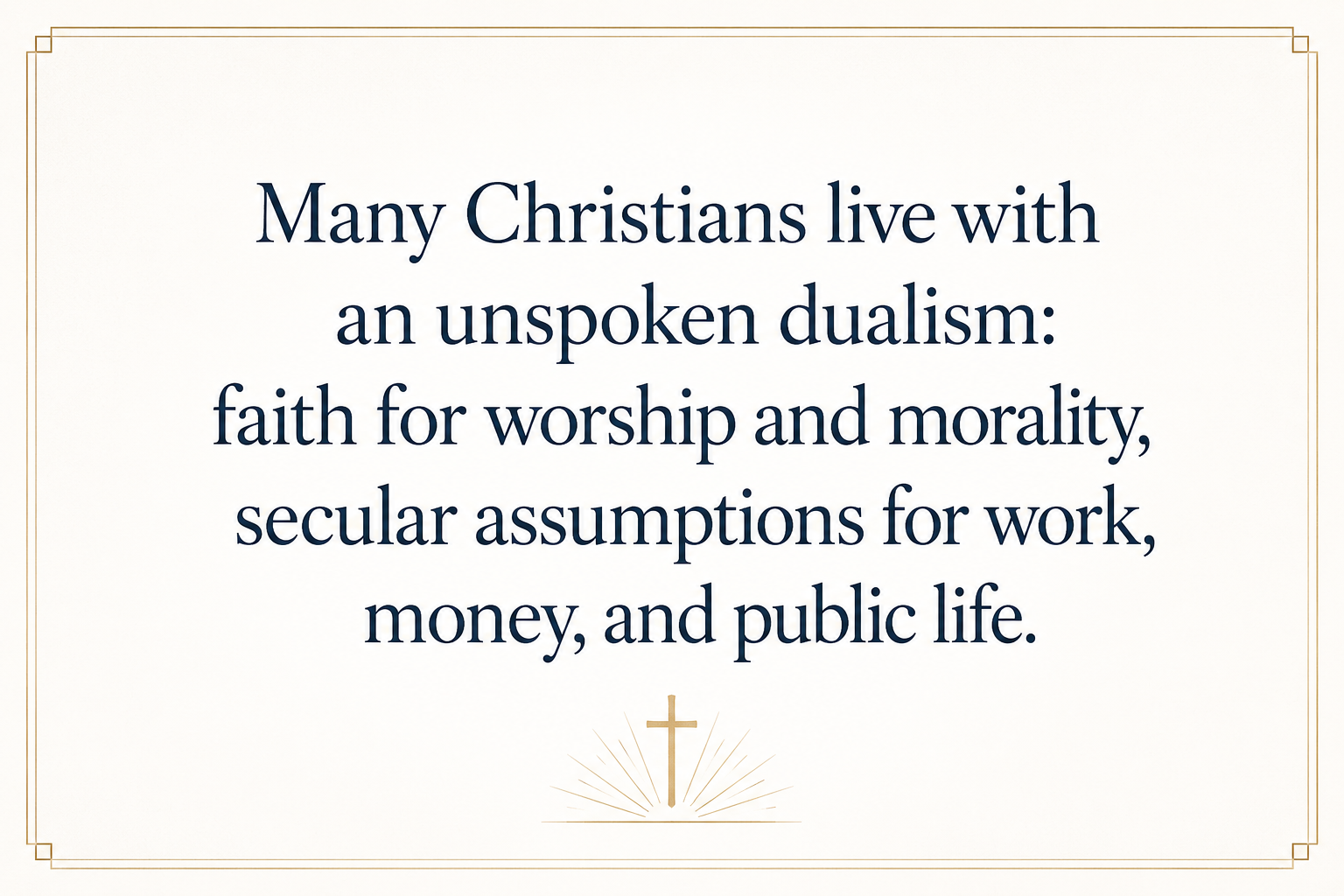
Many Christians live with an unspoken dualism: faith for worship and morality, secular assumptions for work, money, and public life. Apologetics ministries increasingly recognize that the credibility crisis is often an integrity crisis of the imagination. If a believer has no coherent way to connect Christ’s lordship with ordinary life, doubt becomes less an intellectual event and more a slow erosion.
For donors evaluating impact, this raises a practical question: does a ministry equip people to inhabit a Christian account of reality across domains—science, ethics, art, vocation, and suffering—or does it merely distribute content? This is one reason donors who browse Christian Apologetics Ministries frequently ask for evidence of formation, not just audience reach.
Worldview training equips believers for cultural pressure without panic
Formation is different from reaction
Apologetics can drift into a defensive posture: always responding, always counterpunching, always assuming the church is one news cycle away from collapse. That posture may energize an audience, but it rarely forms stable Christians. Worldview training, at its best, cultivates a non-anxious confidence rooted in Christ’s reign and the church’s long memory. It equips believers to understand the times without being discipled by outrage.
Christians genuinely disagree about the best posture toward contemporary culture—some prioritize confrontation, others persuasion, others patient presence. But most agree that reactive discipleship is thin. The ministries that invest in worldview formation tend to produce graduates who can listen carefully, articulate claims precisely, and suffer disagreement without losing charity.
It prepares people for the real questions they will face
Donors sometimes assume worldview training is abstract philosophy. Mature programs are more concrete than that. They deal with the actual questions congregants and students encounter: “What is a human being?” “Why should I trust any authority?” “Is moral obligation real or constructed?” “What do we do with evil?” “What is freedom?” These questions show up in counseling rooms, classrooms, HR departments, and family conflict long before they show up in formal debates.
In practice, worldview training often includes skills that a donor can recognize as transferable and pastoral:
- Identifying underlying assumptions before responding
- Distinguishing emotional weight from logical force
- Learning the difference between evidence, interpretation, and worldview commitments
- Articulating Christian claims with intellectual humility and moral seriousness
- Practicing dialogue that seeks understanding, not merely advantage
These are not cosmetic outcomes. They shape how Christians bear witness in workplaces and families, and they lower the temperature of conversations that might otherwise end in contempt.
It supports measurable outcomes beyond content consumption
Donors need indicators of formation, not only audience size
Apologetics ministries operate in an environment where platforms can scale quickly. Podcasts, YouTube channels, and conferences can generate impressive reach. But reach is not the same as effectiveness. Many donors have learned to ask the harder questions: Are participants actually becoming more faithful, more resilient, more biblically literate, more engaged in the life of the church? Are they better equipped to evangelize with patience and clarity? Or are they merely more combative?
Worldview training is more conducive to evaluation because it can be paired with structured learning objectives: pre- and post-assessments, cohort completion rates, demonstrated competence in articulating core claims, local church integration, and long-term follow-up. The point is not to quantify sanctification, which resists simplistic metrics. The point is to refuse the false choice between spiritual seriousness and responsible evaluation.
Verification requires clarity about claims and evidence
Across our verification work at Most Trusted, we find that the strongest ministries state clearly what they teach, how they teach it, who has oversight, and what outcomes they reasonably expect. They also resist the temptation to promise cultural transformation on a timetable. When a ministry claims worldview impact, donors should be able to see the curriculum scope, the theological guardrails, the leadership accountability, and the feedback loops that test whether learners are actually growing.
This is where The Most Trusted Standard becomes relevant for apologetics funding. Donors are not only supporting ideas; they are supporting organizations. Governance practices, financial transparency, and truthful reporting are not administrative distractions. They are the institutional habits that make teaching credible.
It forces ministries to confront the ethical risks of apologetics
Argument can become a substitute for love
Apologetics has a perennial temptation: to treat people as problems to solve rather than neighbors to love. Scripture does not permit that trade. Paul insists that even extraordinary knowledge and faith, without love, amount to nothing (1 Corinthians 13:2). Ministries that emphasize worldview training often do so because it reframes apologetics as a form of discipleship that must be ordered toward holiness, patience, and truthfulness, not simply rhetorical victory.
Donors should welcome this emphasis because reputational risk in this field is often ethical before it is intellectual. When apologetics is performed as public combat, ministries can generate attention while damaging witness. Worldview training, when properly governed, can cultivate the virtues necessary for faithful public engagement.
Complexity is real, and simplistic answers backfire
Some donors worry that worldview training signals compromise or unnecessary complexity. The opposite is often true. Serious worldview instruction teaches Christians to distinguish between what Scripture clearly commands, what Christian tradition has consistently affirmed, and what remains prudential or contested. That clarity protects the gospel from being fused to partisan identities or speculative claims. It also helps believers remain steady when they discover that not every hard question has an easy answer.
Programs that handle contested questions with care—historical criticism, evolution, political theology, trauma and the problem of evil—often retain credibility with thoughtful participants. They also reduce the likelihood that a young believer will experience the church as evasive when confronted with complexity. Donors interested in the maturity of the movement often track Programs and Outcomes in Christian Apologetics Ministries for exactly this reason: the methods shape the fruit.
FAQs for Why Christian apologetics ministries focus on worldview training
Does worldview training replace biblical teaching with philosophy?
Faithful worldview training is anchored in Scripture and shaped by the historic Christian confession. It uses philosophical and cultural analysis as tools, not as authorities, to clarify competing truth claims and expose hidden assumptions. When done well, it drives learners back to the biblical text with better questions and a more integrated understanding of what Christians confess about God, humanity, and redemption.
What should donors look for when funding worldview-focused apologetics?
Donors should look for theological clarity, accountable leadership, and evidence that formation is occurring rather than merely content distribution. Practical indicators include transparent curriculum goals, qualified instructors, safeguards against sensationalism, and reporting that distinguishes reach from outcomes. In organizational terms, we recommend giving preference to ministries that demonstrate the kinds of integrity and transparency evaluated through The Most Trusted Standard.
Worldview training is a stewardship choice
Christian apologetics ministries emphasize worldview training because the church is contending not only with objections but with entire accounts of reality that shape what people find believable. For donors, this is a stewardship question: whether resources are forming Christians who can love God with the mind, remain faithful under pressure, and bear witness with clarity and charity. Worldview training is not a guarantee of perseverance, but it is often one of the most responsible ways apologetics ministries pursue it.



