
Why Christian adoption ministries need legal counsel is not a peripheral question of paperwork; it is a question of whether a ministry can serve children and families with moral clarity under the rule of law. Adoption is an act of mercy, but it is also a heavily regulated transfer of legal parentage across complex systems. Christian donors often give because Scripture makes God’s concern for the fatherless unmistakable (Psalm 68:5), yet that concern does not exempt ministries from the hard disciplines of compliance and accountability.
Adoption work sits at the intersection of grief, hope, trauma, immigration, contracts, and court orders. When a ministry is under-advised legally, the costs are not abstract. They are borne by birth parents whose rights are mishandled, adoptive parents whose expectations are mis-set, and children whose permanence is delayed or compromised. The ministry also bears them through investigations, reputational erosion, and financial strain that diverts donor dollars away from direct care.
Legal counsel protects children by strengthening permanence and due process
Adoption is pastoral work inside a legal system
The Church is right to speak of adoption with theological weight. Paul uses adoption to explain the gospel itself: believers receive “adoption to sonship” in Christ (Ephesians 1:5). But earthly adoption is not a metaphor; it is a judicial act that creates and terminates legal rights. That is precisely why legal counsel matters. A ministry may have strong pastoral instincts and a sincere pro-life ethic and still mishandle the legal requirements that make a placement stable.
In practice, permanence depends on lawful process: valid consents, proper notices, accurate disclosures, and court filings that withstand scrutiny. Weak documentation, unclear authority, or improvised practices can unravel later in litigation or administrative review. Even when an adoption ultimately stands, delay itself is harm for a child waiting in uncertainty.
Regulatory landscapes are fragmented and high-stakes
Many donors assume “adoption” is a single category. The field is not. Domestic infant adoption, foster care adoption, international adoption, and kinship care each involve different legal frameworks, licensing standards, and oversight bodies. In the United States, the Department of Health and Human Services describes child welfare as a shared federal-state responsibility with significant state-by-state variation in rules and administration U.S. Department of Health and Human Services. Counsel helps a ministry navigate that fragmentation without drifting into informal arrangements that increase risk.

Legal counsel guards against conflicts of interest and coercion
The ethical pressures around money and urgency are real
Christians genuinely disagree about some adoption practices, but there is broad agreement on one point: pressure, inducement, or blurred motives around relinquishment are morally corrosive. Adoption ministry often includes fundraising and financial assistance, which can become entangled with decision-making at the most vulnerable moment of a birth parent’s life. Counsel helps clarify what is permitted, what is wise, and what should be avoided even if technically lawful.
These questions are not theoretical. Private adoption involves substantial fees and services. The U.S. Government Accountability Office has documented wide variation in the costs families may pay for adoption, including agency fees and legal expenses U.S. Government Accountability Office. When money is in the room, disciplined boundaries must be, too. A ministry that is serious about protecting birth parents will insist on clear separation of counseling, financial support, and legal representation, with transparent disclosures and documented consent.
Independent legal advice supports genuinely informed consent
Ministries sometimes provide counseling or case management. That care can be compassionate and appropriate. It is not a substitute for independent legal advice for each party. Good counsel helps a ministry avoid practices that could later be described as undue influence, misrepresentation, or failure to disclose. The goal is not merely to “avoid liability.” The goal is to honor the image of God in each person by ensuring choices are informed, voluntary, and properly recorded.
Legal counsel strengthens governance, contracts, and risk management
Boards need legal clarity to fulfill fiduciary duties
Christian donors give not only to outcomes but to institutions they can trust. Adoption ministries, like other nonprofits, are governed by boards with duties of care, loyalty, and obedience. Those duties become more complex when the ministry operates across states or internationally, contracts with agencies, engages facilitators, or handles sensitive data. Counsel supports a board in asking the right questions before a crisis forces them to.
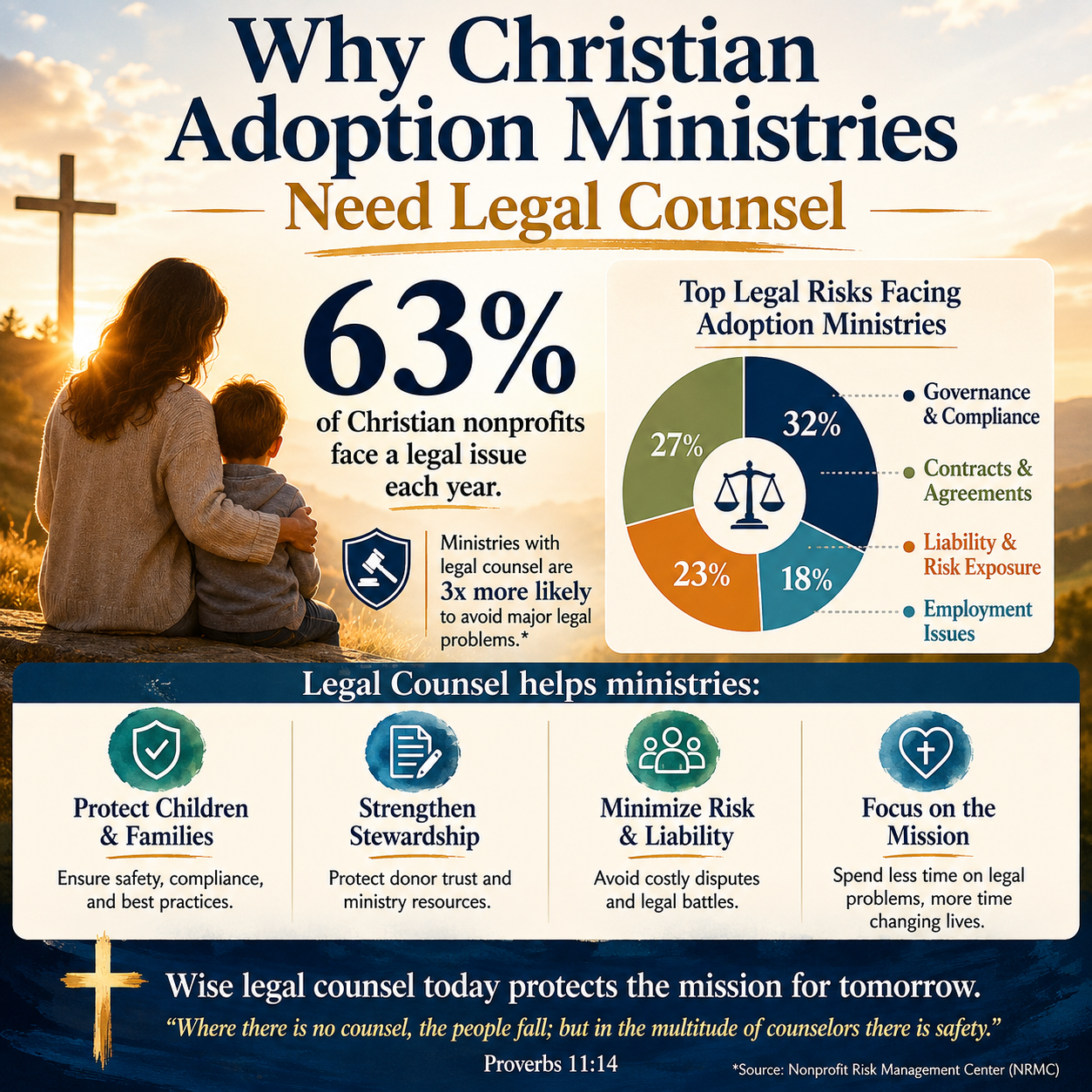
Across our verification work at Most Trusted, we observe that ministries meeting The Most Trusted Standard tend to treat legal review as a governance discipline rather than a last-minute expense. They budget for it, document it, and keep it connected to board oversight. That posture signals seriousness about stewardship.
Contracts and policies are ministry tools, not merely legal shields
Many disputes arise not from malice but from ambiguity. Contracts with partner agencies, home-study providers, lodging hosts, translators, and international intermediaries need defined scopes, fee structures, confidentiality terms, and termination provisions. Policies on records retention, mandatory reporting, and staff conduct need to be written for real-world use, trained, and audited. Counsel helps a ministry craft documents that actually govern behavior rather than merely decorating a binder.
Donors should not romanticize the administrative layer here. A strong contract can be an instrument of neighbor-love because it reduces preventable confusion and protects vulnerable parties from being caught in institutional drift.
Legal counsel enables integrity in international and cross-border adoption work
International adoption is shaped by treaty obligations and national law
International adoption has been a sphere of both genuine mercy and documented abuse globally. It is also one of the most heavily supervised areas of adoption. The Hague Adoption Convention establishes safeguards intended to prevent abduction, sale, and trafficking of children, and the U.S. Department of State describes the Convention’s purpose as protecting children and families while ensuring intercountry adoptions take place in the best interests of the child U.S. Department of State. Ministries that touch international cases need counsel that understands those frameworks and how they intersect with local practice.
What this means in practice is that “a child needs a home” is not a sufficient operating premise. Documentation of orphan status, subsidiarity considerations, authorization of intermediaries, and compliance with sending-country requirements are all areas where errors can lead to halted cases, government sanctions, or, worst of all, a child removed from an adoptive family after placement.
Immigration and citizenship consequences are often underestimated
Even when an adoption is valid under local law, immigration and citizenship outcomes may involve additional steps and timelines. A ministry that offers guidance without qualified counsel risks misinforming families in ways that can be financially and emotionally catastrophic. Counsel helps ensure that communications are accurate, that referrals are appropriate, and that the ministry’s role is clearly delineated so families know where legal responsibility actually lies.
Donors who care about long-term stability should view competent counsel as part of a child’s pathway to permanence, not as overhead to be minimized.
What donors should look for when a ministry claims it is legally compliant
Signs of mature legal stewardship
Because donors are rarely in a position to audit legal files, the practical question becomes: what evidence suggests a ministry treats law as a form of moral discipline rather than an adversary? The most credible ministries are plainspoken about constraints, avoid exaggerated promises, and can describe how they manage legal risk without hiding behind vague assurances.
The following indicators do not guarantee excellence, but they are reasonable signals of seriousness:
- Named, qualified legal counsel engaged on a standing basis, not only during emergencies
- Clear written policies for informed consent, confidentiality, and conflicts of interest
- Board minutes that reflect oversight of compliance, licensing, and risk management
- Documented pathways for mandatory reporting and safeguarding concerns
- Transparent public explanations of the ministry’s role versus the role of attorneys and agencies
Verification should test governance as well as compassion
Donors are right to ask about impact, but adoption ministry is also about rightful process. This is why our work at Most Trusted evaluates ministries against The Most Trusted Standard, including governance, financial integrity, and transparency alongside a clear faith foundation. A ministry may be sincere and still be structurally unsafe. Verification exists to help donors discern the difference with evidence, not impressions.
For donors seeking broader context on how adoption work fits within the larger landscape of faithful practice, see Christian Adoption Ministries. For donors focused specifically on the compliance questions that shape this field, see Legal and Regulatory Compliance in Christian Adoption Ministries.
FAQs for Why Christian adoption ministries need legal counsel
Does legal counsel mainly protect the ministry, or does it protect children and families?
It should do both, but the order matters. Competent counsel protects children and families by strengthening due process, informed consent, lawful documentation, and stable placements. It also protects the ministry by reducing preventable disputes and regulatory exposure. When counsel is treated only as institutional self-defense, ministries tend to become opaque. When counsel is treated as a discipline of integrity, ministries tend to become clearer, more careful, and more trustworthy.
Should donors be concerned if a ministry says it cannot share details because of confidentiality?
Confidentiality is often legitimate in adoption because the cases involve minors, medical information, and court records. The concern arises when “confidentiality” becomes a blanket answer that prevents any meaningful explanation of policies, oversight, or decision-making. Mature ministries can protect identities while still being transparent about how they handle consent, conflicts of interest, fees, safeguarding, and accountability when something goes wrong.
Legal counsel as a discipline of Christian stewardship
Adoption ministry is one of the clearest places where Christian compassion must be joined to careful governance. The God who commands care for the vulnerable also condemns false weights and measures. Legal counsel is not a substitute for prayer, pastoral care, or Spirit-formed character. It is one of the practical means by which a ministry can act justly, love mercy, and walk humbly in an arena where the consequences of error fall on those with the least power to absorb them.



