
How Christian adoption ministries provide post-adoption support is not a secondary question for donors; it is one of the clearest indicators of whether a ministry understands adoption as a covenantal commitment rather than a one-time transaction. Scripture’s concern is not merely for placement, but for perseverance in love: “Let us not love in word or talk but in deed and in truth” (1 John 3:18). For families formed through adoption, the “deed” often begins in court and continues for years in the quiet, costly work of attachment, healing, and belonging.
Post-adoption support is also where the adoption movement has had to mature. Many adoptive parents testify that the hardest chapters begin after homecoming: trauma behaviors that surface months later, school disruptions, marriage strain, complex grief, and spiritual disorientation when joyful expectations collide with real need. Donors who care about faithful orphan care should care equally about whether ministries prepare families for lifelong discipleship and provide support that is clinically informed, pastorally wise, and financially honest.
Post-adoption support is where adoption theology meets lived reality
Adoption is a gospel sign, not a guarantee of ease
The New Testament uses adoption language to describe God’s welcome of believers into his family (Romans 8:15; Ephesians 1:5). That theological truth has inspired many Christian families to adopt, and it should. But the analogy can be misused when it is pressed into sentimental simplicity, implying that love alone resolves the effects of early adversity. Mature ministry practice holds two truths together: adoption reflects God’s redeeming love, and adopted children often carry real wounds that require patient, skilled care.
Research on adverse childhood experiences helps explain why challenges can intensify after placement. The Centers for Disease Control and Prevention has documented associations between adverse childhood experiences and later mental health and behavioral outcomes, including increased risk for depression and substance use disorder (CDC). Many adopted children have experienced multiple disruptions—prenatal exposure, neglect, institutional care, or repeated caregiver loss—each of which can complicate regulation and attachment.
Support is a matter of justice for children and endurance for families
Christian donors tend to resonate with “rescue” narratives, but Scripture’s category is closer to steadfast love. “Defend the weak and the fatherless; uphold the cause of the poor and the oppressed” (Psalm 82:3). Defense and upholding do not end at finalization. When ministries invest in post-adoption support, they reduce the likelihood that families become isolated, children cycle through additional disruptions, or parents quietly withdraw from church due to shame or exhaustion.
Christians genuinely disagree about the boundaries of a ministry’s responsibility after placement, especially when legal custody has transferred and new challenges emerge. Yet the ministries most worthy of trust are candid about what they will do, what they cannot do, and how they will help families access care beyond the ministry’s direct offerings.

The strongest support models integrate clinical care, pastoral formation, and practical help
Trauma-informed services without therapeutic overreach
Post-adoption support should be trauma-informed, but it should not pretend to be a substitute for medical or psychiatric care. Trustworthy ministries maintain a clear scope of practice: they provide education, coaching, referrals, and crisis support, and they partner with licensed clinicians when therapy is needed. Some employ licensed social workers or counselors; others build vetted referral networks for evidence-based approaches such as Trust-Based Relational Intervention and other attachment-aware modalities.
Donors should also watch for signs of therapeutic overreach: ministries offering counseling without appropriate licensure, making categorical claims that a single method “works for every child,” or minimizing the role of medication and specialized care when clinically indicated. A ministry can be deeply Christian and still respect professional boundaries; in fact, that respect is often part of faithful stewardship.
Church-based support that is more than sympathy
Christian families do not only need a counselor. They need a church that understands what trauma looks like in the pew: impulsivity, controlling behavior, withdrawal, sensory overload, and regression that can appear as defiance. Ministries that serve well often equip local congregations with training for children’s ministry volunteers, guidance for small-group leaders, and pastoral frameworks that hold both compassion and accountability.
What this means in practice is that post-adoption support is frequently a bridge between the adoptive household and the local church. When done well, it prevents the common pattern of families drifting away because Sunday morning feels like a weekly test they keep failing.
Practical components that donors can fund with integrity
Education, peer community, and crisis response
Post-adoption support is often less glamorous than international travel or placement milestones, but it is where donor dollars can deliver durable stability. The most effective ministries treat support as a program area with clear goals, documented services, and appropriate staffing, not as an informal add-on.
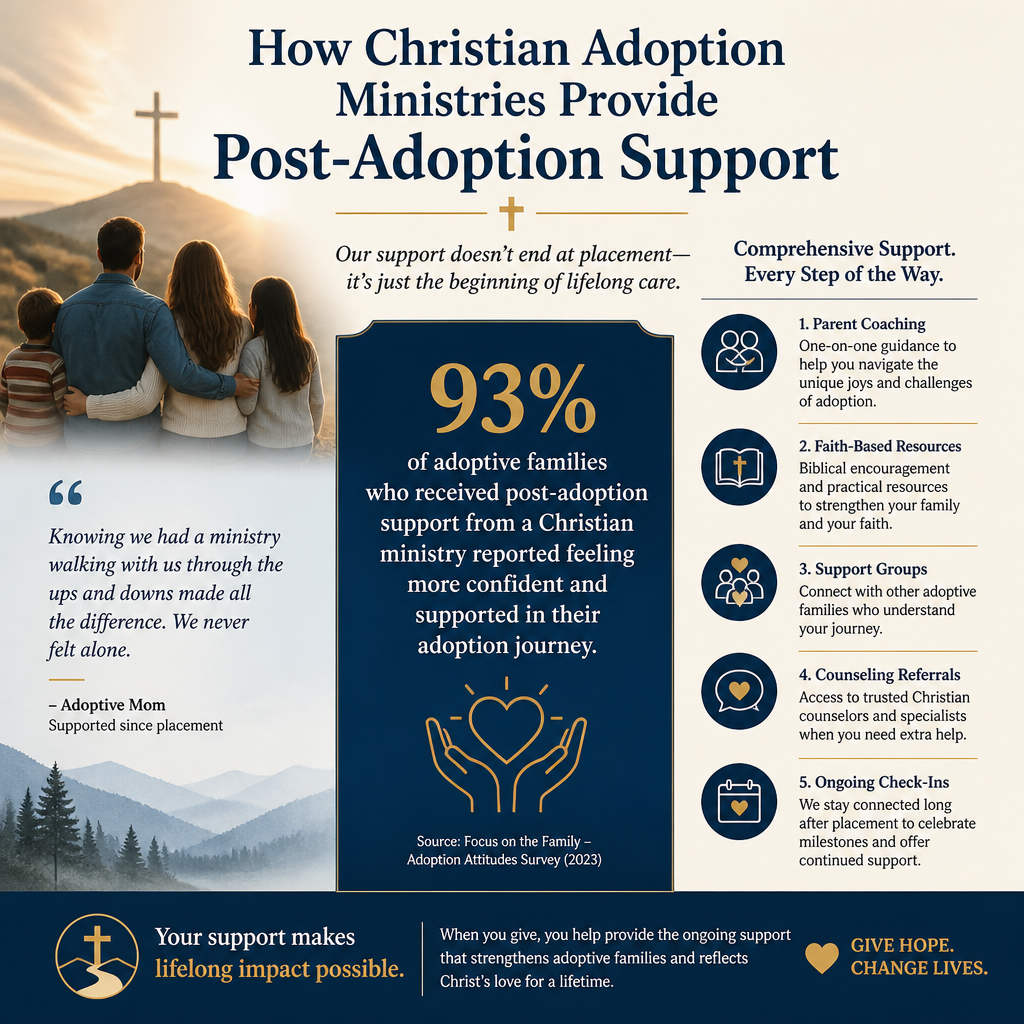
In our verification work at Most Trusted, the ministries that meet The Most Trusted Standard tend to describe post-adoption support in concrete terms: what is offered, who provides it, how families access it, what it costs, and what outcomes are tracked. Donors should expect this level of specificity because post-adoption support is one of the areas where vague promises can unintentionally mask under-resourcing.
- Pre- and post-adoption training on attachment, trauma, and family systems
- Support groups facilitated by trained leaders, not only informal gatherings
- Respite care that is screened, supervised, and policy-governed
- Crisis response pathways including after-hours contacts and safety planning
- Referral networks for clinicians, educational advocates, and medical specialists
Financial assistance with clear criteria and accountability
Some families need practical financial help after finalization: therapy costs, specialized tutoring, neuropsychological evaluations, or adaptive equipment. Donors often ask whether ongoing assistance fosters dependency. The tension is real. Wise ministries address it with transparent eligibility criteria, time-bound aid where appropriate, and collaboration with the family’s church and care team.
The goal is not to subsidize avoidable expenses; it is to keep a family intact when essential care is out of reach. In a health system where mental health access is uneven, modest targeted aid can be the difference between stability and escalating crisis. For donors evaluating this work, it is reasonable to ask how a ministry prevents conflicts of interest, documents need, and reports aggregate outcomes without violating family privacy.
Donor due diligence for post-adoption support requires more than a compelling story
Questions that reveal whether support is real
Many organizations can describe post-adoption support. Fewer can demonstrate that it is staffed, funded, and governed with the seriousness it requires. Donors should look for written policies, clear referral practices, safeguarding procedures for respite care, and evidence that staff receive ongoing training.
It is also appropriate to ask what happens when an adoption is in crisis. Does the ministry have a documented process for safety assessment? Do they refer to child protective services when required by law? Do they maintain appropriate boundaries while remaining present? The absence of clear answers often signals that support depends on individual personalities rather than durable organizational practice.
Transparency and evidence without reducing children to metrics
Outcome measurement in adoption support is complicated. A family may be “stable” while still struggling. Some outcomes—attachment quality, emotional regulation, resilience—are difficult to quantify and should never be reduced to simplistic scores. Yet donors should still expect honest reporting: participation rates, satisfaction data, referral volumes, staff-to-family ratios, and program costs.
When evaluating financial reporting, mature donors have learned not to fixate on overhead ratios. The “Overhead Myth” statement signed by GuideStar (now Candid), Charity Navigator, and the BBB Wise Giving Alliance argued that overhead alone is a poor measure of nonprofit performance and can push organizations toward underinvestment in essential infrastructure (Candid). Post-adoption support often requires precisely the kinds of “infrastructure” expenses—trained staff, clinical partnerships, safeguarding protocols, and data systems—that shallow overhead thinking discourages.
For donors seeking a disciplined way to evaluate ministries, Most Trusted applies The Most Trusted Standard, a 15-criteria framework that examines Faith Foundation, Financial Integrity, Governance and Leadership, and Transparency and Effectiveness. Where adoption is concerned, we pay particular attention to whether promises made in marketing align with what budgets, staffing, and policies actually support.
Many donors begin their research by surveying the broader field of Christian Adoption Ministries, then narrowing toward organizations with demonstrable post-adoption capacity.
Post-adoption support also requires ethical clarity about family preservation and harm prevention
A mature movement counts the costs of separation
The Christian orphan care movement has had to reckon with hard truths about institutionalization and unnecessary separation. UNICEF has long emphasized that many children in residential care are not orphans in the strict sense and that family-based care is generally preferable (UNICEF). Adoption ministries should not weaponize that reality to shame adoptive families, but they should allow it to deepen ethical seriousness: removal and separation are traumatic, even when necessary, and support after adoption must address grief, identity, and loss with honesty.
This is one reason post-adoption support is not merely “services.” It is moral repair work. It helps families tell the truth about origins, maintain appropriate connections when safe and wise, and resist the temptation to treat adoption as an erasure of the child’s story. Donors committed to Christian integrity should favor ministries that speak carefully about birth families, do not traffic in simplistic “before and after” narratives, and train parents for openness and humility.
Safeguarding and governance as pastoral responsibility
Post-adoption programs often involve vulnerable children and stressed families. That combination requires strong safeguarding: background checks, mandated reporting training, two-adult policies, and clear incident-response protocols. Governance is not an administrative footnote; it is a form of pastoral responsibility at organizational scale.
For donors examining the moral credibility of a ministry, it is worth paying attention to whether board oversight is active, conflict-of-interest policies are enforced, and financial statements are readily available. These are not secular intrusions into “spiritual work.” They are ways of ensuring that compassion is paired with accountability.
FAQs for How Christian adoption ministries provide post-adoption support
What should donors expect a Christian adoption ministry to provide after finalization?
Donors should expect clearly described services such as post-placement check-ins, education and support groups, crisis response pathways, and referral networks to licensed clinicians and specialized resources. The ministry should be transparent about scope: what is available to every family, what requires additional funding, and what is outside the ministry’s competence. The most trustworthy organizations document these commitments in policies and budgets rather than relying on informal goodwill.
How can donors tell whether post-adoption support is substantive rather than a marketing claim?
Substantive support is staffed and governed. Donors can look for named program leaders, published descriptions of services, safeguarding policies for respite and group settings, and financial reporting that shows program investment over time. It is also reasonable to ask how many families participate, how the ministry handles crises, and what partnerships exist with licensed professionals and local churches. Ministries that welcome these questions tend to be more prepared to carry families through difficult seasons.
Why post-adoption support is a credible test of trust
Christian donors are right to care about adoption because Scripture is explicit about God’s concern for children without protection and for families under pressure. Yet the credibility of an adoption ministry is proved over time, not at placement. Post-adoption support demonstrates whether a ministry is prepared to bear burdens with families, to tell the truth about trauma and healing, and to operate with the accountability that Christian stewardship requires.
Those who want to fund that kind of faithful work should also understand the wider aims of The Christian Mission Behind Adoption Ministries: not sentiment, but durable love ordered by wisdom, truth, and the fear of the Lord.



