
“What documents Christian adoption ministries maintain for compliance” is not merely an administrative question. For donors, it is one of the few concrete ways to test whether a ministry’s compassion is ordered by truth, lawful authority, and the protection of children. Scripture’s insistence on just weights and measures applies here: integrity is not only a matter of motive but of verifiable practice (Proverbs 11:1).
Adoption work sits at a convergence of high moral stakes and complex regulation. The best ministries are neither defensive nor casual about documentation. They treat records as a form of stewardship: evidence that decisions were lawful, that vulnerable families were treated with dignity, and that donor funds were handled without confusion or self-dealing. Across our verification work at Most Trusted, documentation is one of the clearest dividing lines between ministries that can substantiate their claims and ministries that mainly ask to be trusted.
Start with the regulatory map and legal identity
Compliance documentation begins with a simple reality: adoption is regulated in layers. A ministry may be a licensed child-placing agency, a home-study provider, a facilitator, a grant-maker, a church-based support ministry, or a combination. Each role creates different recordkeeping duties, and the most careful organizations document their scope so it can be audited.
For donors, the first question is basic but decisive: what is this organization legally authorized to do, and where? Ministries that meet The Most Trusted Standard tend to make their legal identity and operational footprint easy to verify, because clarity reduces risk for children, families, staff, and donors.
Core organizational documents
Most Christian adoption ministries maintain an accessible set of documents that establish legal existence and authority, typically including:
- Articles of incorporation and bylaws, with current amendments
- IRS determination letter and current tax status documentation
- State charitable registration filings where required
- State licensing documentation for child-placing or related services when applicable
- Insurance policies relevant to services provided (general liability, professional liability, workers’ compensation)
Where a ministry provides adoption services directly, licensing files often carry the greatest operational weight because they define what the ministry may do, what it must do, and what it must document. State requirements differ materially; responsible ministries treat that difference as a compliance discipline, not an inconvenience.
Why donor confidence is tied to legal clarity
Donors sometimes assume that because a ministry is “Christian,” its work naturally sits above the frictions of regulation. The opposite is closer to the truth. Adoption touches immigration law, family law, safeguarding, financial controls, and, at times, international treaties and foreign government requirements. The ministry that cannot produce basic legal and licensing documentation is not merely under-resourced; it is exposing families and children to unnecessary risk.

Case records that protect children and families
Adoption is personal, often painful, and always consequential. The case file is where ethical intentions are tested against actual practice. Documentation is never a substitute for love, but love that is not careful can become coercive or negligent, particularly when power differentials exist between agencies, prospective adoptive parents, and birth families.
Christian donors often support adoption ministries because they want to see children welcomed into stable families. Case records are the evidence trail that the ministry pursued that outcome lawfully and without manipulating vulnerable people.
For domestic adoption and pregnancy ministry-adjacent services
When a ministry is involved with domestic placement or with services that materially influence a birth parent’s decision, compliance documentation commonly includes:
- Intake documentation and informed consent forms
- Disclosure statements on services, limits, fees, and confidentiality
- Documentation of options counseling and referrals
- Records of expenses paid on behalf of expectant parents, with legal justification where allowed
- Placement agreements and post-placement supervision notes, as required
Christians genuinely disagree about how to speak about “choice” in pregnancy contexts. But legally and ethically, a ministry must be able to demonstrate that it did not use housing, financial aid, or spiritual authority to pressure a decision. Thoughtful documentation can be one of the strongest protections for birth parents against coercion—and for ministries against credible allegations of it.

For foster care and adoption from foster care
Where ministries partner with foster care systems—whether through recruitment, training, wraparound support, or direct services—records tend to include memoranda of understanding with public agencies, training curricula, background check documentation, incident reporting procedures, and documentation of family support services delivered. Donors should expect careful boundaries here: ministries cannot replace state authority, but they can strengthen families when roles are clearly documented.
Safeguarding records and mandatory reporting readiness
Adoption ministries work with minors and with adults in crisis, which makes safeguarding non-negotiable. A ministry’s internal theology of care must translate into operational protections that can be inspected. Jesus’ warnings about harming “little ones” are not abstract; they demand structures that prevent abuse and respond rightly when allegations arise (Matthew 18:6).
From a compliance standpoint, safeguarding is not only about having a policy. It is about maintaining records that prove the policy is practiced.
Core child protection and personnel screening documentation
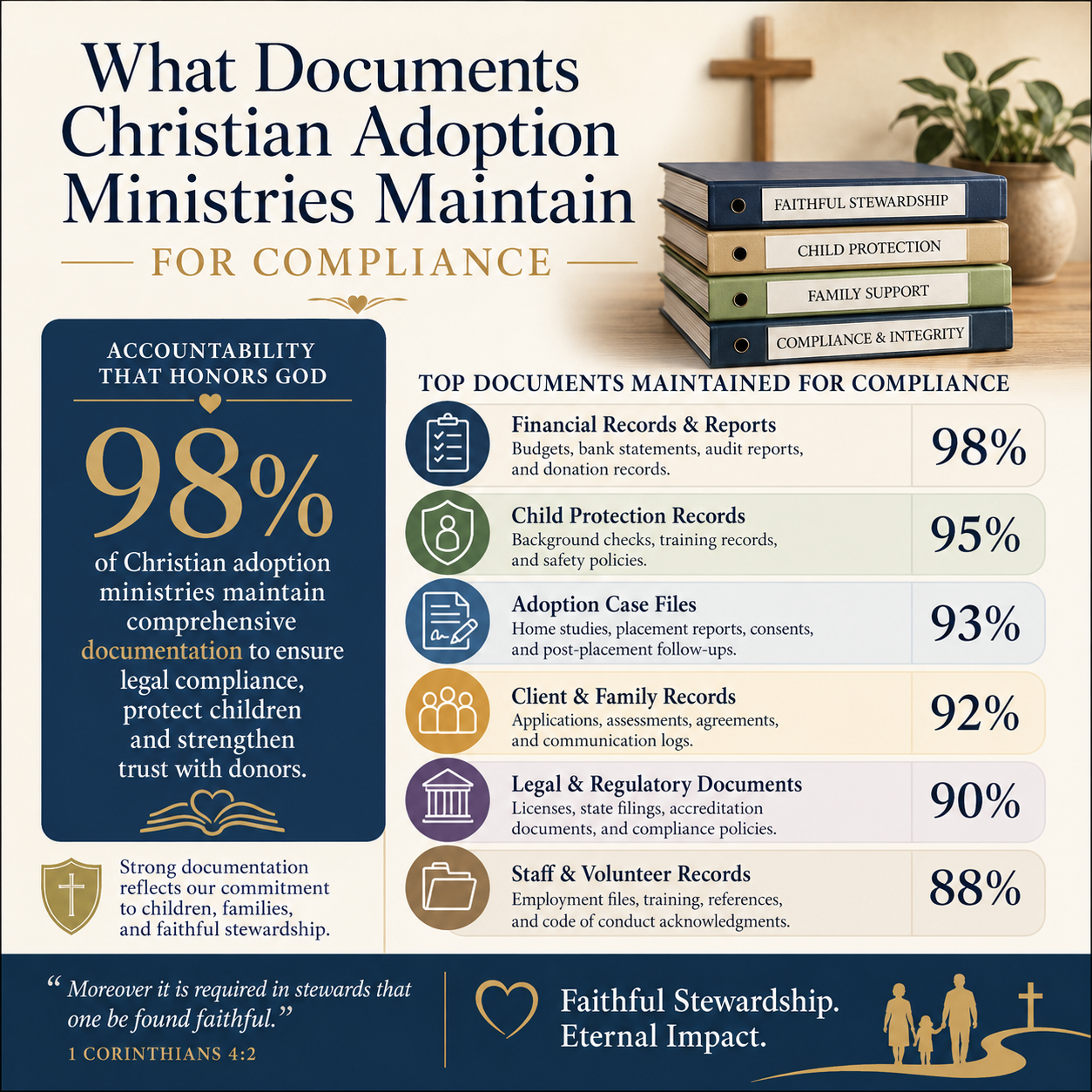
Common compliance-related records include:
- Written child safety policy, code of conduct, and supervision standards
- Background check records consistent with state requirements and the ministry’s risk profile
- Reference checks and documented screening for staff and volunteers
- Training completion records for child safety and mandatory reporting
- Incident reports, allegation response documentation, and escalation logs
Donors should also look for evidence that safeguarding is reviewed by governance, not left solely to program staff. In the ministries that meet The Most Trusted Standard, safeguarding documentation is treated as a board-level risk issue because the cost of failure is borne first by children.
Data privacy and confidentiality
Adoption case information is among the most sensitive data a ministry can hold. Recordkeeping therefore includes access controls, retention schedules, and secure storage procedures. In the United States, privacy obligations may include HIPAA where covered entities or business associate relationships exist, and state confidentiality laws that govern adoption records. Even where a specific statute does not apply, donors should expect a ministry to limit access on a need-to-know basis and to document that limitation.
For donors supporting storytelling and fundraising, this has practical implications. Ministries should have written photo and story release practices, and they should be cautious about sharing identifiable details that could expose children or birth families to harm.
Financial compliance documents that withstand scrutiny
Adoption ministries frequently manage restricted gifts, designated grants, and sometimes fee-for-service revenue. Documentation is how a ministry demonstrates that funds were handled according to law, donor intent, and internal controls. This is not a mere “overhead” question; it is a question of honesty and accountability before God and neighbor.
In the United States, most nonprofits must file Form 990 annually (or 990-EZ/990-N depending on size). Donors can often review these filings directly through the IRS or reputable charity databases. The IRS requires annual returns for most tax-exempt organizations, and provides public access to many nonprofit filings through its resources (IRS).
Financial records donors should expect to exist
Depending on the ministry’s services and complexity, financial compliance documentation commonly includes:
- Audited financial statements or reviewed financials where appropriate
- Annual budgets approved by the board and monitored through variance reporting
- Gift acceptance policy and documentation of restricted gifts
- Grant agreements and grant reporting files, including outcomes reporting where promised
- Conflict of interest disclosures and related-party transaction documentation
Donors should not assume that “adoption fees” eliminate the need for careful controls. Fees can create their own ethical pressures, especially if revenue rises with placements. Strong ministries document how they separate decision-making about a child’s best interests from financial incentives, and how they communicate fees transparently to families.
Sanctions, watchlists, and international risk
Where ministries work internationally—whether through intercountry adoption support, family preservation partnerships, or grants to overseas entities—documentation may include sanctions screening, due diligence on foreign partners, and records demonstrating lawful cross-border transfers. U.S. nonprofits are expected to take reasonable steps to prevent diversion of charitable funds to prohibited actors; documentation is how “reasonable steps” becomes more than a claim.
Governance and program accountability documentation donors can evaluate
Compliance is not limited to government rules. It also includes the ministry’s own promises: what it says to churches, families, and donors. Governance records show whether leadership submits to oversight, and whether the organization’s public communications are tethered to evidence.
This is where mature donors often feel tension. On one hand, adoption ministry requires pastoral sensitivity and discretion. On the other, secrecy is a recurring soil for harm in Christian institutions. Donors can honor confidentiality while still expecting verifiable accountability.
Board and governance records
Sound ministries typically maintain:
- Board meeting minutes and resolutions, including key risk decisions
- Policies on conflicts of interest, whistleblowers, and document retention
- Executive compensation decision records appropriate to nonprofit norms
- Governance committee materials and annual board self-assessment practices where used
Donors looking for a meaningful window into governance often learn more from the presence of consistent minutes and policy enforcement than from a polished webpage. A ministry’s internal paper trail matters because it captures how decisions were made when the decision was costly.
Program effectiveness and transparency records
Adoption outcomes are not always reducible to a single metric, and the field has had to reckon with legitimate debates about what “success” means. Even so, ministries should document what they claim to accomplish: number and type of services delivered, family stabilization efforts, post-placement support, counseling referrals, and safeguarding incident response. Where they claim long-term impact, they should describe the evidence basis and limits without exaggeration.
Donors who want to situate documentation within the broader regulatory context can review Legal and Regulatory Compliance in Christian Adoption Ministries. For donors evaluating the broader theological and operational landscape of orphan care and adoption work, Christian Adoption Ministries provides essential framing that keeps compliance in its proper place: serving the protection of children and the integrity of the Church’s witness.
FAQs for What documents Christian adoption ministries maintain for compliance
Should donors ask to see adoption case files to verify compliance?
No. Case files contain highly sensitive information about children, birth families, and adoptive families. A responsible ministry will not share identifiable case records with donors. What donors can request instead are anonymized policy documents, licensing status, safeguarding policies, audited or reviewed financial statements where available, and descriptions of governance controls that demonstrate accountability without violating confidentiality.
What is one document donors should expect every adoption-related ministry to provide?
A current IRS Form 990 or an explanation of why it is not required, along with basic governing documents and clear descriptions of services. The Form 990 is not a complete picture of integrity, but it is a baseline transparency instrument for many U.S. nonprofits, and it allows donors to test whether public claims align with reported finances and governance disclosures (IRS).
Documentation is part of faithful witness
Christian donors give to adoption ministries because they believe the Church should honor the vulnerable and strengthen families. The question is whether a ministry can demonstrate, with records fit for inspection, that its compassion is disciplined by lawful authority, safeguarding seriousness, and financial integrity. Documentation will never replace spiritual discernment, but it is one of the most practical ways donors can love wisely—seeking mercy that does not abandon justice (Micah 6:8).



