
What churches should know about recovery and relapse is that relapse is not a surprising exception to the recovery journey; it is a common feature of long-term change in a fallen world. Churches that treat relapse primarily as moral failure tend to deepen shame and secrecy. Churches that treat relapse only as a medical event tend to flatten sin, agency, and the need for repentance and restoration. The pastoral task is to hold both truths together: human beings are morally responsible creatures, and addiction often involves entrenched patterns of brain, body, relationships, and trauma that do not unwind on demand.
For Christian donors funding recovery ministry, this is not an abstract debate. Relapse policy determines whether a ministry protects vulnerable people, whether it speaks truthfully about sanctification, and whether it uses resources wisely. It also shapes whether families remain engaged or quietly disappear after a crisis. Serious care requires clear theology, credible clinical boundaries, and verifiable accountability.
Recovery and relapse require a Christian anthropology, not a slogan
Sanctification is real and often slow
Scripture is unsentimental about the power of sin and the necessity of change. “If anyone is in Christ, he is a new creation” (2 Corinthians 5:17) is not sentimental optimism; it is a claim about new identity and new allegiance. At the same time, the New Testament’s repeated exhortations to “put off” and “put on” (Ephesians 4:22–24) assume a process that includes setbacks, re-learning, and persistent shepherding. Churches do not help people by promising instant victory, nor by redefining victory as mere abstinence.
In practice, recovery may involve a period of sobriety followed by relapse, followed by deeper honesty, more structure, and longer stability. The Christian frame does not excuse relapse. It does insist that relapse is not the end of the story, and that God often uses exposure of hidden patterns to bring real repentance into the light (1 John 1:7–9).
Addiction is more than desire and more than disease
Christians genuinely disagree about how much addiction should be described as disease, sin, habit, trauma response, or some combination. A church does not need to settle every contested question to act wisely, but it does need to refuse reductionism. People with substance use disorders often have co-occurring mental health conditions, histories of trauma, and patterns of isolation that are not solved by willpower alone.
What this means for churches is that “accountability” cannot be limited to checking a box in a small group. The church’s ordinary means of grace—preaching, prayer, sacraments, and disciplined community—are central. They are also often insufficient without appropriate treatment, safety planning, and clinical partnership. Mature ministry names both realities without embarrassment.

Churches should plan for relapse before it happens
Relapse is predictable enough to prepare for
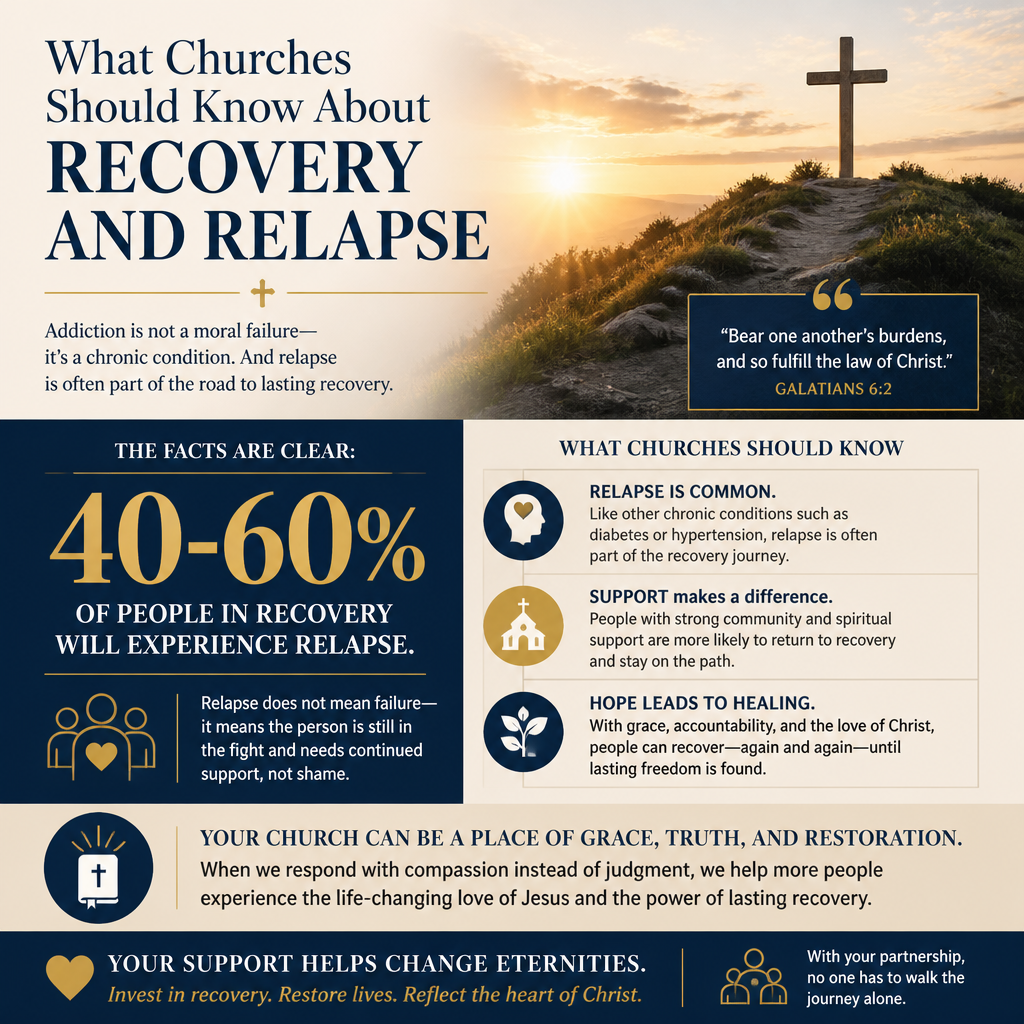
Many churches improvise after relapse, which is usually too late. Preparation is not pessimism; it is prudence. Public health agencies describe relapse as a common part of the recovery process for many people with substance use disorders, and they emphasize the value of treatment and long-term support rather than one-time intervention National Institute on Drug Abuse. Churches should take that realism seriously while still speaking clearly about repentance, truth-telling, and repaired trust.
A relapse plan clarifies who is notified, what immediate steps protect spouses and children, how the person is assessed for risk, and what conditions are required for participation in sensitive roles. It also prevents the destructive pattern in which a leader relapses, confesses broadly, and then is rapidly reinstated without meaningful change or verified accountability.
Safety and mercy are not competing values
Some congregations fear that strong boundaries feel ungracious. Others use “safety” language to avoid the costly work of patient care. Scripture refuses both distortions. Mercy does not require naiveté. Protection of the vulnerable is not optional. When churches work with addiction, they will eventually confront impaired driving, domestic volatility, financial damage, relapse with pornography and sexual acting out, and risks to children.

A clear boundary is often the most merciful action available. It names reality, reduces confusion, and creates a pathway for restoration that does not demand that families carry unreasonable risk.
What effective church-based recovery ministries tend to do
They integrate spiritual care with appropriate treatment pathways
Church-based recovery is strongest when it refuses the false choice between discipleship and treatment. Pastors are not clinicians, and clinicians are not pastors. The most faithful models build referral relationships with licensed providers, inpatient or outpatient programs, and medically supervised detox when needed. Donors should look for ministries that can explain their referral logic and the limits of pastoral counseling, especially for detox risk, severe depression, psychosis, and domestic violence.
For donors seeking reliable ways to evaluate programs in this space, it helps to start with the broader landscape of Christian Addiction Recovery Ministries. Some ministries are primarily peer-support communities. Others are residential programs with significant clinical staffing. Both can serve the church, but they should not be confused.
They establish clarity around relapse, discipline, and restoration
Relapse policy is where theology becomes operational. A ministry can preach grace and still function as though a relapse is disqualifying shame. Or it can preach holiness and function as though consequences are optional. Healthy programs articulate what relapse means for participation, housing, leadership, and reunification with family, and they apply those standards consistently.
The ministries that meet The Most Trusted Standard tend to document these policies and show how governance and leadership oversee them. That is not administrative trivia. In high-stakes ministry, consistency is one of the simplest forms of protection.
- A defined relapse response plan that includes immediate safety steps and next-day follow-up.
- Clear thresholds for higher levels of care, including medical detox and psychiatric evaluation when indicated.
- Boundaries around leadership and volunteer roles, especially with youth and vulnerable adults.
- Family-centered support that does not make spouses and children responsible for managing risk.
- Documented confidentiality practices that distinguish privacy from secrecy and comply with relevant laws.
What donors should ask before funding recovery work
Relapse is also an accountability question
Donors often ask whether a program “works,” but the better early question is whether a program is governed well enough to be trustworthy when it does not. Recovery ministry exposes real risk: vulnerable participants, complex family dynamics, and the temptation to over-promise outcomes. In this field, transparency about failure is a credibility marker, not a liability.
For example, a ministry that reports only success stories may be curating perception rather than telling the truth. A ministry that can describe its retention rates, its relapse response, and its safeguards—without using participants as marketing material—usually has a more mature culture.
Ask how outcomes are defined and reported
Outcomes in recovery are notoriously difficult to measure. Abstinence matters, but so do employment stability, reduced criminal involvement, repaired family relationships, church re-engagement, and sustained participation in a recovery community. Research organizations consistently note that substance use disorder is often chronic and relapse can occur, which means short-term snapshots are an unreliable basis for triumphal claims Substance Abuse and Mental Health Services Administration. A credible ministry will resist simplistic metrics and will still provide concrete evidence of effectiveness.
Across our verification work at Most Trusted, we look for ministries that can connect dollars to real practices: staff qualifications, participant-to-staff ratios where relevant, written policies, audited financials when appropriate to the ministry’s size, and governance that is independent enough to ask hard questions. Donors should expect that level of seriousness, especially when giving to residential programs or ministries working with high-risk populations.
How churches can support families without enabling harm
Families need pastoral care that does not confuse forgiveness with trust
Relapse often fractures a family twice: first through the substance use itself, and then through the recurring cycle of promises and disappointment. Churches sometimes pressure spouses or parents toward quick reconciliation, citing forgiveness while ignoring safety. Forgiveness is a Christian duty. Trust is rebuilt over time and is properly conditioned on observable change. Scripture itself distinguishes restored relationship from unqualified access (consider Paul’s caution in 2 Corinthians 2 and 2 Thessalonians 3’s insistence on accountability within community).
Pastoral care for families should include practical safety planning, connections to counseling, and permission to set boundaries without spiritualizing the consequences away. This is especially urgent where children are involved. A church that calls boundaries “unloving” may unintentionally perpetuate harm.
Churches should build systems that outlast one crisis
One relapse can consume months of a church’s attention and still leave the family isolated. The healthier approach is to build repeatable practices: trained lay leaders for support groups, relationships with vetted local providers, and benevolence policies that distinguish emergency help from ongoing subsidy that enables continued use. Churches also benefit from learning from the broader conversation on Christian Addiction Recovery in Families and Churches, where the recurring tensions—privacy versus secrecy, mercy versus safety, hope versus realism—have been faced in concrete terms.
The goal is not bureaucratic procedure. It is the quiet strength of a community that can tell the truth, bear burdens, and protect the vulnerable without collapsing into panic or denial.
FAQs for What churches should know about recovery and relapse
Should a relapse automatically disqualify someone from serving in church leadership?
Not automatically, but it should trigger a serious review with clear boundaries. Churches need role-specific standards, especially for positions involving teaching, finances, pastoral authority, youth, or vulnerable adults. A credible process considers the nature of the relapse, the person’s honesty and responsiveness to care, the presence of a structured recovery plan, and the time needed to rebuild trust. Restoration is a Christian category; reinstatement on a short timeline is not a biblical requirement.
How can donors tell whether a recovery ministry is trustworthy if relapse is common?
Trustworthiness is shown less by perfect outcomes and more by transparent governance, clear policies, and consistent safeguarding. Donors can ask how relapse is defined, how it is reported internally, what triggers higher levels of care, and whether families and victims are protected. Ministries that meet The Most Trusted Standard typically document these practices and can connect program claims to verifiable evidence: qualified oversight, financial integrity, and candor about limits.
Faithful recovery ministry is built for the long road
Recovery and relapse confront churches with a question that cannot be answered by sentiment: will the church be a community where truth is spoken without despair and grace is offered without naiveté. Donors play a significant role in shaping that answer. Funding ministries with credible safeguards, mature theology, and transparent accountability strengthens the church’s capacity to bear burdens over time, not merely to respond to the crisis of the week.



