
Why child sponsorship ministries focus on education is not a marketing question; it is a discipleship-and-development question. Christian donors are not merely asking what “works.” We are asking what promotes durable human flourishing without displacing families, weakening local churches, or reducing children to fundraising symbols.
Education sits near the center of that inquiry because it is measurable without being merely mechanical, personal without being privatized, and developmental without pretending the gospel is an add-on. The best ministries treat education as one strand in a larger fabric: spiritual formation, family stability, child protection, health, local church partnership, and livelihood resilience.
Education is a high trust proxy for long term flourishing
Why donors gravitate toward education outcomes
Many child sponsorship programs operate in contexts where suffering is not episodic but structural: fragile labor markets, unstable public services, and intergenerational poverty. In those conditions, education functions as a practical proxy for a set of long-term outcomes donors care about—literacy, numeracy, employability, civic participation, and the ability to navigate modern institutions without exploitation.
That proxy matters because Christian compassion is not meant to be only reactive. Scripture presses beyond relief toward restoration. When the prophets condemn those who “trample on the poor,” they are not only naming a lack of charity but the presence of unjust systems and predation. Education is not a complete answer to injustice, but it can strengthen a child’s agency in the face of it.
What the evidence can and cannot claim
Verifiable research consistently associates more schooling with better life outcomes, while also acknowledging that schooling quality, labor market conditions, and governance strongly shape results. For example, the World Bank summarizes decades of work showing that each additional year of schooling is associated with higher earnings on average, while emphasizing that learning—not seat time—is the true driver of economic returns World Bank.
At the same time, sophisticated donors recognize a tension: education can become a thin substitute for discipleship, or a technocratic promise that ignores local realities. The ministries worthy of trust do not treat education as magic. They treat it as a stewardship opportunity with defined limits, pursued alongside pastoral care and family strengthening.

Education is one of the few sponsorship components that can be verified responsibly
Clarity helps protect children and donors
Child sponsorship carries unique ethical risks because it attaches a donor’s money and attention to a named child. Where oversight is weak, the model can drift toward commodification: children turned into profiles, progress reports turned into public relations, and family dignity quietly eroded. Ministries that focus on education often do so because it is easier to define, document, and audit without exposing sensitive personal details.
In our verification work at Most Trusted, we find that stronger ministries can show straightforward evidence of educational support: enrollment confirmation, attendance tracking, fee receipts where appropriate, tutoring participation records, teacher reports, and aggregate learning indicators. Those artifacts are imperfect, but they are substantially more auditable than vague claims of “changed lives.”
What this means within The Most Trusted Standard
The Most Trusted Standard expects ministries to demonstrate not only sincere intent but disciplined stewardship across faith commitments, governance, financial integrity, and public truth-telling. Education support fits that expectation because it can be reported in aggregates, measured over time, and reconciled to budgets without turning a child into a datapoint for donor consumption.
Donors who want to go deeper into the broader landscape should explore Child Sponsorship Ministries with an eye toward how ministries describe outcomes and protect children, not only how they describe need.
Education is often the most scalable way to serve many children without replacing parents
A family strengthening approach rather than a substitution approach
Christians genuinely disagree about the moral hazards of sponsorship. Some worry it individualizes poverty and invites dependency. Others see it as one of the most relational forms of giving available at scale. The best ministries address the critique directly by structuring sponsorship so that parents remain primary and local communities are strengthened rather than bypassed.
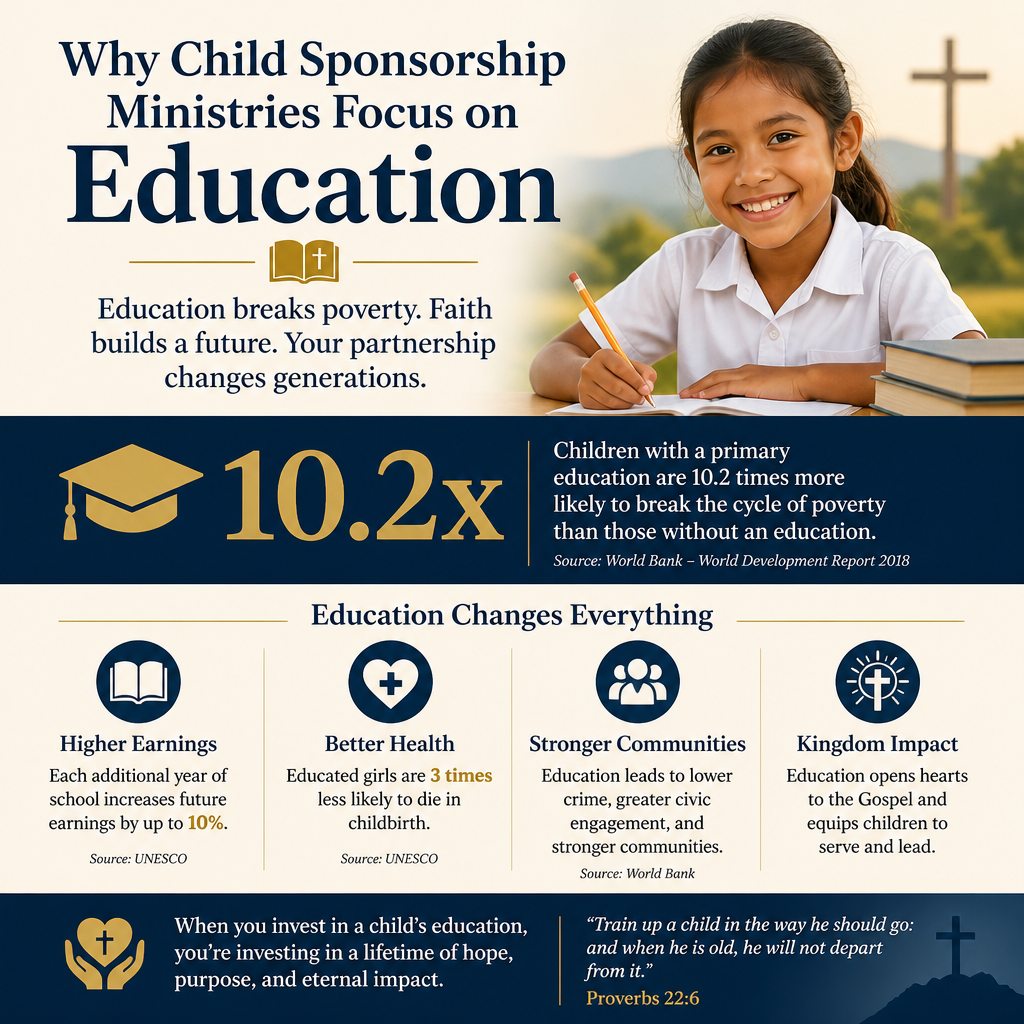
Education-focused support can reinforce, rather than supplant, parental responsibility. Paying fees, providing uniforms, tutoring, or mentoring can reduce pressure that drives harmful coping strategies—child labor, early marriage, or migration—while still honoring the household as the child’s core place of belonging.
Scalability without erasing local institutions
Education also creates a practical pathway to work with existing schools, churches, and community organizations rather than building parallel systems that collapse when funding shifts. That is not a romantic claim about the quality of every local institution; some are deeply strained. It is an acknowledgement that long-term sustainability usually requires strengthening what can be strengthened rather than importing permanent dependency.
For donors assessing whether a ministry’s approach honors families and local leadership, How Child Sponsorship Ministries Measure Impact is a helpful lens because it forces the question: what is being measured, who benefits, and what is being incentivized?
Education programs create structured opportunities for holistic care
Schools as a platform for protection and discipleship
Education is rarely only education in the field. Schools and tutoring centers are one of the few places where children can be seen regularly by trained adults. That regular contact can support child protection—identifying abuse, trafficking risk, neglect, or unsafe migration pressures—when staff are properly trained and accountable.
Where ministries partner with local churches and Christian educators, education settings can also support spiritual formation without coercion. The goal is not to use schooling as a cover for proselytism, nor to hide Christian identity to appease donors. It is to serve children with integrity: honest faith, appropriate boundaries, and respect for family and community dynamics.
What well designed education support often includes
Education-focused sponsorship tends to be most credible when it is part of a coherent child well-being approach rather than a single benefit. In practice, that often includes:
- Support that reduces barriers to enrollment and consistent attendance
- Academic tutoring or remedial support when learning gaps are present
- Child protection policies, training, and reporting mechanisms
- Caregiver engagement, including meetings and practical coaching
- Referral pathways for health, nutrition, or psychosocial needs
None of these components guarantees impact. The harder question is whether the ministry has the governance and transparency to implement them safely. Donors should expect clear child safeguarding standards, documented staff training, and credible reporting structures, not only warm stories.
The field has had to reckon with mixed evidence on sponsorship outcomes
What research suggests and why interpretation matters
Some of the most cited academic work on sponsorship reports positive associations with adult outcomes such as education and employment. A frequently discussed example is research by economists associated with the University of Chicago and other institutions examining long-term outcomes for individuals who were sponsored as children University of Chicago. Donors should read such findings carefully: results can vary by country context, program design, implementation quality, and selection effects.
The presence of encouraging studies does not remove the need for vigilance. Christian donors have watched other sectors repeat painful patterns: programs that look successful in reports but quietly reward harmful incentives on the ground. The point is not cynicism. The point is moral seriousness.
Questions a careful donor should ask
Education is a common focus in sponsorship partly because it can be evaluated, but evaluation is only as honest as the incentives behind it. A careful donor will ask:
Are the educational claims specific? “Improved literacy” should mean something operational—grade-level reading assessments, teacher-verified progress, or validated tools—not just enthusiasm.
Is the ministry transparent about limitations? If local schools are weak or conflict disrupts attendance, does the ministry report that plainly and adapt, or does it mask fragility with success language?
Is the child protected? Communication with sponsors should follow child safeguarding best practices, and data should be handled with restraint. The ministry’s duty of care outweighs the donor’s curiosity.
Is Christ honored without being used? Ministries should avoid both manipulative evangelism and embarrassed silence about Christian conviction. Mature Christian giving expects truthfulness.
FAQs for Why child sponsorship ministries focus on education
Does focusing on education mean a sponsorship ministry is neglecting the gospel?
Not necessarily. Education can be an expression of Christian love of neighbor when it is pursued as part of holistic care and grounded in honest partnership with local churches and families. The concern is legitimate when education becomes a substitute for spiritual formation or when ministries obscure their faith commitments to broaden fundraising. Donors should look for integrity: clear Christian identity, appropriate boundaries, and a refusal to instrumentalize children for religious or financial ends.
What evidence should donors expect from education focused child sponsorship?
Donors should expect evidence that matches the claim. For basic access claims, that may include enrollment and attendance records. For learning improvement claims, donors should look for credible assessment methods and transparent reporting in aggregate. For broader well-being claims, donors should expect documented child protection policies, caregiver engagement, and referrals for needs that interfere with learning. Where reporting is consistently story-driven without verifiable indicators, trust should be earned cautiously.
Education is a wise focus when it is paired with integrity
Why child sponsorship ministries focus on education comes down to stewardship, verifiability, and the moral aim of helping children grow into adulthood with greater agency, protection, and opportunity. Education is not salvation, and it is not a guarantee against injustice. It is, however, one of the most responsible places for sponsorship to concentrate when the ministry also honors families, protects children, tells the truth about outcomes, and submits itself to accountable governance.
Christian donors are not called to naive optimism or paralyzing suspicion. We are called to wise generosity—giving that loves the child in front of us, strengthens the community around that child, and insists on ministries worthy of trust.



