
How child sponsorship ministries enroll children in their programs is not a minor operational detail; it is where donor intent, child protection, and the integrity of Christian compassion either align or quietly fracture. The same enrollment pathway that connects a donor to a child’s needs can also create incentives to misrepresent a child’s situation, bypass family consent, or privilege marketing value over the child’s best interest.
Scripture’s command is plain: “Defend the weak and the fatherless; uphold the cause of the poor and the oppressed” (Psalm 82:3). Yet Christian donors have learned that good intentions are not a sufficient safeguard. Enrollment practices determine whether sponsorship supports families and local churches with humility, or whether it unintentionally pressures communities to produce “sponsor-ready” stories.
Enrollment begins with a ministry model, not a marketing need
Before any child is enrolled, a mature ministry has already answered a prior question: what is the program actually designed to do? Some sponsorship programs are fundamentally child-centered, using sponsorship as a long-term mechanism for education, health, mentoring, and discipleship. Others are community-centered, where “sponsorship” functions as a communication and funding channel for interventions that serve many children and households. Both can be legitimate; the ethical risk comes when the public narrative promises one model while the internal practice follows another.
Across our verification work at Most Trusted, ministries that meet The Most Trusted Standard tend to describe their sponsorship model with careful specificity. They explain what sponsorship funds can and cannot do, what portion is directed to individual benefits versus shared community services, and how the ministry prevents the enrolled child from becoming a fundraising asset rather than a person made in God’s image.
Child-centered and community-centered enrollment pathways
A child-centered model usually enrolls a child into a defined package: school fees, tutoring, nutrition support, case management, and periodic assessment. The ministry’s enrollment process is built around eligibility criteria, documentation, and ongoing monitoring for that child.
A community-centered model often enrolls children within a geographic program area, pairing a sponsor relationship with broader interventions: water access, teacher training, livelihoods support for caregivers, or church-based youth discipleship. The enrollment process is less about “picking the neediest child in the country” and more about enrolling children within a local ecosystem so that the household and community can sustain long-term change.
Why donors should insist on clarity
Confusion between models is not merely semantic. If donors believe their monthly gift is paying a specific child’s school fees when it is actually underwriting a shared program, the ministry has created a transparency problem even if the work is effective. Christian integrity requires truthful speech, especially when the subject is vulnerable children.
For broader context on how the sponsorship sector operates and why these distinctions matter, see Child Sponsorship Ministries.

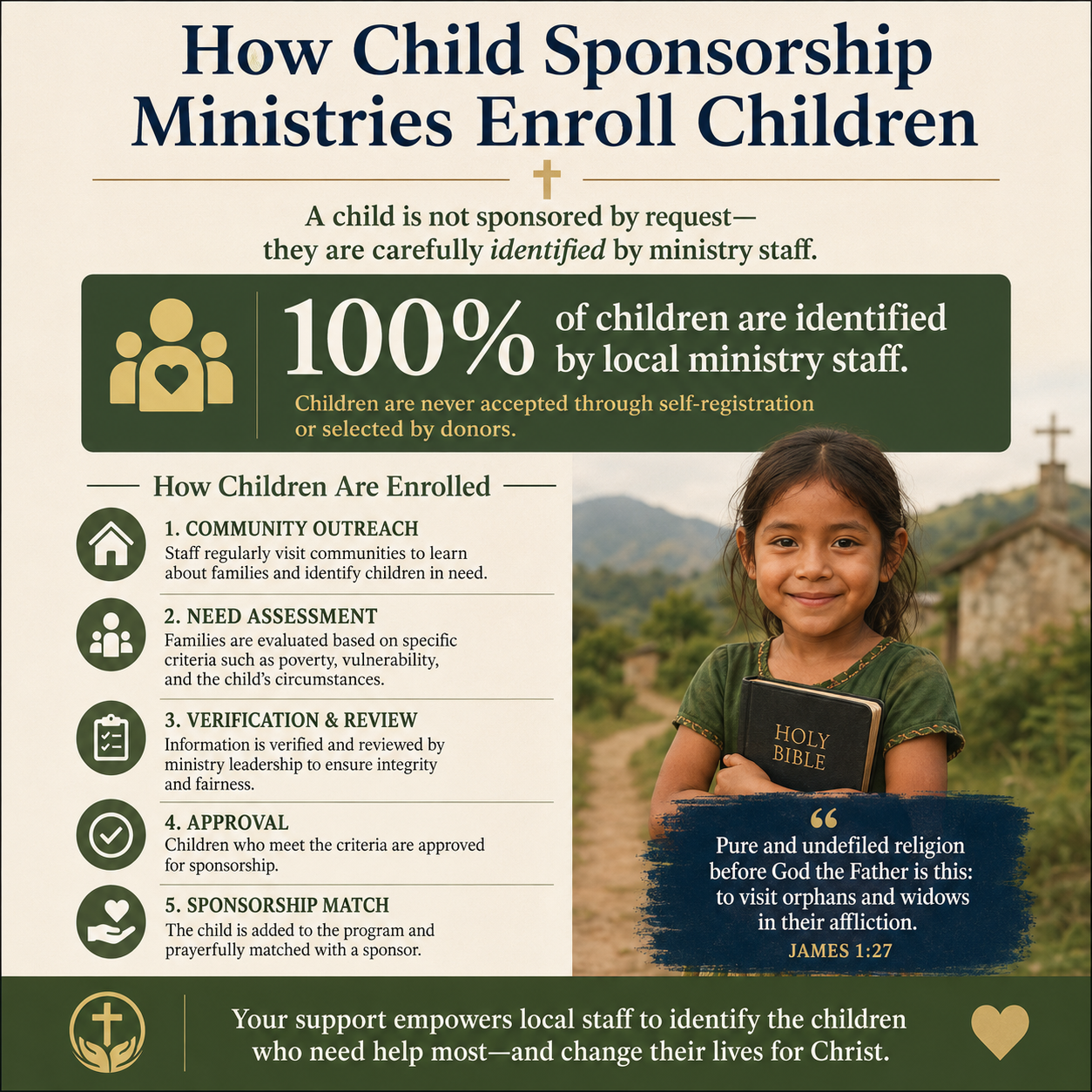
How children are identified and deemed eligible
Enrollment is typically preceded by identification and screening. In healthy programs, a child is not “recruited” for sponsorship; a child is assessed for participation in a program that has defined protective aims. The core question is whether the ministry’s eligibility criteria are child-protective, locally appropriate, and verifiable.
Common identification channels
Child sponsorship ministries commonly identify potential participants through schools, local churches, community leaders, and partner NGOs. Each channel carries distinct risks. Schools may provide broad access but can also privilege children who are already enrolled and exclude the most marginalized. Church referrals can be relationally strong but must not become coercive or politicized. Community leaders can help validate need, yet the ministry must guard against favoritism and the quiet pressures of local power.
Eligibility criteria and the danger of incentive distortion
Many ministries prioritize children based on poverty indicators, disability, household vulnerability, or educational risk. The hard question is how those criteria are verified and whether the enrollment system creates incentives to exaggerate need. When enrollment is tied to a foreign sponsor’s emotional engagement, the temptation is to make every child’s story fit a narrative of extreme desperation.
Prudent ministries use consistent tools—household assessments, school records, health screenings, and community validation—and they document how assessments are performed and audited. The best programs also build in safeguards so that local staff are not rewarded for enrolling “more children” but evaluated for child wellbeing outcomes and compliance with protection protocols.
Consent, dignity, and safeguarding are enrollment essentials
A child cannot ethically be enrolled without informed consent and meaningful safeguarding. In many contexts, the legal guardian’s consent is required, but Christian ethics presses beyond legal sufficiency toward moral seriousness. Enrollment should protect a child’s dignity, avoid exploitation of images and stories, and establish clear reporting channels if harm occurs.
Jesus’s warning about causing “little ones” to stumble (Matthew 18:6) is not rhetorical flourish. It sets a moral perimeter around children that ministries must treat as non-negotiable, including during fundraising enrollment.
What informed consent should include
Consent is not a signature on a form; it is comprehension and freedom. Guardians should understand what sponsorship is, what information will be shared with sponsors, what benefits are possible, what is not guaranteed, and how the child’s participation can end. They should also understand that sponsorship is not adoption, migration, or a private financial transfer to the household.
Where children are old enough to understand, wise ministries seek the child’s assent as well. Children should not be made to perform gratitude or write letters under pressure. The sponsor relationship must serve the child, not the ministry’s fundraising cadence.
Safeguarding protocols that should be visible at enrollment
Enrollment is the moment to establish boundaries and reporting. We expect to see, at minimum, written child protection policies, staff and volunteer screening, training for anyone who interacts with children, and a process for reporting abuse that does not depend on the same staff who manage enrollment.
For donors evaluating whether a ministry treats safeguarding as central rather than performative, the following enrollment signals are commonly meaningful:
- Clear limits on what personal information is shared with sponsors
- Photo and story consent procedures that respect local law and ethics
- Documented protocols for home visits and one-on-one interactions
- Training records for staff who collect child data and narratives
- Independent reporting mechanisms for safeguarding concerns
Documentation, storytelling, and the sponsor match
After eligibility and consent, ministries typically gather documentation: identity details, household context, school status, and a photo. This is also where sponsorship becomes susceptible to distortion, because the data gathered for care can be repurposed for marketing. The moral question is not whether ministries communicate need; it is whether they do so truthfully, proportionately, and without violating privacy.
What data is collected and how it should be protected
Enrollment often involves collecting sensitive personal information. Mature ministries treat this as stewardship, not as content. They have data retention policies, restricted access, and clarity on what is stored digitally, what is stored locally, and how long it is kept. They also disclose, in plain language, how sponsor communications work and what identifying information is withheld.
Donors should be cautious when a ministry’s public materials suggest extensive personal access—full names, exact locations, direct contact—without explaining protective controls. A sponsor’s desire for closeness can be sincere; a ministry’s responsibility is to guard the child.
The sponsor match and the risk of commodifying children
Some programs match a sponsor to a specific child; others connect sponsors to a program area while still using a child profile as a relational anchor. Both approaches can be handled with integrity. Problems arise when the ministry presents a match as a direct financial pipeline to the child while using funds broadly without clarity, or when the program enrolls children primarily to maintain a supply of profiles.
Christians genuinely disagree about the best sponsorship model, but there is far less disagreement about the necessity of truthful representation. The sponsor relationship should be framed as covenantal care at a distance—prayer, faithful giving, and respectful encouragement—rather than as ownership or entitlement.
Because the enrollment narrative is where misrepresentation most often occurs, donors should pay attention to how ministries communicate impact and overhead. The sector has long contended with the “overhead” fixation that can distort nonprofit truth-telling; major charity evaluators have warned against this reductionism in the Overhead Myth letter endorsed by GuideStar, BBB Wise Giving Alliance, and Charity Navigator (GuideStar).
How enrollment should be audited and reported to donors
A trustworthy enrollment process is observable. It produces documentation that can be reviewed, metrics that can be audited, and narratives that can be checked against reality. For Christian donors, the point is not suspicion as a posture; it is stewardship as obedience. “Moreover, it is required of stewards that they be found faithful” (1 Corinthians 4:2).
Operational controls that separate care from fundraising pressure
Strong ministries separate functions that can otherwise compromise one another. The staff responsible for child assessments and safeguarding should not be evaluated primarily on how many sponsor profiles are produced. Enrollment decisions should have supervisory review, and exceptions should be documented rather than quietly normalized.
Where field partners conduct enrollment, the ministry should describe partner due diligence: written agreements, training requirements, periodic audits, and the right to suspend enrollment if safeguarding or integrity standards are violated.
What donors should be able to verify
At a minimum, donors should be able to verify that the ministry can explain its enrollment criteria, its consent process, its child protection standards, and how sponsorship funds are allocated. When ministries publish meaningful information, they reduce the gap between donor imagination and field reality.
This is one reason Most Trusted evaluates ministries against The Most Trusted Standard, examining faith commitments, financial integrity, governance, and candor about effectiveness. Enrollment practices touch all of these. A ministry that will not describe enrollment with specificity is asking donors to bear risk that the ministry is responsible to carry.
For readers assessing how donations are handled in sponsorship programs, see How Child Sponsorship Ministries Use Donations.
FAQs for How child sponsorship ministries enroll children in their programs
Do child sponsorship ministries choose the neediest children first?
Some do, using household poverty assessments or vulnerability criteria. Others enroll children within defined communities so that the program can strengthen schools, caregivers, and local services alongside the child. The ethical issue is not which model is chosen but whether the ministry explains its criteria truthfully and applies them consistently without fundraising pressure.
Does sponsorship money go directly to the child who is enrolled?
Sometimes sponsorship funds support benefits that are tracked to an individual child, and sometimes they support shared services in the child’s community. Both can be legitimate when disclosed clearly. Donors should expect plain statements about how funds are allocated and what a sponsor relationship does and does not guarantee.
Enrollment is where integrity becomes visible
Child sponsorship can be a disciplined form of Christian mercy: steady, relationally attentive, and oriented toward long-term formation. But because enrollment sits at the intersection of vulnerability and fundraising, it is also where ministries are most tempted to oversimplify or overpromise.
Wise donors do not reduce sponsorship to sentiment or cynicism. We can insist on truth-telling, safeguarding, and verifiable practices while still giving generously. That combination—compassion governed by integrity—is the kind of stewardship that honors Christ and protects children.



