

When Christian donors ask what outcomes child sponsorship ministries report to donors, they are usually asking more than a list of metrics. They are asking whether their giving is actually strengthening a child’s life, a family’s resilience, and a community’s capacity—without quietly creating dependency, distorting local incentives, or substituting sentiment for stewardship.
Child sponsorship sits at a particular intersection of Christian compassion and modern accountability. Scripture commends tangible mercy toward the vulnerable (James 1:27), and it also warns against self-deception in our moral reasoning (Jeremiah 17:9). A mature approach to outcomes reporting holds both together: love that acts, and truth that can be tested.
1. Outcomes reporting begins with clarity about the program model
The outcomes a ministry can report responsibly depend on what sponsorship actually funds. Some ministries treat sponsorship as a restricted package of services for an enrolled child. Others use sponsorship as a relational fundraising vehicle that supports broader community development. Both can be legitimate, but they imply different outcome claims, different risks, and different standards of proof.
Across our verification work at Most Trusted, the ministries that meet The Most Trusted Standard tend to describe their model plainly: what the sponsor’s gift supports, what is delivered through local partners, what is time-bound, and what is not guaranteed. Clarity here is not marketing; it is ethical communication.
Child-level delivery versus community-level support
A child-level service model can report outcomes such as school attendance, learning supports delivered, or participation in a nutrition program. A community-level model may report outcomes such as improved access to clean water, strengthened child protection systems, or household economic resilience. Problems arise when a ministry reports child-specific outcomes while operating primarily at a community level, or when a sponsor is led to believe a child receives direct funds in contexts where direct transfers are not used.
What a donor should be able to understand
A sponsor should be able to answer, in ordinary language, these questions: What services does this child receive because of sponsorship? What does the ministry monitor? What outcomes does it claim, and over what timeline? A credible ministry will not treat those questions as suspicion. It will treat them as stewardship.

2. The most common reported outcomes and what they can really mean
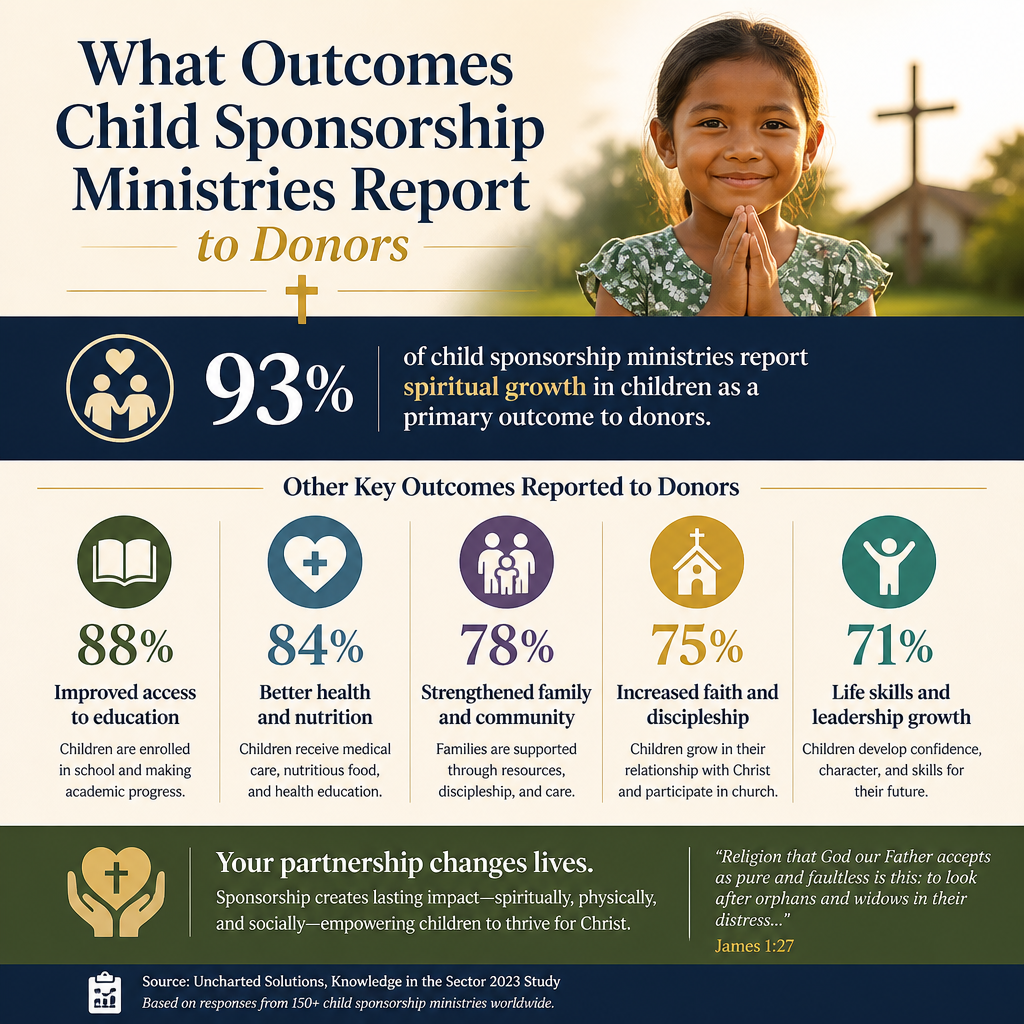
Many sponsorship ministries report outcomes in four broad domains: education, health and nutrition, protection, and spiritual formation. These categories can be meaningful, but donors should ask whether the reported indicators are outputs, short-term outcomes, or long-term outcomes. Counting activity is not the same as demonstrating change.
Education outcomes
Education-related reporting often includes enrollment, attendance, grade progression, completion, tutoring participation, and provision of school materials. These are important, especially in places where school costs and family instability are real barriers. Where ministries report learning outcomes, the strongest reports specify how learning is assessed (for example, standardized tests, literacy screening tools, or government exam results) rather than assuming seat time equals learning.
Donors should also recognize a tension: education outcomes are affected by factors beyond the ministry’s control—school quality, household labor needs, displacement, local conflict. Mature reporting will name these constraints rather than treating every positive trajectory as solely the ministry’s achievement.
Health and nutrition outcomes
Health reporting may include immunization referrals, growth monitoring, nutrition supplementation, access to clean water, and reductions in preventable illness. The difficulty is attribution. A child’s improved health may reflect national public health efforts, seasonal changes, or household income shifts, not only sponsorship services.
For donors who want a credible benchmark, it helps to remember that child well-being is often assessed at population level using tools such as the under-five mortality rate and stunting prevalence. These are commonly tracked by global health authorities like UNICEF and the World Health Organization, though they are not sponsorship-specific measures. For example, UNICEF regularly reports on stunting and child nutrition trends in its global child health and nutrition materials (UNICEF).
Protection outcomes
Many sponsorship ministries now report on child protection: training for staff and volunteers, case management for abuse or neglect, safe spaces, and referral pathways. This shift reflects a necessary reckoning across the sector. Protection is not an optional add-on; it is a moral requirement.
Where reporting is credible, ministries distinguish between building a protection system (policies, training, reporting mechanisms) and actual changes in risk exposure (reduced violence, safer household environments). The latter is much harder to measure, and ministries should not claim it lightly.
Spiritual formation outcomes
Christian donors often care about spiritual formation, but the field has had to learn restraint. Counting decisions, baptisms, or church attendance can become both theologically thin and operationally distortive. Stronger ministries describe discipleship inputs and community relationships: Scripture engagement opportunities, church partnerships, pastoral care, and the integrity of witness.
We also encourage donors to consider the difference between reporting spiritual activities and reporting spiritual outcomes. Scripture does not reduce the work of the Spirit to human metrics. Yet ministries can still report truthfully on what they do and what participants choose, without manipulating numbers or implying that sponsorship purchases conversion.
3. Better reporting separates outputs, outcomes, and long-term impact
A recurring weakness in sponsorship communication is the collapse of categories. Ministries report outputs as though they were outcomes, and outcomes as though they were long-term impact. Donors then believe they are funding durable transformation when they are primarily funding services delivered this quarter.
Outputs are not meaningless, but they are not the whole story
Outputs include counts: children enrolled, meals served, school kits distributed, clinic visits facilitated. Outputs can reflect real work and real cost. They also support accountability for delivery.
The problem is not reporting outputs; the problem is presenting them as evidence of sustained change. A ministry can distribute materials faithfully and still fail to address underlying barriers such as family instability, trauma, disability inclusion, or local school quality.
Outcomes and impact require time and careful design
Outcomes are changes in knowledge, behavior, or condition: improved literacy, reduced absenteeism, increased household savings, or improved caregiver practices. Long-term impact is even harder: adult employment, reduced early marriage, intergenerational poverty reduction, or sustained church vitality.
We also recommend donors pay attention to evaluation design. Some sponsorship ministries partner with universities or research organizations for stronger studies. Others use internal monitoring systems. Both can be appropriate if they are honest about limitations, avoid overclaiming, and show that evidence shapes decisions.
- Clear definitions of each indicator and who is included in the measure.
- Baseline and follow-up data, not only end-of-year snapshots.
- Disaggregation by age and gender when it matters for interpretation.
- Safeguards against selection bias where participants are not representative.
- Transparent limitations on attribution, especially for community outcomes.
For donors trying to evaluate credibility, it helps to consult broader research on what does and does not change long-term poverty dynamics. The “Starvation Cycle,” described by Goggins Gregory and Howard, is one widely cited framework that explains why meeting immediate needs without strengthening systems can perpetuate fragility (Stanford Social Innovation Review).
4. The hardest outcomes involve family stability and local agency
Child sponsorship ministries often sit in a complicated moral landscape. On the one hand, individual children are genuinely vulnerable. On the other hand, children belong in families where possible, and healthy development depends on consistent caregivers, not only services. This tension has shaped modern best practice in child-focused work.
Family strengthening outcomes are often more faithful than child-only metrics
Some of the most meaningful outcomes a sponsorship ministry can report relate to caregivers: improved parenting practices, increased household income stability, reduced reliance on harmful coping strategies, and successful referrals for family preservation. These outcomes are not always as emotionally immediate as a child’s photo and letter. They are often closer to the actual drivers of long-term well-being.
Donors should not assume that “family-based” outcomes are less urgent. They may be the most protective outcomes available in the real world.
Avoiding incentives that unintentionally separate children from families
Christians genuinely disagree about the proper role of residential care in different contexts, particularly where government systems are weak and extended family networks are strained. Yet there is broad agreement across serious child welfare work that unnecessary family separation is harmful.
Where sponsorship intersects with residential programs, donors should expect heightened transparency: admission criteria, family tracing efforts, reintegration rates, independent safeguarding, and clear evidence that the ministry is not recruiting children to sustain funding. If a ministry is unwilling to discuss those issues, the risk profile is high.
For donors who want to explore the wider landscape of sponsorship work with greater discernment, we maintain a topical overview of Child Sponsorship Ministries that reflects how donors commonly evaluate trustworthiness across the field.
5. What trustworthy ministries report to donors beyond the numbers
The most responsible outcomes reporting is not a spreadsheet without a story, and it is not a story without a spreadsheet. It is a coherent account of stewardship: what was intended, what was done, what changed, what did not, and what the ministry learned.
Programs change, and reporting should show learning
When reporting is serious, it includes course corrections: a curriculum that did not improve learning, a livelihoods project that benefited some households but excluded the most vulnerable, or a child protection process that needed strengthening. This kind of honesty is not weakness. It signals that the ministry is governed by truth rather than fundraising pressure.
The When Helping Hurts framework, articulated by Corbett and Fikkert, has shaped many ministries’ willingness to confront unintended harm and paternalism. Donors do not need a ministry to be perfect; they should require it to be teachable and accountable.
Financial integrity and governance belong in outcomes conversations
Outcomes do not float free from financial integrity and governance. A ministry can report plausible outcomes and still be structurally unsafe: conflicted boards, weak controls, or opaque restricted funds. Conversely, strong governance without real effectiveness also fails the donor’s calling to steward resources for genuine good.
That is one reason Most Trusted evaluates ministries against The Most Trusted Standard, which addresses doctrinal faithfulness, financial integrity, governance and leadership, and transparency and effectiveness as a unified credibility question. Donors are rarely choosing between compassion and accountability. They are choosing whether compassion will be disciplined by truth.
Donors comparing reporting practices across organizations may also want a fuller picture of how ministries define and measure impact in sponsorship contexts. Our coverage of How Child Sponsorship Ministries Measure Impact reflects the main reporting patterns we see, including the gaps that most often mislead well-intentioned givers.
FAQs for What outcomes child sponsorship ministries report to donors
Should a child sponsorship ministry promise specific results for each sponsored child?
In most cases, no. A ministry can commit to delivering defined services and to monitoring defined indicators, but it should be cautious about guaranteeing outcomes that depend on household decisions, school quality, public health conditions, or local instability. The most trustworthy reporting explains what the ministry controls, what it influences, and what it cannot promise without overclaiming.
Are spiritual outcomes appropriate to report in child sponsorship?
They can be, if reported with theological restraint and with respect for local churches and families. Reporting should emphasize faithful witness, discipleship opportunities, and church partnership rather than implying that sponsorship purchases spiritual outcomes. Christian donors can rightly care about spiritual formation while also refusing manipulative or inflated spiritual metrics.
Outcomes reporting should strengthen trust, not manufacture it
Child sponsorship can be a faithful expression of Christian love when it strengthens children within families and communities, protects the vulnerable, and speaks truthfully about what changes and why. Donors should expect outcomes that are defined, measured with integrity, and reported with humility about limits. This is not skepticism; it is stewardship worthy of the Lord we serve.



